Pediatrics Overview for NPTE Final Frontier
 Call Kai
 Learn
Learn Practice Test
 Spaced Repetition
 Match
Match Flashcards
 Knowt Play
1/94

There's no tags or description
Looks like no tags are added yet.
Name | Mastery | Learn | Test | Matching | Spaced | Call with Kai | Chat |
|---|
No analytics yet
Send a link to your students to track their progress
95 Terms
Gestational Age
Weeks since mother's last menstruation, most widely used during pregnancy.
Chronological Age
Age in weeks since birth.
Corrected or Adjusted Age
Chronological age - prematurity (from 40 weeks), used for preemies to account for milestone expectations.
APGAR Score
A scoring system to assess the health of newborns at 1 min, 5 mins, and 10 mins (only if needed).
APGAR Appearance
0: Blue, 1: Blue extremities, 2: No blue.
APGAR Pulse
0: Absent, 1:
APGAR Grimace
0: No response, 1: Grimace, 2: Cry or withdrawal.
APGAR Activity
0: Flaccid, 1: Some flexion, 2: Active motion extremities.
APGAR Respiration
0: Absent, 1: Weak cry, hypoventilation, 2: Strong cry.
Gross Motor Development
Development progresses from reflexes before cortex to gross motor before fine motor.
PEDS Milestones Month 3
Prone on elbows, can lift head in prone.
PEDS Milestones Months 3 - 4
Supine to sidelying, prone to supine, pull to sit without head lag, sitting with UE support.
PEDS Milestones Months 5 - 6
Feet to mouth.
PEDS Milestones Months 6 - 7
Supine to prone.
PEDS Milestones Months 9-10
Quadruped creeping.
PEDS Milestones Months 10 - 15
Begins to walk unassisted, quadruped, cruises to sideways.
PEDS Milestones 10 months
Transitions in and out of squatting, plantigrade, pulls to stand.
PEDS Milestones 10 months
Independent ring sitting, controls grasp AND release.
PEDS Milestones 10 months
Transfers objects between hands, improving grasping skills, pincer, three jaw chuck.
PEDS Milestones 10 months
Stacks two cubes, trunk rotation in sitting, crawling on belly.
Practice Question 1
A newborn is examined at birth using the APGAR screening test. The following observations are made at 5 mins: heart rate 120 bpm, strong crying, grimace with irritability testing, kicking and arm movement are present, and the baby demonstrates normal color throughout the body. What is the most appropriate action of the PT?
Integrated
When the reflex disappears to allow for normal development
Persistent
A reflex that has not integrated and indicative of central nervous system (CNS) dysfunction
Flexor Withdrawal
Noxious stimulus (pinprick) to sole of foot leads to toes extending, foot dorsiflexing, and LE flexing uncontrollably. Onset: 28 weeks gestation, Integrated: 1-2 months.
Crossed Extension
Noxious stimulus to ball of foot of LE fixed in extension leads to opposite LE flexing, then adducting and extending. Onset: 28 weeks gestation, Integrated: 1-2 months.
Rooting
Stroking the side of baby's cheek causes head to turn toward stimulus and mouth to open. Onset: 28 weeks gestation, Integrated: 3 months.
Traction
Grasp forearm and pull up from supine into sitting position. Onset: 28 weeks' gestation, Integrated: 2-5 months.
Asymmetrical Tonic Neck (ATNR)
Rotation of the head to one side causes flexion of skull limbs, extension of the jaw limbs, resulting in a 'bow and arrow' posture. Onset: Birth, Integrated: 4-6 months.
Palmar Grasp
Maintained flexion of fingers occurs with maintained pressure to palm of hand. Onset: Birth, Integrated: 4-6 months.
Moro
Drop patient backward from sitting position causes extension, abduction of UEs, hand opening and crying followed by flexion, adduction of arms across chest. Onset: 28 weeks gestation, Integrated: 5-6 months.
Symmetrical Tonic Labyrinthine (TLR / STLR)
In prone position, increased flexor tone of all limbs; in supine position, increased extensor tone of all limbs. Onset: Birth, Integrated: 6 months.
Positive Supporting
Rigid extension (co-contraction) of the LEs occurs with contact to the ball of the foot in upright standing position. Onset: Birth, Integrated: 6 months.
Plantar Grasp
Maintained flexion of toes occurs with maintained pressure to ball of foot under toes. Onset: 28 weeks gestation, Integrated: 9 months.
Symmetrical tonic neck (STNR)
Flexion or extension of the head results in flexion of UEs and extension of LEs or vice versa. Onset: 4-6 months, Integrated: 8-12 months.
Startle
Sudden loud or harsh noise causes sudden extension or abduction of UEs, crying. Onset: Birth, Integrated: Persists.
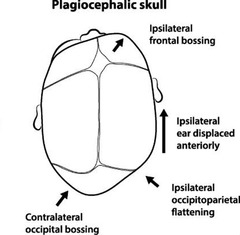
Plagiocephaly
A condition characterized by an asymmetrical head shape.
Fine motor development screening
An assessment to evaluate the fine motor skills of a child.
Physical Therapy Intervention(s)
Strategies to address muscle imbalances and encourage continued normal motor development.
Practice Question 2.1
Which of the following positions is LEAST expected during gait in this child? A. High guard position of the arms B. Abduction and internal rotation of the hips C. Hips and knees slightly flexed D. Pronated feet.
Practice Question 2.2
Which of the following types of grasp would be LEAST expected in this patient when attempting to pick up a crayon? A. Pincer grasp B. Palmar grasp C. Three jaw chuck grasp.
Persistent ATNR reflex
A reflex that remains active beyond the typical developmental period, affecting the ability to transition positions.
Integrated ATNR reflex
A reflex that has been successfully integrated into normal movement patterns and no longer interferes with development.
Persistent STNR reflex
A reflex that continues to be present and affects the child's ability to move and transition between positions.
Persistent TLR reflex
A reflex that remains active and can impact the child's ability to control head and body movements.
Cerebral Palsy
A group of disorders affecting movement and muscle tone, often caused by damage to the developing brain.
Torticollis
A condition characterized by a twisted neck, resulting in the head being tilted to one side.
Plagiocephaly
A condition resulting from prolonged asymmetrical pressure on the skull, leading to a parallelogram shape.
Down's Syndrome
A genetic disorder caused by the presence of an extra chromosome 21, leading to developmental delays and physical features.
Autism Spectrum Disorder
A developmental disorder characterized by challenges with social skills, repetitive behaviors, and communication.
Muscular Dystrophy
A group of genetic diseases causing progressive weakness and loss of muscle mass.
Scheuermann Disease
A condition that causes abnormal curvature of the spine during adolescence.
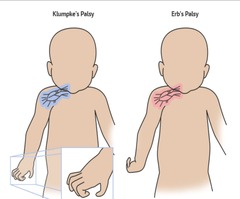
Erb's Palsy
A type of paralysis that affects the arm and is caused by injury to the upper group of arm nerves.
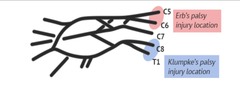
Klumpke's Palsy
A type of paralysis affecting the hand and wrist due to injury to the lower group of arm nerves.
Spastic Cerebral Palsy
Characterized by velocity-dependent resistance of a muscle to stretch, often leading to contractures and crouched gait.
Ataxic Cerebral Palsy
A disorder of coordination, force, and timing, associated with cerebellar involvement.
Hypotonic/Dyskinetic Cerebral Palsy
A disorder characterized by involuntary movements that are slow and writhing, often due to basal ganglia dysfunction.
Gross Motor Classification of CP Level 1
Patient will walk without restrictions but will have limitations in more advanced gross motor skills.
Gross Motor Classification of CP Level 2
Patient will walk without assistive device with limitations in walking outdoors and in the community.
Gross Motor Classification of CP Level 3
Patient will walk with assistive device with limitations in walking outdoors and in the community.
Gross Motor Classification of CP Level 4
Patient self mobility will be severely limited; children are transported or use power mobility outdoors and in the community.
Gross Motor Classification of CP Level 5
Patient self mobility will be severely limited, even with the use of assistive technology, requires caregiver.
Plagiocephaly Assessment
Involves assessing cervical spine range of motion and strength, and educating parents on positioning, exercises, and tummy time.
Patient mobility without restrictions
Patient will walk without restrictions but will have limitations in more advanced gross motor skills.
Patient mobility with assistive device
Patient will walk with assistive device with limitations in walking outdoors and in the community.
Severe self mobility limitation
Patient self mobility will be severely limited, even with the use of assistive technology.
Patient mobility without assistive device
Patient will walk without assistive device with limitations in walking outdoors and in the community.
Plagiocephaly
Results from prolonged asymmetrical pressure on the premature skull.
Plagiocephaly shape
Creates a parallelogram shape when viewed from the vertex.
Occipitoparietal flattening
Occurs with contralateral occipital bossing in plagiocephaly.
Ipsilateral frontal bossing
Occurs with anterior displacement of the ear in plagiocephaly.
Plagiocephaly assessment
Assess c/s ROM and strength, educate parents on positioning, exercises, and tummy time.
Down's Syndrome cause
Results from presence of full or partial extra copy of the 21st chromosome; trisomy 21.
Down's Syndrome risk factor
Increased risk with increased age of the mother.
Neck flexion limitation
Forceful neck flexion and rotation activities should be limited due to laxity of odontoid ligament and potential for a subluxation of atlanto-axial joint.
Motor function encouragement
Encourage motor function and avoid hyperextension of the elbows and knees during weight bearing activities.
Symptoms of Down's Syndrome
Hypotonia, ligamentous laxity, delayed motor milestones, deficits in memory and expressive language, impairments in postural control and coordination, decreased quadriceps and hip abductor strength, inefficient movement strategies due to hypotonia.
Autism Spectrum Disorder characteristics
Social/communication skill limitations, especially non-verbal skills, repetitive behaviors, sensory processing issues, difficulty developing relationships, hypo-reactive or hyper-reactive to sensory input, dyspraxia.
Interventions for Autism Spectrum Disorder
Controlled, multi-sensory input, give specific information, behavioral interventions, encouraging motor development, coordination, visual supports, using first, then (or sequencing), consistency.
Practice Question 5 scenario
A 6-year-old child with Down's Syndrome is being treated by a physical therapist. The child has moderate developmental delay, hypotonia, and incoordination, and is able to walk with assistance.
Practice Question 6 scenario
Which of the following signs and symptoms is LEAST likely to be seen in a 7 years old male patient with muscular dystrophy?
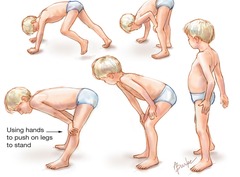
Duchenne Muscular Dystrophy
X-linked recessive, inherited by boys; dystrophin gene missing - destruction of muscles' cells; causes pseudohypertrophy (collagen and adipose tissue).
Examination for Duchenne Muscular Dystrophy
Strength, ROM, Functional testing, skeletal alignment, respiratory function, assess need for adaptive equipment.
PT interventions for Duchenne Muscular Dystrophy
Maintain mobility as long as possible; maintain joint ROM with active/passive; DO NOT OVER FATIGUE.
Scheuermann Disease
Characterized by Schmorl's Nodes and angled/wedged thoracic spine; pain with thoracic extension and rotation; aggravation with long periods of standing/sitting or physical activity; increased thoracic kyphosis & lumbar lordotic curve.
PT Interventions for Scheuermann Disease
The Schroth Method, stretch pecs, strengthen thoracic extensors and scapular stabilizers.
Erb's Palsy
Injury to the C5-C6 nerve roots resulting in loss of abduction and lateral rotation of the shoulder; characterized by Waiter's tip deformity.
Klumpke's Palsy
Injury to the C8-T1 nerve roots resulting in paralysis of the intrinsic muscles of the hand; characterized by claw hand.
Mechanism of Injury for Erb's Palsy
Stretching head downward.
Mechanism of Injury for Klumpke's Palsy
Stretching of arm overhead.
Treatment for Erb's and Klumpke's Palsy
Immobilization, then gentle ROM.
Practice Question 7 Diagnosis
A patient reports loss of sensation over the ulnar side of the hand with weakness in the intrinsic hand muscles leading to nonfunctional hand; the MOST LIKELY diagnosis is Klumpke's palsy.
Upcoming Class: SCI (for PTs)
Saturday 3/23 at 8:30am PST (11:30am EST).
Upcoming Class: PTA Mega Review
Saturday 3/23 at 8:30am PST (11:30am EST).
Upcoming Class: Vestibular Rehab
Tuesday 3/26 at 5pm PST (8pm EST).
Upcoming Class: EKG & Exercise Progression
Tuesday 3/26 at 5pm PST (8pm EST).