Equilibrium
 Call Kai
 Learn
Learn Practice Test
 Spaced Repetition
 Match
Match Flashcards
 Knowt Play
1/35

There's no tags or description
Looks like no tags are added yet.
Name | Mastery | Learn | Test | Matching | Spaced | Call with Kai | Chat |
|---|
No analytics yet
Send a link to your students to track their progress
36 Terms
Chemical equilibrium is a state in a reversible chemical reaction where the forward and reverse reactions occur at the same rate. This results in no net change in the concentrations of reactants and products over time. Although reactions continue at the molecular level, the overall amounts of substances remain constant.
Characteristics of Chemical Equilibrium
Reactions are still occurring, but the rates of the forward and reverse reactions are equal.
The system appears stable, but molecular activity continues.
Conditions for Equilibrium
Can be achieved regardless of whether the reaction starts with all reactants, all products, or a mix of both.
The concentrations of reactants and products do not change, indicating a balance in the reaction.
Importance of Chemical Equilibrium
Manufacturing Processes: Optimizing reactions in industrial settings.
Biological Systems: Regulating metabolic pathways.
Environmental Chemistry: Predicting the behavior of chemical systems in nature.
Factors Affecting Chemical Equilibrium
Concentration Changes: Adding or removing reactants or products can shift the equilibrium position.
Pressure Changes: Particularly affects gaseous reactions; changes in pressure can shift the equilibrium.
Temperature Changes: The effect depends on the reaction's enthalpy change (ΔH).
Chemical equilibrium is termed "dynamic" due to the continuous activity of both forward and reverse reactions occurring simultaneously within a closed system.
Key Characteristics of Dynamic Equilibrium
Simultaneous Reactions: At equilibrium, the forward reaction (reactants converting to products) and the reverse reaction (products converting back to reactants) happen at the same rate.
Constant Concentrations: Although the individual reactions are ongoing, the overall concentrations of reactants and products remain unchanged over time. This stability is what characterizes the equilibrium state.
Why It Matters
Continuous Activity: The term "dynamic" emphasizes that the system is not static. Molecules are constantly colliding and reacting, even though the macroscopic properties (like concentration) appear stable.
Reversible Nature: In a dynamic equilibrium, the reactions can proceed in both directions, allowing for a balance that can shift if conditions change (e.g., temperature, pressure, or concentration).
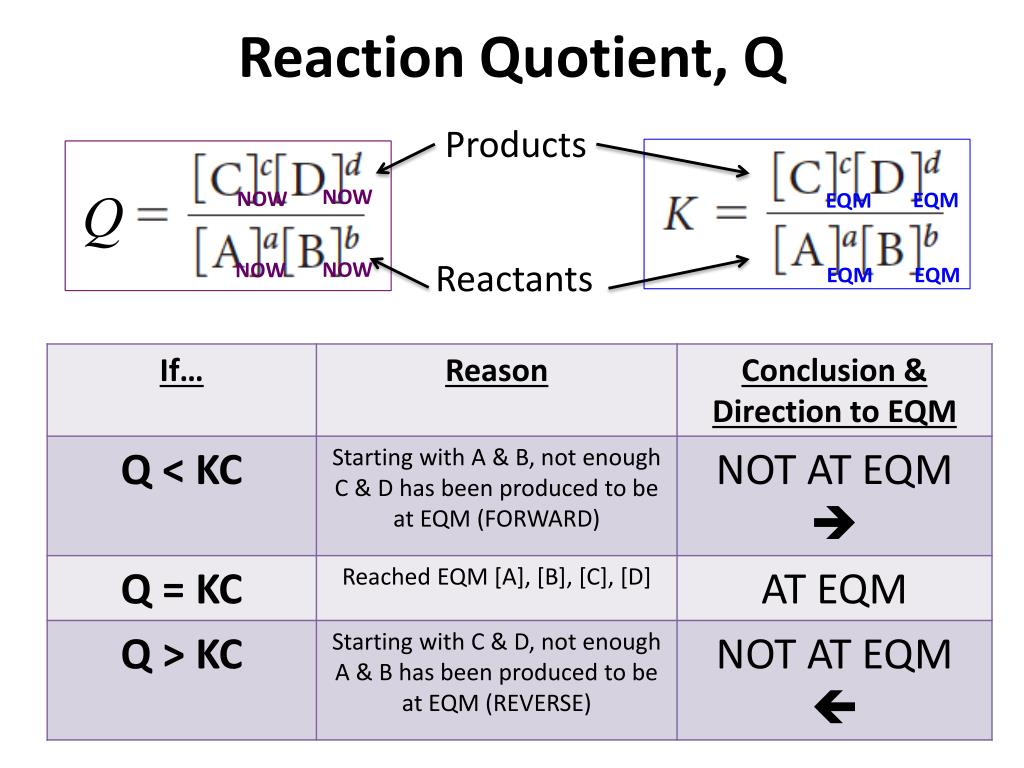
The reaction quotient (Q) is a dimensionless quantity that measures the relative amounts of products and reactants in a chemical reaction at a specific point in time.
It is calculated using the concentrations or partial pressures of the reactants and products involved in the reaction.
Key Points in Calculation
Concentrations: Use molar concentrations for aqueous solutions or partial pressures for gases.
Stoichiometric Coefficients: The concentrations are raised to the power of their respective coefficients in the balanced equation.
Pure Solids and Liquids: These are typically omitted from the calculation as their activity is considered to be 1.
Importance of Q
Q is crucial for predicting the direction of a chemical reaction:
If Q < K: The reaction will proceed forward, favoring the formation of products.
If Q > K: The reaction will shift backward, favoring the formation of reactants.
If Q = K: The system is at equilibrium, and concentrations of reactants and products remain constant.
What is the Equilibrium Constant (K)?
The equilibrium constant (K) is a numerical value that represents the ratio of the concentrations of products to reactants in a chemical reaction at equilibrium. It is a crucial concept in understanding how far a reaction proceeds to form products under specific conditions.
Importance of the Equilibrium Constant
Indicates Reaction Extent: K provides insight into the extent of a reaction. A large K value suggests that products are favored, while a small K indicates that reactants are favored.
Independent of Initial Concentrations: The value of K is determined solely by the conditions of the reaction (such as temperature) and is independent of the initial concentrations of reactants and products.
Calculation of the Equilibrium Constant
K=[Products]/[Reactants]
[Products] and [Products] are the molar concentrations of the products and reactants at equilibrium.
Types of Equilibrium Constants
Kc: Concentration-based equilibrium constant, used when dealing with molar concentrations.
Kp: Pressure-based equilibrium constant, used for gaseous reactions expressed in terms of partial pressures.
What is the Law of Mass Action?
The law of mass action is a fundamental principle in chemistry that describes the relationship between the concentrations of reactants and products in a chemical reaction.
It states that the rate of a chemical reaction is directly proportional to the product of the concentrations (or activities) of the reactants, each raised to a power corresponding to its stoichiometric coefficient in the balanced chemical equation.
Rate of Reaction
The rate of a chemical reaction can be expressed mathematically as:
Rate=k[A]a[B]b
k = rate constant
[A]and [B] = concentrations of reactants
aa and bb = stoichiometric coefficients
Equilibrium Constant
At equilibrium, the concentrations of reactants and products are related by the equilibrium constant KK:
K=[C]c[D]d[ / A]a[B]b
[C][C] and [D][D] = concentrations of products
[A][A] and [B][B] = concentrations of reactants
cc and dd = stoichiometric coefficients of products
Applications
The law of mass action is used to predict the direction of a chemical reaction at equilibrium based on changes in concentration, temperature, and pressure. It helps in understanding how systems respond to changes and maintain equilibrium.
How does reversing a reaction affect the equilibrium constant K?
The new equilibrium constant is the reciprocal of the original constant (Knew = 1 / Korig).
When is the approximation (x is small) generally valid?
When K is very small (K < 10-3) and initial reactant concentrations are relatively large.
How do you know when to use an ICE table for equilibrium problems?
Use an ICE Table When:
You are given initial amounts and need equilibrium concentrations. (e.g., "You start with 0.50 M A and 0.50 M B, find the concentration of $C$ at equilibrium.")
You are given initial amounts and the equilibrium constant Kc or Kp). You set up expressions in terms of x to solve for the final state.
You are given initial concentrations and one equilibrium concentration, and you need to find K or the other remaining equilibrium amounts.
Do NOT Use an ICE Table When:
You already know all equilibrium concentrations. If every concentration at equilibrium is given, just plug them directly into the equilibrium expression ( K = [products] / [reactants] )
You are predicting reaction direction (Q vs K). If you just need to see which way a reaction will shift using initial concentrations, calculate the reaction quotient Q and compare it to K
Standard Setup
Component | Reactants | Products |
Initial | Starting Molarity or Pressure | Starting Molarity (often 0) |
Change | -ax (lost according to stoichiometry) | +bx (gained according to stoichiometry) |
Equilibrium | Initial - Change | Initial + Change |
What’s the difference between K and Q?
The difference comes down to when you measure the concentrations.
Both use the same expression—the ratio of product concentrations to reactant concentrations raised to their stoichiometric coefficients—but they tell you different things about where the system currently sits.
Feature | Equilibrium Constant (Kc) | Reaction Quotient (Qc) |
Timing | Calculated ONLY using concentrations at equilibrium. | Calculated using concentrations at any given moment in time. |
Value Type | Fixed constant for a reaction at a specific temperature. | Variable value that changes as the reaction progresses. |
Purpose | Shows the final balance of products vs. reactants. | Shows where the reaction is right now relative to equilibrium. |
Comparing Qc and Kc tells you which way the reaction will shift:
Qc < Kc: Too many reactants. The reaction shifts right (forward) to make more products.
Qc = Kc: The system is already at equilibrium. Rates of forward and reverse reactions are equal.
Qc > Kc: Too many products. The reaction shifts left (reverse) to make more reactants.