Congenital Anomalies and Variants
 Call Kai
 Learn
Learn Practice Test
 Spaced Repetition
 Match
Match Flashcards
 Knowt Play
1/15

There's no tags or description
Looks like no tags are added yet.
Name | Mastery | Learn | Test | Matching | Spaced | Call with Kai | Chat |
|---|
No analytics yet
Send a link to your students to track their progress
16 Terms
an accessory spleen is also referred to as
splenule, splenunculus, or a supernumerary spleen
an accessory spleen is a
small, round island of splenic tissue is typically located near the splenic hilum or possibly near the tail of the pancreas
an accessory spleen will appear
isoechoic to the spleen
splenic cleft
a common anomaly when the spleen appears to be divided by a hyperechoic line in some individuals
2 uncommon congenital anomalies of the spleen are
asplenia and polysplenia
asplenia
the congenital absence of the spleen
polysplenia leads to the
development of multiple small masses of splenic tissue
asplenia and polysplenia have been associated with
some complex cardiac malformations and the abnormal location of other organs—termed heterotaxia syndromes.
ectopic splenic tissue is also referred to as
splenosis
splenosis can occur following
splenic rupture
ectopic splenic tissue can resemble
a mass
wandering spleen
extremely rare condition in which case the splenic ligaments are absent or underdeveloped, thus allowing the opportunity for the spleen to be highly mobile and often positioned well into the lower abdomen.
an individual with wandering spleen can suffer from
splenic torsion because the vessels of the spleen may twist secondary to the hypermobility of the organ
vascular torsion can lead to a
splenic infarction
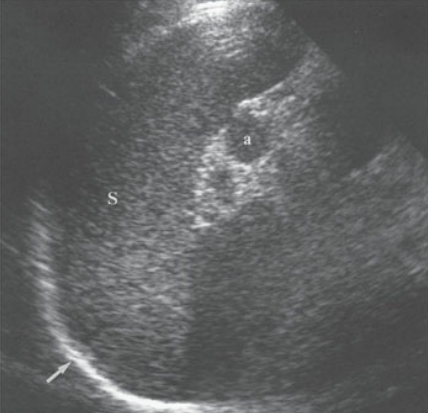
Accessory spleen. An isoechoic mass is seen adjacent to the spleen (S) at the level of the splenic hilum. This is the most common location and appearance of an accessory spleen (a). The diaphragm is also clearly identified in this image (arrow).