3: Relict Leopard Frog - Status Part 3
 Call Kai
 Learn
Learn Practice Test
 Spaced Repetition
 Match
Match Flashcards
 Knowt Play
1/34

There's no tags or description
Looks like no tags are added yet.
Name | Mastery | Learn | Test | Matching | Spaced | Call with Kai | Chat |
|---|
No analytics yet
Send a link to your students to track their progress
35 Terms
What stochastic event occurred in Black Canyon, October 2006?
storm that caused debris flow
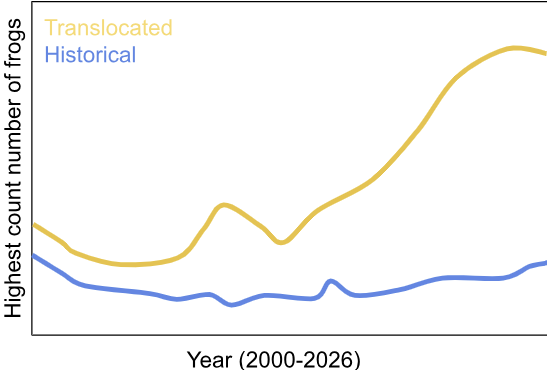
In 2017, what was the high-count of frogs?
1163
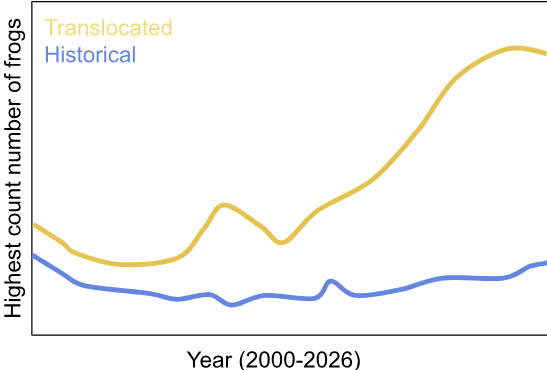
Monitoring - Relative Abundance: Visual Counter Survey Data (VES)
surveying the sight and taking the highest count
minimum estimation of the total population of frogs
Estimate of' ‘True’ Abundance: Mark-Recapture
Catch, mark, and release a sample of animals
Then sample again, keeping track of those that are marked and unmarked (new captures)
The true abundace of the population can be estimated as…
X (total in population) / M (marked) = C (total captured in second sample) / R (recaptures)
Lincoln-Peterson Estimator
simplest of such estimates to estimate population size
What is the Double Sampling Method?
Conduct Mark-recapture and VES at the same site
The Double Sampling Method first calibrates relative abundance from…
VES to estimates of true abundance from Mark-recapture
Calibrating the relative abundance from VES to estimates of true abundance from Mark-recapture provides a ratio that you can then apply to:
VES data from other sites where there is no estimate of true abundanceE
Essentially, what does the Double Sampling Method provide?
a ratio or correction factor to adjust VES data
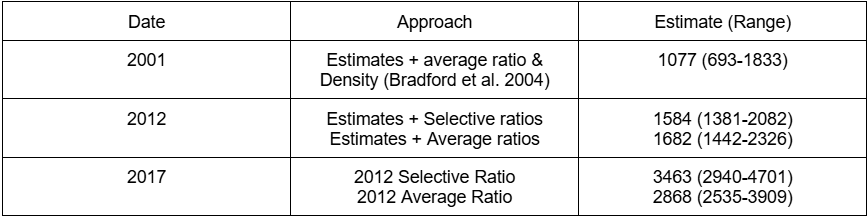
Change in total population over time:
Total population estimates
Estimates for the entire species (post-metamorphs)
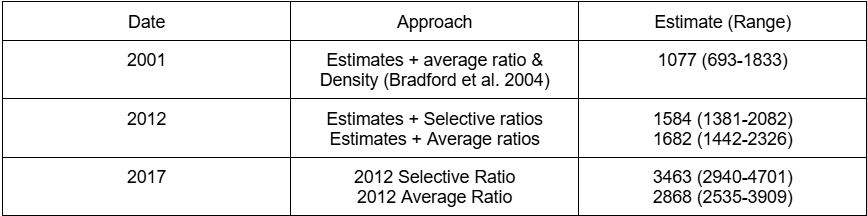
What do the total population estimates indicate?
Estimates of total populations increased over time from 2001 to 2017
Status of Translocation Site:
Grapevine Spring, AZ
Has rocky pools favored by frogs
Translocation Site:
Quail Spring, Spring 2008, after rehab effort → After cattle and burros abandoned the site in July 2010
no more open water, and no disturbances that hammered the vegetation
What are the translocation success criteria?
Over-wintering
Breeding Activity
Natural Recruitment
‘Sustainable’ population
What is Over-wintering?
Do tadpoles/juveniles born in spring survive to next spring/survive winter
What is breeding activity?
Egg masses, tadpoles (born at sites)
What is Natural Recruitment?
Animals are born at the sight from animals that are at the sight
Has to be documented
often determined years after final release
What is ‘Sustainable’ population?
Is the population stable over-time?
Habitat management:
Mechanical vegetation reduction at Blue Point Spring
maintain open habitat by reducing grass
Maintaining important breeding pools (habitat)
Most ‘volunteer’ crew maintaining important breeding pool in a drainage ditch along an access road in Hoover Dam
frogs favor backwater habitat
In 2011, USFW Multidistrict Litigation:
USFWS legal agreement with WildEarth and Center for Biological Diversity to conduct actions under ESA for 251 candidate species including R. onca
What was the USFWS legal agreement with WildEarth and Center for Biological Diversity?
to conduct actions under ESA for 251 candidate species including R. onca
In 2016, Special Status Assessment (SSA) to inform listing decision on…
Updated:
Current distribution
Status of populations
Current threats
Mitigation needs (plans in terms of mitigation)
In 2016, just prior to the USFW decision, what was signed?
A revision and renewal of CAS
Current Stressors/’Threats’ Identified in 2016 SSA, revised CAS:
Present or threatened destruction or curtailment of habitat or range
Overutilization
Disease or predation
Inadequacy of regulatory mechanisms
Other natural or manmade factors affecting continued existence
Estimation of True Abundance
Why was overutilization negated as a ‘threat’/stressor?
There was no overutilization because all populations are on federal lands, illegal to use such frogs
Why was Inadequacy of regulatory mechanisms negated as a ‘threat’/stressor?
There were plenty of mechanisms to maintain populations
What did present or threatened destruction or curtailment of habitat or range involve?
Habitat degradation
Groundwater diversion and withdrawal
Overgrowth of emergent vegetation
Nonnative plants (invasive)
Burro and cattle grazing (but also a benefit)
Reduced connectivity of populations (but also a benefit)
Habitat degradation in Lake Mead:
drying out, underground water pressure decreasing, which led to no water rising up
How was burro and cattle grazing detrimental but also a benefit?
may hammer frogs, but also hammer vegetation, resulting in habitats that frogs favor
What did disease or predation involve?
Nonnative crayfish, bullfrogs, fishes
Amphibian chytrid pathogen
Chytrid pathogen present within historical range and in one population in R. onca
Negative impact on R. onca survivorship
What did other natural or manmade factors affecting continued existence involve?
Small population size
Flash, flood, events
Drought and Wildfire
Evaluation of “stressor” severity (High, Medium, Low), conducted by USFWS
USFWS Listing Decision, 2016