Strength and Conditioning Exam 3
 Note
Note Call Kai
 Learn
Learn Practice Test
 Spaced Repetition
 Match
Match Flashcards
 Knowt Play
1/95

There's no tags or description
Looks like no tags are added yet.
Name | Mastery | Learn | Test | Matching | Spaced | Call with Kai | Chat |
|---|
No analytics yet
Send a link to your students to track their progress
96 Terms
A warm-up strategy that includes
Raise: Elevate body temperature, heart rate, respiration rate, blood flow, and joint fluid viscosity via low-intensity activities.
Activate and Mobilize: Actively move through a range of motion.
Potentiate: Perform sport-specific activities that progress in intensity.
What is RAMP Protocol
Flexibility
The joint's range of motion (ROM), which includes both:
Static: ROM during a passive movement.
Dynamic: ROM during active movements, requiring voluntary muscular actions
Stretch Reflex
An involuntary contraction that occurs when muscle spindles are stimulated during a rapid stretching movement, which should be avoided as it limits the range of motion.
Warming up
________ Has positive effects on performance like causing Faster muscle contraction, relaxation of both agonist and antagonist muscles, Improvements in the rate of force development and reaction time, Improvements in muscle strength and power, Lowered viscous resistance in muscles, Increased blood flow to active muscles
increased
A warmup. provides an ________ psychological preparedness for performance
aerobic
The warm-up needs to be specific to the activity and consist of a period of _______ exercise , followed by stretching, and ending with a period of upcoming activity (sport specific
5-10 min ; 10-20 minutes
A general warm-up period may consist of a __ to __min jogging or skipping
A specific warm-up period incorporates movements similar to the movements athletes sport .
The whole warm-up typically lasts between __-__ min
development
The warmup is an integral part of the training session. Strength and conditioning professionals should plan warm-ups incorporating short-, medium-, and long-term considerations that will contribute to the overall _______ of the athlete
ROM
Joint structure, age and sex, muscle and Elasticity and plasticity of connective tissues,Stretch tolerance and Neural control can affect flexibility and ______
the less body mass and the pelvic structure for bearing children.
Females have better ROM than men due to what?
central and peripheral
Range of motion is controlled by the______ and________ nervous system, including both afferent and efferent mechanisms (Golgi tendon organs)
True
True or False:
Exercise through a full ROM and develop both agonist and antagonist muscles to prevent loss of ROM.
False they are NOT transient
True or False: Acute affects of ROM are transient. For longer-lasting effects, a stretching program is required.
5 weeks
For a flexibility program, Two sessions per week for a minimum of _ weeks to increase ROM of the joint. Stretches should be held 15-30 seconds
after practice/competitionbbecause of increased muscle temperature.
When should an athlete stretch?
5-10 min
Stretching should be performed for _____ minutes
active contraction
Autogenic inhibition and reciprocal inhibition is accomplished via ____________ before a passive stretch of the same muscle.
contracting
Reciprocal inhibition is accomplished by ________ the muscle opposing the muscle that is being passively stretched.(hamstring partner stretch, if u push down the right leg the left leg that is straight is being affected as well)
Golgi tendon organs
Both result from stimulation of ________, which cause reflexive muscle relaxation.
Static
Slow and constant, with the end position held for 15 to 30 seconds
Ballistic
Typically involves active muscular effort and uses a bouncing-type movement in which the end position is not held
Dynamic Stretching
A type of functionally based stretching exercise that uses sport-specific movements to prepare the body for activity
Static Stretching:
Get into a position that facilitates relaxation. Move to the point in the ROM where you experience a sensation of mild discomfort. If performing partner-assisted PNF stretching, communicate clearly with your partner. Hold stretches for 15 to 30 seconds. Repeat unilateral stretches on both sides
Dynamic Stretching:
Carry out 5 to 10 repetitions for each movement, either in place or over a given distance.Progressively increase the ROM on each repetition.Increase the speed of motion on subsequent sets where appropriate.Actively control muscular actions as you move through the ROM.
Proprioceptive Neuromuscular Facilitation (PNF)
Hold-relax, Passive prestretch (10 seconds), Isometric hold (6 seconds), Passive stretch (30 seconds)–Contract-relax, Passive prestretch (10 seconds), Concentric muscle action through full ROM, Passive stretch (30 seconds
hold-relax with agonist contraction
The ______ with _______ contraction is the most effective PNF technique
Testing
helps asses athletic talent and ability. It helps show areas of improvement.
Allows coaches to set specific goals for individual athletes that help to accomplish group or team objectives.
Provides a way to determine if a candidate has the needed basic physical abilities that, in combination with technique training and practice, can produce a competitive player.
Test
A procedure for assessing ability in particular endeavor
Field Test
A test used to assess ability that is performed away from the laboratory and does not require extensive training or expensive equipment
Measurement
The process of collecting data
Evaluation
Analyzing test results for purpose of making decisions
Mid-Test
A test administered one or more times during the training period to assess progress and modify the program as needed to maximize benefit
Formative evaluation
Periodic reevaluation based on midtests administered during the training, usually at regular intervals
Posttest
A test administered after the training period to determine the success of the training program in achieving the training objectives
Validity
The measure of test or test items measure what it is supposed to. One of the most important characteristics of testing
Construct Validity
The ability of a test to represent the underlying construct (the theory developed to organize and explain some aspects of existing knowledge and observations).
Face Validity
The appearance to the athlete and other casual observers that the test measures what it is purported to measure. (what it looks like)
Content validity
The assessment by experts that the test covers all relevant subtopics or component abilities in appropriate proportions. (testing exactly what its supposed to and the numbers align)
Criterion-referenced validity
The extent to which test scores are associated with some other measure of the same ability (comparing people of the same position scores)
Concurrent validity
The extent to which test scores are associated with those of other accepted tests measuring the same ability.
Discriminant validity
The ability of a test to distinguish between two different constructs.
Reliability
Measure of degree of consistency
Variables that can affect reliability
Intrasubject (within subjects) variability, Lack of interrater (between raters) reliability or agreement, Intrarater (within raters) variability, Failure of the test itself to provide consistent results
true
For a test to be valid, it must emulate the energy requirements and important movements of the sport for which ability is being tested.
Experience and level of training status, age, sex, and health status of the athlete
Factors like ______ can all affect the testing results
high temp, high humidity and altitude
Environmental factors like_____ can affect aerobic endurance tests and lower the validity. The best option to is complete the tests in a controlled environment that can be repeated for other tests.
proper hydration, nutrition, and training enough to establish a baseline of fitness in the activity being tested.
Before testing weeks before the athletes should be undergoing what
Cramps, dizziness, nausea, difficulty with motor skills, incoherent, garbled speech, Red/discolored skin, and lack of sweat
Signs of heatstroke or heat exhaustion:
true
True or False: When testing make sure that you keep your variables the same, that the test formats are the same, the tester is the same person, the same time between attempts (3-5 minutes)
2.5
When increasing weights in test you must increase by ____ lbs.
1-2
How many max test can be performed a day?
1 Rep max
To test Maximum muscular strength (low-speed strength) you would Generally tested via _______
Maximum muscular strength (low-speed strength)
_______ is Related to the force a muscle or muscle group can exert in one maximal effort
Broad jump, vertical jump, Time stair sprint
To test Anaerobic or maximum muscular power (high-speed strength) testing May include what?
Anaerobic or maximum muscular power (high-speed strength)
Related to the ability of muscle tissue to exert high force while contracting at a high speed (also called maximal anaerobic muscular power or anaerobic power)
Anaerobic capacity
: Maximal rate of energy production by the combined phosphagen and anaerobic glycolytic energy systems for moderate-duration activities
Local muscular endurance
Ability of certain muscles or muscle groups to perform repeated contractions against a submaximal resistance
Aerobic capacity
Maximum rate at which an athlete can produce energy through oxidation of energy resources (carbohydrates, fats, and proteins)
Usually expressed as a volume of oxygen
consumed per kilogram of body weight per minute (i.e., ml·kg–1·min–1);
Vo2 max test
How do we test for Aerobic capacity?
Agility
The ability to change direction or speed of the entire body in sport specific
Agility
______ testing is generally confined to physical capacity testing such as change-of-direction speed or cognitive components such as anticipation.
Speed
Movement of distance per time unit
Flexibility
Range of motion around a joint
Balance
Ability to maintain static and dynamic equilibrium
Stability
Ability to return to a desired position
Body composition
Relative proportions by weight of fat and lean tissue
Anthropometry
The science of measurement applied to the human body
Generally includes girth measurements : height and weight
80lbs for men and 35lbs for women
In the YMCA Bench Press Test: Resistance is set at lbs for males and __ lbs for females.
60BPM
In a YMCA Bench Press Test Set metronome cadence to __bpm should give you 30 reps in a minute at worst.
This test is performed until the athlete can no longer perform repetitions with the metronome
1.5-Mile Run
This is a LSD run. Athletes should perform this test as quickly as possible at a steady pace that they can barely maintain over the distance.Each runner’s time should be recorded in minutes and seconds.
12-Minute Run:
This test should be performed on a 400 m track or flat course with markers every 100 m. Athletes travel as far as possible in __ minutes. The distance covered by athletes (e.g., 5.25 laps × 400 m = 2,100 m) should be calculated and recorded
Begins at point A
Sprints to point B and touches the base of the cone with the right hand.
Shuffles left and touches the base of cone C with the left hand.
Shuffles right and touches the base of cone D with the right hand.
Shuffles left and touches the base of cone B with the left hand.
Runs backward past point A.
Explain how a T-Test is oerformed
Have the athlete warm up and dynamically stretch for several minutes.
Allow at least two practice runs at submaximal speed.
The athlete assumes a starting position using a three- or four-point stance.
On an auditory signal, the athlete sprints the specified distance at maximal speed.
The best split times of two trials are recorded to the nearest 0.1 second.
Allow at least 2 minutes of active recovery or rest between trials.
Explain a Straight-Line Sprint Test:
Chest, Abdomen, and Thigh
Skinfold Measurement site for men are
Tricep, Superillium(above the hip) , and Thigh
Skinfold Measurement site for women are
Chest
Upper arm
Forearm
Waist
Hips
Thigh
Calf
What are the sides for Girth Skinfolds
Mean
Average of the scores
Median
middle most score
Mode
one that occurs the most
Supinated grip
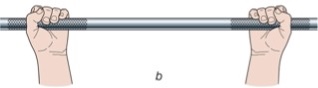
Pronated Grip
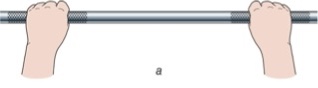
Alternated grip
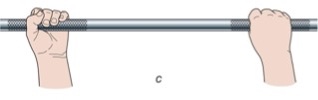
Hook grip
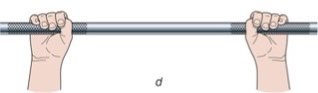
The thumb is wrapped around the bar in all grips.
What do pronated, supinated, alternated, and hook grips have in common?
open or false grip
What is called when the thumb does not wrap around the bar?
Common, Narrow, and wide
What are the three different grip widths?
stable position
A ___________ enables proper body alignment and stress on proper bones and muscles
Both free weight and machine exercises require a this
1. Head
2. Shoulders and Upper-Back
3. Hips/Buttocks
4. Left Foot
5.Right Foot
What are the 5 points of contact position provides stability for seated or supine exercises.
slightly wider than;on the floor
Exercises performed while standing typically require feet being _________ the hips with heels and balls of feet ______. Seated or supine exercises performed on a bench usually require a five-point body contact position.
full range of motion
A ___________ maximizes the value of an exercise and improves or maintains flexibility.
Sticking point
The ________ is the most strenuous movement of a repetition, and it typically occurs soon
breathe out; inhale
Instruct athletes to _______ during the concentric and ________ during the eccentric
Bar overhead, Bar on the Back, Bar racked on the front of the shoulder, and bar over face
What are some types of exercises that need to be spotted
power moves
Never spot _______
alternated
When spotting bench press the grip should be _______
the load and experience of the lifter
The number of spotter that a person happens is determined by ____________