Benign and malignant scrotal neoplasms
 Call Kai
 Learn
Learn Practice Test
 Spaced Repetition
 Match
Match Flashcards
 Knowt Play
1/63

There's no tags or description
Looks like no tags are added yet.
Name | Mastery | Learn | Test | Matching | Spaced | Call with Kai | Chat |
|---|
No analytics yet
Send a link to your students to track their progress
64 Terms
Most common malignancy in men 15-35 yrs of age
Scrotal neoplasms
Most extratesticular masses are ___________
Malignant
Most intratesticular masses are ____________
Benign
Most common “pure” germ cell tumor of testes
Seminoma
Seminoma is most common in ______________
While males
Seminoma
Normal AFP but INCREASED hCG
Increased risk of seminoma formation in pts with cryptorchidism
Spreads to retroperitoneal lymph nodes first
Pure seminomas have best prognosis of all germ cell tumors, very responsive to treatment
Can be cured when unilateral orchiectomy is performed
Seminoma is associated with
Trisomy 21, Klinefelter syndrome, smoking
USA Seminoma
Solid round or oval tumor
Uniform low level echoes, WITHOUT calcification
Hypoechoic to surrounding tissues
Tumors >1.6cm have hypervascularity
Rarely become necrotic or cystic
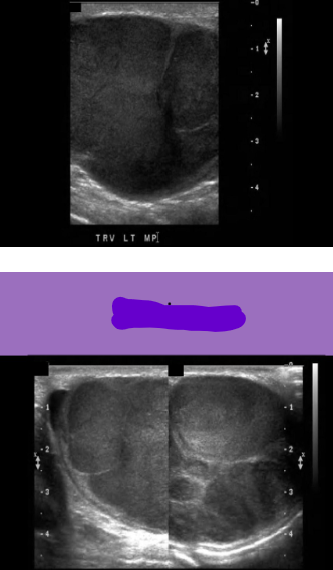
Seminoma
Non-seminomatous germ cell tumors
Germ cell tumors are divided into seminomatous (pure seminoma) and non-seminomatous (seminoma and non-seminoma portions) groups
More aggressive than seminoma
Cause visceral mets
Requires orchiectomy
Generally unresponsive to radiation or chemotherapy
Mixed malignant germ cell
Embryonal cell carcinoma
Yolk sac tumor
Teratoma
Choriocarcinoma
Embryonal cell carcinoma
Men age 25-35yrs
Labs: AFP and beta hCG elevated in most cases
Any tumor that secretes high levels of bhCG can lead to gynecomastia
Most aggressive testicular malignancy
Embryonal cell carcinoma
Most aggressive cancer with invasion of tunica albuginea
Embryonal cell carcinoma
Embryonal cell carcinoma USA
More heterogeneous than seminoma
Can have solid and cystic portions along with coarse calcifications
Distortion of the organ contour with tumor invasion
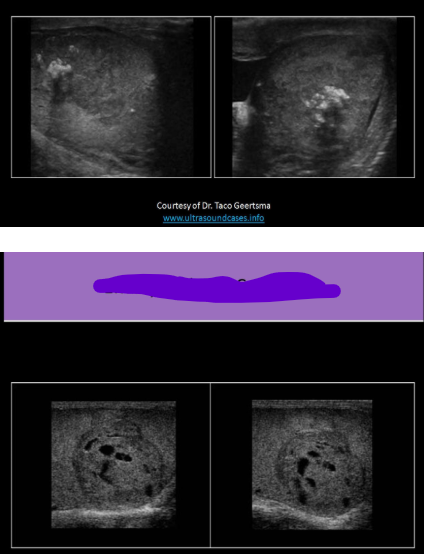
Embryonal cell carcinoma
Most common non-seminomatous germ cell tumor
Mixed germ cell tumors
Mixed germ cell tumors
Contains two or more types of germ cell tumor tissue
Lab testing on the tumor types that make up the mass
Usually occur age 20-30
Rarely occur before puberty or after 50
Most common combination is teratoma and embryonal cell carcinoma
USA varies with components
Not possible to distinguish sub-types by sonography
Second most common primary malignancy of the testicles
Mixed germ cell tumors
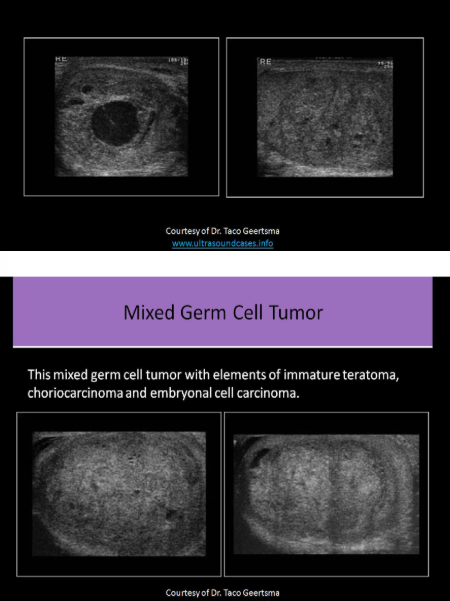
Mixed germ cell tumor
Most common testicular tumor in pts <2 yrs of age
Yolk sac tumor
Yolk sac tumor
5 year survival rate 25-35%
Lab testing: elevated AFP, normal bhCG
May see cystic areas and echogenic foci due to hemorrhage and necrosis
2nd most common testicular tumor in infants and young children
Teratoma
Teratoma
Usually benign but can malignant
1/3 mets within 5 years
If found in adults → Usually malignant
Contains bone, cartilage, smooth muscle and other tissues
Labs: Elevated AFP and bhCH with malignancy
Any tumor that secretes high levels of bhCG can lead to gynecomastia
Teratoma USA
Large heterogeneous, complex mass
Calcs and cystic components
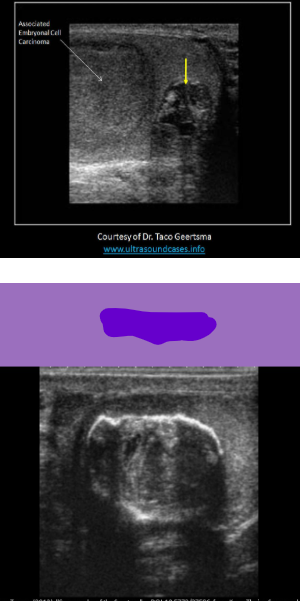
Teratoma
Choriocarcinoma
Rarest type of germ cell tumor
Most common in ages 20-30yrs
Lab testing: causes increased levels of beta hCG, AFP levels usually normal
Mets early, worst prognosis of all germ cell tumors
Any tumor that secretes high levels of bhCG can lead to gynecomastia
Stromal cell tumors
Leydig cell
Sertoli cell
Granulosa cell
Mixed
Leydig cell tumors
>85% benign
Occurs in pts age 5-10years or 30-60 years
Painless, palpable mass
Normal AFP, beta hCG levels
Produce testosterone and sometimes estrogen
Can cause endocrine imbalance with estrogen and testosterone (endocrinopathy) leading to precocious puberty, impotence, gynecomastia
Leydig cell tumors USA
Small (<1cm), solid homogeneous
Large, mildly irregular borders
Hypoechoic
Increased peripheral vascularity is usually benign
Areas of hemorrhage seen
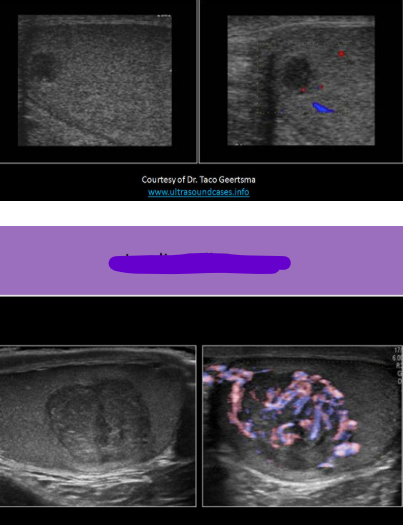
Leydig cell tumor
Sertoli cells tumors
Rare; malignant or benign
Painless mass
Similar to Leydig cell tumor in symptoms and appearance
Tumor may calcify
Can cause endocrine imbalance with estrogen and testosterone (endocrinopathy) leading to precocious puberty and gynecomastia
Bilateral and multifocal
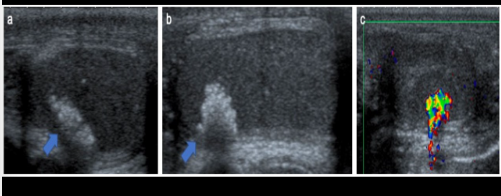
Sertoli cell tumor
Mixed germ and stromal cell tumor
Gonadoblastoma - gonadal stromal tumor cells combined with germ cell tumor cells; majority occurs with cryptorchidism and hypospadias
Germ cell stromal - seX cord cells
Testicular mets
Most commonly comes from prostate or lung primary
Usually multiple tumors identified
More common than germ cell tumors in pts >50yrs old
Primary carcinoma is typically unilateral, while secondary carcinoma is typically bilateral
Most common bilateral testicular tumor
Lymphoma
Most common secondary malignancy of the testes
Lymphoma
Lymphoma
Majority of pts diagnosed at age 60-70 years
Extension into the epi and cord is common
Can be focal or diffuse
Lymphoma USA
Homogeneous and hypoechoic tissue replaces the testes tissue
Hemorrhage and necrosis is rare
Increased vascularity
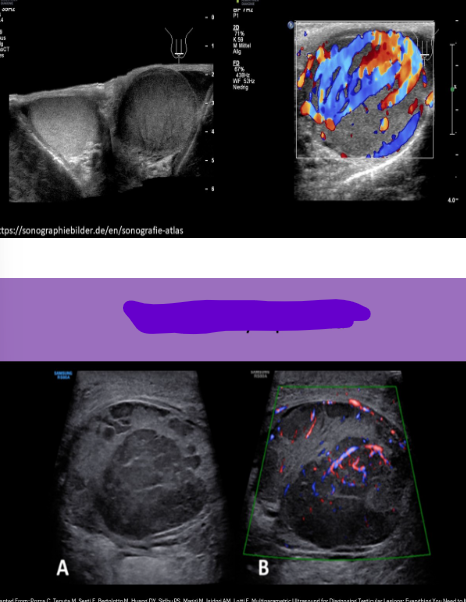
Lymphoma
Leukemia
2nd most common mets neoplasm
Can be focal or diffuse
An be unilateral or bilateral
Leukemia USA
Nonspecific, similar to lymphoma
Hypoechoic enlargement of the teste
Hypervascularity
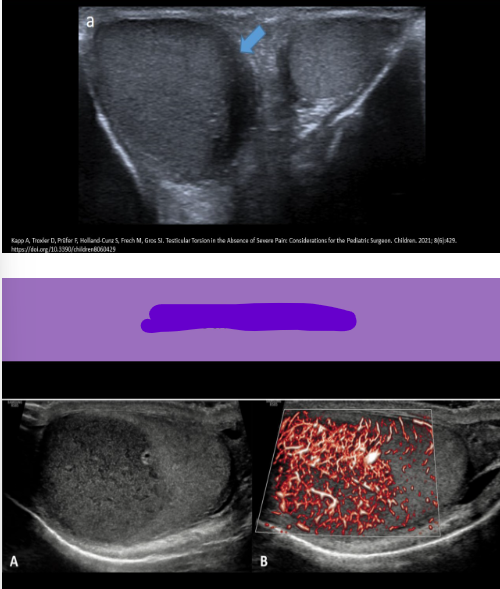
Leukemia
Rare tumors
Adrenal rests
Epidermoid cyst
Malakoplakia
Carcinoid
Mesenchymal
Arenal rests
Associated wish Cushing syndrome and adrenal hyperplasia
Hypoechoic, multifocal masses
Wheel spoke vascularity
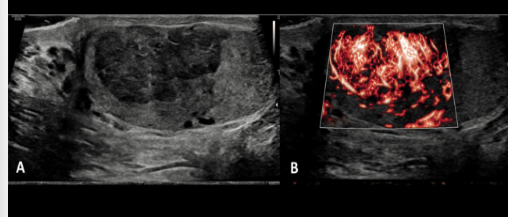
Adrenal rest tumor
Sarcoidosis
Presents as recurrent epididymis
USA Sarcoidosis
Inflammatory disease that can affect multiple organs
Can be found in testicles and/or epi
Irregular, hypoechoic solid mass in testicle
Can also be diffuse with multiple hypoechoic nodules
Enlarged epididymis with hypoechoic nodule formation
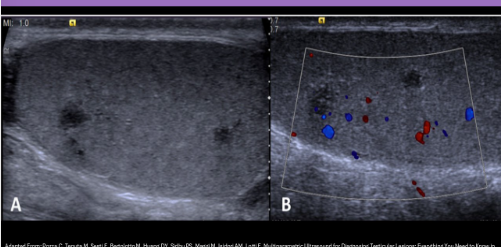
Sarcoidosis
Benign extratesticular tumors
While most intratesticular tumors are malignant, most extratesticular tumors are benign
Most involve the epididymis
Gentle transducer can be used to demonstrate the mass can move independently of testis
Sarcoidosis can form nodules in the epididymis
Spermatic granulomas are a common residual effect of a vasectomy
Adenomatoid tumor
Most common Benign extratesticular tumors
Adenomatoid
Adenomatoid USA
Rounded or ovoid with varying echogenicity
Well circumscribed
Hypovascular/avascular on color Doppler eval
Adenomatoid USA
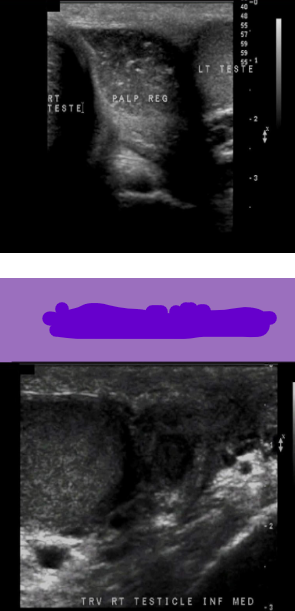
Adenomatoid tumor
Extratesicular malignant neoplasms
Fibrosarcoma
Lipsarcoma
Lymphoma
Rhabdomyosarcoma
Mets
Which of the following is normal with seminomatous tumors but abnormal with non-seminomatous tumors:
AFP levels
bhCG
Testosterone
WBC
AFP levels
When a solid tumor is identified in the testicle, what should be done to further evaluate this pt
Aortic evaluation
What can be used to described the expected ultrasound appearance of a testicular seminoma tumor?
Hypoechoic with low-level internal echoes
Non-seminomatous tumors are:
More aggressive than seminomatous tumors
Unresponsive to treatment
Cause visceral mets
All of the above
All of the above
Which of the following tumors would present with elevated AFP and bhCG levels?
Mixed germ cell
Embryonal cell carcinoma
Testicular teratoma
All of the above
All of the above
Any germ cell tumor that secretes high levels of bhCG can lead to the formation of:
Gynecomastia
What benign tumor is associated with estrogen
Leydig cell
Primary testicular cancer is typically _________, while secondary testicular cancer is typically _______
Unilateral, bilateral
What are the two most common secondary testicular cancers?
Lymphoma and leukemia
What scrotal mass is associated with Cushing syndrome
Adrenal rest