Biomechanics Exam 5
 Studied by 0 people
 Call Kai
 Learn
Learn Practice Test
 Spaced Repetition
 Match
Match Flashcards
 Knowt Play
1/41

There's no tags or description
Looks like no tags are added yet.
Name | Mastery | Learn | Test | Matching | Spaced |
|---|
No study sessions yet.
42 Terms
Which of the following is a widely used approach to determining a unique solution to a statically indeterminate problem in muscle musculoskeletal biomechanics?
a. Stabilization
b. Continuation
c. Boundary condition
d. Reduction
e. Synchronization
d. Reduction
Authors of “Changes in Tibiofemoral Forces due to Variations in Muscle Activity during Walking” were able, within an optimization framework, to systematically vary the coordination of muscles to determine the influence on tibiofemoral force. One of their findings was…
a. Muscle coordination has a negligible influence on tibiofemoral force.
b. Minimizing the sum of muscle activations produced the lowest tibiofemoral force throughout the gait cycle
c. The measured in vivo tibiofemoral force was higher than any tibiofemoral force predicted by the model
d. Peak tibiofemoral forces were sensitive to activations of muscles of the lower limb, especially during the late stance phase of walking.
d. Peak tibiofemoral forces were sensitive to activations of muscles of the lower limb, especially during the late stance phase of walking.
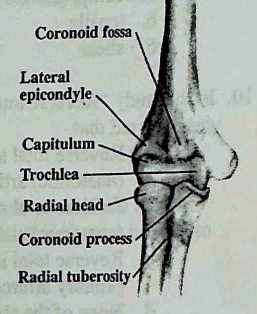
True or False: The main contributor to intrinsic stability of the elbow is the articulation between the capitulum of the humerus and the radial head
False
The overhead throwing motion produces very high tensile stresses on the medial side of the elbow (valgus load). This stress is carried mainly by the __________.
a. Lateral Collateral ligament
b. Annular ligament
c. Ulnar or medial collateral ligament
d. Olecranon process
c. Ulnar or medial collateral ligament
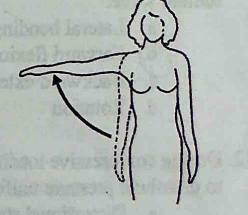
Referring to the motion of the shoulder, the drawing at right depicts __________.
a. Adduction
b. Abduction
c. Internal rotation
d. External rotation
e. Flexion
b. Abduction
The surface area of the glenoid fossa is ____________ that of the humeral head, which allows a significant freedom of movement.
a. ½ - 7/8
b. 2/3
c. ¼ - 1/3
d. 1/8
c. ¼ - 1/3
The _____________ provides dynamic restraints to anterior, posterior, and inferior displacement of the glenohumeral joint.
a. Glenoid labrum
b. Deltoid muscle
c. Acromion arch
d. Clavicle
e. Rotator cuff
e. Rotator cuff
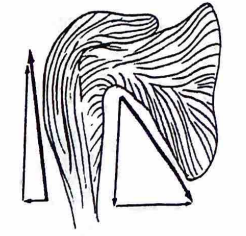
In the example shown at right the deltoid and oblique rotator cuff muscles function as a force couple to abduct the should joint. What is the importance of the offsetting vertical force components?
a. They push the humeral head against the acromion.
b. They prevent excessive anterior/posterior translation of the humeral head.
c. They stabilize the humeral head on the glenoid.
d. They limit the amount of internal rotation that accompanies abduction.
c. They stabilize the humeral head on the glenoid.
In order to maintain a stable position of a cementless implant, the transfer of load must take place through ____________ stress at the bone-implant interface.
a. Compressive
b. Tensile
c. Shear
c. Shear
In the study “Reverse total shoulder arthroplasty component center of rotation affects muscle function” it was reported that
a. Reverse total shoulder arthroplasty increased the deltoid moment arm relative to primary (anatomic) arthroplasty
b. Reverse total shoulder arthroplasty decreased the deltoid moment arm relative to primary (anatomic) arthroplasty
c. Reverse total shoulder arthroplasty increases the glenohumeral joint reaction force relative to primary arthroplasty
d. None of the above
a. Reverse total shoulder arthroplasty increased the deltoid moment arm relative to primary (anatomic) arthroplasty
An abdominal cavity with a cross-sectional area of 300 cm² and a pressure of 13.3 kPa produces a resultant force of about 400 N acting to resist torso _____________ and reduce compressive loads on the lumbar spine.
a. Lateral bending
b. Forward flexion
c. Backward extension
d. Rotation
b. Forward flexion
During compressive loading of a spinal motion segment, the nucleus pulposus exerts a ____________ to distribute pressure uniformly throughout the intervertebral disc.
a. Distortional stress
b. Hydrostatic stress
c. Tensile stress
d. Shear stress
b. Hydrostatic stress
True or False: The facet joints in the spine are essentially non-load bearing, especially in hyperextension and in combines flexion and rotation.
False
True or False: Motion of the spine is generally confined to one or two motion segments with relatively large motion between adjacent vertebrae
False
True or False: The angle of the facet joints to the transverse and frontal planes is constant throughout the spine. Thus, the allowable rotation is equivalent in the cervical, thoracic, and lumbar spine.
False
During upright standing the line of gravity of the trunk usually passes ventral (in front of) to the center of the fourth lumbar vertebral body, which creates a ________________.
a. Constant forward-bending moment on the spine (would cause flexion)
b. Constant backward-bending moment on the spine (would cause extension)
c. Constant pain in the back
a. Constant forward-bending moment on the spine (would cause flexion)
Which postures are correctly ranked from the lowest to highest in terms of the load they produce in the lumbar spine?
a. Lying down, sitting slumped over on a stool, standing upright
b. Standing upright, sitting slumped over on a stool, lying down
c. Lying down, standing upright, sitting slumped over on a stool
d. Standing upright, lying down, sitting slumped over on a stool
e. None of the above
c. Lying down, standing upright, sitting slumped over on a stool
You are evaluating a material that your colleague suggested could be used to create an artificial annulus fibrosus in the lumbar spine. If it is to function as an anatomical annulus fibrosus, then it must be able to sustain a high _________ in order to contain the gel-like nucleus pulposus.
a. Hoop tensile stress
b. Coefficient of friction
c. Hydraulic permeability
a. Hoop tensile stress
The cruciate ligaments of the knee function to…
a. Limit anterior and posterior translation
b. Limit flexion and extension
c. Limit tibiofemoral axial rotation
d. Prevent bone-on-bone contact
e. a and c
e. a and c
(Limit anterior and posterior translation AND limit tibiofemoral axial rotation)
The force on each femoral head during two-leg upright standing is ~1/3 of body weight, and this force increases to approximately _________ during the single-leg stance phase of gait.
a. 2.7 x body weight
b. 0.5 x body weight
c. 1 x body weight
d. 10 x body weight
a. 2.7 x body weight
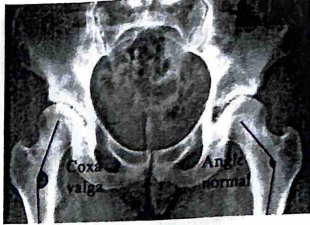
A short lever arm of the abductor force, such as in coxa valga, results in a somewhat __________ joint reaction force.
a. Increased
b. Decreased
a. Increased
An orthopaedic surgeon might insert a prosthetic cup deeper in the acetabulum to reduce the gravitational force lever arm (of the torso) and thereby ___________ the hip joint reaction force.
a. Increase
b. Decrease
b. Decrease
The following is an advantage of hip resurfacing over total hip replacement:
a. Bone preservation
b. More natural hip loading and less stress shielding
c. Requires a smaller incision
d. Low dislocation rate
e. a, b, and d
e. a, b, and d
(Bone preservation, More natural hip loading and less stress shielding, and Low dislocation rate)
Tibiofemoral motion is a combination of gliding and rolling. At the beginning of flexion is when the __________ amount of rolling occurs. and the roll:glide ratio is approximately ___________.
a. Lowest, 2:1
b. Highest, 2:1
c. Lowest, 1:2
d. Highest, 1:2
d. Highest, 1:2
Which mechanical model accounts for the changing roll:glide ratio with knee flexion?
a. Simple hinge
b. Crossed four-bar linkage which treats the ACL and PCL as two crossed bars
c. Ball joint
d. Rolling pivot joint
b. Crossed four-bar linkage which treats the ACL and PCL as two crossed bars
Knee menisci are important because they ______________.
a. Prevent bone-to-bone contact between tibia and femur
b. Transmit 50-100% of the load
c. Absorb shock
d. Lubricate the joint
e. All of the above
e. All of the above
(Prevent bone-to-bone contact between tibia and femur, Transmit 50-100% of the load, Absorb shock, Lubricate the joint
The patella functions to ______________.
a. Increase lever arm of the quadriceps
b. Provides a bony shield to the distal femur
c. a and b
d. None of the above
c. a and b
(Increase lever arm of the quadriceps, Provides a bony shield to the distal femur)
The tibiofemoral joint force ranges from approximately 2-4 times body weight during walking and is mainly transmitted through the __________ compartment of the knee.
a. Medial
b. Lateral
a. Medial
Patellofemoral joint reaction force ranges from 0.5 times body weight during level walking to over _________ body weight during deep knee bends.
a. 1x
b. 3x
c. 5x
d. 7x
d. 7x
Which of the following best describes the “screw-home” locking mechanism of the knee?
a. Valgus rotation of the tibia that occurs at maximum flexion
b. Internal rotation of the tibia at 90 degrees of flexion
c. External rotation of the tibia at full extension
d. Internal rotation of the tibia at full extension
c. External rotation of the tibia at full extension
Which of the following is known to be true and may explain the lower incidence of PCL rupture compared to ACL rupture?
a. The PCL does not contribute to knee stability.
b. The PCL is approximately twice as strong as the ACL.
c. The PCL is much more extensible than the ACL.
d. The PCL is smarter than the ACL.
b. The PCL is approximately twice as strong as the ACL.
True or False: During normal shoulder rotation, the contact point on the surface of the humeral. head remains constant.
FALSE
True or False: A glenohumeral dislocating force cannot be created by an imbalance of shoulder muscles forces (e.g. those of the rotator cuff) because the joint is so intrinsically stable
False
Which of the following explains why the gluteus medius shows its maximum contractile force during midstance, in the single-leg stance phase of gait?
a. It is a major contributor to forward propulsion
b. Its role is to eccentrically control the knee during flexion
c. It produces an abduction force to prevent the pelvis from descending on the opposite side
d. It helps absorb ground reaction forces as the foot strikes the ground
c. It produces an abduction force to prevent the pelvis from descending on the opposite side
A person’s elbow is flexed ~90 degrees and is pronating, The person is most likely
a. Putting cans on a shelf
b. Tying a shoe
c Sweeping
d. Flipping pancakes
d. Flipping pancakes
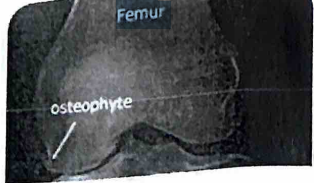
Using your knowledge of knee mechanics and the tendency for osteoarthritis to affect a certain side of the tibiofemoral articulation, you deduce that this standing anterior-posterior radiograph is of the person’s ____________ knee.
a. left
b. right
a. left
The arm shown her held at 90 degrees of shoulder abduction belongs to a 60kg person. The net muscle force M and glenohumeral joint reaction force J act horizontally. You can tell by simple analysis that…
a. Abduction the shoulder 90 degrees subjects the glenohumoral joint to extremely high shear forces
b. J is typically 2-4x body weight when the shoulder is abducted 90 degrees
c. J approaches body weight when the arm is abducted 90 degrees
d. The tension in M is much less than body weight
c. J approaches body weight when the arm is abducted 90 degrees
Which of the following was a finding of the study, "Metal-Carbon Fiber Composite Femoral Stems in Hip Replacements?"
a. The composite stem provided increased bone density in all Gruen zones ten years postoperatively relative to preoperative levels.
b. The composite implant provided increased proximal bone density and reduced distal bone density at the time of a ten-year follow-up.
c. Clinical outcomes with the composite implant were far superior to those of an all-metal stem at the time of a ten-year follow-up.
d. The composite stems were not biocompatible
b. The composite implant provided increased proximal bone density and reduced distal bone density at the time of a ten-year follow-up.

According to the rule of mixtures on parallel materials i and b the rations are used to predict the portion of load carried by each material. For the femoral stem component of a total hip replacement anchored in the proximal femur, the ratio is generally weighted much more towards the ______________, which explains the phenomenon known as stress shielding
a. implant
b. bone
c. muscle
d. bone cement
a. implant
Two approaches to mitigating stress shielding in the proximal femur after total hip arthroplasty are,
a. Long stem implants and hydroxyapatite coating
b. Short neck implants and full porous coating
c. Short stem implants and stiffness reduction to more closely match the stiffness of bone
d. Laser etching and ceramic bearing surfaces
c. Short stem implants and stiffness reduction to more closely match the stiffness of bone
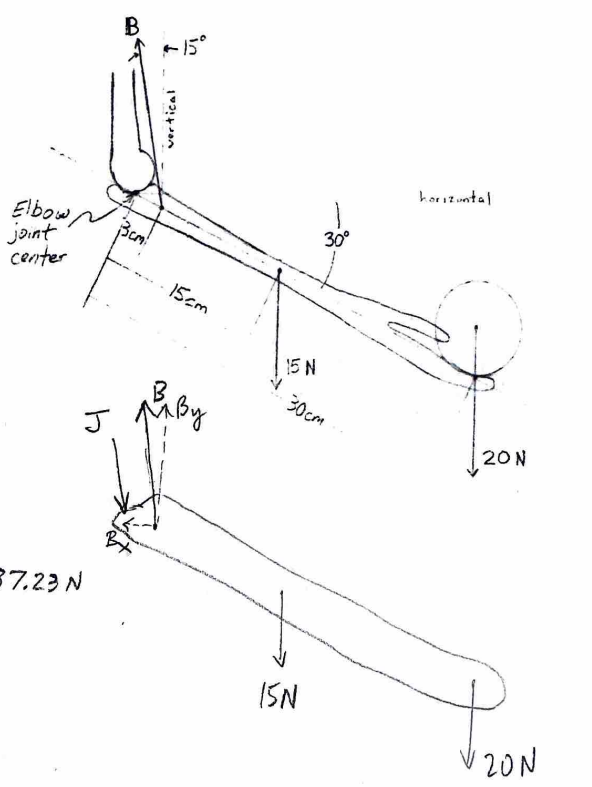
Consider the forearm when the elbow is 30 degrees below horizontal and the biceps (B) insert at angle 45 degrees with the forearm (15 degrees from vertical). The muscle insertion is 3cm from the elbow joint center; the forearm (W) weighs 15 N and its center of mass is 15 cm from the elbow joint center; and the hand supports a 20N weight (L) at a point which is 30 cm from the elbow joint center.
Draw a free body diagram of the forearm
If the maximum force the biceps muscle can exert is 1000 N, calculate the percentage of maximum muscle force required to hold the forearm in this position
Also calculate the magnitude and direction of the joint reaction force R
Sum of M at J = 0.
Bcos15(3cos30) = Bsin15(3sin30) + 15(15cos30) + 20(30cos30)
2.51B = 0.39B + 194.86 + 519.62
B = 337.02 N
337.02/1000 = 0.33702
0.33702×100
33.7% of Max
Sum of Fx = 0
Jx = Bx
Jx = 337.02sin15
Jx = 87.23 N
Sum of Fy = 0
By = Jy + 15 + 20
337.02cos15 = Jy + 35
Jy = 290.54 N
J = sqrt(Jx² + Jy²)
sqrt(87.23² + 290.54²)
J = 303.35 N
tan(theta) = Jx/Jy
theta = 16.7 degrees with respect to vertical
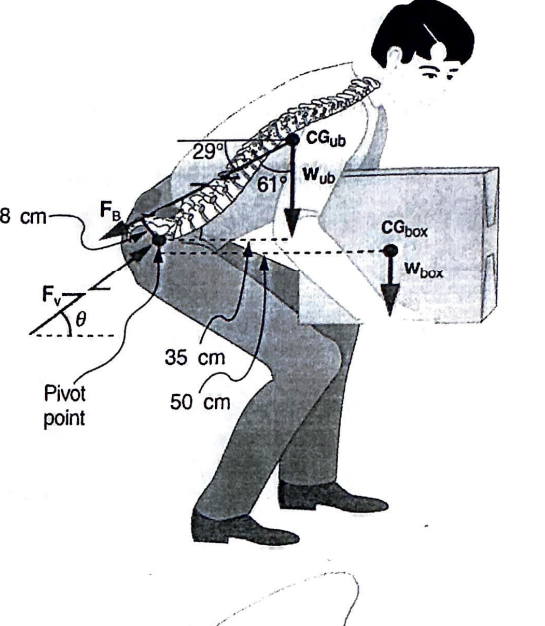
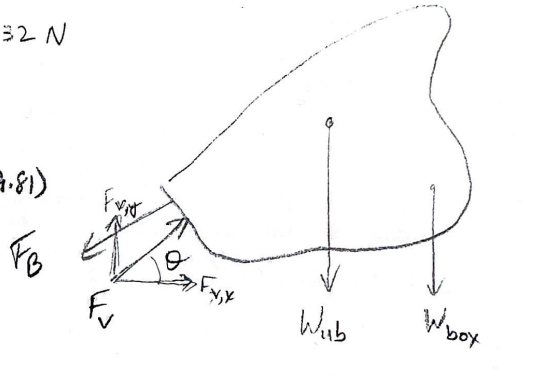
Consider the person lifting a heavy box with his back, shown in the figure below. (a) Calculate the magnitude of the force FB in the back muscles that is needed to support the upper body plus the box. FB acts 29° from horizontal and its perpendicular lever arm with respect to the pivot point is 8 cm. The mass of the upper body (Wub) is 55.0 kg and the mass of the box (Wbox) is 30.0 kg. (b) Calculate the magnitude and direction of the force Fv exerted by the vertebrae on the spine at the indicated pivot point.
Sum of M at pivot = 0
FB(8cm) = Wub(35 cm) + Wbox(50 cm)
8FB = 35(55)(9.81) + (30)(9.81)(50)
FB = 4199.9 N
Sum of Fx = 0
FBx = Fvx
4199.9cos(29) = Fvx
Fvx = 3673.32 N
Sum of Fy = 0
Fvy = FBy + 55(9.81) + 30(9.81)
Fvy = 4199.9sin(29) + 539.55 + 294.30
Fvy = 28770.0 N
Fv = sqrt(Fvx² + Fvy²)
Fv = 4661.6 N
theta = tan-1(Fvy/Fvx)
theta = 38 degrees with respect to horizontal