1) Concepts of Theory, Components, and Purpose of Theory
 Call Kai
 Learn
Learn Practice Test
 Spaced Repetition
 Match
Match Flashcards
 Knowt Play
1/21

There's no tags or description
Looks like no tags are added yet.
Name | Mastery | Learn | Test | Matching | Spaced | Call with Kai | Chat |
|---|
No analytics yet
Send a link to your students to track their progress
22 Terms
Assessment
Diagnosis
Plan
Implement/Intervention
Evaluation
Ah Daddy Pls I mEss u
Knowledge
Awareness or perception of reality acquired through insight, learning, or investigation
Knowledge : Google Drive
Examples:
the collective information and nursing facts in our brain
knowing that handwashing makes us clean
Knowledge
A reasonably accurate understanding of the world perceived by members of the discipline
Nursing is a discipline, it’s a profession
A group of people who have a similar train of thought
Science
A way of explaining observed phenomena as well as a system of gathering, verifying, and systemizing information about reality
Both a process (scientific method) & product (technology)
Science : TikTok fact checks
Example: Research shows that the scientific way of handwashing (sterile technique) reduces infection.
Science
The process of verifying before believing
Phenomenon / Phenomena
Observable fact or event
Designation of an aspect of reality
May be sensed or not, but it exists in the real world
A viral trend on TikTok is a phenomenon.
Something happens in real life, and it catches attention
Example: When a patient has an infected wound, there is a certain phenomenon that can be seen. Like redness, swelling, and eventually postformation.
Concept
A word or term that refers to phenomena that occur in nature or thought
Formulated in words that enable people to communicate meaning about reality in the world
elements or components of a phenomenon necessary to understand the phenomenon
Concept : Hashtag
When you type in a certain hashtag/term, it will bring you to all the similar thoughts.
Example: “infection” - explains the redness, swelling, and fever in the wound.
Concept
abstract and derived from impressions the human mind receives about phenomena through SENSING the environment
Assumption
Statement or view that is widely accepted as true
Something that you think is true, although you have no definite proof
Sometimes we make mistakes because we assume wrong
Example: When you go to a coffee shop, you assume that there's free wifi.
Although assumptions may not be susceptible to testing, they can be argued philosophically
The action towards the ______ is aligned
Example: As a nurse, we assume that our patients want to get better. You want to do everything in your power to make sure they get better. So we plan and create interventions for wound care.
Assumption
Beliefs about phenomena one must accept as true to accept a theory about the phenomena as true.
May be based on accepted knowledge or personal beliefs and values.
Proposition
A statement or assertion that expresses a judgment or opinion
“If, then” statement
The analogy is that if a person drinks water, then the person’s skin will glow.
Example: If there’s proper wound cleaning, then the wound will not be infected.
Principle
A fundamental truth, doctrine, or law
A scientific law that explains the method of a natural action
“Be the change you want to see in the world” — Mahatma Gandhi’s doctrine
Treat others the way you want to be treated
Example: The principle of beneficence; we strive to do good. Nurses must act to promote healing.
Theory
Systematic explanation of an event in which constructs and concepts are identified, relationships are proposed, and predictions are made
A set of interpretive assumptions, principles, or propositions that help explain or guide action
A foundation of something bigger
Like having a Spotify Premium, you’ll be able to understand the story of Hamilton because of the system and collection of songs. Similar to theory, it builds up to something bigger.
Example: You can’t be an RN without understanding what made you become an RN.
Theory
A set of logically interrelated concepts, statements, propositions, and definitions, which have been derived from philosophical beliefs of scientific data and from which questions or hypotheses can be deduced, tested, and verified
Example: According to Orem’s Self-Care Theory, you can't take care of yourself if the community, health system, and family are not supportive.

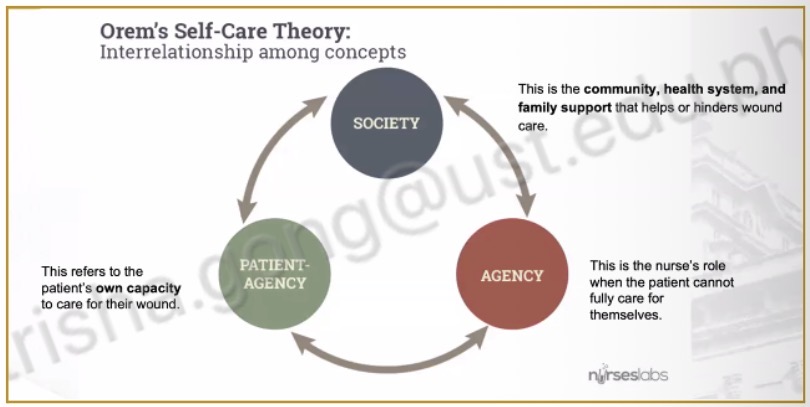
Orem’s Self-Care Theory
According to this theory, you can't take care of yourself if the community, health system, and family are not supportive.
Paradigm
A worldview or overall way of looking at a discipline and its science
An organizing framework that contains concepts, theories, assumptions, beliefs, values, and principles that form the way a discipline interprets the subject matter
A pattern of shared understandings & assumptions about reality & the world
A model or example that shows how something works or is produced
Different methods, same results
Analogy: IOS vs Android
Nursing Example: Florence Nightingale’s Environmental Theory
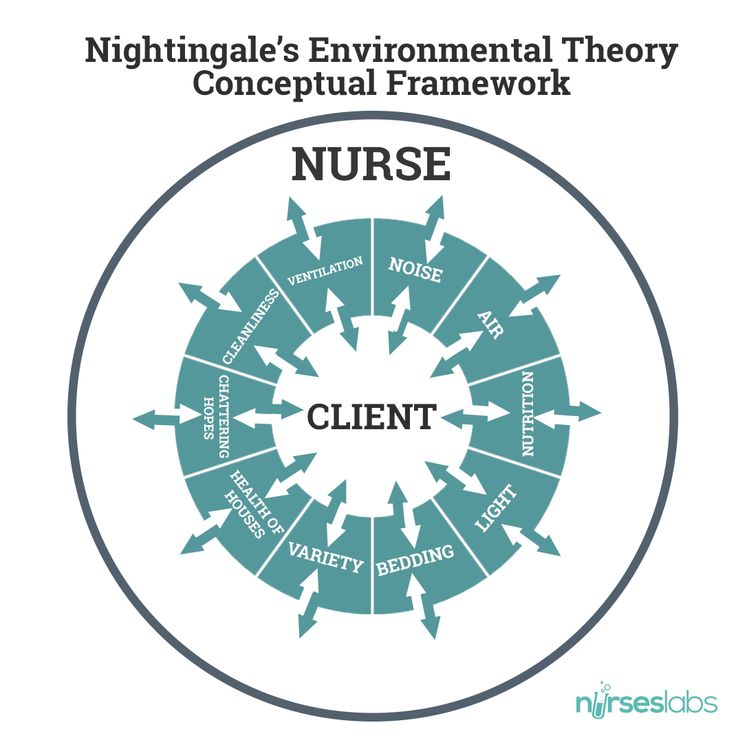

Florence Nightingale’s Environmental Theory
This is an example of a Paradigm:
This theory defines nursing as the act of utilizing the patient’s environment to assist in their recovery and healing
Paradigm Shift
Occurs when the traditional theories no longer describe the world, as newer information has been learned

Metaparadigm
Represents the worldview of a discipline: the global perspective that subsumes more specific views and approaches to the central concepts with which the discipline is concerned.
Ideology within which the theories, knowledge, and processes for knowing find meaning and coherence.
Like K-pop, Everything revolves around the 4 main companies—HYBE, SM, JYP, and YG —but all of them produce the same K-pop idols, even with different systems.
Nursing’s metaparadigm is generally thought to consist of the concepts of
Person = patient
Environment = external environment
Health = the ability to function independently
Nursing = science, art, and practice, a discipline of caring
Example: In wound care, we consider the person/patient. Our goal is recovery and wound healing. The environment needs to be clean, it is at the hospital or at home. The nursing intervention is the process of cleaning the wound.
Metaparadigm
The most abstract and general component of the structural hierarchy of nursing knowledge (Kuhn, 1974)
Metaparadigm
“Globally to the subject matter of greatest interest to members of a discipline” (Power & Knapp, 2011, p. 107)
Purpose of a Metaparadigm |
Summarize the intellectual and social missions of the discipline
Why do we do what we do?
Place boundaries on the subject matter of that discipline
Each discipline has its own boundaries. One profession cannot do everything.
The environment is as important as the person themselves. When we care as nurses, we don't just care for the patient; we also have to take into account all the external factors affecting the patient's decision-making.
What is the purpose of a Metaparadigm?
