Defense Mechanism
 Call Kai
 Learn
Learn Practice Test
 Spaced Repetition
 Match
Match Flashcards
 Knowt Play
1/33

There's no tags or description
Looks like no tags are added yet.
Name | Mastery | Learn | Test | Matching | Spaced | Call with Kai | Chat |
|---|
No analytics yet
Send a link to your students to track their progress
34 Terms
Mature
Altruism
Anticipation
Asceticism
Humor
Sublimation
Suppression
Mature: Altruism
Sense of fulfillment or purpose from serving others.
According to working on my own goal.
They can channel their need to help into something structured while we still guide them to focus on their occupational activity.
Goal: Don't stop the helping — channel it into something structured.
More Activities:
Write a “Thank You” note or letter (encouragement) to SELF
To express desire to help and connect while reflecting on own growth
Write a “Thank You” note to OTHERS
They get to give back and feel valued. This reinforces purpose without neglecting own needs.

Mature: Anticipation
Realistically planning for future emotional discomfort to reduce shock.
Foresight = when it's about to happen.
Goal: Help them feel prepared WHILE learning to stay present.
More Activities:
Coping Plan
Calendar/Vision Board “Transition Timeline” write preparation steps each day.
It channels the need to plan into manageable actions
They see progress visually and feel more in control
More present-oriented, less consumed by future worries

Mature: Asceticism

Mature: Humor
Using comedy to express feelings, to metabolize painful reality without causing discomfort to self or others.
Goal: Help them use it more intentionally, not to deflect.
More Activities:
Stress Re-write: Write a stressful situation with an exaggerated funny ending.
Helps reframe while still processing emotions.
Write a stressful / comical memory, then write 2 different endings — one serious, one funny.
Helps practice humor as reframe without avoiding emotional weight.

Mature: Sublimation
Instead of acting out, redirect the energy into something constructive.
Goal: Help them externalize / transform raw emotions into tangible, productive output = reduces distress and gives sense of accomplishment.
More Activities:
Gardening, Painting, Writing, Number activity to identify current frustrations
Table of "what I feel and who I feel these towards" then choose projects to pour energy into.

Mature: Suppression
Consciously setting aside a thought/feeling to function effectively, with intention to address it later. Client says "I don't want to think about that right now, but I will later."
Goal: Activities must help them practice skill where they DON'T lose track of postponed concerns.
More Activities:
Notebook / whiteboard / blackboard -> jot down distracting thoughts/worries -> will revisit during a specific designated "worry time" later in the day.
Helps them visually and physically place concerns so they can engage in current occupations without anxiety of forgetting.
Result: Improved focus and follow-through.

Defense Mechanism: Immature
Acting Out
Blocking
Hypochondriasis
Introjection
Passive-Aggressive Behavior
Regression
Schizoid Fantasy
Somatization
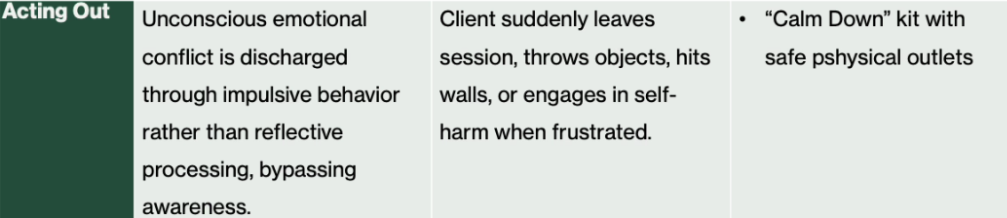
Immature: Acting Out
Cannot verbalize, immediate release of tension that breaks safety and therapy.
Goal: Don't punish the acting — give it a safer, controlled outlet and build a bridge to words.
More Activities:
Calm Down Kit with safe physical outlets
To release physical tension as transitional steps toward more reflective coping.
Piece of paper to be scribbled or torn apart → check how they felt in the end.
This physically externalizes anger, physically releases the need, and creates bridge toward verbal expression.
Immature: Blocking
Client stops mid-sentence during stressful discussions; forgets instructions immediately; says "nakalimutan ko" when asked about difficult topics.
Goal: Give activities that make them go back to their line of thought.
More Activities:
Teach deep breathing or relaxation techniques
Ground 5-4-3-2-1
Interrupts anxiety response and attention goes back to present.

Immature: Hypochondriasis
It is easier for them to think they are physically ill than to face what they are truly feeling.
Goal: Help them gently connect physical sensations to emotions. Do NOT dismiss their discomforts.
More Activities:
Rate Physical discomfort before/after activity.
Gently introduce idea that body and emotions are connected via simple & non-judgmental questions.
Helps cx start line of thinking to notice patterns between physical sensations in daily experiences in safe & gradual way.
Goal: Help them build awareness of their mind-body connection. Gradually, it reduces need to rely on physical symptoms as primary way of expressing stress.

Immature: Introjection
Client repeats harsh self-criticism that sounds like a parent. Expresses rigid beliefs not their own. "I'm useless" — but voice is mother's.
Goal: Help them recognize thought is NOT actually their own and notice patterns without feeling attacked.
More Activities:
Tabular form: 1st column > self thoughts during day; 2nd column > who asked this?; 3rd column > kinder self-talk.
Write down one thing you said to yourself today and next to it write who said it to you before.
Practice positive "I am" statements in front of a mirror.

Immature: Passive-Aggressive Behavior
Client agrees to tasks but consistently arrives late, "forgets" equipment, does tasks poorly, or makes sarcastic remarks.
Goal: Help build awareness of hidden resentment and practice expressing more directly. Help cx recognize patterns of indirect resistance.
More Activities:
Note when they feel angry and what they did (or didn't do) about it to build awareness.
They understand their triggers and learn direct communication.

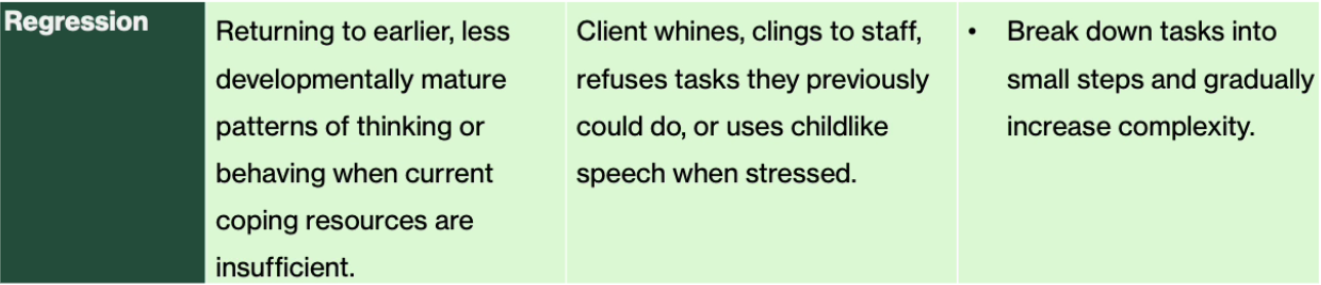
Immature: Regression
Client whines, clings to staff, refuses tasks they previously could do, or uses childlike speech when stressed.
Goal: help them stay in their present level of functioning and build confidence.
More Activities:
Break down tasks into small steps and gradually increase complexity.
Completing each step successfully → builds confidence → reinforces current capabilities → gently challenges need to regress.
Simple daily snack, Fold clothes, Make their beds
Achievable tasks to feel more competent and more in control.
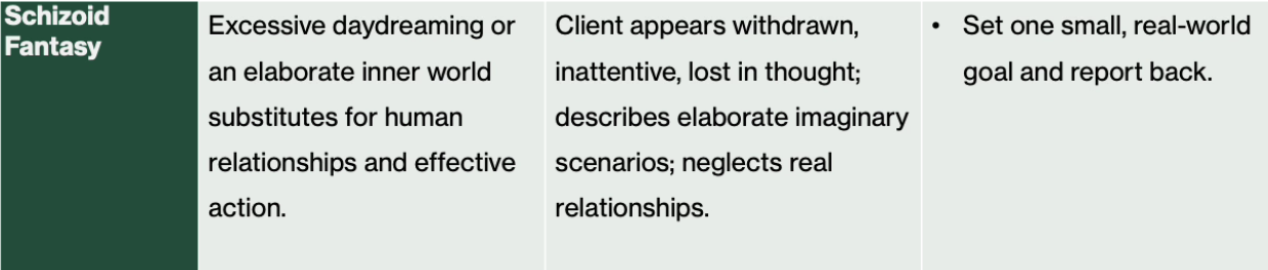
Immature: Schizoid Fantasy
Retreats because reality & responsibilities feel unsatisfying or "overwhelming".
Goal: Gently help them reconnect with reality WITHOUT completely letting go of their imagination.
More Activities:
Cx to draw or describe one of their fantasies, then identify one small realistic piece of it that can happen.
E.G Daydreaming of travelling → plan a short walk to a nearby park.
Helps bridge gap from fantasy and reality, helps access real engagement without feeling pressured & attacked.
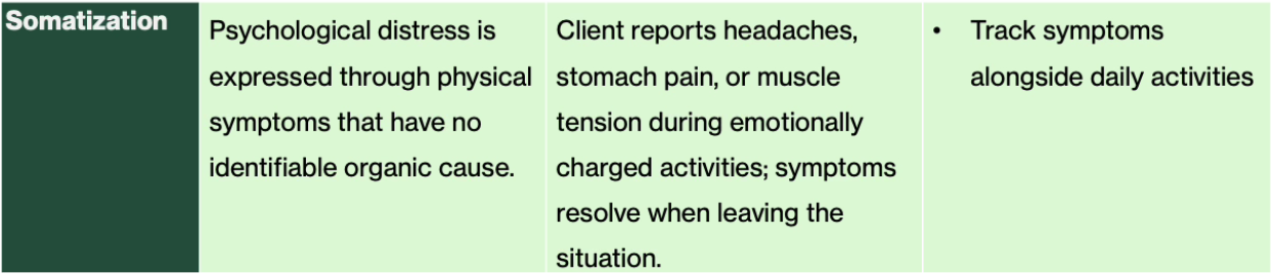
Immature: Somatization
Unconsciously showing distress; they haven't learned to identify or verbalize feelings.
Goal: Give physical sensation so emotions can build awareness into their bodies and mind.
More Activities:
Track symptoms alongside daily activities - to see pattern.
Drawing session where cx will outline their own body, then color/mark the area where they feel physical manifestations, and write or express emotions at that time.
Visual tools help externalize patterns between physical pain and emotional state → let OT understand root cause.
It helps link stress and physical symptoms and helps OT empower verbal expression more directly, reducing reliance on bodily stress.
Defense Mechanism: Neurotic
Controlling
Displacement
Externalization
Inhibition
Intellectualization
Rationalization
Isolation of Affect
Dissociation
Reaction Formation
Repression
Sexualization
Undoing
Neurotic: Controlling
“boss around”
Belief: "If everything is predictable, nothing bad happens to me."
Goal: Help them tolerate uncertainty and quietly let go of need to be in charge [doing the opposite].
More Activities:
Create a balanced weekly schedule with both structured and unstructured time [open-ended such as "choose a task for later"]
Helps cx be comfortable with flexibility to reduce rigidity.
Gradually introduce unexpected changes in their routine and during the session.
![<p>Belief:<em> "If everything is predictable, nothing bad happens to me."</em></p><p></p><p><strong>Goal: </strong>Help them tolerate uncertainty and quietly let go of need to be in charge [doing the opposite].</p><p></p><p><strong>More Activities:</strong></p><ol><li><p>Create a balanced weekly schedule with both structured and unstructured time [open-ended such as "choose a task for later"]</p></li></ol><ul><li><p>Helps cx be comfortable with flexibility to reduce rigidity.</p></li></ul><ol start="2"><li><p>Gradually introduce unexpected changes in their routine and during the session.</p></li></ol><p></p>](https://assets.knowt.com/user-attachments/7dbc52dc-aece-4baa-ae87-1a0bf52b62c2.png)
Neurotic: Displacement
“divert mo sa iba”
Confronting real issues is too threatening.
Goal: Help cx explore own feelings safely but at same time identify root of emotions.
More Activities:
Writing who and what they are angry about and asking if it's the real target or if it's someone else.
Builds self-awareness and reduces need to displace.
Write down a situation that made them angry → OT guides to trace back step-by-step: (1) what happened (2) how did you feel (3) who made you upset?
Builds capacity to address conflict more directly.

Neurotic: Externalization
“not a me problem, but a U”
They blame others because it is too painful to take responsibility themselves.
Goal: Help them see own role in difficulties → helps explore own role without feeling attacked.
More Activities:
Draw a larger circle and ask cx to place everything you are worried about into two categories (1) things that you have control over, put inside the circle (2) things that you can't control, put outside → OTs redirect.
It helps cx gradually reduce need to externalize blame.
Also: Identify what they can control [their actions] vs. what they cannot [others' actions] and list own role in both creating and solving it.
![<p><span>They blame others because it is too painful to take responsibility themselves.</span><br></p><p><strong>Goal:</strong><span> Help them see own role in difficulties → helps explore own role without feeling attacked.</span></p><p></p><p><strong>More Activities:</strong></p><ol><li><p>Draw a larger circle and ask cx to place everything you are worried about into two categories (1) things that you have control over, put inside the circle (2) things that you can't control, put outside → OTs redirect. </p></li></ol><ul><li><p>It helps cx gradually reduce need to externalize blame. </p></li></ul><ol start="2"><li><p>Also: Identify what they can control [their actions] vs. what they cannot [others' actions] and list own role in both creating and solving it.</p></li></ol><p></p>](https://assets.knowt.com/user-attachments/f36d883b-1551-4328-8fbc-6cd71a240566.png)
Neurotic: Inhibition
“can’t, won’t, don’t, wouldn’t”
Goal: Help them take manageable first step without feeling overwhelmed → gradually face fears in safe & manageable way.
More Activities:
Cx identify one small specific action they can take toward a feared activity [cooking → first step could be washing the food].
Helps build momentum in confidence through success. Makes activity larger → feels less intimidating → more achievable.
Rate fear level [1-10] for various activities to identify safe starting points.
Build confidence gradually.
![<p><strong>Goal:</strong><span> Help them take manageable first step without feeling overwhelmed → gradually face fears in safe & manageable way.</span></p><p></p><p><span><strong>More Activities:</strong></span></p><ol><li><p>Cx identify one small specific action they can take toward a feared activity [cooking → first step could be washing the food]. </p></li></ol><ul><li><p>Helps build momentum in confidence through success. Makes activity larger → feels less intimidating → more achievable.</p></li></ul><ol start="2"><li><p>Rate fear level [1-10] for various activities to identify safe starting points. </p></li></ol><ul><li><p>Build confidence gradually.</p></li></ul><p></p>](https://assets.knowt.com/user-attachments/c21da0cd-8cf6-46e1-96be-62178973ef76.png)
Neurotic: Intellectualization
“young Sheldon”
They are talking about trauma like reading a textbook because feeling it feels too overwhelming.
Goals: Rebuild capacity to notice and tolerate emotions without needing to intellectualize.
More Activities:
Practice using feeling words "Nararamdaman ko..." instead of thinking words "Sa tingin ko...".
Practice identifying and expressing emotions.
Before or after discussing stressful topic → cx guided to pause or notice physical sensations.
Helps them notice and tolerate emotions.

Neurotic: Rationalization
“napalusot”
They convince themselves they have a good reason even when real reason is uncomfortable to face. Play safe.
Goal: Make cx aware of their true motivations.
More Activities:
Cx can write down a situation and identify through column (1) the reason they gave (2) real reason
To help cx look beneath surface of own explanation, increasing self-awareness.
Cx can write down their reason for a behavior → OT asks "Paano kung 'di yan yung real reason?" [gentle questioning]
Help them practice looking beyond initial justification = consider other possible motivations.
![<p><span>They convince themselves they have a good reason even when real reason is uncomfortable to face. Play safe.</span></p><p><br><strong>Goal:</strong><span> Make cx aware of their true motivations.</span></p><p></p><p><span><strong>More Activities:</strong></span></p><ol><li><p>Cx can write down a situation and identify through column (1) the reason they gave (2) real reason</p></li></ol><ul><li><p>To help cx look beneath surface of own explanation, increasing self-awareness.</p></li></ul><ol start="2"><li><p>Cx can write down their reason for a behavior → OT asks "Paano kung 'di yan yung real reason?" [gentle questioning]</p></li></ol><ul><li><p>Help them practice looking beyond initial justification = consider other possible motivations.</p></li></ul><p></p>](https://assets.knowt.com/user-attachments/4bb9846a-8a15-4102-8116-5e8ad41758f1.png)
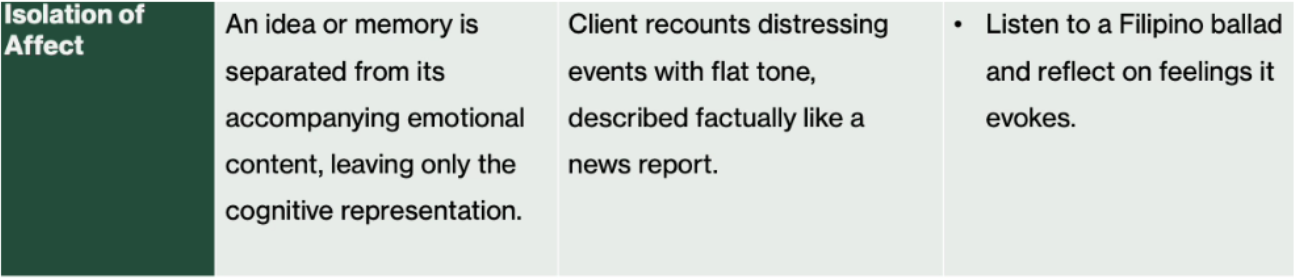
Neurotic: Isolation of Affect
“Matilda”
They can talk about painful thing like reading a news report because feeling it directly would be too overwhelming.
Goal: Gently reconnect with emotions and practice connecting again with bodily sensation.
More Activities:
OT asks cx to recall a neutral memory, not traumatic, and describe what body felt that time. Over time, it helps progress slightly with emotional memories.
Bridges gap between intellectual recall and emotional experience.
Listening to a Filipino ballad song → cx will identify what emotions the song brought up.
Helps recognize and name feelings in safe yet contained way, gradually reduces need to isolate.
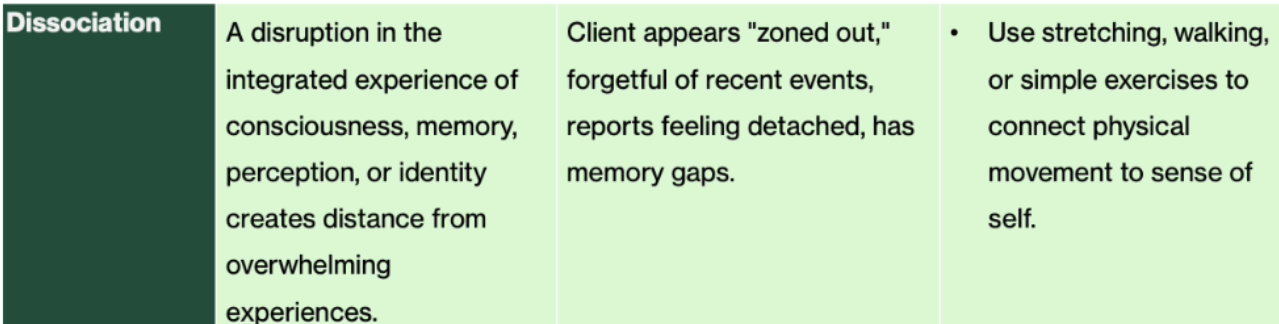
Neurotic: Dissociation
“parang may memory gap”
Unconsciously checking out from themselves or being disconnected from themselves, surrounding, or memories.
Goal: Don't force recall — help them stay grounded in present and feel safe in body.
More Activities:
Grounding 5-4-3-2-1 + sensory anchor: Name 5 see, 4 touch, 3 hear, 2 smell, 1 taste. Use grounding object — textured ball, cold water, scent.
Safe Place routine: Predictable daily routine + designated "safe corner" in clinic.
Helps build safety and control, so they can stay present longer without dissociating.
Neurotic: Reaction Formation
“plastikch”
They are incredibly kind and helpful, but deep down harbor resentment or anger they simply cannot show.
Goal: Help cx safely explore and accept more complex or negative feelings. Give practical daily activities to check in with authentic feelings without judgment.
More Activities:
Journaling [2-5 mins a day] → write down whatever comes to mind [bad/good]. OTs can notice true feelings.
Gradually, automatic tendency to cover them up with opposite behaviors can be abolished.
Write down a situation where they felt they had to act too nice; then write what they really felt underneath.
Validate full range of emotions while reducing need to hide behind exaggerated opposite behavior.
![<p>They are incredibly kind and helpful, but deep down harbor resentment or anger they simply cannot show.</p><p><br><strong>Goal:</strong> Help cx safely explore and accept more complex or negative feelings. Give practical daily activities to check in with authentic feelings without judgment.</p><p></p><p><strong>More Activities:</strong></p><ol><li><p>Journaling [2-5 mins a day] → write down whatever comes to mind [bad/good]. OTs can notice true feelings. </p></li></ol><ul><li><p>Gradually, automatic tendency to cover them up with opposite behaviors can be abolished.</p></li></ul><ol start="2"><li><p>Write down a situation where they felt they had to act too nice; then write what they really felt underneath. </p></li></ol><ul><li><p>Validate full range of emotions while reducing need to hide behind exaggerated opposite behavior.</p></li></ul><p></p>](https://assets.knowt.com/user-attachments/cf1c4135-c39f-47da-aebb-6a00208e1706.png)
Neurotic: Repression
“amnesia”
Unconsciously buries painful/threatening memories out of awareness because acknowledgement is too distressing.
Forgotten feelings still affect behavior.
Goal: Help cx build safety and coping skills in present WITHOUT forcing them to remember.
More Activities:
Doing a simple daily routine that is predictable and follows it consistently.
Sense of structure, safety, and control of present life.
Gradually have cx sense of safety → approach any repressed material whenever they are ready.
Focus on current behaviors and teach new skills: "Ano ang ginagawa mo ngayon para sa stress?"

Neurotic: Sexualization
“in heat”
They use sex/sexual talk to cope, not out of desire.
Breaks boundaries, distracts from real issue.
Goal: Don't shame — help them name the real feeling underneath and teach non-sexual ways to meet it + keep professional boundaries.
More Activities:
1. Name-Pause-Replace: When they notice sexualized thought/urges → pause and ask "what do I really feel? stressed? bored? lonely?" → list non-sexual activity to address it.
2. Say need in non-sexual terms: Instead of acting out sexually → psychoeducation + roleplay proper phrases. E.g. "When I'm anxious I make sexual jokes, but what I need is a break”
Practice boundaries through roleplay.[exercise][walk]
![<ul><li><p><span>They use sex/sexual talk to cope, not out of desire.</span></p></li><li><p><span>Breaks boundaries, distracts from real issue.</span></p></li></ul><p></p><p><strong>Goal: </strong>Don't shame — help them name the real feeling underneath and teach non-sexual ways to meet it + keep professional boundaries.</p><p></p><p><strong>More Activities:</strong></p><p><span>1. </span><strong>Name-Pause-Replace:</strong><span> When they notice sexualized thought/urges → pause and ask "what do I really feel? stressed? bored? lonely?" → list non-sexual activity to address it.</span><br><span>2. </span><strong>Say need in non-sexual terms:</strong><span> Instead of acting out sexually → psychoeducation + roleplay proper phrases. E.g. "When I'm anxious I make sexual jokes, but what I need is a break”</span></p><ul><li><p><span>Practice boundaries through roleplay.[exercise][walk]</span></p></li></ul><p></p>](https://assets.knowt.com/user-attachments/af822c1c-0df7-4bf3-aa68-e572d8618cfd.png)
Neurotic: Undoing
“at what cost”
They over-apologize or go to great lengths to make up for negative thoughts because they feel guilty.
Goal: Help cx tolerate discomfort of thoughts without acting out so much.
More Activities:
Specific 5 minutes before performing undoing behavior and using that time to say self-acceptance phrases.
Helps build tolerance of imperfections and break compulsive side.
Practice self-talk for accepting mistakes without needing to "fix" them.

Defense Mechanism: Narcissistic
Denial
Distortion
Projection
Splitting
Narcissistic: Denial
They insist they are not depressed, even though they cannot get out of bed because facing the truth is unbearable.
Goal: Help cx gently externalize their thoughts without forcing them to accept reality at once.
More Activities:
Not listing if good or bad fact of cx's day → build habit of observing reality objectively.
Gradually reduces need to deny and makes it easier to accept help whenever ready.
Write down a list of worries or difficulties without asking them to change or interpret them.
Gradually, need for denial lessens and opening door for insights increases.

Narcissistic: Distortion
“ako lang may kaya nito”
Believing they have special powers or abilities because facing truths about limitations becomes to painful
Goal: Help cx's to gently align their perceptions with reality — be a factual observer in a non-judgmental way.
More Activities:
Cx identify a situation in the day where they feel strongly about themselves and ask another one for their perspective.
Helps build habit of reality testing.
OTs can present a neutral factual observation: "I notice you arrived 20 minutes late today." Ask client to describe what they think happened and compare it with a trusted observer check facts without confrontation.

Narcissistic: Projection
“being too much ki self”
They accuse others of being angry or dishonest when, in fact, they themselves feel that way because facing those feelings threatens or overwhelms them.
Goal: Help cx gently recognize and own their emotions.
More Activities:
Encourage cx to reframe "others" to "I" statements. ("ang init ng ulo niya" → "ang init rin ng ulo ko ngayon")
Helps internalize and own feelings.
Ask cx to describe what someone else is feeling right now and gently ask if they felt this way also.

Narcissistic: Splitting
“generalizing”
Cx view other people ALL good or ALL bad.
Goal: Help cx practice seeing gray areas in people and situations.
More Activities:
Cx can be asked to go identify one person that they have strong feelings about, and they need to list down one neutral or negative about them each day.
Practice owning positive and negative aspects to build capacity to balance thinking.
Cx can be asked a neutral or factual observation that they see as all bad ("what do they do every day") → practice seeing others as a whole individual.
Reduces need to split and improves ability to rely on others in balanced way.
