Psychobiological Influences on Mental Health Nursing: Biological Basis for Understanding Psychotropic Drugs - Lecture 1 Exam 1
 Call Kai
 Learn
Learn Practice Test
 Spaced Repetition
 Match
Match Flashcards
 Knowt Play
1/113

There's no tags or description
Looks like no tags are added yet.
Name | Mastery | Learn | Test | Matching | Spaced | Call with Kai | Chat |
|---|
No analytics yet
Send a link to your students to track their progress
114 Terms
The study of the effect of biological influences on behavior, emotions, and cognitive processes.
Psychobiology
The locus of all mental activity is the _______. All actions of the ________ are carried out through interactions of nerve cells.
brain
Nurses need to understand both the normal and abnormal mental processes in terms of 1. ________ ___________ and 2. _________. Alterations in mental processes can lead to mental disturbances and physical manifestations.
1. brain structure
2. function
1. Genetics
2. Neurodevelopment
3. Drugs
4. Infections (PANDAS, pediatric autoimmune Neuropyschiatric Disorders Associated with Streptococcal Infections)
5. Psycho-social experiences (stress, traumatic experiences)
The origin of a psychiatric illness is related to a number of factors which ultimately cause an alteration in brain function that accounts for disturbances in a persons behavior and mental experiences such as:
The alterations in brain functions are the target of ....
psychotropic drugs
The treatment of mental illness with psychotropic drugs dates back to the ...
1950s
Weighs about three pounds, Contains billions of neurons, Has three major divisions (stem, cerebrum, cerebellum)
brain
Connects the spinal cord to the brain and controls autonomic vital body functions such as breathing and cardiac function, cranial nerves arise from the brain stem
Brain Stem
Largest portion of the brain and is divided into two hemispheres and four lobes
Cerebrum
Control center for coordination of voluntary movements, maintains equilibrium, muscle tone, and postural control
Cerebellum
Insight, decision making, motivation, judgement Voluntary motor ability
ex: mentally ill patients may be impulsive, have no motivation, have poor judgement, and poor insight
frontal lobe
Connects to the limbic system (the emotional brain), allows expression of all emotions such as love, hate, aggression, fear
ex: mentally ill patients may not be able to express emotions
temporal lobe
Interprets visual images and language formation
occipital lobe
Concept formation and abstraction, reading, math, right and left orientation
ex: mentally ill patients can not think abstractly, they will think it is actually raining cats and dogs rather than just raining super hard
parietal lobe
Early biological theories associated a single neurotransmitter with a specific disorder. what is an example of this
**These theories are now viewed as overly simplistic, because of the large number of other neurotransmitters, hormones, an co-regulators that are thought to play an important and complex role in brain function and mental illness
dopamine and schizophrenia
what does low dopamine lead to
lack of motivation, depression --> schizophrenia and parkinson's movement disorders
give rise to human activity, body functions, emotions, dreams, memory, creativity, and intelligence. They are manufactured in the neurons, released from axons into the synaptic space (synapse), and received by dendrites. After the message is transmitted, the _____________ are taken up back into the neuron (reuptake)
Neurotransmitters (chemical messengers)
1. __________ and 2. ____________ cause the process of neurotransmission to occur.
1. stimuli
2. memories
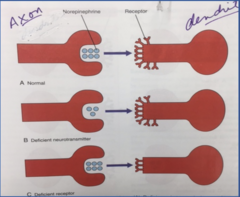
down regulation
target cells lose receptors in response to the hormone
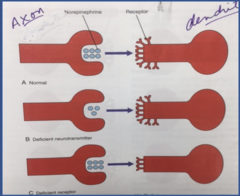
up regulation
target cells form more receptors in response to the hormone
what are the different monoamines
1. Dopamine (DA)
2. Serotonin (5-HT) (SE)
3. Norepinephrine (NE)
4. Histamine (H)
what are the different amino acids
1. Glutamate (+) - excitatory
2. GABA (gamma - Aminobutyric acid) (-) - inhibitory
what are the different peptides
1. Endogenous Opioids
2. Substance P
3. Melatonin
what is a cholinergic
1. acetylcholine
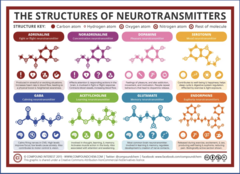
structures of neurotransmitters
Which Neurotransmitters are dysregulated in Depression?
a. Histamine and Melatonin
b. Norepinephrine and Epinephrine
c. Serotonin and Norepinephrine
d. Dopamine and Histamine
c. Serotonin and Norepinephrine
Which part of the brain is associated with Insight, decision-making, motivation, judgment Voluntary motor ability?
a. Occipital Lobe
b. Parietal Lobe
c. Frontal Lobe
d. Temporal Lobe
c. Frontal Lobe
The study of the interaction between the nervous system and the endocrine system is known as ...
Neuroendocrinology
a collection of glands that secrete hormones (50) directly into the circulatory system, effects are slow and prolonged as opposed to the nervous system!
endocrine system
When there is an alteration in the functioning of the brain, the ___________ _________ (master gland) is directly affected by way of the hypothalamus
pituitary gland
A decreased level of thyroid hormone results in a lowered basal metabolic rate and is indicated in ....
depressive disorders
An increased level of thyroid hormone is indicated in...
manic episodes or psychosis
Increased cortisol may be related to ....
associated with dysfunction of the adrenal cortex and is commonly observed in both Addison's Disease and Cushing's Syndrome
depression
Healthy functioning essential to well-being
When suppressed, the body becomes vulnerable
Conversely, when overly responsive it launches an autoimmune attack against specific organs
Decreased amounts of adrenocorticotropic hormone may result in a less efficient stress response
When stress is prolonged, the adrenal cortex is stimulated by adrenocorticotropic hormone (ACTH) to release cortisol, "the stress hormone"
immune system function
slows down the immune system, freeing the energy dedicated for immune functions to flow into "fight or Flight" reactions
Cortisol
are controlled by a biological, internal clock
Circadian rhythms
Rhythm pattern disturbances are well documented in __________ ______________ and ______________ (dysregulate Norepinephrine and Serotonin)
Bipolar Disorder and Depression
can interfere with the circadian rhythm (sedative-hypnotics and psychostimulants)
Psychotropic medications
Familiar and genetic factors under most psychiatric disorders. It is believed that .....
multiple genes rather than single genes are causative factors
genetic variations can lead to altered drug responses in different individuals and cultural groups
Pharmacogenetics
a psychobiological process similar to the seizure phenomenon. The limbic system is the recipient of repeated, daily subthreshold electrical stimulation, leading to an increased responsiveness to stable low doses of the stimulations over time.
proposed to explain the recurrent nature of several neurobiological disorders including depression, bipolar disorder, chemical dependency, schizophrenia and others
Kindling
what is the result of kindling
1. Covert seizure like activity
2. A lowered seizure threshold
3. Eventually the client becomes so sensitive that seizures occur from a milder stimulus or even in the absence of any stimulus
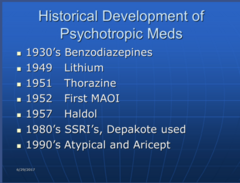
historical development of psychotropic meds
what is the registered nurses role in Psychopharmacology
1. Patient assessment
2. Coordination of treatment modalities
3. Drug administration
4. Monitoring drug effects (blood levels)
5. Medication education
what is the advanced practice nurse practitioner role in Psychopharmacology
1. Drug maintenance programs
2. Clinical research trials
3. Prescriptive authority
Psychotropic medications
are not intended to 'cure' mental illness
The ideal psychiatric drug relieves mental symptoms without ...
inducing unwanted mental effects
what do most psychotropic drugs do
Increase, decrease, or stabilize the activity of neurotransmitters
how the drug affects an organ
- Action of the drug on the person
-- Type of changes produced
-- Molecular effects (reuptake inhibited)
Pharmacodynamics
how the organ affects the drug
- Action of the person on the drug (ADME)
-- How is the drug absorbed/distributed/ metabolized/ excreted
-- Determines blood level and dosing schedule
Pharmacokinetics
Hypothyroidism can lead to which of the following disorders?
a. Depression
b. Mania
c. Psychosis
d. Insomnia
a. Depression
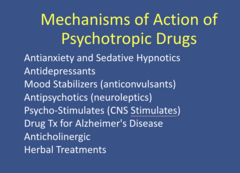
Mechanisms of Action of Psychotropic Drugs
action: potentiate and promote the activity of GABA
Antianxiety:
Alprazolam (Xanax)
Alprazolam (Niravam)
Chlordiazepoxide (Librium)
Clonazepam (Klonopin)
Diazepam (Valium)
Lorazepam (Ativan)***
Oxazepam (Serax)
Clorazepate (Tranxene)
Sedative-Hypnotics:
Estazolam (Prosom)
Flurazepam (Dalmane)
Temazepam (Restoril)
Triazolam (Halcion)
Quazepam (Doral)
benzodiazepines
what do we use benzodiazepines (LORAZEPAM - ATIVAN) for
(work quickly!)
1. PTSD
2. anxiety disorders
3. anxiety
4. skeletal muscle relaxation
5. ETOH withdrawal
6. panic disorders
7. insomnia (sedative/hypnotic)
what are the side effects/adverse reactions of benzodiazepines (LORAZEPAM - ATIVAN)
1. addictive potential
2. withdrawal
3. drowsiness, sedation
4. Ataxia (impaired coordination) dizziness
5. feelings of detachment (may aggravate in depressed people)
6. increase irritability or hostility
7. tolerance, dependency, rebound 7. insomnia/anxiety
what are the very important things to remember about benzodiazepines (LORAZEPAM - ATIVAN)
1. Tolerance!!!!
2. Taper to prevent withdrawal
3. Romazicon (flumazenil)- benzo antagonist
-- Can reverse all benzo actions
-- Used as a treatment for benzo overdose
4. Monitor for sedation
5. Patient teaching
-- alternative methods to decrease anxiety
6. Decrease dose in elderly
7. Half-life: short
8. Not to be Rx in first trimester of pregnancy
9. Interactions with CNS depressants such as alcohol, barbiturates, and opioids can cause respiratory depression!
10. Contraindicated in patients with hx of ETOH abuse
Short-acting sedative-hypnotic sleep agents ("Z-hypnotics"):
Zolpidem (Ambien)
Zaleplon (Sonata)
Eszopiclone (Lunesta)
Action: Act on GABA-benzodiazepine receptor complex
Use: Sleep
Advantages:
1. Quick on-set with short half-life
2. Non-addictive
3. No resp. depression
4. Few rebound symptoms (e.g., insomnia, anxiety)
Short acting sedative hypnotic drugs (non-benzodiazepines)
Melatonin receptor agonists:
Ramelteon (Rozerem)
Doxepin (Silenor)
ADVANTAGES:
1. Nonaddictive
2. Not a muscle relaxer nor a an anticonvulsant nor a sedative
3. Does not worsen depressive symptoms
4. No abuse potential
Antianxiety and Hypnotic Drugs (non-benzodiazepines)
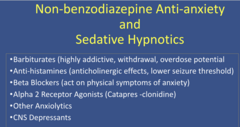
Non-benzodiazepine Anti-anxiety and Sedative Hypnotics
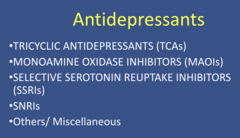
antidepressants
Although antidepressants are safe and effective for many people, they may be risky for ...
children, teens, and young adults.
A "black box" warning—the most serious type of warning that a prescription can carry—has been added to the labels of ...
antidepressants.
The black box labels now warn that antidepressants may cause some people to have ....
For this reason, anyone taking an antidepressant should be monitored closely, especially when they first start taking the medication.
suicidal thoughts or make suicide attempts
Uses: depression, anxiety and/or panic attacks, OCD, chronic pain, PMS, sleep, ADHD, nocturnal enuresis, school phobias/social anxiety
(Serotonin, NE, Dopamine)
Drugs:
Nortriptyline (Pamelor)
Amitriptyline (Elavil)
Imipramine (Tofranil)
Tricyclic antidepressants (TCAs): antidepressant drugs
what are the side effects of tricyclic antidepressants
1. Sedation and weight gain most common!
2. orthostatic hypotension
3. anticholinergic side effects
4. tremors, restlessness, insomnia, N&V
5. blood dyscrasias, cardiotoxicity, heart block
6. photosensitivity
what are anticholinergic side effects
1. dry mouth
2. urinary retention
3. constipation
4. blurred vision
5. weight gain
6. sedation
what are some important things to note about tricyclic antidepressants
1. Monitor for suicidal ideation (especially during initial therapy!) Black Box Warning!
2. High overdose potential!!!
3. ECG - (heart block, cardiac problems)
4. Orthostatic blood pressures
5. To discontinue - taper dose
6. Starting slowly may limit sedative effects
7. Sedation - give dose at bedtime
8. Rx for dry mouth, constipation, etc.
Action: Inhibit serotonin reuptake, allowing more serotonin to stay in the synaptic gap!
Drugs:
Fluoxetine (Prozac)
Sertraline (Zoloft)
Paroxetine (Paxil)
Citalopram (Celexa)
Escitalopram (Lexapro)
Fluvoxamine (Luvox)
selective serotonin reuptake inhibitors (SSRIs) - antidepressant drugs
what should you monitor for SSRIs
Monitor for suicidal ideation (especially during initial therapy!) Black Box Warning!
what are the most common side effects of SSRIs
1. AKATHISIA, AGITATION, INSOMNIA
2. HA
3. GI DISTURBANCES
- nausea (take with food), anorexia, weight loss
4. SEXUAL DYSFUNCTION
- decreased sex drive
- difficulty achieving orgasm or erection
- RX-switch to another SSRI/drug holidays
serotonin syndrome
Can begin 2 to 72 hr after starting treatment and can be lethal.
what are the manifestations of serotonin syndrome
1. Confusion, agitation, poor concentration, hostility
2. Disorientation, hallucinations, delirium
3. Seizures leading to status epilepticus
4. Tachycardia leading to cardiovascular shock
5. Labile blood pressure, diaphoresis
6. Fever leading to hyperpyrexia
7. Incoordination, hyperreflexia
8. Nausea, vomiting, diarrhea, abdominal pain
9. Coma leading to apnea (and death in severe cases)
what are the two most important pieces of client education when it comes to serotonin syndrome
1. Observe for manifestations. If any occur, withhold the medication and notify the prescriber.
2. D/C MAOI 2 weeks prior to SSRI/TCA (determined by half-life of the MAOI) D/C SSRI 2 weeks prior to MAOI (5-6weeks for Prozac)
drugs:
Venlafaxine (Effexor)
Desvenlafaxine (Pristiq)
Duloxetine (Cymbalta)
side effect: Increases Blood pressure and pulse
Serotonin-norepinephrine reuptake inhibitors (SNRIs) - antidepressant drugs
Drug:
Mirtazapine (Remeron)
Serotonin-norepinephrine dis-inhibitors (SNDIs) - antidepressant drugs
Drugs:
Isocarboxazid (Marplan)
Phenelzine (Nardil)
Tranylcypromine (Parnate)
Selegiline (Emsam) (First transdermal patch delivering medication systemically over 24 h period
Tyramine containing foods to avoid:
- aged cheese
- fermented or aged protein, meat or fish
- pickled or smoked foods
- some wines, draft beer
- yeast or protein extracts
- spoiled or overripe fruit
- Monosodium glutamate (MSG)
- Beef and chicken liver
Monoamine oxidase inhibitors (MAOIs) - antidepressant drugs
Adverse reactions related to patient on MAOIs eating tyramine-containing foods or taking certain medications.
MAOIs interfere with the metabolism of tyramine, causing increased NE
Nursing implications
1. **HOLD DOSE
2. elevate head
3. IM chlorpromazine (Thorazine)
4. IV phentolamine (Regitime- alpha blocker)
5. external cooling techniques
6. evaluate diet - diet teaching
hypertensive crisis
drug:
Bupropion (Wellbutrin)
Does not cause sexual side effects
Avoid Medication with patients with a history of seizures.
Norepinephrine and Dopamine Reuptake Inhibitor. - antidepressant drugs
other antidepressants
drugs:
Vilazodone (Viibryd)
Trazodone (Oleptro)
A patient with a history of recent alcohol abuse asks you to give them a medication for their anxiety. Which medication should be avoided and why?
a. Wellbutrin (Bupropion)
b. Prozac (Fluoxetine)
c. Ativan (Lorazepam)
d. Effexor (Venlafaxine)
c. Ativan (Lorazepam)
You are caring for a patient who was recently prescribed medication to treat their depression. The patient reports having significant sexual side effects. Which of the following statements regarding your patient are true?
a. SSRIs can cause sexual side effects
b. SNRIs can cause sexual side effects
c. Wellbutrin is known to cause sexual side effects
d. Antidepressants are not known to cause sexual side effects
a. SSRIs can cause sexual side effects
drug:
Lithium
USES
1. acute episodes of mania and hypomania
2. recurrent bipolar illness
3. other disorders with an affective component
4. aggressive conduct disorder
Considerations
1. renal function
2. blood level (steady state - usually in 7 days)
3. 0.6 to l.4 mEq/L (above 1.4 is toxic)
4. contraindicated in pregnancy
5. decrease dose in elderly
mood stabilizer
Life-threatening emergency: usually dose related.
N&V, diarrhea, coarse hand tremor, twitching, lethargy, hyperactive deep tendon reflexes, ataxia, tinnitus, vertigo, weakness
Then - fever, decreased urine output, dec. BP, irreg. P, ECG changes, change in LOC, seizures, death.
>1.4 mEq/l
Rx:
1. hold medication
2. VS, including LOC, rectal T
3. protect airway
4. Stat Li blood levels
5. hydration (IV) Remember Lithium binds to H20
causes:
1. Decreased Na intake
2. Diuretic therapy
3. Decreased renal functioning
4. Medical illness
5. Over-dose
6. Fluid and electrolyte loss
7. Non-steroidal anti-inflammatory drug tx
teaching:
1. maintain fluid intake (2-3 quarts / day), and Na intake
divided doses
2. signs of lithium toxicity
3. If pt. forgets a dose, skip dose if longer than 2 hours and take next scheduled dose (do not double-up!)
4. periodic blood levels for maintenance
(q. 3 months for first 6 months then q. 6 months)
5. physical check-up (renal status)
lithium toxicity
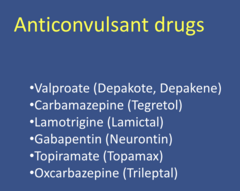
anticonvulsant drugs
drug:
valproate (Depakote; Depakene)
USE: bipolar
SE:thromobcytopenia;hepatic dysfunction
mood stabilizers - anticonvulsants
USES:
1. Schizophrenia and Schizoaffective Disorder
2. organic brain syndrome with psychosis
3. psychotic depression
4. acute manic episodes
5. For vocal tics associated with Tourettes (Haldol, Orap)
6. For aggressiveness, agitation inappropriate behavior in PDD, or severe MR
7. Migraine HA, Emesis, Hiccups
Action:
TYPICAL - DOPAMINE (DA) ANTAGONISTS
ATYPICAL - DA ANTAGONISTS AND 5HT and also blocks SEROTONIN reuptake
***decrease dopamine availability to basal ganglia.
antipsychotics
what are the POSITIVE symptoms of schizophrenia
hallucinations
delusions
bizarre behaviors
disorganization
what are the NEGATIVE symptoms of schizophrenia
poverty of speech
flat affect/anhedonia
dec. social interaction
low motivation
low energy
drug:
Chlorpromazine
(Thorazine)
- Strong antagonists (blocking agents)
- Bind to D2 receptors
- Block attachment of dopamine
- Reduce dopaminergic transmission
- Decrease dopamine= ^acetylcholine ^EPS
Significant side effects
Weight gain
Sedation
Antipsychotic Drugs(first-generation, conventional, typical)
what should the nurse monitor for with antipsychotics
Extrapyramidal Symptoms (EPS) ATI p. 136
Acute dystonia: 1-5 days after 1st dose
Pseudoparkinsonism: 5-30 days after 1st dose
Akathisia (muscle restlessness: 5-60 days after 1st dose
Tardive dyskinesia (TD): late EPS-months to years to develop
MANIFESTATIONS
1. Sudden high fever, Muscle rigidity, Blood pressure fluctuations, Diaphoresis, Tachycardia, Muscle rigidity, Decreased level of consciousness, Coma
NURSING ACTIONS
2. This life‑threatening medical emergency can occur within the first week of treatment or anytime thereafter.
3. Stop antipsychotic medication, Monitor vital signs, Apply cooling blankets, Administer antipyretics, Increase the client's fluid intake.
4. Administer dantrolene or bromocriptine to induce muscle relaxation as ordered
5. Administer medication as prescribed to treat arrhythmias
6. Assist with immediate transfer to an ICU.
7. Wait 2 weeks before resuming therapy
Neuroleptic malignant syndrome (NMS) ATI p. 137
Produce fewer extrapyramidal side effects (EPS)
Target both the negative and positive symptoms
Often chosen as first-line treatment
Dopamine and serotonin (5-HT) antagonists
How can increase the hormone prolactin leading to:
galactorrhea,
gynecomastia
Amenorrhea
low libido
Second-Generation (Atypical) Antipsychotic Drugs
Drugs Less likely to cause EPS and NMS
Drug:
Clozapine (Clozaril): potential fatal side effect of agranulocytosis
Risperidone (Risperdal): highest risk of EPS in 2nd generation, high incidence of galactorrhea
- Risperadal Consta: Long-Acting Injectable
Quetiapine (Seroquel): High sedation
Olanzapine (Zyprexa, Zyprexa Relprevv: Long-Acting Injectable): cardiac implications
Ziprasidone (Geodon): cardiac implications
Paliperidone (Invega):
- Invega Sustenna: Long-Acting Injectable
- Invega: Trinza: Long-Acting Injectable
Iloperidone (Fanapt): high incidence of galactorrhea
Lurasidone (Latuda)
Asenapine (Saphris)
Aripiprazole (Abilify)
Second-Generation (Atypical) Antipsychotic (2)
Why is it important to monitor white blood cell count in patients taking Clozapine (Clozaril)?
agranulocytosis
Your patient has been diagnosed with bipolar disorder. What medication do you expect the patient to be prescribed?
a. Lithium
b. Aripiprazole (Abilify)
c. Clozapine (Clozaril)
d. Ativan (Lorazepam)
a. Lithium
The patient from Question 7 is starting to exhibit the following signs and symptoms: coarse hand tremor, twitching, lethargy, and hyperactive deep tendon reflexes. It is time to give the patient their next dose of Lithium. What is your top priority?
a. Educate the patient on a proper lithium diet
b. Teach patient effective coping skills
c. Call the doctor
d. Hold lithium dose
d. Hold lithium dose
(Block the reuptake of NE and DA)
For attention deficit hyperactivity disorder (ADHD)
Methylphenidate (Ritalin, also Daytrana, a transdermal system) * first line treatment for ADHD in children
Dextroamphetamine (Adderall, Vyvanse)
Intuniv (guanfacine)
use:
ADHD
narcolepsy
treatment resistant depression
geriatric depression
nursing implications
Growth (drug holidays during low stress times)
Anorexia/GI
Insomnia
Stomachache
HA
Newer stimulants:
Quillivant XR (methylphenidate HCl)
Zenzedi (dextroamphetamine sulfate)
Aptensio XR (methylphenidate HCL)
Psycho- Stimulants
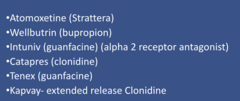
Non-Stimulants for ADHD
For Alzheimer's disease
Some efficacy in slowing the rate of memory loss and improving memory
Donepezil (Aricept)
Tacrine (Cognex)
Galantamaine (Razadyne)
Revastigmine (Exelon)
Memantine (Namenda, Namenda XR)
acetylcholinestererase inhibitors
Major concerns:
Potential long-term effects
-Nerve damage
-Kidney damage
-Liver damage
Possibility of adverse chemical reactions
-With other substances
-With conventional medications (example St. John's wort can cause Serotonin Syndrome with SSRIs)
Herbal Medicine