BIO102-EXAM2
 Call Kai
 Learn
Learn Practice Test
 Spaced Repetition
 Match
Match Flashcards
 Knowt Play
1/17

There's no tags or description
Looks like no tags are added yet.
Name | Mastery | Learn | Test | Matching | Spaced | Call with Kai | Chat |
|---|
No analytics yet
Send a link to your students to track their progress
18 Terms
Prokaryote Def.
single-celled (unicellular)
0.5-10 μm
ubiquitous
may be free-living, symbiotic, and
colonial
Prokaryotes
one circular chromosone not in a membrane
no membranous organelles
divides by binary fission
Eukaryote
paired linear chromosones, in nuclear membrane
many membranous organelles
divides by mitosis
Bacteria
cell wall composed of peptidoglycan
membrane based on fatty acids
some use chlorophyll in photosynthesis
cannot generate methane
sensitive to streptomycin
genes do not contain introns
Archaea
cell wall composed of protein
membrane based on nonfatty acid lipids
do not use chlorophyll
some generate methane
insensitive to streptomycin
genes my contain introns
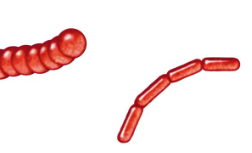
Bacillus
rod/cylinder
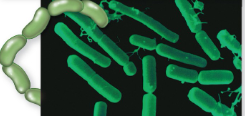
Coccus
spherical
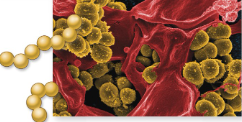
Spiral
Spirillum - rigid
Spirochete - flexible
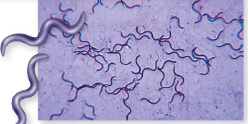
Staphylo-
clusters
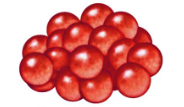
Strepto-
chains
Nucleoid
the region where the DNA resides

Chromosome
circular thread of DNA that contains the cell’s genetic information

Ribosomes
use mRNA to synthesize proteins
made of protein and ribosomal RNA
Plasmids
self replicating circular pieces of DNA apart from the chromosome
carry non-crucial genes
can be transferred among some bacteria by conjugation

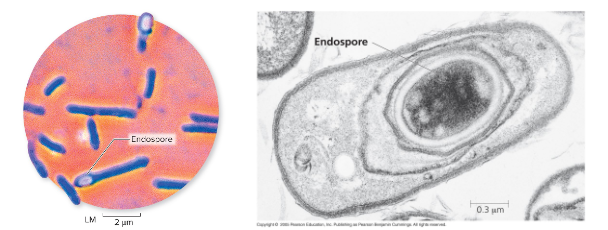
Endospore
metabolically inactive resting cells
produced when nutrients are depleted
resistant to desiccation, heat, chemicals, and radiation
last from years to 1000’s of years
produced by bacillus and clostridium
Cell membrane
outer boundary of the cell; regulates what can enter and exit the cell (selective permeability)
phospholid bilayer that encloses the cytoplasm
integral and transmembrane protein serve various functions

Cell wall
outside the cell membrane; gives the cell its shape and protects it from osmotic pressure
-made of peptidoglycan (in bacteria)
polymer of disaccharides linked by polypeptides

Flagella