quizlet.com/499922421/biochem-exam-2-module-3-quiz-flash-cards/
 Call Kai
 Learn
Learn Practice Test
 Spaced Repetition
 Match
Match Flashcards
 Knowt Play
1/29

There's no tags or description
Looks like no tags are added yet.
Name | Mastery | Learn | Test | Matching | Spaced | Call with Kai | Chat |
|---|
No analytics yet
Send a link to your students to track their progress
30 Terms
Lactose intolerance arises from
A. Bacteria in the intestine that produce toxic metabolites
B. The inability of intestinal enzymes to cleave the lactose
C. A sensitivity to galactose
D. A sensitivity to glucose
E. An allergic reaction to glucose
B. The inability of intestinal enzymes to cleave the lactose
In glycoproteins carbohydrate is most often linked to threonine, asparagine or __________.
A. Serine
B. Lysine
C. Valine
D. Aspartic acid
E. Tyrosine
A. Serine
Under stressful conditions epinephrine is released from the adrenal medulla. The release of epinephrine has which of the following effects on glucose metabolism?
A. Glycogenolysis is stimulated
B. Glycogenesis is inhibited
C. Adenylate cyclase is activated
D. Both A and B are correct
E. All of the above are correct
E. All of the above are correct
The preferred energy source of the brain is __________.
A. Fructose
B. Glucose
C. Arabinose
D. Maltose
E. Sucrose
B. Glucose
Which of the following is not a homoglycan?
A. Cellulose
B. Glycogen
C. Starch
D. Heparin
E. Amylose
D. Heparin
Which of the following carbohydrates is a nonreducing sugar?
A. Glucose
B. Fructose
C. Lactose
D. Sucrose
E. Ribose
D. Sucrose
How many stereoisomers are possible for an aldohexose
A. 4
B. 8
C. 12
D. 16
E. 32
D. 16
The binding of insulin to receptors on the surface of muscle cells stimulates which of the following processes
A. Glycogenolysis
B. Glycogenesis
C. Release of ATP
D. Formation of cyclic AMP
E. Release of glucagon
B. Glycogenesis
The accumulation of AGEs is linked to which of the following diseases?
A. Atherosclerosis
B. Arthritis
C. Diabetes
D. Both A and B are correct
E. All of the above are correct
E. All of the above are correct
Fructose-2,6-bisphosphate
A. Is an indicator of high cellular glucose concentration
B. Is formed by PFK-1
C. Activates aldolase
D. Both A and B are correct
E. All of the above are correct
A. Is an indicator of high cellular glucose concentration
An enzyme family called the _________ catalyzes the phosphorylation of hexoses in the body.
A. Hexolysases
B. Phosphorolysases
C. Hexokinases
D. Glucokinases
E. Phosphofructokinases
C. Hexokinases
Which of the following yields N-acetyl-D-glucosamine on hydrolysis.
A. Cellulose
B. Heparin
C. Chitin
D. Amylopectin
E. Amylose
C. Chitin
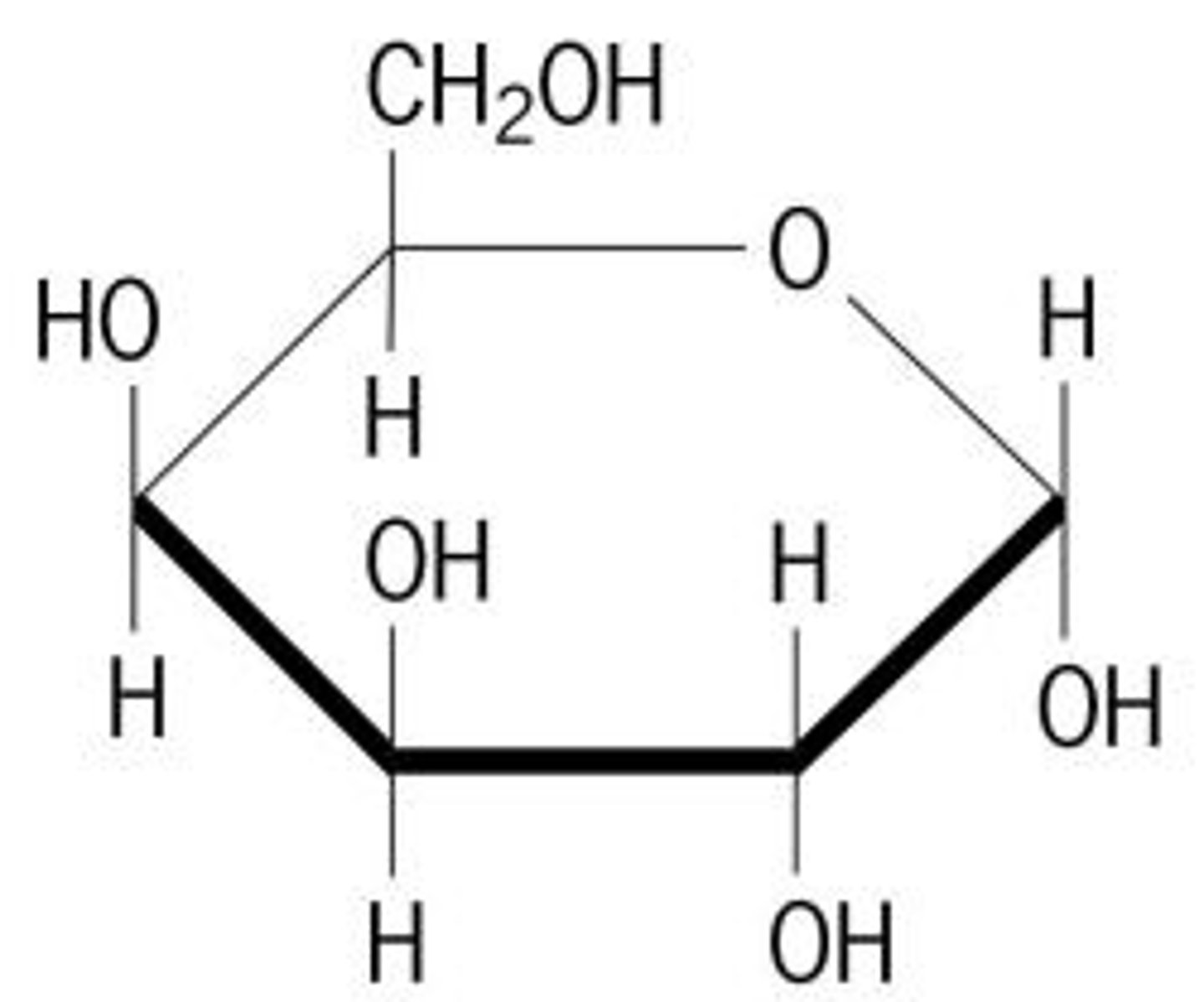
The name of this sugar is...
(see image attached)
A. D-Galactose
B. D-Glucose
C. L-Glucose
D. D-Fructose
E. L-Iduronate
A. D-Galactose
Carbohydrate is thought to enhance the stability of protein molecules by:
A. Changing the protein's shape to better resist denaturation.
B. Protecting the underlying protein from the action of proteolytic enzymes
C. Using hydrogen bonding to increase the stability of the protein
D. Both A and B are correct
E. All of the above are correct
B. Protecting the underlying protein from the action of proteolytic enzymes
A glycosidic link is chemically an _____.
A. Ether
B. Ester
C. Amide
D. Aldehyde
E. Ketone
A. Ether
Name this sugar....
(see image attached)
A. L-Galactose
B. D-Glucose
C. L-Glucose
D. D-Fructose
E. L-Fucose
D. D-Fructose

Cellulose is indigestible to most animals because:
A. Cellulose is not soluble in water
B. Animals lack the enzymes required to hydrolyse the b links of the cellulose
C. Cellulose has no food value and therefore cannot be digested
D. Both A and B are correct
E. None of the above are correct.
B. Animals lack the enzymes required to hydrolyse the b links of the cellulose
Which of the following is required for the conversion of UDP-glucose to glycogen?
A. Glycogen synthase
B. Branching enzyme
C. Glucose phosphorlyase
D. Debranching enzyme
E. Both A and B are correct
E. Both A and B are correct
In the bottom of the flow chart the circles represent molecules involved in a fictitious but actively respiring electron transport chain and arrows show the normal flow between these molecules. A, B, and C represent chemical inhibitors that will block the passing of electrons between molecules. Given the following results after the use of each inhibitor, state the correct order of the molecules in the diagram below.
After inhibitor A:
molecules reduced=cyta, FeS1
molecules oxidized=FADH2, Hemeb4, cyt1a1, FeS2, O2,cytb, UQ
After inhibitor B:
molecules reduced= Hemeb4, FeS1, cyta, FADH2
molecules oxidized=cyta1a1, FeS2, O2, cytb, UQ
After inhibitor C:
molecules reduced=Hemeb4, FeS1, cyta, FADH2, cyt1a1, FeS2, UQ
molecules oxidized=O2, cytb
A. FeS1, cyta, HemeB4, FADH2, cyt1A1, FeS2, UQ, cytb, O2
B. FeS1, cyta, HemeB4, FADH2, cyt1A1, O2,, FeS2, UQ, cytb
C. FeS1, cytb, HemeB4, FADH2, cyt1A1, FeS2, UQ, cyta, O2
D. FeS1, cyta, FADH2, cyt1A1, FeS2, UQ, cytb, O2, HemeB4
A. FeS1, cyta, HemeB4, FADH2, cyt1A1, FeS2, UQ, cytb, O2
Which of the following polysaccharides can bind exceptionally large amounts of water?
A. Cellulose
B. Glycogen
C. Starch
D. Heparin
E. Amylose
D. Heparin
Which of the following sugars contains a b-1,4-linkage?
A. Cellulose
B. Glucose
C. Amylose
D. Sucrose
E. Maltose
A. Cellulose
Glycogen is:
A. Main energy storage molecule of animals
B. Main carbohydrate reserve of animals
C. Main carbohydrate found in seeds
D. A form of plant starch
E. Both C and D are correct
B. Main carbohydrate reserve of animals
Glycoconjugates result from the covalent linkage of carbohydrate to proteins or _________
A. Amino acids
B. Lipids
C. Nucleotides
D. Both A and B are correct
E. None of the above are correct
B. lipids
Both glycogenesis and glycogenolysis are controlled primarily by the interplay between the two hormones insulin and ________.
A. Glycogen synthetase
B. Glucagon
C. Fructose kinase
D. Glucose hydrolyase
E. Pentose kinase
B. Glucagon
The most abundant organic substance on earth is ______.
A. Starch
B. Cellulose
C. Sucrose
D. Glucose
E. None of the above
B. cellulose
The presence of which of the following molecules indicates that the cell has sufficient energy reserves?
A. ATP
B. Citrate
C. ADP
D. Fructose-1,6-biphosphate
E. Both A and B are correct
E. Both A and B are correct
The three most common homoglycans found in nature are cellulose, starch and __________.
A. Amylose
B. Lactose
C. Fructose
D. Glycogen
E. Sucrose
D. Glycogen
In glycolysis ________ moles of NADH are produced per mole of glucose consumed
A. 1
B. 2
C. 3
D. 4
E. 5
B. 2
Reaction of an amino acid with C1 of a cyclic aldose produces which of the following linkages?
A. Ester
B. Amide
C. Glycosidic
D. Imine
E. Schiff base
C. Glycosidic
Glycoproteins lack which of the following groups typically found in proteoglycans?
A. Uronic acids
B. Sulfate groups
C. N-Glycosidic linkages
D. Both A and B are correct
E. All of the above are correct
D. Both A and B are correct