3.1.11 Electrode potentials & electrochemical cells
 Call Kai
 Learn
Learn Practice Test
 Spaced Repetition
 Match
Match Flashcards
 Knowt Play
1/37

There's no tags or description
Looks like no tags are added yet.
Name | Mastery | Learn | Test | Matching | Spaced | Call with Kai | Chat |
|---|
No analytics yet
Send a link to your students to track their progress
38 Terms
What are electrochemical cells?
Two different metals dipped in salt solutions of their own ions & connected by a wire (the external circuit)
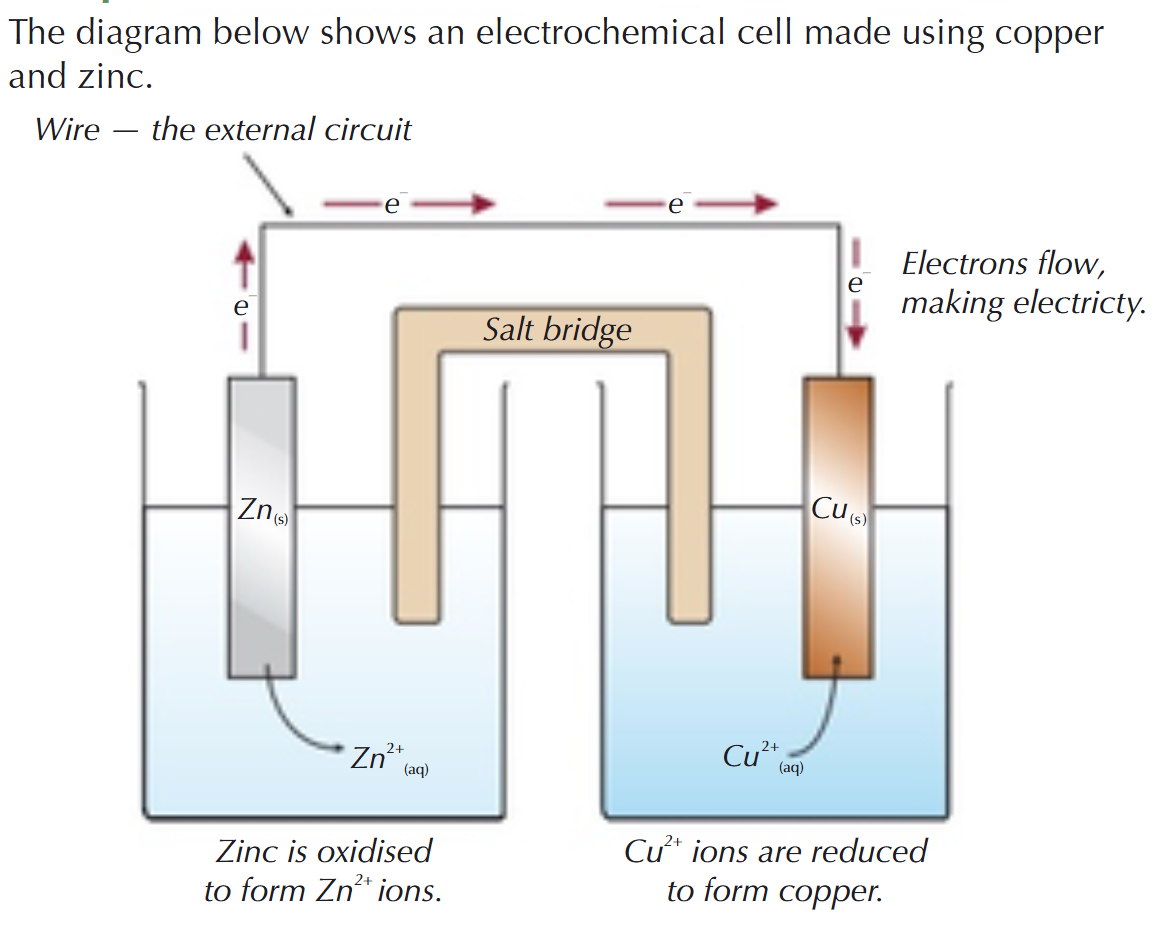
Describe this electrochemical cell
Copper electrode is dipped in a solution of Cu2+(aq) ions & a zinc electrode is dipped in a solution of Zn2+(aq) ions
Zinc loses electrons more easily than copper, so in the left half-cell, zinc is oxidised to Zn2+(aq) ions, releasing electrons into the external circuit
In the right half-cell, the same number of electrons are taken from the external circuit, reducing the Cu2+ ions to copper atoms
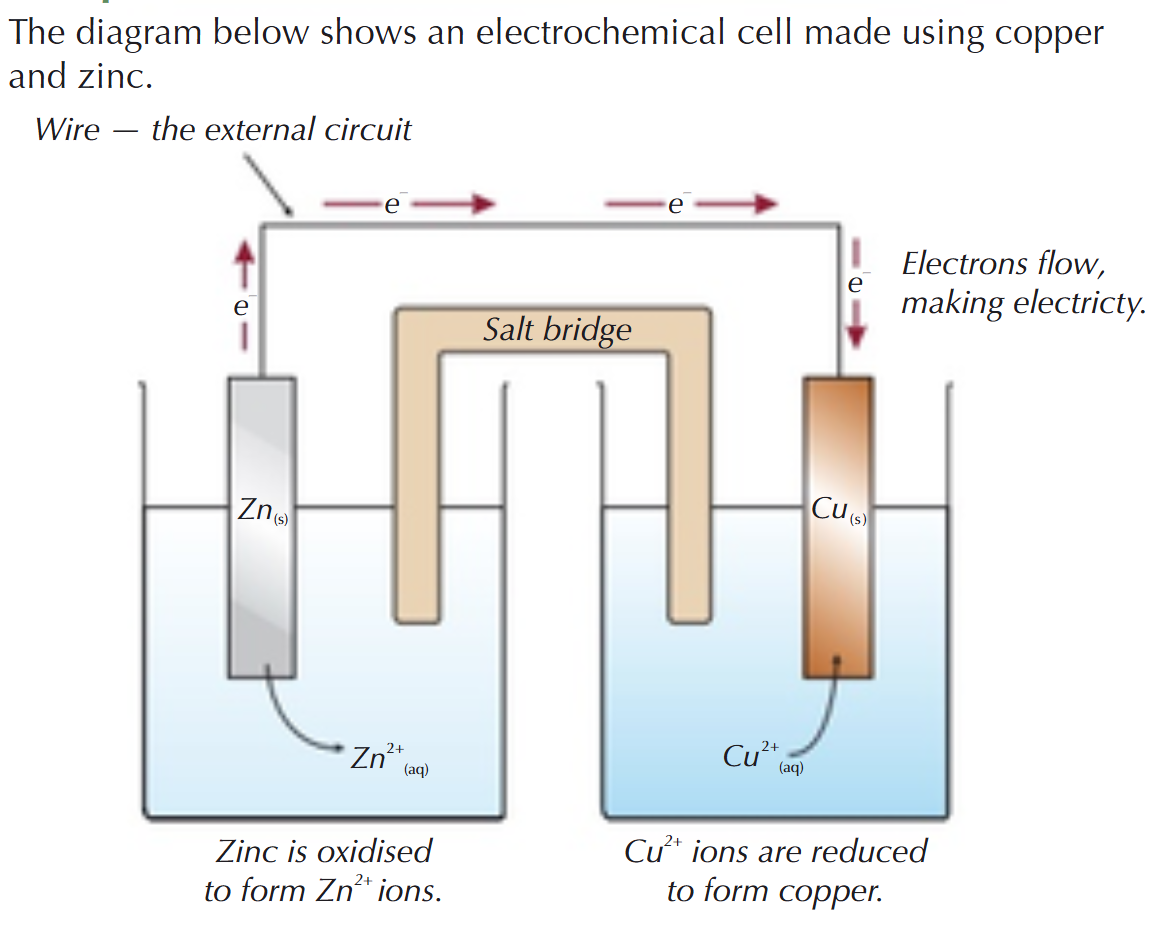
What connects the two solutions in an electrochemical cell?
A salt bridge:
a strip of filter paper soaked in potassium nitrate solution, KNO3(aq)
Allows the ions to flow between the half-cells & completes the circuit (balances out the charges)
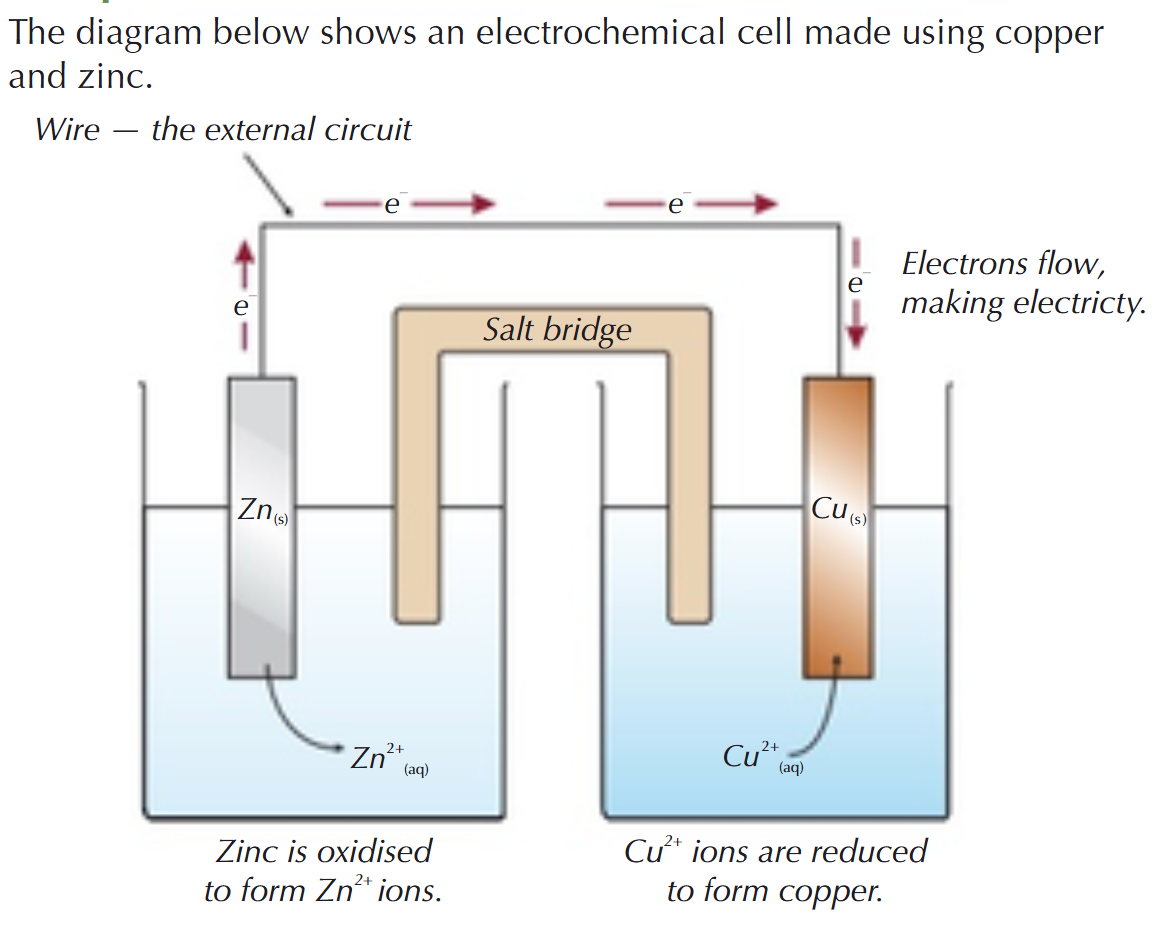
Which way do electrons flow through the wire in an electrochemical cell?
From most reactive metal to the least reactive metal
How is the voltage/cell potential between two half-cells measured?
By putting a voltmeter in the external circuit
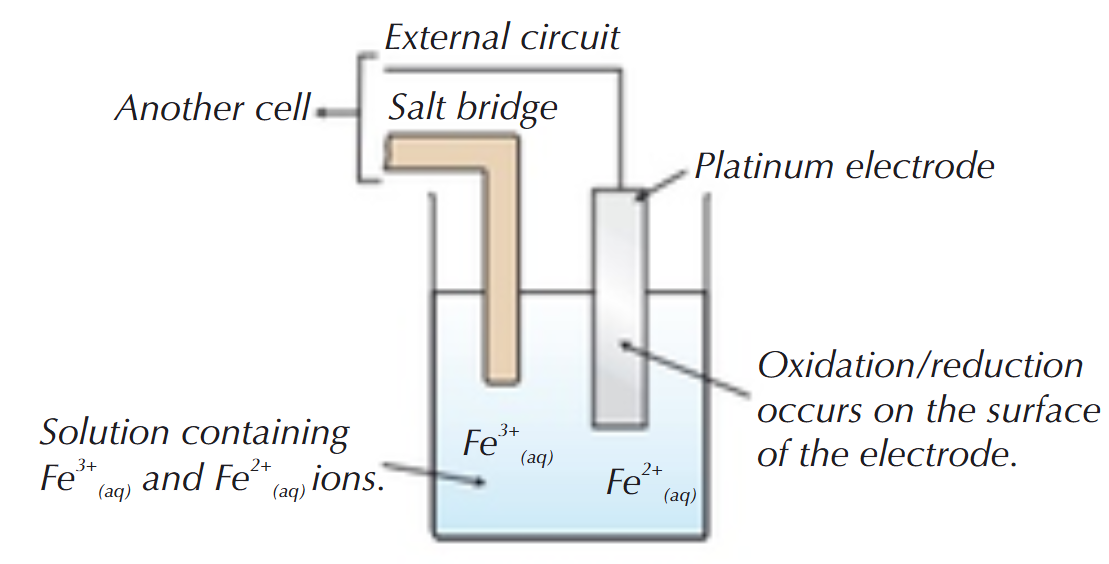
Describe this half-cell
A half-cell with solutions of two aqueous ions of the same element:
a platinum electrode is dipped into the solution, as it is inert & conducts electricity
conversion from Fe2+(aq) to Fe3+(aq), or vice versa, happens on the surface of the electrode
the direction of the conversion depends on the other half-cell in the circuit
if the other cell contains a metal that is less reactive than iron, then Fe2+ will be oxidised to Fe3+ at the electrode
if the other cell contains a more reactive metal, Fe3+ will be reduced to Fe2+ at the electrode
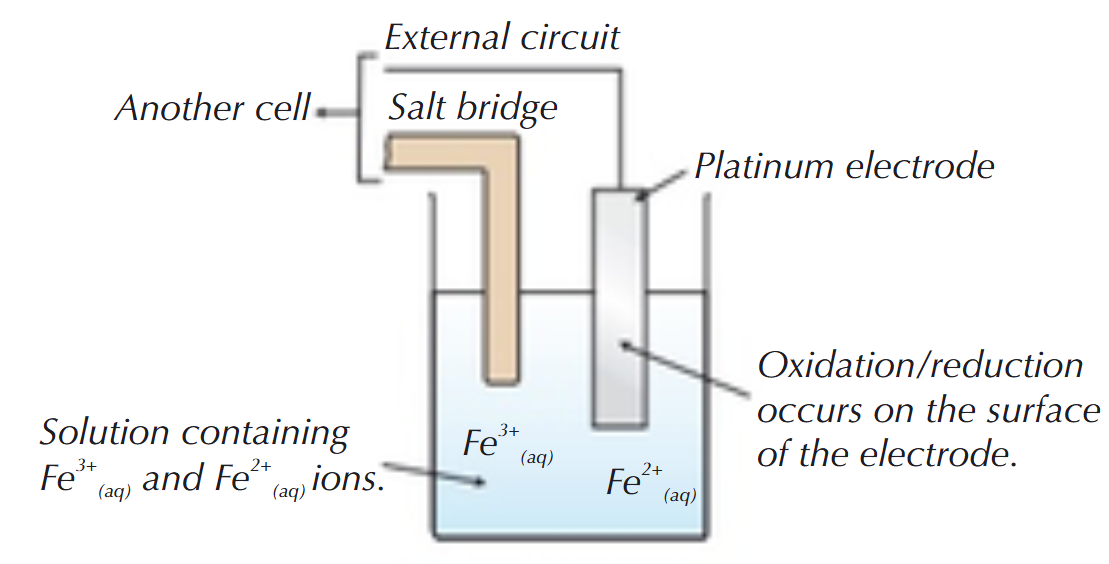
The reactions that occur at each electrode in a cell are reversible. What determines which direction each reactions goes in?
How easily each metal is oxidised (measured using electrode potentials):
a metal that’s easily oxidised has a very negative electrode potential
a metal that’s harder to oxidise has a more positive electrode potential
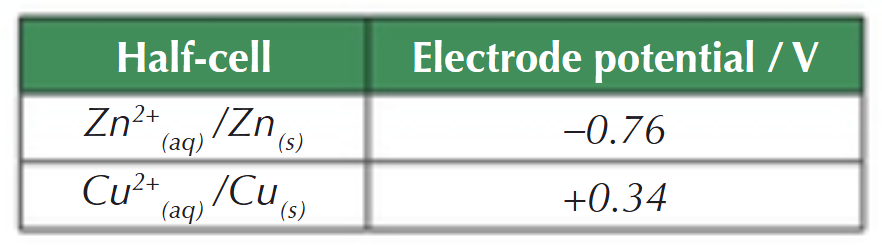
Which metals are reduced/oxidised & why?
Oxidised: zinc (zinc half-cell has a more negative electrode potential)
Reduced: copper (copper half-cell has a more positive electrode potential)
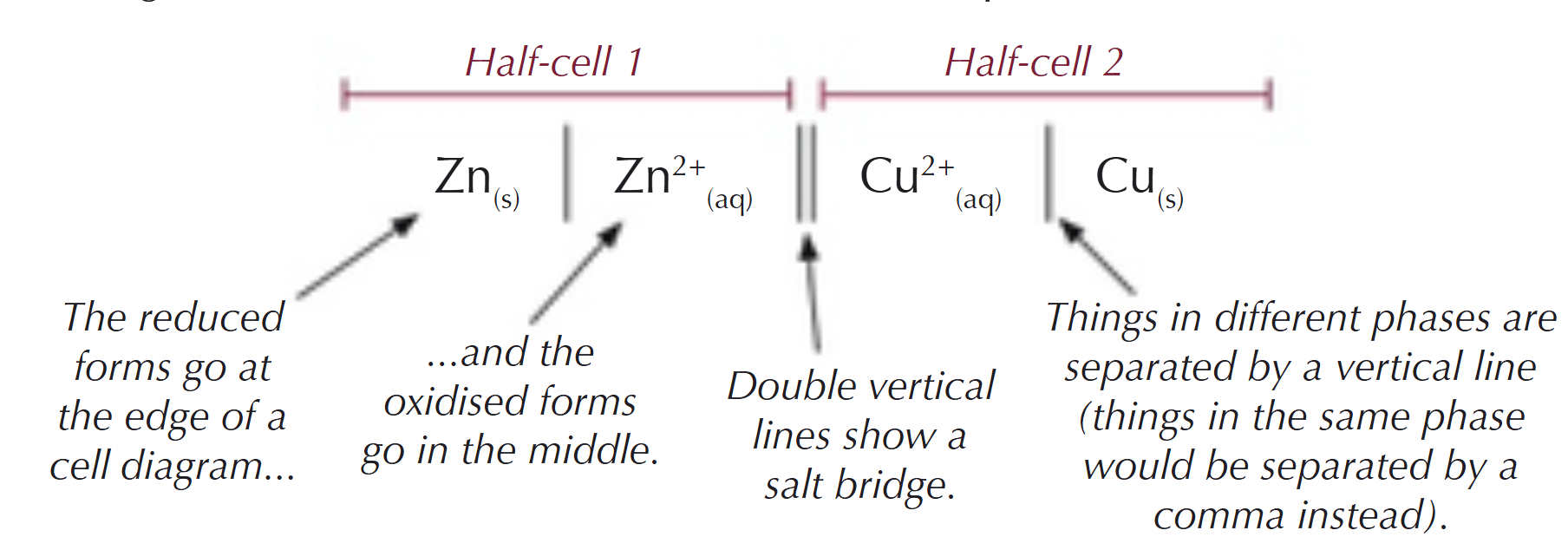
How are electrochemical cells drawn (conventional representation) ?
ROOR → Reduced I Oxidised II Oxidised I Reduced:
Use the electrode potentials to work out which half-cell goes on the left & which goes on the right
Write out the left-hand half-equation as an oxidation reaction. Then write out the right-hand half-equation as a reduction reaction
Write out the reactants & products of the oxidation reaction, followed by the reactants & products of the reduction reaction
Add in a salt bridge by drawing two vertical lines between the half-cells
Draw a vertical line between any reagents that are in different phases. Put a comma between any reagents that are in the same phase
If either of the half-cells have a separate electrode (e.g. platinum), put that on the outside & separate it from the half-cell with a vertical line
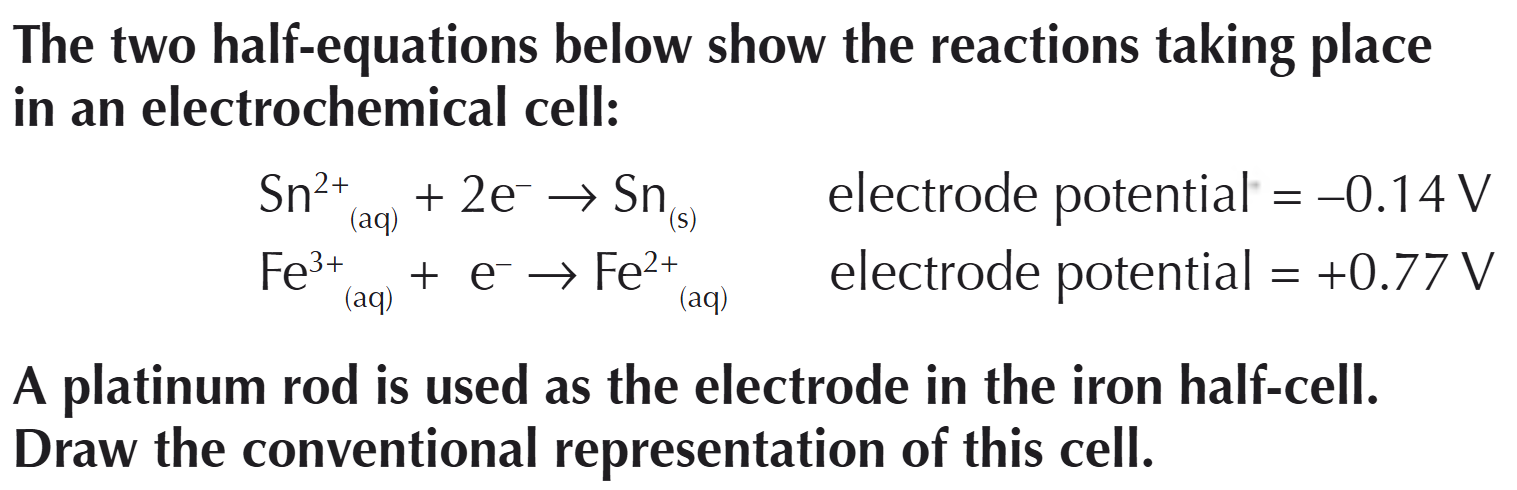
Draw the conventional representation of this electrochemical cell


Write half-equations for the reactions occurring at the positive & negative electrodes of this cell
Positive electrode is on the right-hand side & the negative electrode is on the left-hand side:
reduction occurs at the positive electrode: Pb2+ (aq) + 2e- → Pb (s)
oxidation occurs at the negative electrode: Al3+ (aq) → Al (s) + 3e-
remember → think “NO PRoblem”
What is the equation to calculate the cell potential (Eθcell) ?
(will always be a positive voltage → more negative Eθ value is being subtracted from the more positive Eθ value)


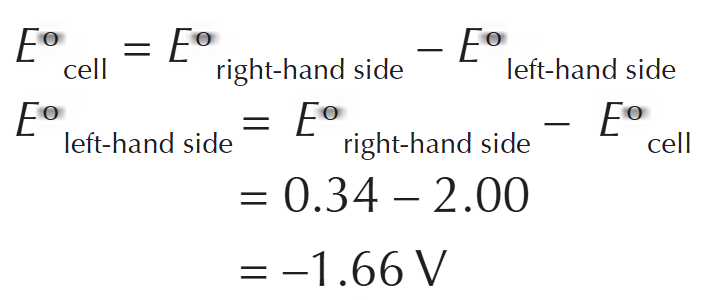
Calculate the standard electrode potential of the aluminium half-cell
What factors affect the electrode potential?
Temperature, pressure & concentration:
half-cell reactions are reversible → equilibrium position is affected by same changes just like any other reversible reaction
Changing the equilibrium position changes the cell potential. What is done to get around this issue?
Standard conditions are used to measure electrode potentials:
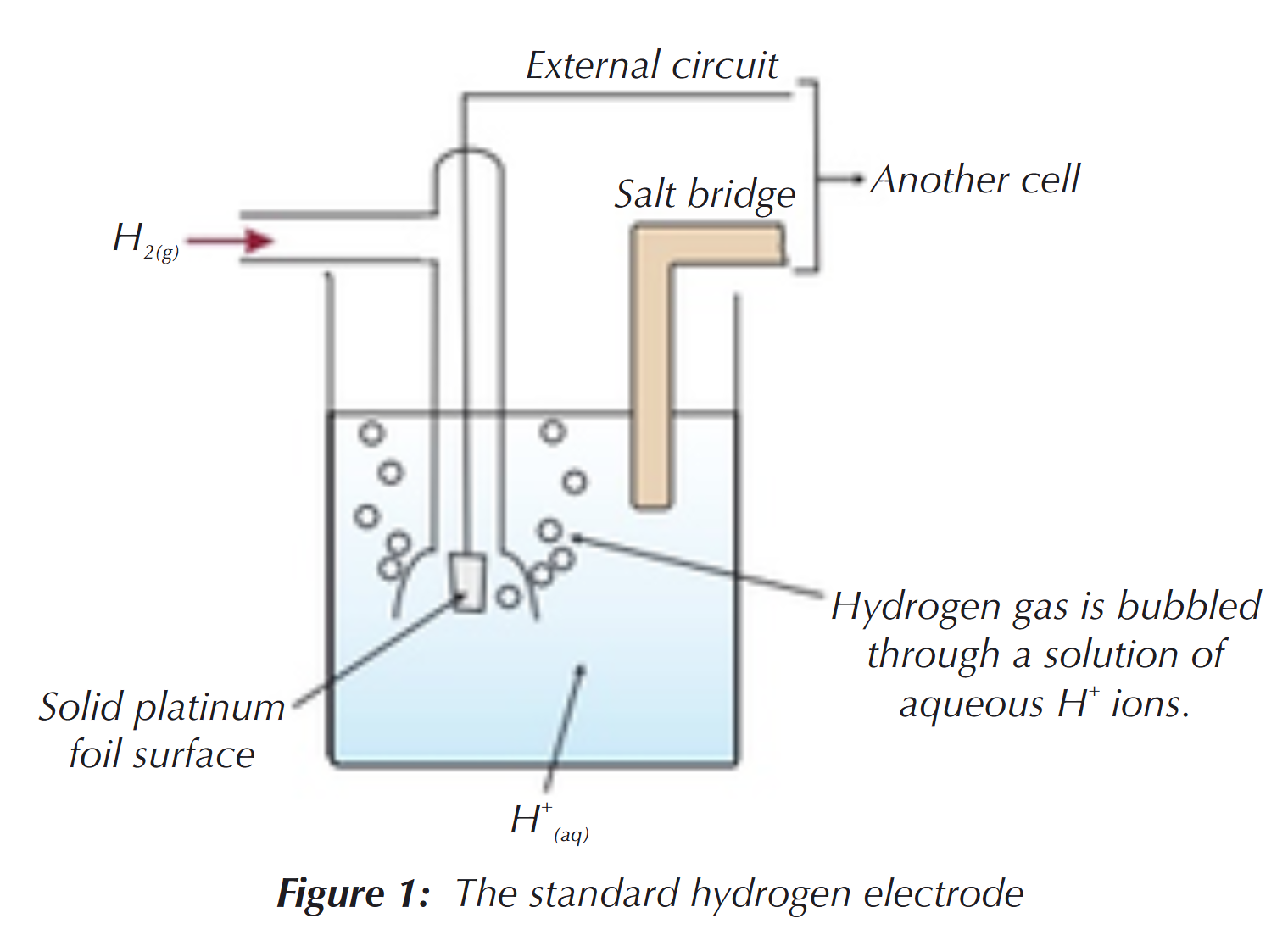
you measure the electrode potential of a half-cell against a standard hydrogen electrode
hydrogen gas is bubbled through a solution of aqueous H+ ions
a platinum electrode is used as a platform for the oxidation/reduction reactions
What are the standard conditions to be used when measuring electrode potentials using the standard hydrogen electrode?
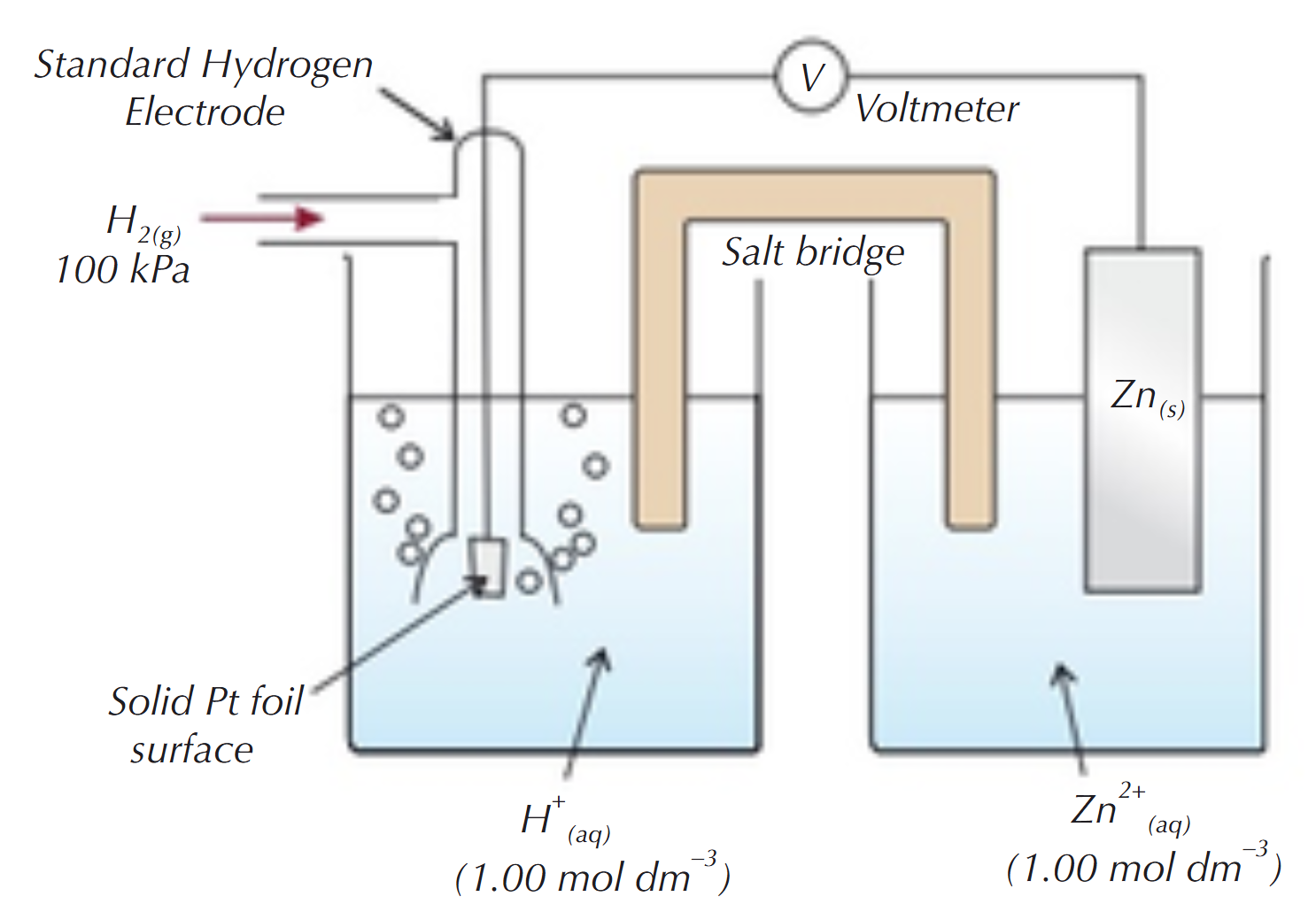
Any solutions of ions (H+) must have a concentration of 1.00 moldm-3 (e.g. acid, such as HCl)
Temperature must be 298K
Pressure must be 100kPa
What is the standard electrode potential of a half-cell?
The voltage measured under standard conditions when the half-cell is connected to a standard hydrogen electrode
What is the electrode potential of the standard hydrogen electrode half-cell?
0.00V
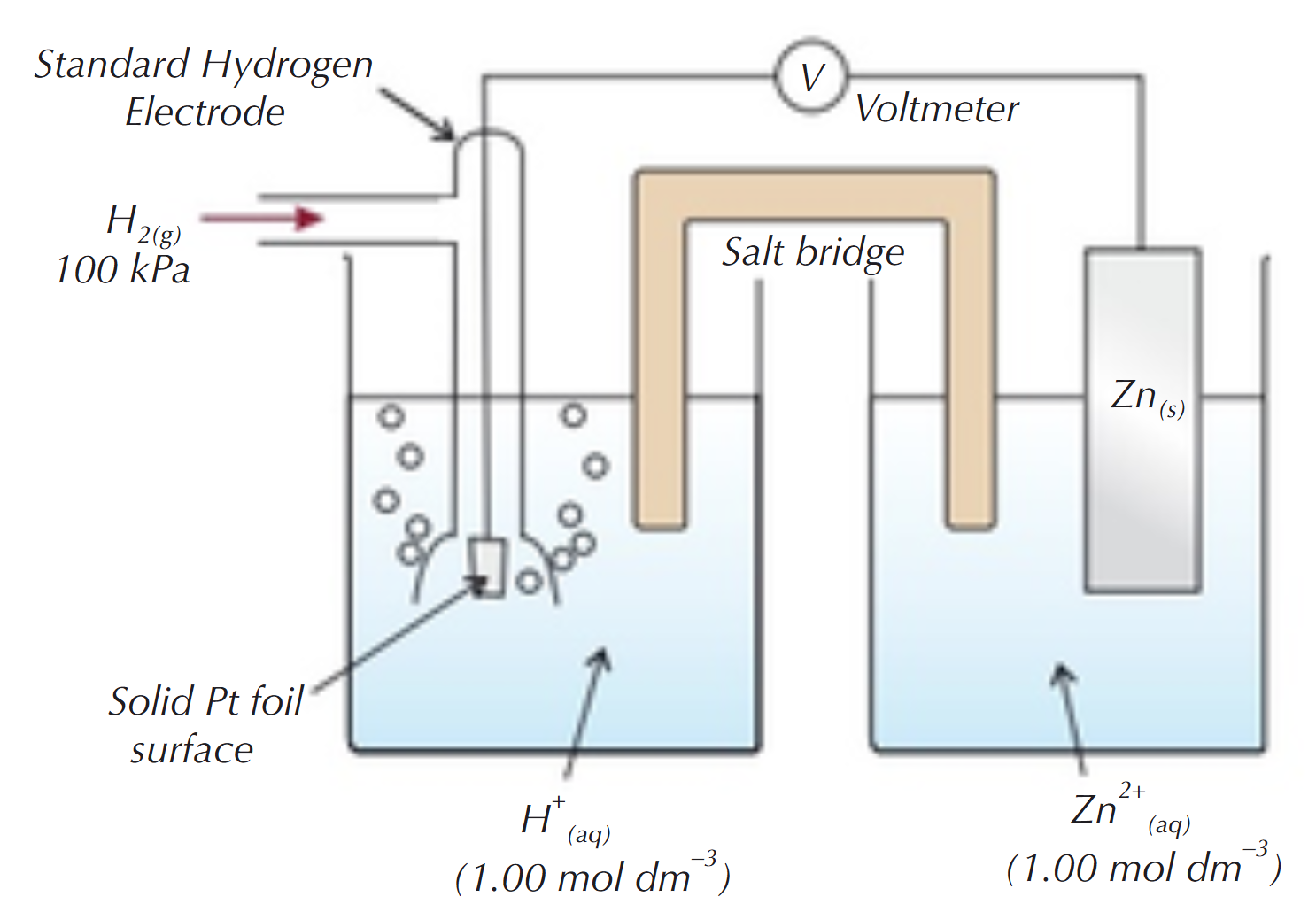
What is the conventional representation of this electrochemical cell?

What is an electrochemical series?
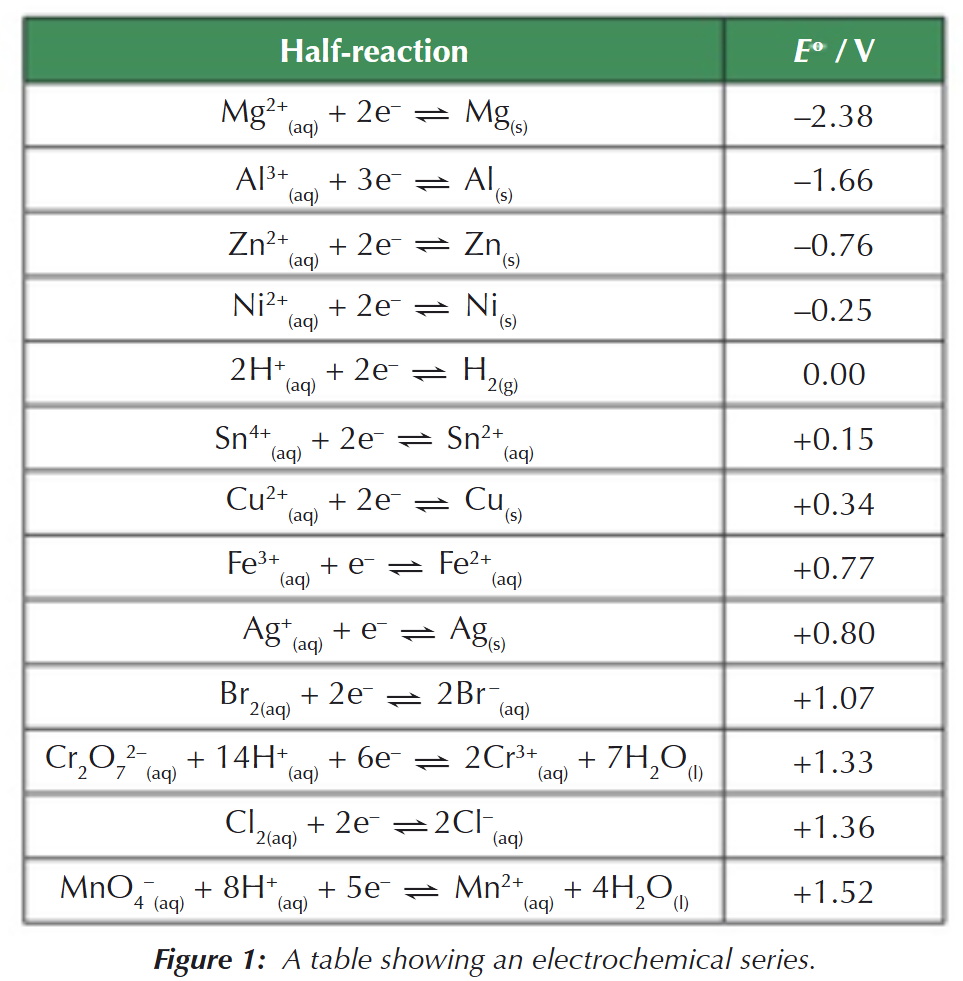
A list of electrode potentials in numerical order for different electrochemical cells:
electrode potentials are written starting from the most negative & going down to the most positive
half-equations are always written as reduction reactions
oxidising agents are on the left & reducing agents are on the right
best reducer is always the most negative (think if it’s negative, it’s reduced) & best oxidiser is always the most positive
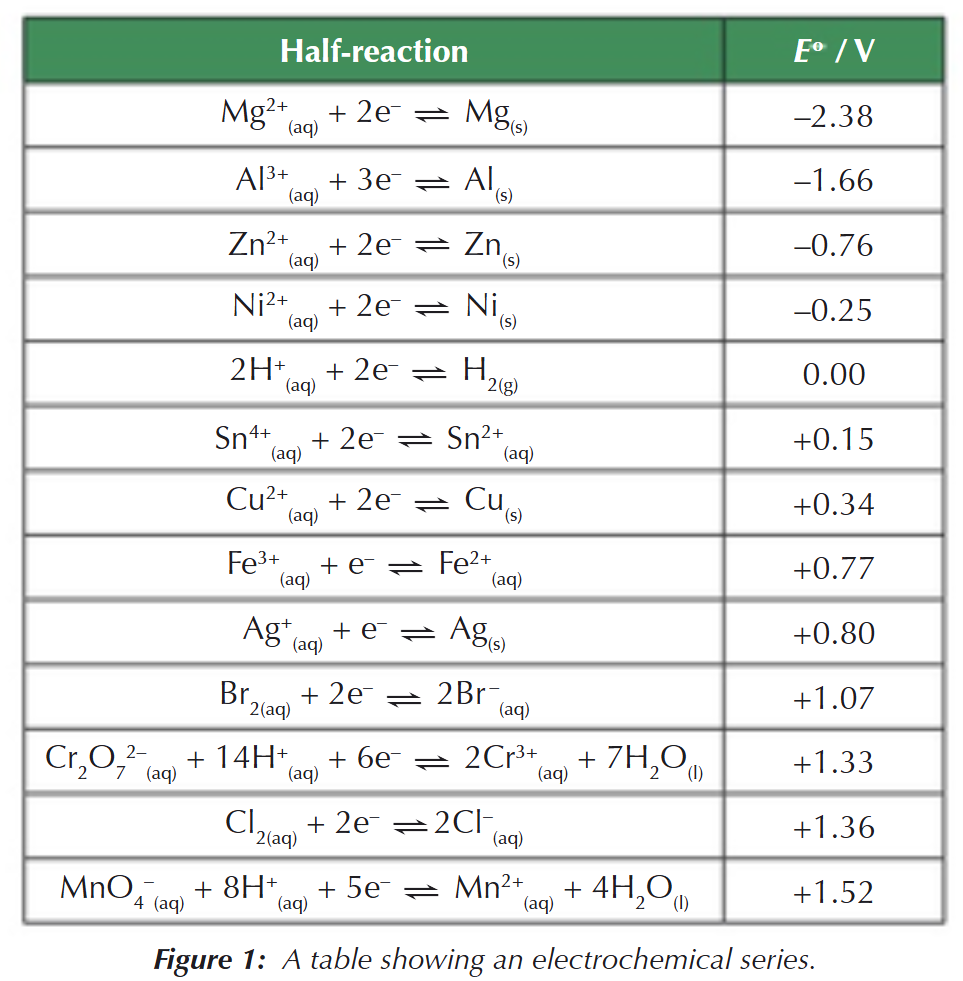
When two half-equations are put together in an electrochemical cell, which directions do they go in?
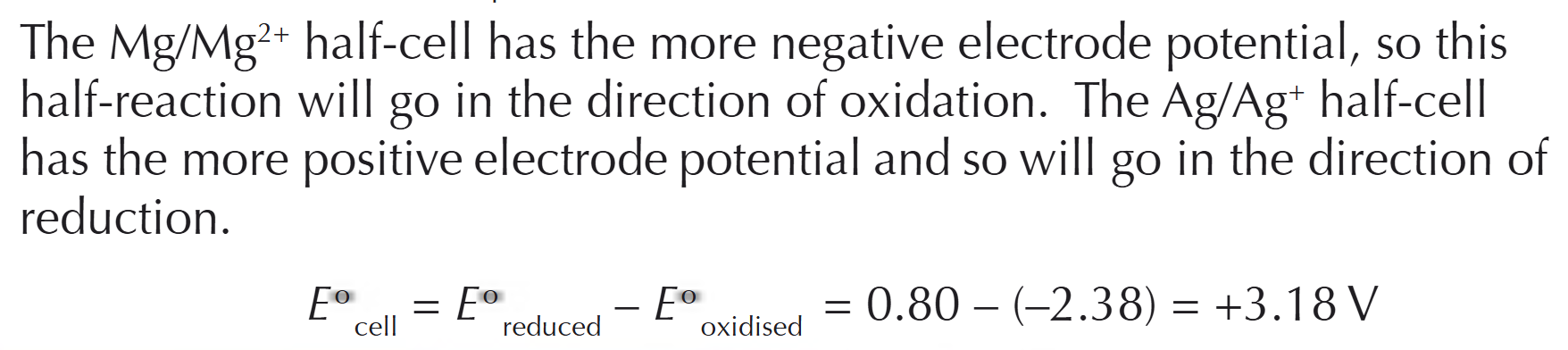
The half-equation with the more negative electrode potential goes in the direction of oxidation
The half-equation with the more positive electrode potential goes in the direction of reduction
What is the equation to calculate the standard cell potential when two half-cell are connected together?
Work out which half-equation is going in the direction of oxidation & which half-equation is going in the direction of reduction
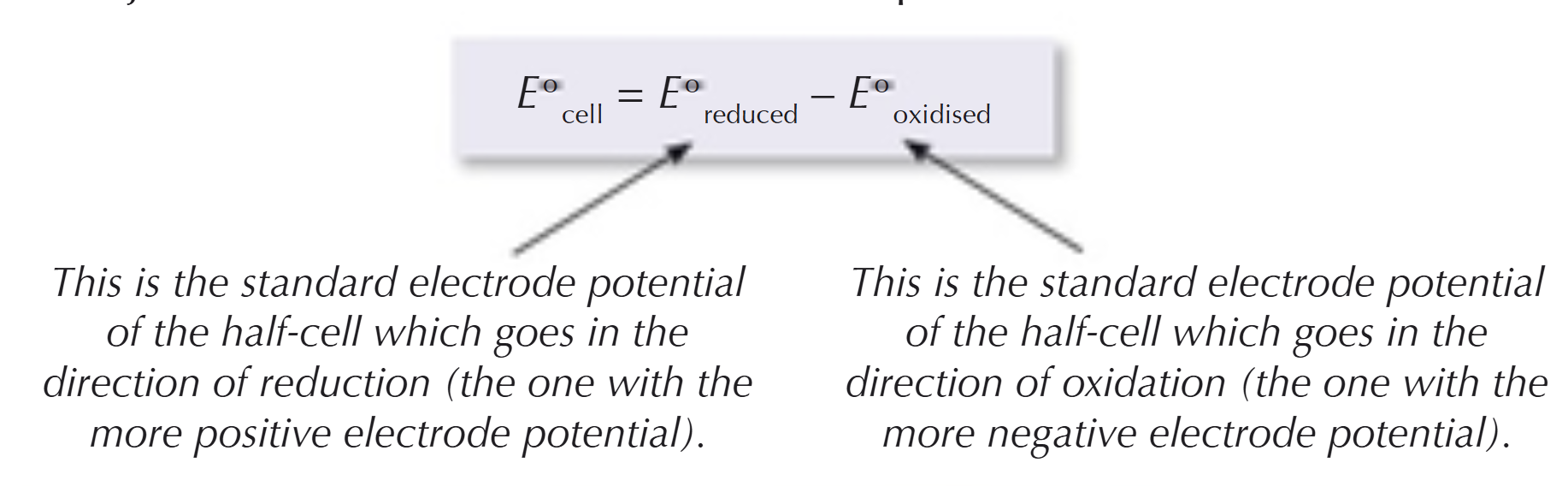

Calculate the cell potential of an Mg/Ag electrochemical cell using the two redox reaction equations
How can electrode potentials be used to predict whether a redox reaction will happen & which direction it will go in?
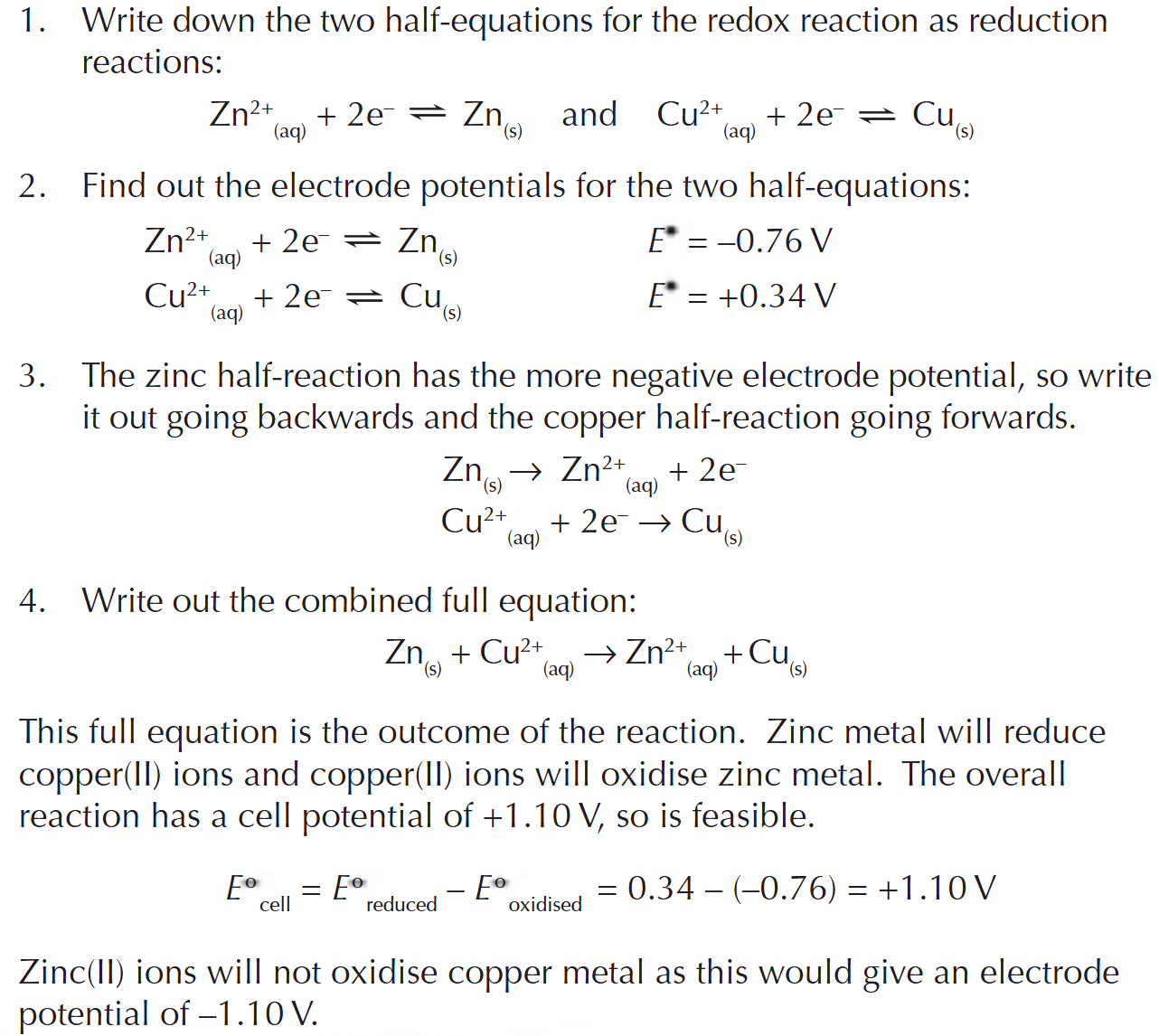
Find the two half-equations for the redox reaction & write them both as reduction reactions
Use an electrochemical series to work out which half-equation has the more negative electrode potential
Write out the half-equation with the more negative electrode potential going in the direction of oxidation & the half-equation with the more positive electrode potential going in direction of reduction
Combine the two half-equations & write out a full redox equation
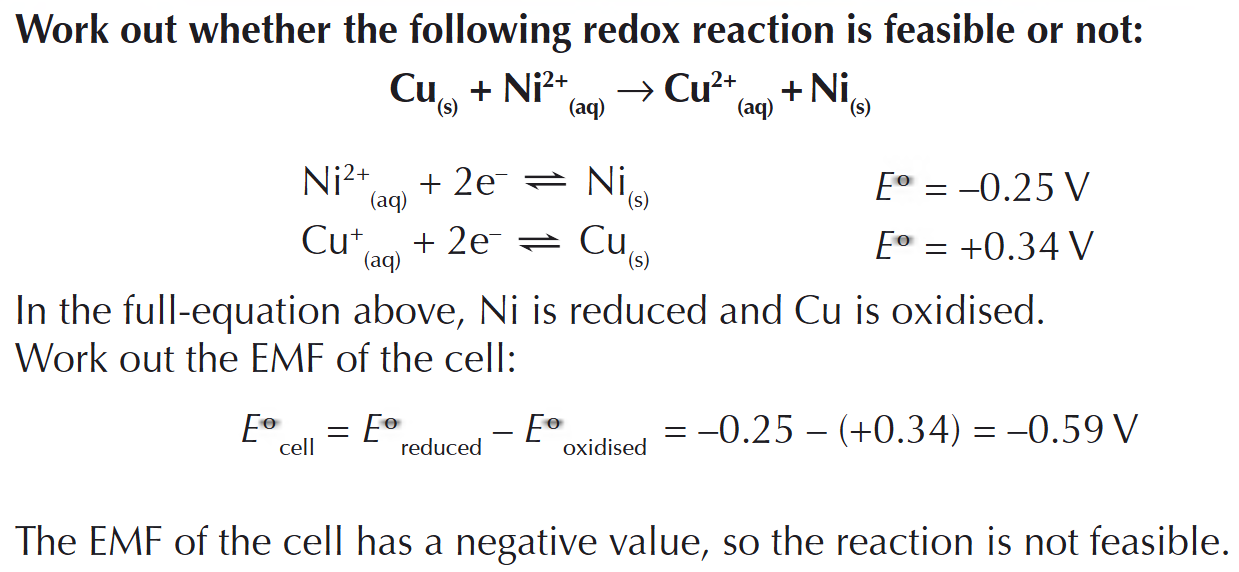
This is the feasible direction of the reaction & will give a positive overall Eθ value
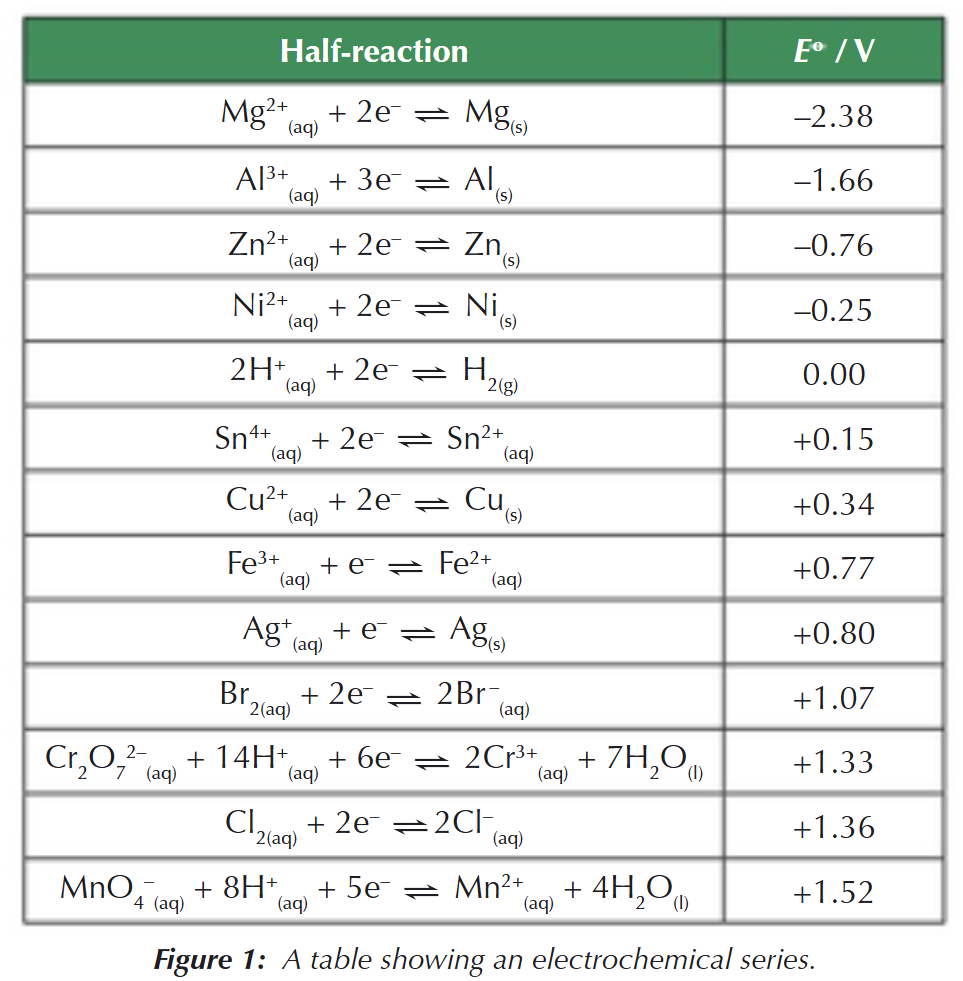
Work out the direction of the reaction when a Zn/Zn2+ half-cell is connected to a Cu2+/Cu half-cell
Deduce whether the following redox reaction is feasible or not: Cu(s) + Ni2+ (aq) → Cu2+(aq) + Ni(s)
Why do the half-equations have non-reversible arrows?
It’s impractical to reverse them in a battery:
they can be made to run backwards under the right conditions, but this can make the battery leak or explode
zinc electrode forms the casing of the battery, so becomes thinner as the zinc is oxidised
How are batteries recharged?
A current is supplied to force electrons to flow in the opposite direction around the circuit & reverse the reactions
This is possible as none of the substances in a rechargeable battery escape or are used up
What are fuel cells?
Re-chargeable batteries in which a fuel donates electrons at one electrode & oxygen gains electrons at the other electrode
As the fuel enters the cell it becomes oxidised, which sets up a potential difference/voltage within the cell
What is an example of a fuel cell & how does it work?
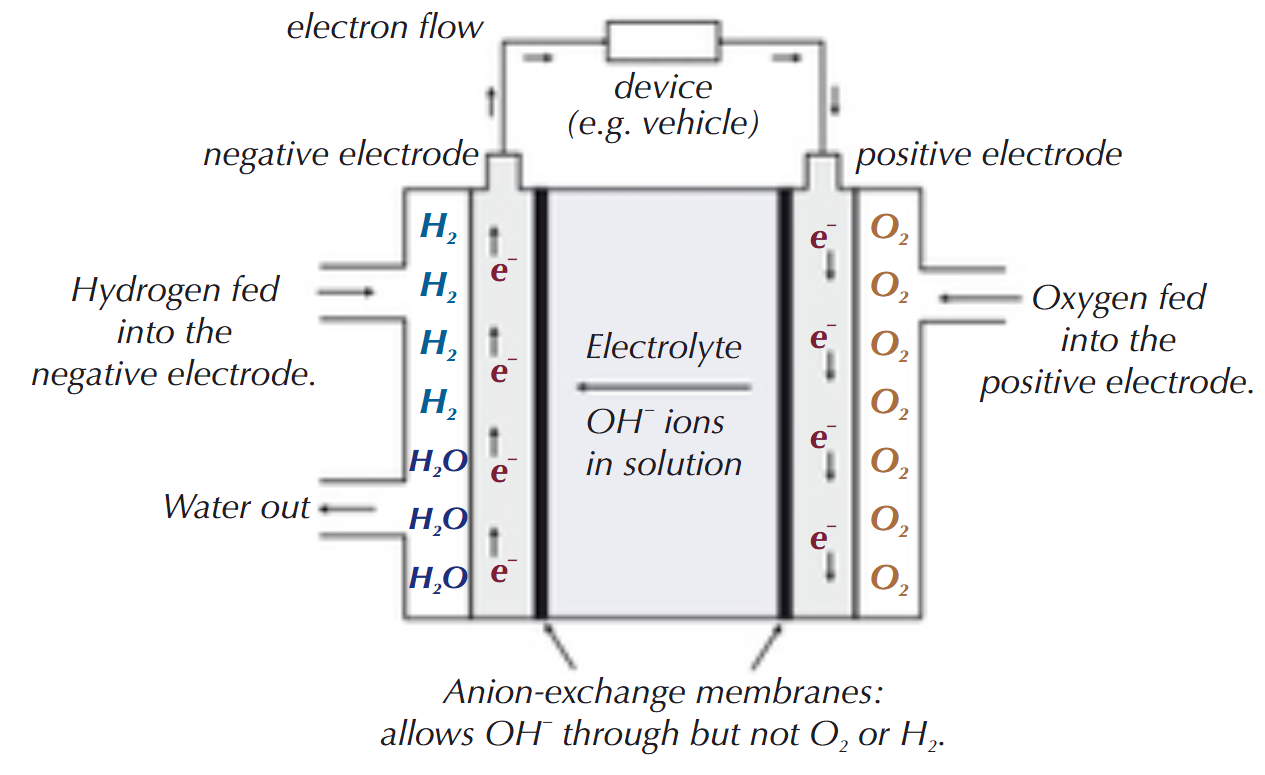
The hydrogen-oxygen fuel cell:
hydrogen & oxygen gas are fed into two separate platinum-containing electrodes
electrodes are separated by an anion-exchange membrane that allows anions (OH⁻ ions) & water to pass through it, but not hydrogen & oxygen gas. The electrolyte is an aqueous alkaline solution (KOH). Hydrogen is fed to the negative electrode
reaction at negative electrode is: H2(g) + 2OH⁻(aq) → 2H₂O(l) + 2e⁻
the electrons flow from the negative electrode through an external circuit to the positive electrode. The OH⁻ ions pass through the anion-exchange membrane towards the negative electrode. Oxygen is fed to the positive electrode
reaction at positive electrode is: O₂(g) + 2H₂O(l) + 4e⁻ → 4OH⁻(aq)
overall reaction: 2H₂(g) + O₂(g) → 2H₂O(l)
What are the advantages of fuel cells?
Much more efficient than an internal combustion engine in machines (waste a lot of energy as thermal energy) → more energy is converted into kinetic energy
Unlike batteries, fuel cells don’t need to be recharged → just need a continuous supply of oxygen & hydrogen gas
The only waste product is water & no carbon dioxide is emitted directly from the cell, unlike a combustion engine
What are the disadvantages of fuel cells?
Hydrogen is highly flammable & must be stored & transported correctly
It is expensive to transport & store hydrogen → storage of hydrogen is in pressurised containers
Energy is required to make the hydrogen & oxygen gas in the first place
fossil fuels are generally used to pass water through an electrolysis process → contributes to CO₂ emissions
Describe the zinc-carbon fuel cell
Non-rechargeable battery:
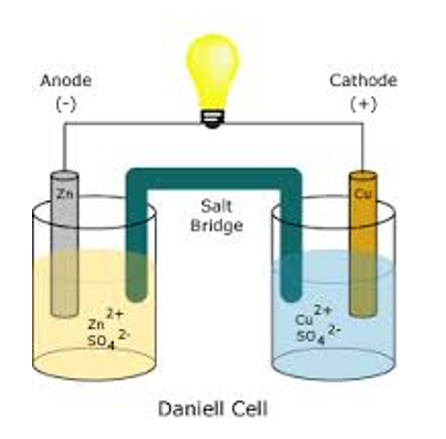
uses Zn(s)/Zn2+(aq) & Cu(s)/Cu2+(aq) reactions
zinc rod is the negative electrode & copper rod is the positive electrode
at the negative electrode (oxidation): Zn(s) → Zn2+(aq) + 2e-
at the positive electrode (reduction): Cu2+(aq) + 2e- → Cu(s)
overall equation: Zn(s) + Cu2+(aq) ⇌ Zn2+(aq) + Cu(s)
How did Alessandro Volta discover non-rechargeable batteries?
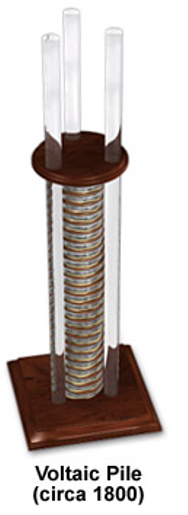
Used alternating discs of copper & zinc with damp pads between them
Found that by connecting wires to the top & bottom disc, an electric charge passed around the external circuit
the voltage was proportional to the number of discs used → called this device a ‘pile’
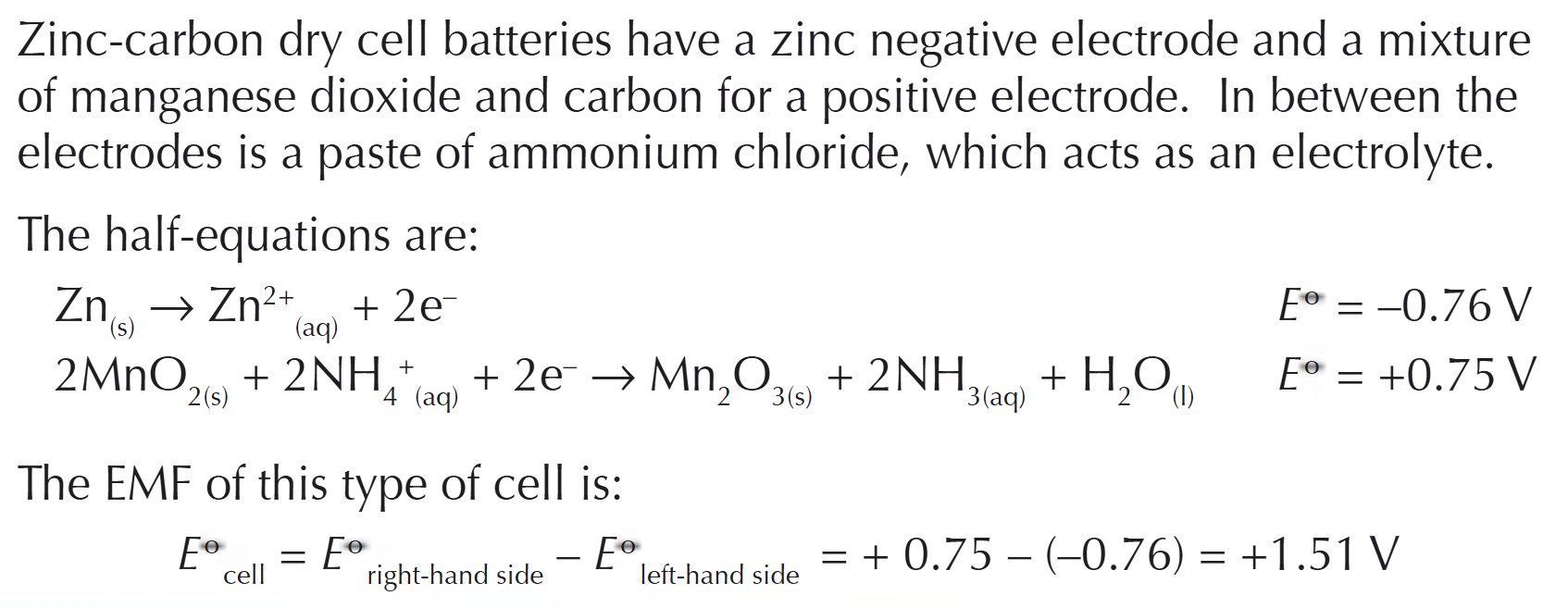
What is the dry cell?
Non-rechargeable battery:
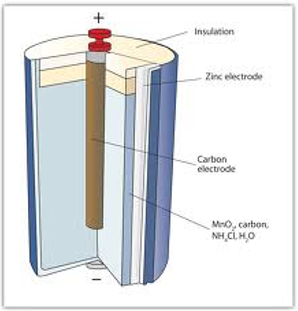
contains a paste of manganese dioxide & ammonium chloride around a carbon rod (positive electrode)
surrounded by a zinc case (negative electrode)
Zn(s) → Zn2+(aq) + 2e-
MnO2 + H2O + e- → MnO(OH) + OH-
Overall equation: Zn + 2MnO2 + H2O → Zn2+(aq) + 2MnO(OH) + 2OH-
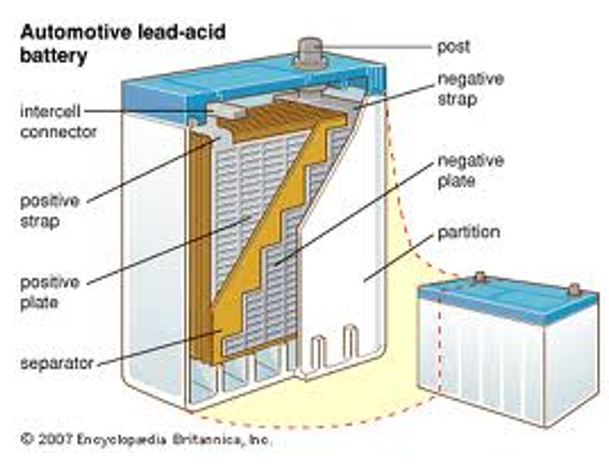
What is the lead-acid battery?
Re-chargeable battery:
acting as electrodes are plates that separate the cells, immersed in dilute sulphuric acid
negative electrodes are plates made from lead & positive electrodes are plates made from lead coated in lead (IV) oxide
negative electrode: Pb (s) + SO42- (aq) ⇌ PbSO4 (s) + 2e-
positive electrode: PbO2 (s) + SO42- (aq) + 4H+ (aq) + 2e- ⇌ PbSO4 (s) + 2H2O (l)
What are the simplified electrode reactions in a lithium cell?
Positive electrode: Li+ + CoO2 + e- → Li+[CoO2]-
Negative electrode: Li → Li+ + e-
List the reactivity series & the mnemonic to remember it
(Most reactive)
Please → Potassium
Stop → Sodium
Calling → Calcium
Me → Magnesium
A → Aluminium
Careless → Carbon
Zebra → Zinc
Instead → Iron
Try → Tin
Learning → Lead
How → Hydrogen
Copper → Copper
Saves → Silver
Gold → Gold
(Least reactive)