ESS Standard Topic 6.4
 Call Kai
 Learn
Learn Practice Test
 Spaced Repetition
 Match
Match Flashcards
 Knowt Play
1/17

Earn XP
Description and Tags
Stratospheric Ozone
Name | Mastery | Learn | Test | Matching | Spaced | Call with Kai | Chat |
|---|
No analytics yet
Send a link to your students to track their progress
18 Terms
Ozone
A molecule composed of 3 oxygen atoms
Very reactive
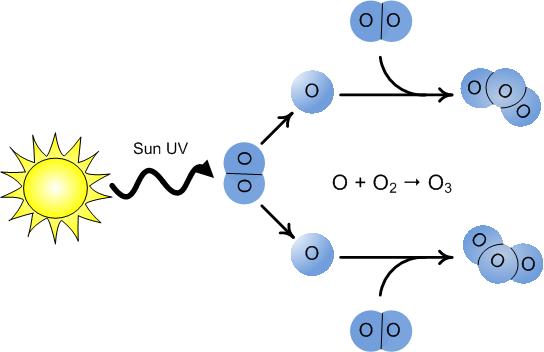
The Formation of Ozone
Ozone layer considered to be in steady state equilibrium:
UV radiation passing through the Earth’s upper atmosphere is continuously absorbed by the formation and destruction of ozone.
Where is the Ozone Layer Beneficial?
The stratosphere: Protects the Earth from All UVC radiation and most UVB rays (C being the most dangerous form of Ultraviolet Radiation)
Where is the Ozone Layer Negative?
The troposphere: The ozone reacts with nitrogen creating photo chemical smog (Air pollution)
Ultraviolet Radiations effect on Humans
Damages human living tissues
Increases the incidence of cataracts
Mutation during cell division
Skin cancer
Ultraviolet Radiations effect on Plants
Reduces productivity in photosynthetic organisms.
Especially phytoplankton – basis of many aquatic food webs.
Reduced photosynthesis rates
Altered plant metabolism
Decreased crop yields
Benefits of Ultraviolet radiation
In animals it stimulates the production of Vit D.
Treats psoriasis and vitiligo (skin diseases)
Steriliser, water purifier
Forensics, lighting, lasers
Ozone Depleting Substances - in the name
Chlorofluorocarbons (CFCs) - aerosols or refrigerants
Hydrochlorofluorocarbons (HCFCs) - blowing agents/foamed plastic
Halons - fire extinguishers
Methyl bromide - pesticides
Nitrogen oxides
Chlorofluorocarbons (CFCs) effect on Ozone
When exposed to UV radiation in the stratosphere they release chlorine or bromine atoms.
ODSs react with ozone resulting in ozone destruction. Disturbing the equilibrium
They can also react with oxygen molecules preventing more ozone from being formed. Through a catalytic chain reaction.
CFCs vs HCFCs
HCFCs have a shorter lifespan, non-flammable and also non toxic but they also destroy the ozone
What happens when the Ozone Layer depletes?
This leads to increased ozone depletion
Increased UVB radiation reaches the Earth's surface
Affects ecosystems and human health
Causes increased rates of skin cancer and cataracts
Reduces terrestrial and marine productivity
Annual Ozone Thinning
Holes appear in the Ozone layer every spring as the UV radiation activates the ODSs, releasing chlorine and bromine atoms.
Ozone Holes
Areas of low stratospheric ozone (Worst in the Southern Hemisphere)
United Nations Environment Programme (UNEP)
Formed Key agreements to do with:
Air pollution
Contamination of international waterways
Provide information to countries and the public on disadvantages of pollution
Brought together 24 countries in 1987 to sign the initial Montreal Protocol on ODSs
Montreal Protocol
An international treaty that regulates the production, trade and use of chlorofluorocarbons (CFCs) and other ODSs.
It is regarded as the most successful example of international cooperation in management and intervention to resolve a significant environmental issue and prevent from planetary boundary from being crosses.
Strength of the Montreal Protocal
Raised awareness of CFCs and ozone depletion
Global Participation: 197 countries now signed- widespread impact
Legally Binding: Phase out in Europe achieved by 2000 (world 2030?) CFCs🡪 HCFCs (eventually phase out HCFCs by 2040)
Flexibility and Adaptation: has been amended several times to adjust to new scientific knowledge
Financial and Technical Assistance: LEDC’s granted a longer time to implement the treaty
Scientific Consensus: based on a solid foundation of scientific research and data
Limitations of the Montreal Protocol
Relies on national governments complying and making laws. These need policing (and money)
There is a black market in ODS
Old fridges are still in circulation
ODS remain in the atmosphere for a long time
Reasons for the ODSs Black Market
ODS substitutes are often costlier than CFCs
Updating equipment to enable use of alternative chemicals is expensive
The lifetime of CFC containing equipment is long
Penalties in many countries are small