animal reproduction exam 1
0.0(0)
 Studied by 3 people
 Call Kai
 Learn
Learn Practice Test
 Spaced Repetition
 Match
Match Flashcards
 Knowt Play
Card Sorting
1/240

Earn XP
Description and Tags
Last updated 4:00 PM on 2/20/23
Name | Mastery | Learn | Test | Matching | Spaced | Call with Kai |
|---|
No analytics yet
Send a link to your students to track their progress
241 Terms
1
New cards
how do animals reproduce?
asexual and sexual reproduction
2
New cards
asexual reproduction
mitotic division “cloning”
* generates offspring genetically identical to each other and the parent
* in vertebrates: parthenogenesis
* germ cells differentiate w/o sperm into a genetically identical organism to the female
* generates offspring genetically identical to each other and the parent
* in vertebrates: parthenogenesis
* germ cells differentiate w/o sperm into a genetically identical organism to the female
3
New cards
sexual reproduction
germ cells produce gametes
* sperm and oocyte
* 1/2 the genetic material of each parent
* result: increased genetic variation
* sperm and oocyte
* 1/2 the genetic material of each parent
* result: increased genetic variation
4
New cards
benefits of sexual reproduction
* increased genetic variation
* genetic improvement
* perpetuation of the species
* genetic improvement
* perpetuation of the species
5
New cards
importance of controlling reproduction with HIGH reproductive efficiency
food animals → more food, more profit for the producer
\
overpopulation
* animal damage control problems
* resource depletion
\
overpopulation
* animal damage control problems
* resource depletion
6
New cards
importance of controlling reproduction with LOW reproductive efficiency
* low population growth, resources conserved
* suboptimal production of animal products, less food, profits
* suboptimal production of animal products, less food, profits
7
New cards
advances in modern reproductive physiology
* in vitro fertilization (IVF)
* embryo transfer
* pregnancy detection
* contraception
* estrous synchronization
* frozen semen
* artificial insemination
* father of AI → Rutgers
* sex selection
* embryo transfer
* pregnancy detection
* contraception
* estrous synchronization
* frozen semen
* artificial insemination
* father of AI → Rutgers
* sex selection
8
New cards
how does a rabbit test human pregnancy?
* 1920s
* human chorionic gonadotropin (hCG) is detectable in blood & urine in early pregnancy
* rabbits are induced ovulators
* thus, hCG will induce rabbit ovulation
* rabbit test:
* female rabbit is injected with this urine, after 2-3 days, rabbit is killed and ovaries are observed
* ovulation → pregnancy
* no ovulation → no pregnancy
* human chorionic gonadotropin (hCG) is detectable in blood & urine in early pregnancy
* rabbits are induced ovulators
* thus, hCG will induce rabbit ovulation
* rabbit test:
* female rabbit is injected with this urine, after 2-3 days, rabbit is killed and ovaries are observed
* ovulation → pregnancy
* no ovulation → no pregnancy
9
New cards
how do home pregnancy tests work?
* mid 1970s
* monoclonal antibodies developed to detect hCG in urine
* hCG: antibody complex generates a color reaction
* color change indicates a positive pregnancy test
* monoclonal antibodies developed to detect hCG in urine
* hCG: antibody complex generates a color reaction
* color change indicates a positive pregnancy test
10
New cards
asexual reproduction: cloning mammals
dolly the sheep → feb. 1997
* 1st mammal cloned from an adult cell
* transferred nucleus from adult cell to an egg whose DNA had been removed
* dolly was the first animal to show that clones can breed normally & produce healthy offspring
* 1st mammal cloned from an adult cell
* transferred nucleus from adult cell to an egg whose DNA had been removed
* dolly was the first animal to show that clones can breed normally & produce healthy offspring
11
New cards
theriogenology
branch of veterinary medicine which deals with reproductive medicine (male and female) including clinical practice of obstetrics, gynecology, and andrology
12
New cards
obstetrics
field of study concentrated on pregnancy, childbirth, and the postpartum period
13
New cards
gynecology
medical practice dealing with health of the female reproductive system
14
New cards
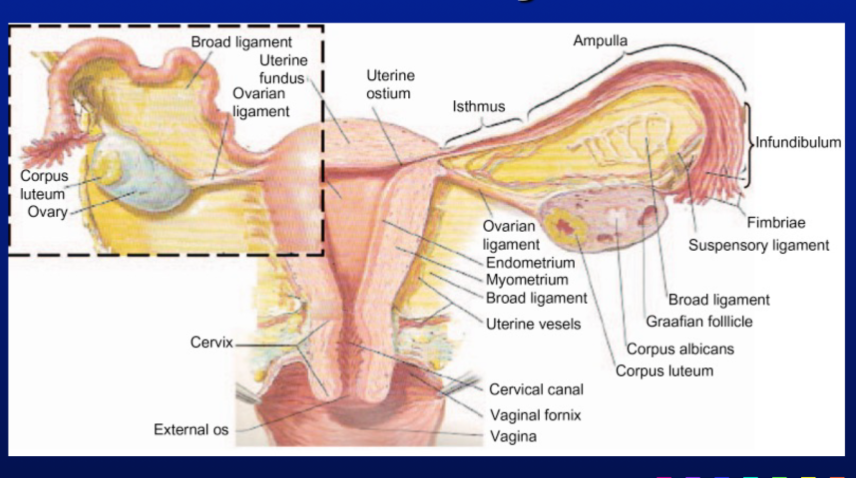
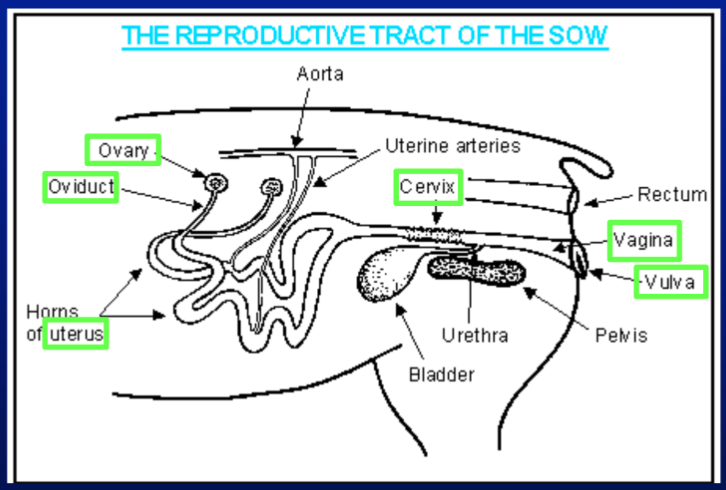
anatomy of the female reproductive tract
* ovaries
* oviduct
* uterus
* cervix
* vagina
* external genitalia
* oviduct
* uterus
* cervix
* vagina
* external genitalia
15
New cards
human female reproductive anatomy
16
New cards
reproductive tract of the sow
17
New cards
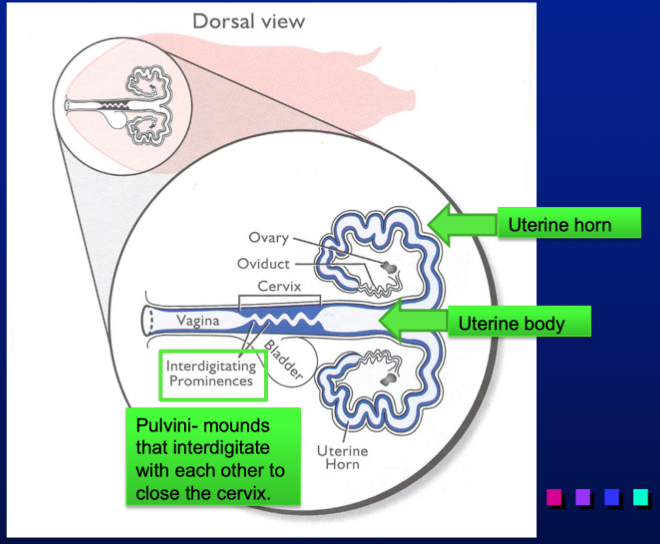
reproductive tract: non ruminant (dorsal view sow)
18
New cards
pulvini
mounds that interdigitate with each other to close the cervix
19
New cards
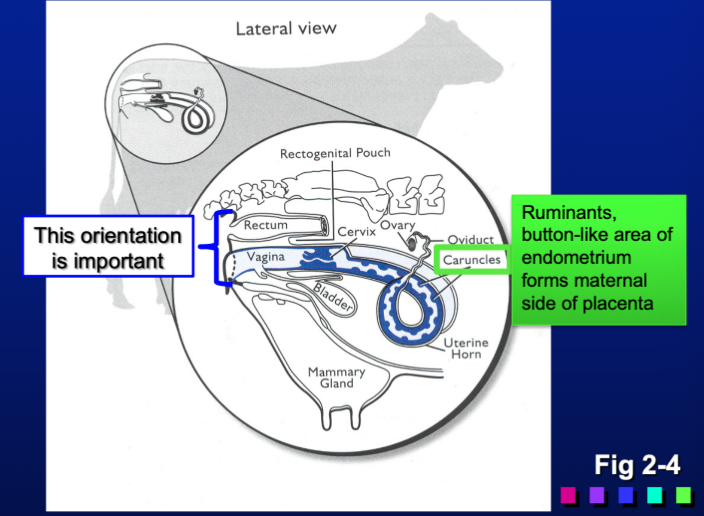
reproductive tract: ruminant (lateral view cow)
20
New cards
caruncles
ruminants, button-like area of endometrium forms maternal side of placenta
21
New cards
peritoneum
connective tissue lining the abdominal cavity
* with embryonic growth, the tract becomes surrounded by peritoneum
* forms the broad ligament
* suspensory tissue
* houses vascular supply, lymphatics, and nerves
* with embryonic growth, the tract becomes surrounded by peritoneum
* forms the broad ligament
* suspensory tissue
* houses vascular supply, lymphatics, and nerves
22
New cards
broad ligament development
1) UH and rectum develop dorsal to peritoneum
2) as development advances, UH and R push into body cavity and eventually become completely surrounded by peritoneum
3) broad ligament = 2 layers of peritoneum that sandwich the tract between them. each layer is continuous with the peritoneal lining of body cavity
2) as development advances, UH and R push into body cavity and eventually become completely surrounded by peritoneum
3) broad ligament = 2 layers of peritoneum that sandwich the tract between them. each layer is continuous with the peritoneal lining of body cavity
23
New cards
components of broad ligament
mesovarium
* connective tissue (CT) covering ovary
mesosalpinx
* CT covering oviduct
* helps to orient infundibulum
mesometrium
* CT covering uterus
* largest part of broad ligament
* supports uterine horns and body
* connective tissue (CT) covering ovary
mesosalpinx
* CT covering oviduct
* helps to orient infundibulum
mesometrium
* CT covering uterus
* largest part of broad ligament
* supports uterine horns and body
24
New cards
tubular portion of the tract
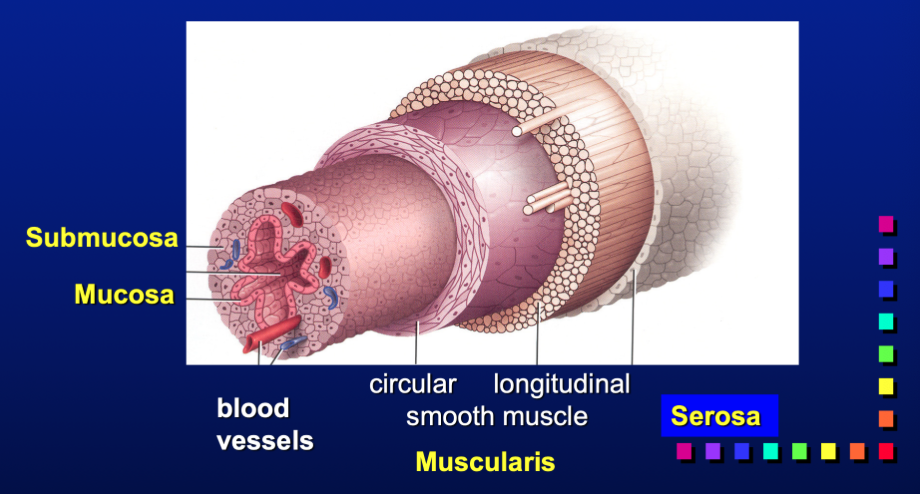
mucosa → submucosa → muscular → serosa
\
mucosa
* surrounds the lumen
* secretes mucus that lubricates tract
* cell type varies depending upon region
* oviduct: ciliated cells (movement)
* vagina: squamous cells (protection)
submucosa
* beneath muscularis
* varies in thickness depending upon region
* houses blood vessels, nerves, and lymphatics
* supports mucosa
muscularis
* double layer of smooth muscle
* outer longitudal layer
* inner circular layer
* this allows for contraction of the tract
serosa
* outer layer
* squamous (flattened cells)
\
mucosa
* surrounds the lumen
* secretes mucus that lubricates tract
* cell type varies depending upon region
* oviduct: ciliated cells (movement)
* vagina: squamous cells (protection)
submucosa
* beneath muscularis
* varies in thickness depending upon region
* houses blood vessels, nerves, and lymphatics
* supports mucosa
muscularis
* double layer of smooth muscle
* outer longitudal layer
* inner circular layer
* this allows for contraction of the tract
serosa
* outer layer
* squamous (flattened cells)
25
New cards
ovaries
* located near kidneys
* function: to produce
* gametes → ova
* hormones
* steroid - androgens, estrogens, progestins
* protein - inhibin and relaxin
* function: to produce
* gametes → ova
* hormones
* steroid - androgens, estrogens, progestins
* protein - inhibin and relaxin
26
New cards
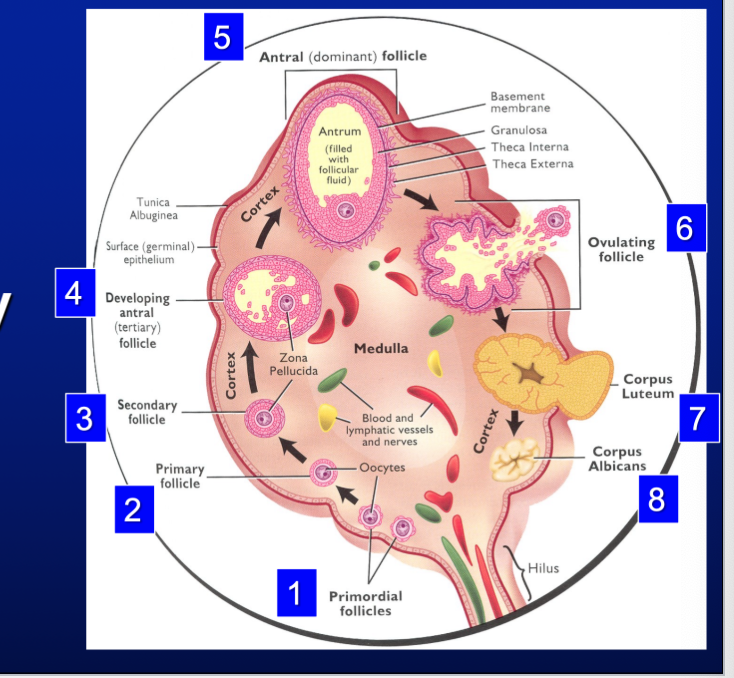
ovarian anatomy
outer covering
* germinal epithelium: location of ovarian cancer
* tunica albuginea: holds everything in place
cortex (outer portion)
* follicles
* corpora lutea, corpora albicans
medulla (center)
* vasculature, nerves, lymphatics, and CT
* germinal epithelium: location of ovarian cancer
* tunica albuginea: holds everything in place
cortex (outer portion)
* follicles
* corpora lutea, corpora albicans
medulla (center)
* vasculature, nerves, lymphatics, and CT
27
New cards
why is the equine (horse) ovary unusual?
* medulla and cortex are reversed
* ovulation occurs at 1 location: the ovulation fossa, corpus luteum forms here
* follicles but not CL can be palpated by rectal exam
* ovulation occurs at 1 location: the ovulation fossa, corpus luteum forms here
* follicles but not CL can be palpated by rectal exam
28
New cards
folliculogenesis
process whereby immature follicles develop into more advanced follicles and become candidates for ovulation
29
New cards
follicle cell types
granulosa cells (GC)
* direct oocyte development (nurse cells), steroidogenesis, and follicular fluid secretion; avascular
theca cells
* externa: outermost layer of antral follicle; provides structural integrity and support (contains CT)
* interna: flattened spindle-shaped cells along basement membrane of antral follicle and produce androgens
* direct oocyte development (nurse cells), steroidogenesis, and follicular fluid secretion; avascular
theca cells
* externa: outermost layer of antral follicle; provides structural integrity and support (contains CT)
* interna: flattened spindle-shaped cells along basement membrane of antral follicle and produce androgens
30
New cards
types of follicles
primordial
* most immature and smallest
* non-growing pool of follicles
* females are born with a set number of follicles
* oocyte w/ single layer of squamous cells
primary
* growing pool
* oocyte w/ single layer of cuboidal cells
* either (1) develop further; or (2) degenerate (atresia)
secondary
* 2 or more layers of granulosa cells
* no antrum
* contains zona pellucida (thick translucent layer surrounding oocyte)
tertiary or antral
* follicular fluid-filled antrum
* multiple granulosa cell layers
* theca externa and interna
* most immature and smallest
* non-growing pool of follicles
* females are born with a set number of follicles
* oocyte w/ single layer of squamous cells
primary
* growing pool
* oocyte w/ single layer of cuboidal cells
* either (1) develop further; or (2) degenerate (atresia)
secondary
* 2 or more layers of granulosa cells
* no antrum
* contains zona pellucida (thick translucent layer surrounding oocyte)
tertiary or antral
* follicular fluid-filled antrum
* multiple granulosa cell layers
* theca externa and interna
31
New cards
corpus luteum
following follicle rupture…
* corpus hemorrhagicum forms (bloody body)
* granulosa and theca cells differentiate into luteal cells (CL)
* produce progesterone
* corpus albicans (scar like)
* corpus hemorrhagicum forms (bloody body)
* granulosa and theca cells differentiate into luteal cells (CL)
* produce progesterone
* corpus albicans (scar like)
32
New cards
atretic follicles
degenerating follicles
* only 0.1% of ovarian follicles ovulate the rest 99.9% die (atresia)
* only 0.1% of ovarian follicles ovulate the rest 99.9% die (atresia)
33
New cards
ovulation
* follicle ruptures
* ovum released
* corpus hemorrhagicum forms
* ovum released
* corpus hemorrhagicum forms
34
New cards
polycystic ovarian syndrome (PCOS)
* multiple small cysts > enraptured follicles
* high androgens
* infertility
* insulin resistance
* high androgens
* infertility
* insulin resistance
35
New cards
ovarian cancer - causes
leading cause of death from gynecologic cancers
\
theory 1: ovarian surface epithelium (OSE)
1. repeated ovulation - wound and repair of the OSE triggers mutations leading to cancer
2. gonadotropin stimulation - FSH/LH action on OSE induces tumor formation
1. most ovarian cancers occur in postmenopausal (PM) women
2. gonadotropin are elevated in PM women
\
theory 2: fallopian tube epithelial (FTE) cells that have lost functional p53 from serous tube intraepithelial cancers (STIC)
* over time (6-8 yrs) these cancerous cells seed the ovary and distance metastases
\
theory 1: ovarian surface epithelium (OSE)
1. repeated ovulation - wound and repair of the OSE triggers mutations leading to cancer
2. gonadotropin stimulation - FSH/LH action on OSE induces tumor formation
1. most ovarian cancers occur in postmenopausal (PM) women
2. gonadotropin are elevated in PM women
\
theory 2: fallopian tube epithelial (FTE) cells that have lost functional p53 from serous tube intraepithelial cancers (STIC)
* over time (6-8 yrs) these cancerous cells seed the ovary and distance metastases
36
New cards
new treatment for ovarian cancer
* FTE vs OSE
* clinical trials are underway to test whether salpingectomy without ovariectomy reduces the incidence of ovarian cancer
* clinical trials are underway to test whether salpingectomy without ovariectomy reduces the incidence of ovarian cancer
37
New cards
“plan ahead” test
* jan 2006
* test developed in England to predict how many eggs women have in their ovaries
* test developed in England to predict how many eggs women have in their ovaries
38
New cards
how are eggs measured
blood levels of 3 hormones
1) inhibin B - a protein derived from egg follicles
2) anti-mullerian hormone - generated by the cells that surround eggs that have not yet matured
3) follicle stimulated hormone - which prompts development of the eggs
\
\*Inhibin B & AMH decline as ovaries age
\*FSH increases with age
\
* not a fertility test
* can be used to decide how long to delay conception
* cost: \~ $300-$400
1) inhibin B - a protein derived from egg follicles
2) anti-mullerian hormone - generated by the cells that surround eggs that have not yet matured
3) follicle stimulated hormone - which prompts development of the eggs
\
\*Inhibin B & AMH decline as ovaries age
\*FSH increases with age
\
* not a fertility test
* can be used to decide how long to delay conception
* cost: \~ $300-$400
39
New cards
ovarian volume & antral follicle count (AFC)
* ideal AFC is 15-20 ovaries
* if AFC is
* if AFC is
40
New cards
corpus luteum (CL)
* transient endocrine organ
* formed by cells of the ruptured follicle
* theca interna & granulosa cells “luteinize” or differentiate to form the CL
* formed by cells of the ruptured follicle
* theca interna & granulosa cells “luteinize” or differentiate to form the CL
41
New cards
CL function
* secretes progesterone
* function: maintain pregnancy; regulate the cycle
* clinical significance: 25-55% of early embryonic loss is due to insufficient luteal function
* function: maintain pregnancy; regulate the cycle
* clinical significance: 25-55% of early embryonic loss is due to insufficient luteal function
42
New cards
corpus albicans
* as the CL regresses
* corpus albicans is formed
* white
* “scar” from the former CL
* present at the end of cycle
* corpus albicans is formed
* white
* “scar” from the former CL
* present at the end of cycle
43
New cards
avian reproductive system
* functional LEFT ovary and oviduct
* right ovary and oviduct are rudimentary
* adapted to reduce weight for flight
* flightless birds have same arrangement
* no corpus luteum
* right ovary and oviduct are rudimentary
* adapted to reduce weight for flight
* flightless birds have same arrangement
* no corpus luteum
44
New cards
hen’s ovary
* comparable to mammalian oocyte
* called “the yolk” but consists of:
* germinal disc- location sperm enters that will form embryo
* yolk- energy + nourishment for embryo
* vitelline membrane- zona pellucida in mammals
* avian follicles- no antrum or follicular fluid
* each contains a large, yolk-filled ovum
* called “the yolk” but consists of:
* germinal disc- location sperm enters that will form embryo
* yolk- energy + nourishment for embryo
* vitelline membrane- zona pellucida in mammals
* avian follicles- no antrum or follicular fluid
* each contains a large, yolk-filled ovum
45
New cards
importance of the germinal disc
* lies on the surface of the yolk
* 3 mm white spot
* contains female haploid pro nucleus
* site of fertilization
* 3 mm white spot
* contains female haploid pro nucleus
* site of fertilization
46
New cards
avian tract
* infundibulum - receives the egg with yolk
* magnum - secretes albumen
* isthmus - adds the shell membrane
* shell gland or uterus - secretes the shell
* vagina - receives sperm
* cloaca- common opening for the GI and reproductive tracts
* magnum - secretes albumen
* isthmus - adds the shell membrane
* shell gland or uterus - secretes the shell
* vagina - receives sperm
* cloaca- common opening for the GI and reproductive tracts
47
New cards
mammalian oviduct
* fallopian tube or salpinx
* paired muscular tubes
* infundibulum
* fimbriae: beat to propel egg into oviduct
* ampulla
* isthmus
* paired muscular tubes
* infundibulum
* fimbriae: beat to propel egg into oviduct
* ampulla
* isthmus
48
New cards
oviduct function
* transport of gametes, embryo
* muscosa produces secretions to maintain:
* oocyte, sperm
* fertilized egg
* site of fertilization (ampulla)
* muscosa produces secretions to maintain:
* oocyte, sperm
* fertilized egg
* site of fertilization (ampulla)
49
New cards
uterus
basic structure
* uterine horns (2)
* body
* cervix (neck)
* uterine horns (2)
* body
* cervix (neck)
50
New cards
duplex uterus (2 cervices)
type 1: marsupials
* 2 cervices
* 2 separate uterine horns
* 2 vaginas
* no uterine body
\
type 2: rabbits
* 2 cervices
* 2 uterine horns
* 1 vagina
* 2 cervices
* 2 separate uterine horns
* 2 vaginas
* no uterine body
\
type 2: rabbits
* 2 cervices
* 2 uterine horns
* 1 vagina
51
New cards
bicornuate uterus
* 2 uterine horns
* small uterine
* 1 cervix
\
* poorly to moderately developed uterine horns (mare & cow)
\
* highly developed uterine horns (bitch, queen, sow)
\
* small uterine
* 1 cervix
\
* poorly to moderately developed uterine horns (mare & cow)
\
* highly developed uterine horns (bitch, queen, sow)
\
52
New cards
simplex uterus (no uterine horns)
large uterine body
53
New cards
structure of the uterine wall
* perimetrium - outer layer (serosa)
* myometrium - muscle (muscular)
* circular and longitudal
* endometrium - inner layer
* mucosa and submucosa
* secretory → sperm + embryo survival
* contains uterine glands
* myometrium - muscle (muscular)
* circular and longitudal
* endometrium - inner layer
* mucosa and submucosa
* secretory → sperm + embryo survival
* contains uterine glands
54
New cards
uterine functions
* sperm transport - contractions
* regulation of CL function
* uterine signal which causes CL regression or luteolysis - PGF2alpha
* Implantation/placentation - vascularization
* Parturition - contractions
* regulation of CL function
* uterine signal which causes CL regression or luteolysis - PGF2alpha
* Implantation/placentation - vascularization
* Parturition - contractions
55
New cards
structure of cervix
* sphincter-like
* cartilage, CT, and smooth muscle
* thick walled
* canal lined with mucous membrane
* cartilage, CT, and smooth muscle
* thick walled
* canal lined with mucous membrane
56
New cards
function of cervix
* flushing system/lubrication
* outflow of mucus: eliminate microorganisms
* sperm reservoir
* cervical crypts
* barrier during pregnancy
* outflow of mucus: eliminate microorganisms
* sperm reservoir
* cervical crypts
* barrier during pregnancy
57
New cards
cervix during pregnancy
* thick cervical mucous
* barrier to sperm transport
* prevents uterine infection
* at time of birth
* cervical plug liquifies
* cervical canal opens
* barrier to sperm transport
* prevents uterine infection
* at time of birth
* cervical plug liquifies
* cervical canal opens
58
New cards
cervical mucous
viscosity is hormone-dependent
* high estrogen (E2) → watery mucous
* during estrus and at ovulation
* facilitates sperm entry
* high progesterone (P4) → thick mucous
* during pregnancy
* inhibits sperm entry
* high estrogen (E2) → watery mucous
* during estrus and at ovulation
* facilitates sperm entry
* high progesterone (P4) → thick mucous
* during pregnancy
* inhibits sperm entry
59
New cards
vagina functions
* copulatory organ
* semen deposition
* excretory duct
* reproductive secretions
* urine
* birth canal
* semen deposition
* excretory duct
* reproductive secretions
* urine
* birth canal
60
New cards
vagina
anterior portion - near cervix
* columnar epithelium
* highly secretory
\
posterior portion = vestibule
* stratified squamous epithelium
* vestibular glands (Bartholin’s glands) secrete mucous
* portion common to the urinary and reproductive systems
* columnar epithelium
* highly secretory
\
posterior portion = vestibule
* stratified squamous epithelium
* vestibular glands (Bartholin’s glands) secrete mucous
* portion common to the urinary and reproductive systems
61
New cards
external genitalia of female
vulva - external part of the tract
\
* labia major and minor
* outer and inner folds of skin
* contains fat, smooth muscle
* forms a commissure
* closes entry to the vagina
\
* clitoris
* homolog of the penis
* erectile tissue, sensory nerves, epithelium
* erect during estrus
* function - sensory
\
* labia major and minor
* outer and inner folds of skin
* contains fat, smooth muscle
* forms a commissure
* closes entry to the vagina
\
* clitoris
* homolog of the penis
* erectile tissue, sensory nerves, epithelium
* erect during estrus
* function - sensory
62
New cards
primary functions of the male reproductive tract
* **gamete production** and maturation
* **hormone production**
* gamete delivery
* seminal fluid production and sperm delivery
* **hormone production**
* gamete delivery
* seminal fluid production and sperm delivery
63
New cards
primary parts of the male reproductive tract
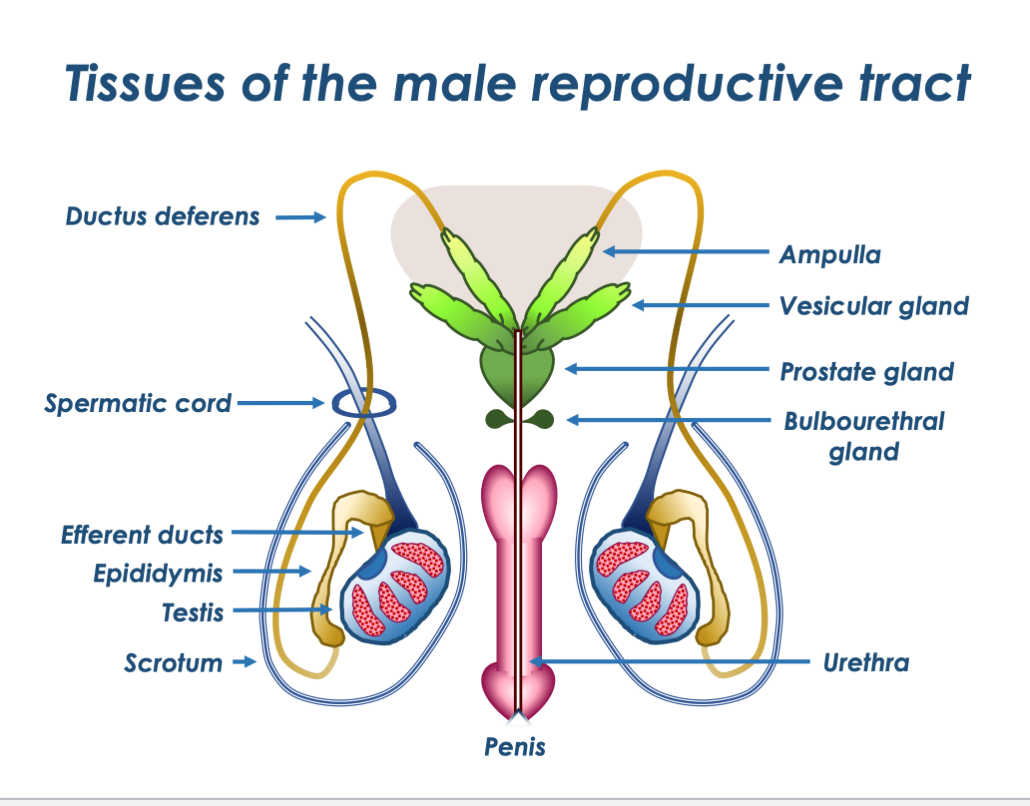
* testis and support tissues
* excurrent ducts
* accessory sex glands
* excretory tissues
* excurrent ducts
* accessory sex glands
* excretory tissues
64
New cards
tissues of the male reproductive tract
65
New cards
testis
site of gamete and hormone production (where gametes and androgens are born)
* testicular capsule → tunica albuginea
* testicular capsule → tunica albuginea
66
New cards
testis parenchyma
seminiferous tubules house developing gametes
67
New cards
a mammalian gamete needs:
* immune privilege
* correct hormone signaling
* temperature homeostasis
* correct hormone signaling
* temperature homeostasis
68
New cards
immune privilege
the blood testis barrier (BTB) saves sperm from self
* loss of tubule immune privilege (BTB) results in loss of meiotic and post meiotic germ cells
* the BTB is generated primarily by Sertoli cells
* loss of tubule immune privilege (BTB) results in loss of meiotic and post meiotic germ cells
* the BTB is generated primarily by Sertoli cells
69
New cards
hormone signaling
* loss of hormone signaling (testosterone) results in loss of post-meiotic germ cells
70
New cards
testosterone
* made by Leydig cells
* required for normal physiology in and out of the testis
* required for normal physiology in and out of the testis
71
New cards
temperature homeostasis
* loss of temperature homeostasis results in loss of all germ cells
72
New cards
summary → what a gamete needs
* immune privilege - BTB (mostly Sertoli cells)
* hormones (testosterone) - Leydig cells
* steady temperature (cool relative to the body)
* hormones (testosterone) - Leydig cells
* steady temperature (cool relative to the body)
73
New cards
how does the testis cool itself?
testis support tissues → the SCROTUM supports and controls temperature of the testis
* via evaporation
* via evaporation
74
New cards
spermatic cords
connect the testis to the body
* cremaster muscle
* supports testis
* testicular artery
* ductus deferens
* pampiniform plexus
* T return to body
* testis heat exchange
* these cords transfer hormones and heat to and from the testis
* cremaster muscle
* supports testis
* testicular artery
* ductus deferens
* pampiniform plexus
* T return to body
* testis heat exchange
* these cords transfer hormones and heat to and from the testis
75
New cards
excurrent ducts
move and modify gametes
76
New cards
efferent ducts
moving and concentrating gametes
* mixed epithelium
* move spermatozoa (smooth muscle and ciliated cells)
* concentrate spermatozoa through water resorption (short cells)
* mixed epithelium
* move spermatozoa (smooth muscle and ciliated cells)
* concentrate spermatozoa through water resorption (short cells)
77
New cards
epididymis
moving, modifying, and storing mature gametes
* single long tubule
* surrounded by smooth muscle to move sperm
* multiple segments with different cell types to generate different environments
* different segments (caput, corpus, and caudal) have different epithelial morphologies and functions
* single long tubule
* surrounded by smooth muscle to move sperm
* multiple segments with different cell types to generate different environments
* different segments (caput, corpus, and caudal) have different epithelial morphologies and functions
78
New cards
sequence of events
* Millieu changes from segment to segment
* epididymis secretes a part of the seminal fluid
* spermatozoa mature as they transit the epididymis
* epididymis secretes a part of the seminal fluid
* spermatozoa mature as they transit the epididymis
79
New cards
sperm proteins change dramatically as they transit the epididymis
caput:
* removal of abnormal spermatozoa
* membrane modification
corpus:
* sperm gain motility
cauda:
* gain fertilization (capacitation ability)
* long term storage
\*cauda → primary site for sperm reserves
* removal of abnormal spermatozoa
* membrane modification
corpus:
* sperm gain motility
cauda:
* gain fertilization (capacitation ability)
* long term storage
\*cauda → primary site for sperm reserves

80
New cards
ductus deferens (vas deferens)
moving and moving gametes
* narrow epithelium surrounded by smooth muscle
* moves spermatozoa from caudal epididymis to accessory sex glands
* target tissue for permanent sterilization in men (2.4% worldwide)
* cause of sterility in men with cystic fibrosis
* narrow epithelium surrounded by smooth muscle
* moves spermatozoa from caudal epididymis to accessory sex glands
* target tissue for permanent sterilization in men (2.4% worldwide)
* cause of sterility in men with cystic fibrosis
81
New cards
primary functions of the excurrent ducts
* maturation
* gamete delivery
* seminal fluid production and delivery
* gamete delivery
* seminal fluid production and delivery
82
New cards
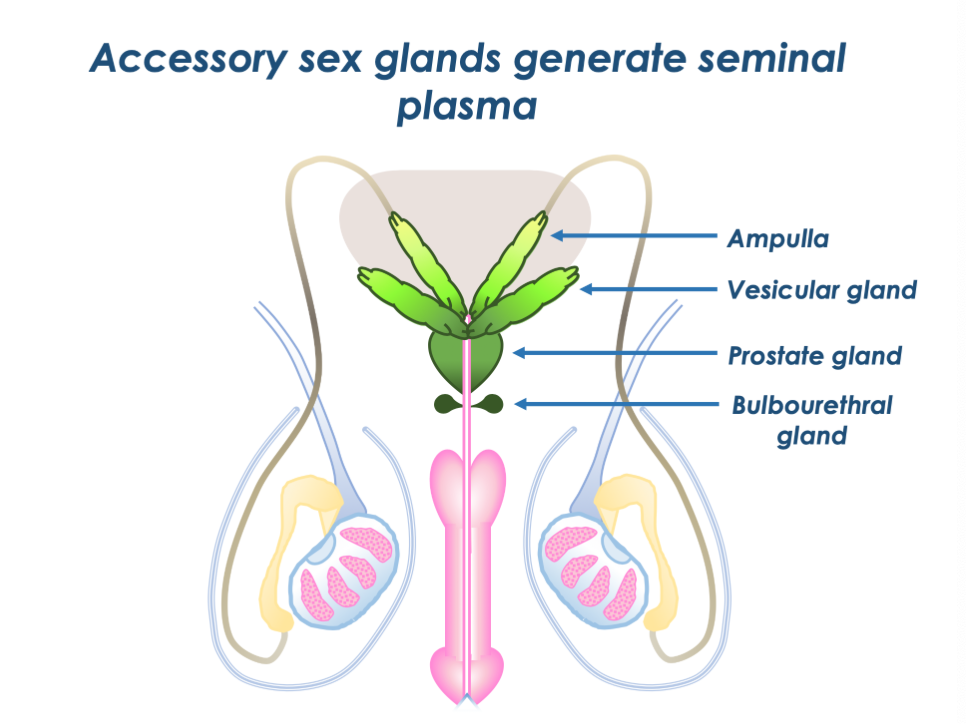
accessory sex glands generate seminal plasma
* ampulla
* vesicular gland
* prostate gland
* bulbourethral gland
* vesicular gland
* prostate gland
* bulbourethral gland
83
New cards
ampulla
widening of vas deferens
* moves fluid and sperm from vas to urethra (smooth muscle)
* secretes seminal fluid (mucosa)
* moves fluid and sperm from vas to urethra (smooth muscle)
* secretes seminal fluid (mucosa)
84
New cards
vesicular glands (seminal vesicles)
similar morphology to ampulla
* not a contiguous portion of the reproductive tract
* generates and stores seminal fluid - majority of ejaculate
* not a contiguous portion of the reproductive tract
* generates and stores seminal fluid - majority of ejaculate
85
New cards
prostate
species specific morphology
* generates prostate fluid
* protects sperm after ejaculation
* PSA (prostate specific antigen) - reduces semen viscosity
* generates prostate fluid
* protects sperm after ejaculation
* PSA (prostate specific antigen) - reduces semen viscosity
86
New cards
bulbourethral gland
* species specific morphology
87
New cards
primary functions of accessory sex glands
seminal fluid production and delivery
88
New cards
male excretory tissues
penis and urethra
89
New cards
urethra
contractile muscle around a duct designed for delivery
90
New cards
primary functions of excretory tissues
gamete delivery and seminal fluid production & delivery
91
New cards
fertilization
* mammalian fertilization combines the chromosomes of the egg and the sperm
* the inherited sex chromosomes will determine sex
female → 2 X’s (XX)
male → 1 X and 1 Y (XY)
* mother (diploid XX)
* egg (haploid X)
* father (diploid XY)
* sperm (haploid X or haploid Y)
* the inherited sex chromosomes will determine sex
female → 2 X’s (XX)
male → 1 X and 1 Y (XY)
* mother (diploid XX)
* egg (haploid X)
* father (diploid XY)
* sperm (haploid X or haploid Y)
92
New cards
x vs Y chromosome
* X chromosome is abt 3x larger than y chromosome
* sex determining region of the Y chromosome = SRY gene
* directs development of male phenotypes
* sex determining region of the Y chromosome = SRY gene
* directs development of male phenotypes
93
New cards
embryogenesis
fertilized egg divides
1) blastocyst
* ICM
* blastocoele
2) inner cell mass → embryo
3) trophoblast → placenta
1) blastocyst
* ICM
* blastocoele
2) inner cell mass → embryo
3) trophoblast → placenta
94
New cards
differentiation
* during early embryogenesis, the inner cell mass (ICM) differentiates to form the 3 germ layers of the embryo:
* ectoderm
* mesoderm
* endoderm
* ectoderm
* mesoderm
* endoderm
95
New cards
germ layers of embryo
endoderm
* digestive system
* lungs
* endocrine system
mesoderm
* muscle
* skeleton
* cardiovascular
* reproductive system
ectoderm
* nervous sytem
* skin
* hair
* digestive system
* lungs
* endocrine system
mesoderm
* muscle
* skeleton
* cardiovascular
* reproductive system
ectoderm
* nervous sytem
* skin
* hair
96
New cards
the reproductive system is derived from:
* mesoderm
* ectoderm (hypothalamus and pituitary)
* ectoderm (hypothalamus and pituitary)
97
New cards
germ layers of the embryo
* endoderm (inside skin)
* mesoderm (middle skin)
* reproductive system
* gonads
* uterus, cervix, vagina
* epididymis, ductus deferens, accessory sex glands
* ectoderm (outer skin)
* reproductive tract
* vagina and vestibule
* penis and clitoris
* nervous system
* hypothalamus and pituitary
* mesoderm (middle skin)
* reproductive system
* gonads
* uterus, cervix, vagina
* epididymis, ductus deferens, accessory sex glands
* ectoderm (outer skin)
* reproductive tract
* vagina and vestibule
* penis and clitoris
* nervous system
* hypothalamus and pituitary
98
New cards
pituitary (hormone center)
* hypophysis: Greek for “lying underneath”
* posterior hypophysis - neurohypophyisis
* derived from neural tissue of brain floor
* anterior hypophysis - adenohypophysis
* derived from ectoderm in the roof of the embryonic mouth
* posterior hypophysis - neurohypophyisis
* derived from neural tissue of brain floor
* anterior hypophysis - adenohypophysis
* derived from ectoderm in the roof of the embryonic mouth
99
New cards
mouth + brain = pituitary
* posterior pituitary (neurohypophysis)
* infundibulum of brain (neural tissue) pinches off and grows down towards the mouth
* becomes the posterior pituitary
* stores and secretes hormones OXYTOCIN and ADH
* anterior pituitary (adenohypophysis)
* rathke’s pouch diverts from roof of mouth and joins up with posterior pituitary
* becomes the anterior pituitary
* synthesizes and secretes LH, FSH, PRL, GH, TSH, ACTH
* infundibulum of brain (neural tissue) pinches off and grows down towards the mouth
* becomes the posterior pituitary
* stores and secretes hormones OXYTOCIN and ADH
* anterior pituitary (adenohypophysis)
* rathke’s pouch diverts from roof of mouth and joins up with posterior pituitary
* becomes the anterior pituitary
* synthesizes and secretes LH, FSH, PRL, GH, TSH, ACTH
100
New cards
diverticulum
a sac/pouch diverting from a main tube/cavity
 Note
Note  Flashcards (142)