Radiation Physics
 Call Kai
 Learn
Learn Practice Test
 Spaced Repetition
 Match
Match Flashcards
 Knowt Play
1/30

There's no tags or description
Looks like no tags are added yet.
Name | Mastery | Learn | Test | Matching | Spaced | Call with Kai | Chat |
|---|
No analytics yet
Send a link to your students to track their progress
31 Terms
directly related
Relationship between frequency and photon _____
inversely related
frequency and photon energy are ______ related to wavelength
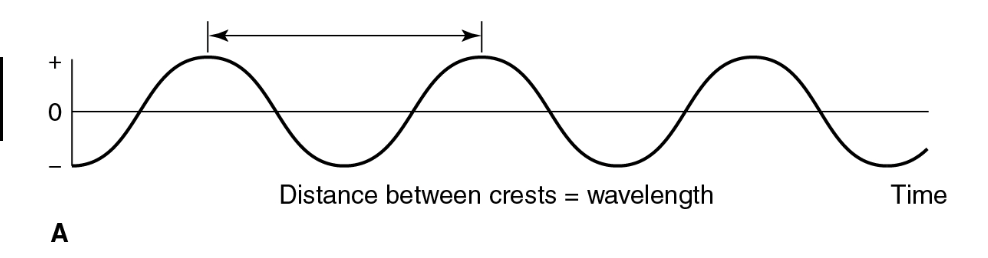
wavelength
refers to the distance between two consecutive wave crests
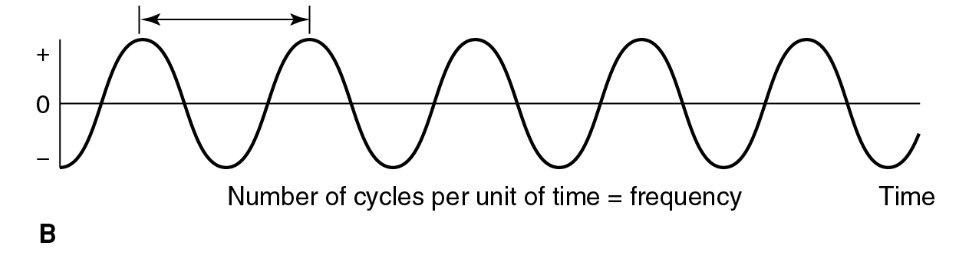
frequency
refers to the number of cycles per second
greater frequency
shorter wavelength = _____
heated cathode (-) filament
the source of the electrons is the ____
thousands of volts (kilovolts) are applied.
the electrons are driven across the anode’s focal spot when what is applied?
interact with tungsten atoms
kinetic energy is converted to HEAT and x-ray PHOTON energy
when high speed electrons are suddenly stopped at the focal spot they interact with what and what happens to their energy?
HETEROgeneous (polyenergetic)
What kind of energy is x-ray beam?
Bremsstrahluung (Brems) or “Braking” Radiation
Characteristic Radiation
Two interactions that are produced at the anode through energy conversion process
Bremsstrahlung (brems) radiation.
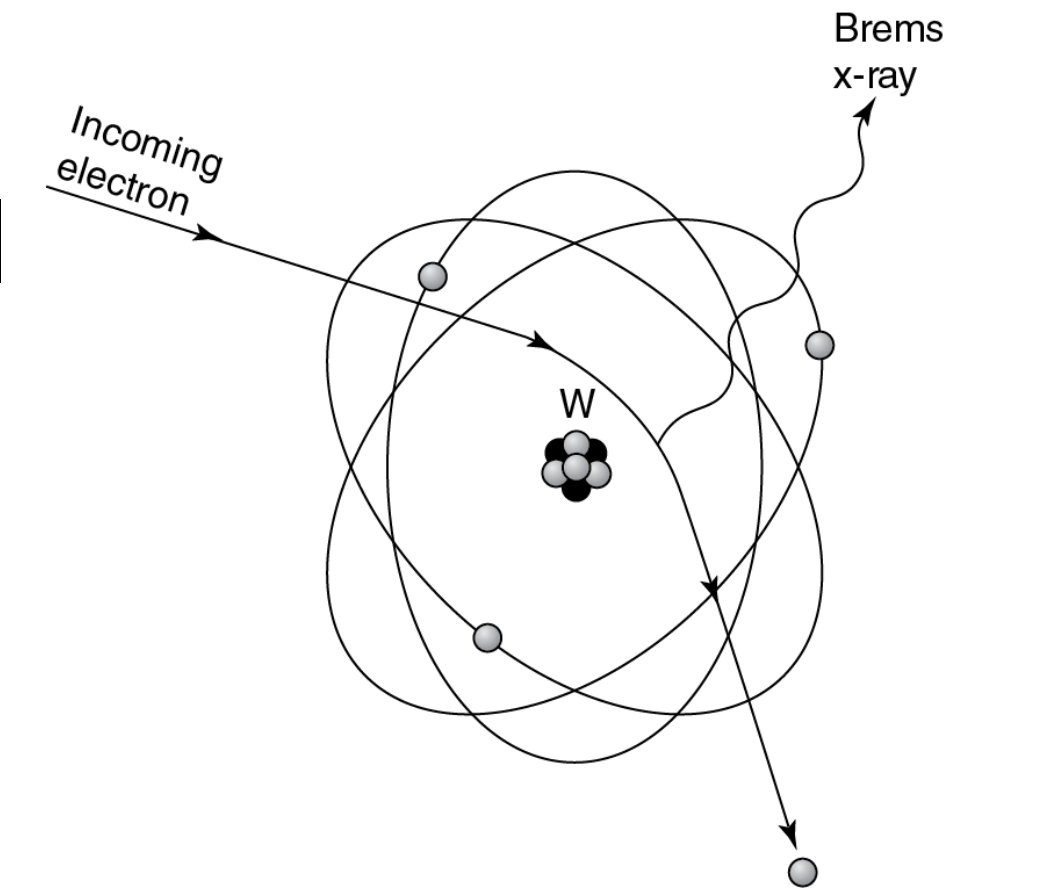
high speed electron is deflected from its path and the loss of kinetic energy is emitted in the form of an x-ray photon.
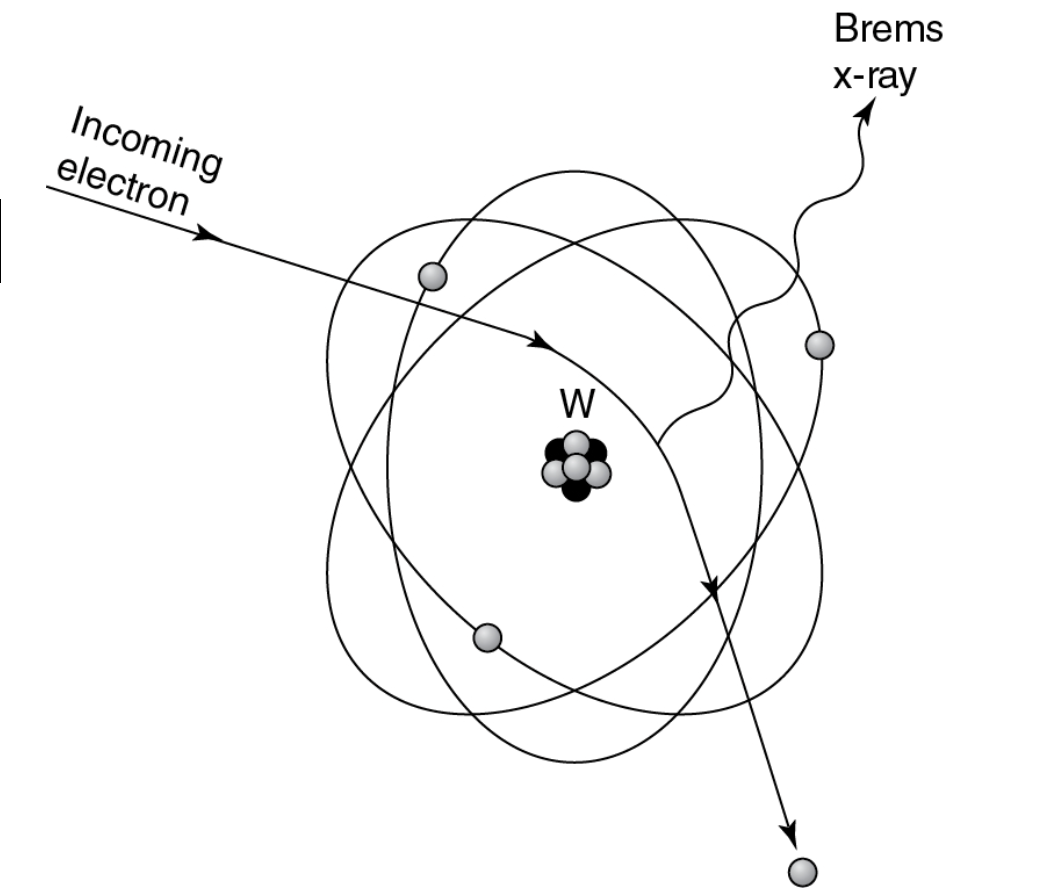
High speed electron is accelerated toward a tungsten atom within the anode focal track
The negative electron is attracted by the positive nucleus of the tungsten atom
As a result, pulled off course and redirected towards the nucleus
The electron’s deflection from its original course caused by the “braking” (slowing down) results in a loss of energy
What happens in brems radiation?
70%-90%
Brems radiation comprises how much of the primary x-ray beam?
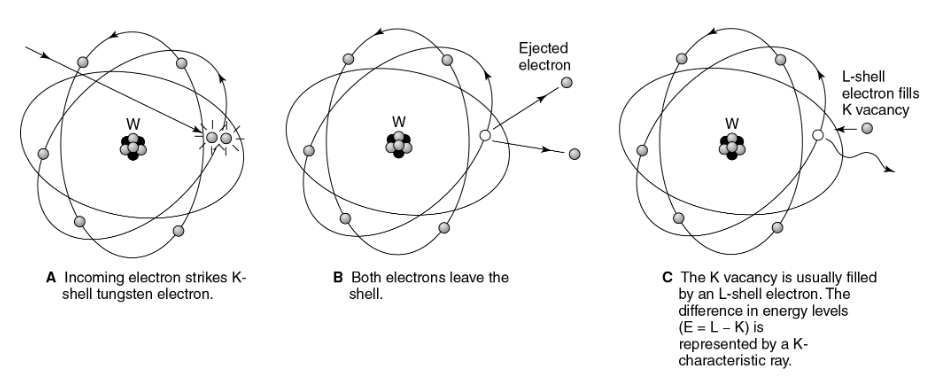
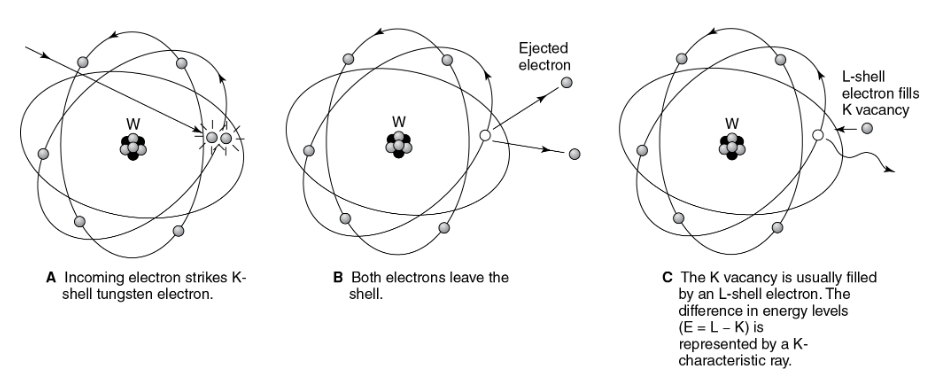
A high speed ELECTRON encounters a tungsten atom and ejects a K-shell electron
Thereby leaving a vacancy in the K shell.
An electron from a higher energy level shell FILLS the vacancy
In doing so, because of the difference in energy level between the K and L shells, a K-characteristic x-ray photon is emitted.
What happens during Characteristic Radiation?
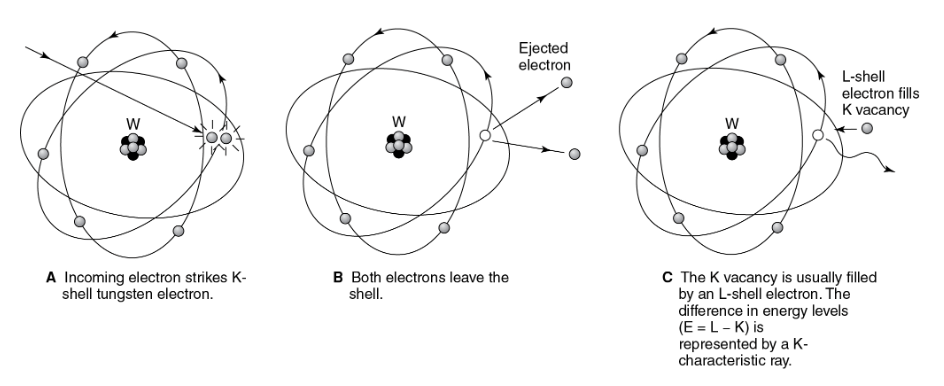
the difference in binding energy between the K and L shells.
The energy of the characteristic ray is equal to ______
69 keV energy
The K-characteristic x-rays from a tungsten target x-ray tube have what energy?
10%-30%
Characteristic radiation comprises the minor portion of the x-ray beam
attenuation
The gradual decrease in exposure rate as ionizing radiation passes through tissues is called ____
Photoelectric effect
Compton scatter
Two major types of interactions that occur between x-ray photons and matter (in diagnostic x-ray range of energy)
Photoelectric effect
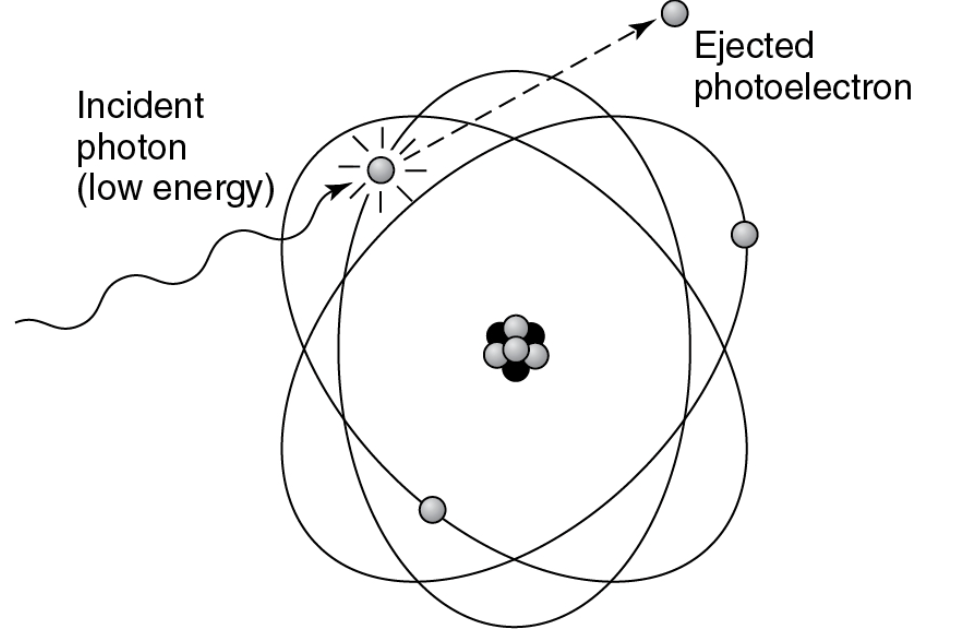
A relatively low-energy (low-kV) x-ray PHOTON interacts with tissue and expands all of its energy (true/total absorption) to eject an inner shell electron.
this leaves an innershell orbital vacancy
An electron from the shell above drops down to fill the vacancy and gives up energy in the form of a characteristic ray
ALL of its energy
In the photoelectric effect, the incoming (low-energy) photon releases how much of its energy as it ejects an inner shell electron from the orbit?
absorbers having high atomic number (i.e. bone, positive contrast media)
The photoelectric effect is more likely to occur in _____ with low-energy photons
Short-scale contrast
The photoelectric effect produces what kind of contrast?
Compton scatter
A fairly high energy (high kV) x-ray PHOTON interacts with tissue atoms, giving up some of its energy to eject an outer shell
recoil electron
the ejected electron from compton scatter is called?
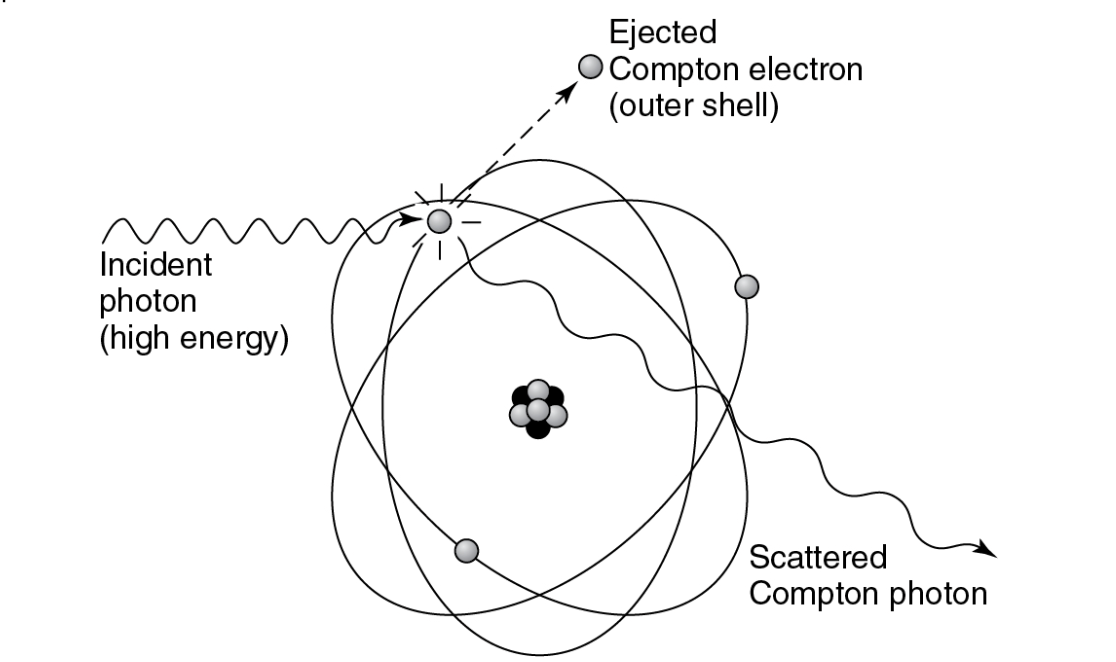
RETAINS
The photon in compton scatter changes direction (scatters) as it exits the body but ______ much of its original energy.
DOES NOT pose
Because the scattered photon exits the body, it does _____ a radiation hazard to the patient.
image fog
pose a radiation hazard to personnel.
The compton scatter contribute to the:
High-energy
short wavelength
electromagnetic radiations that break apart electrically neutral atoms
Ionization is caused by:
beam attenuation
type of interaction that occurs between x-ray photons and tissue
exposure depends on:
Radiation quality (kV)
Subject being irradiated (thickness)
Nature of part (atomic number of part)
Exposure dose is affected by: