BI108: Test 5 Study Guide
 Call Kai
 Learn
Learn Practice Test
 Spaced Repetition
 Match
Match Flashcards
 Knowt Play
1/234

There's no tags or description
Looks like no tags are added yet.
Name | Mastery | Learn | Test | Matching | Spaced | Call with Kai | Chat |
|---|
No analytics yet
Send a link to your students to track their progress
235 Terms
Hormone
A signaling molecule released by one cell or tissue that travels to other cells, binds specific receptors, and can change gene expression or cellular activity in target cells.
Gamete
A typically haploid reproductive cell produced by meiosis (e.g., sperm or egg) that can fuse with another gamete at fertilization to form a new individual.
Gametogenesis
The developmental process by which germline cells undergo meiosis and differentiation to produce mature gametes.
Gonad
An organ that produces gametes and sex hormones (e.g., testes, ovaries, ovotestes).
Genitalia
External and internal reproductive organs involved in sexual reproduction (examples: cloaca, penis, vulva).
Ornamentation
A physical trait that functions as a display or decoration, often shaped by sexual selection to increase mating success.
Sex (biological)
A composite phenotype made up of multiple traits (gametes, gonads, genitalia, internal reproductive tracts, secondary sexual morphology, behavior, and physiology) shaped by genetics, chromosomes, hormones, environment, and social factors.
Chromosomal sex
The sex determined by chromosome complement at fertilization (examples: 46XX, 46XY, mosaic or aneuploid configurations like 45X, 47XXY).
Gonadal sex
The developmental outcome in which bipotential gonadal primordia differentiate into testes, ovaries, or ovotestes (around ~6 weeks in humans).
Anatomical (internal) sex
Differentiation of internal reproductive tracts (Müllerian vs. Wolffian derivatives) under hormonal control (approx. mid-gestation).
Anatomical (external) sex
Development of external genital structures from common embryonic tissues (glans, urogenital folds, urogenital membrane, labioscrotal swellings), influenced by hormone signaling; often used for sex assignment at birth.
Psychological sex/Gender identity
An individual’s sense of their own gender, shaped postnatally by brain development influenced by genetic, hormonal, and environmental interactions.
Pubertal sex / Secondary sexual characteristics
Hormone-driven changes during puberty that produce secondary sexual traits (e.g., body hair, breast development, voice change), which are malleable and vary across individuals.
Steroid hormone (note)
A class of hormones (derived from cholesterol) whose synthesis requires enzymes encoded by genes; steroid hormones themselves are not directly coded by genes.
Aromatase
The enzyme that converts testosterone into estradiol (an estrogen)
5-alpha-reductase
The enzyme that converts testosterone into dihydrotestosterone (DHT), a potent androgen that influences certain external genital developments.
Müllerian duct
An embryonic duct system that differentiates into female internal reproductive structures (uterus, oviducts, cervix) when not suppressed.
Wolffian duct
An embryonic duct system that differentiates into male internal reproductive structures (epididymis, vas deferens, seminal vesicle) under androgen stimulation.
Anti-Müllerian hormone (AMH; from Sertoli cells)
A hormone produced by Sertoli cells in developing testes that causes regression of the Müllerian ducts.
Leydig cell (function)
Testicular cells that produce testosterone, driving Wolffian duct differentiation and, after conversion to DHT, masculinization of external genitalia.
variations of sex development
Biological variations (e.g., differences in enzyme activity like 5α-reductase deficiency, congenital adrenal hyperplasia, chromosomal mosaics) that can produce diverse gonadal, internal, or external sexual phenotypes.
congenital adrenal hyperplasia (cah)
A group of conditions causing impaired cortisol/aldosterone synthesis and, in some forms, elevated androgen production that can masculinize genital development in individuals with ovaries.
Environmental endocrine disruptors
Chemicals (e.g., some phthalates, linuron) or maternal/gestational factors that can alter hormone signaling in utero and affect sexual development.
Life-history stage (in context of sex)
The idea that individuals can move between phenotypic regions associated with “sexes” at different stages of life (e.g., embryonic, pubertal, adult), so sex is not a single fixed trait.
Polygenic and environmental basis of gender identity
The concept that gender identity is influenced by many genes (polygenic), has heritable components, and is shaped substantially by unique environmental factors and gene×environment×hormone interactions.
Misconception: single-cause sex determination
The incorrect idea that one gene, one hormone level, or one visible trait alone defines sex; in reality sex is multidimensional and emergent from multiple factors.
Clinical/social caution
Biological diversity in sex phenotypes is natural; using simplified biological definitions of sex to determine social or legal status is inappropriate because biology is complex and not prescriptive.
How does the environment affect sexual development of mammals?
In mammals, genitalia development occurs within the womb, which is more protected from external forces than organisms that develop in the environment. However, hormone signaling can change within the womb because of:
• Maternal adrenal tumor can elevate testosterone exposure
• Other embryos in uterus
• Industrial and agricultural pollutants and pharmaceuticals can be hormone disruptors
• cigarette and alcohol use
Brain development affects gender identify, and is influenced by:
• Hormone-independent developmental processes (e.g., SRY-gene dependent)
• Hormone-dependent during embryonic and post-natal development
• Environment x genetics x hormone interactions (pre- & postnatal)
steroid hormones are…
not coded by genes, but the enzymes needed to produce them are coded by genes
Do genetics of sex differentiation stay the same across animals?
No — they vary across animal groups, including vertebrates
Are all individuals easily classified into two sex categories?
No — many species show intersex phenotypes and intermediate forms.
Do only sex chromosomes determine sexual phenotype?
No — genes off the typical sex chromosomes often influence developmental sex pathways.
What is temperature-dependent sex differentiation?
A mechanism where developmental temperature overrides genetic pathways to determine sexphenotype.
How do hormones affect sexual traits?
Hormones can strongly influence traits from tissue to whole-system levels.
Are only "sex" hormones involved in sexual phenotypes?
No — other hormones (e.g., cortisol) can affect sexual phenotype
Where are androgens and estrogens produced?
gonads and other tissues
Can cells convert testosterone to estradiol?
Yes — many cells use the enzyme aromatase to convert testosterone into estradiol
Are blood androgen and estrogen levels reliable binary indicators of sex?
No — circulating androgen and estrogen levels are not typically binary or definitive indicators of sex
Why are the terms "masculinization" and "feminization" problematic?
They are an oversimplification of sexual development and forms a binary
From what do mammalian genital structures develop?
From a shared anatomical basis that can differentiate into more than the two common pathways.
Do external genitalia always match sex chromosome makeup?
No — variation in developmental pathways means external genitalia may not be concordant with chromosomes and can be intermediate.
Does gamete size alone explain parental investment and sex-specific behavior?
No — the hypothesis that larger gametes drive higher female parental investment does not cover behavioral diversity.
What factors affect evolution of sex-specific behaviors?
Ecology, sex ratio, and life-history traits influence sex-specific behavioral evolution
How common is same-sex sexual behavior in animals?
Very common
In an endotherm above their Upper Critical Temp (UCT), what mechanisms can they use to maintain Tb and activity?
a. reduce metabolic rate
b. thermogenesis
c. increase heat loss
d. increase metabolic rate
C — they cannot reduce metabolic rate and maintain activity
Protein conformation
The three-dimensional shape of a protein that determines its function; extreme temperatures cause thermal denaturation and loss of function.
Thermal denaturation
Change in protein conformation at extreme temperatures leading to loss of function
Membrane fluidity
Degree of lipid mobility in cell membranes; decreases in cold (rigid, less permeable) and increases in heat (too fluid, more permeable). Reaction rate (temperature dependence) — Chemical and diffusion rates increase with temperature;enzymes have an optimal temperature.
Endotherm
An animal that produces its own heat metabolically
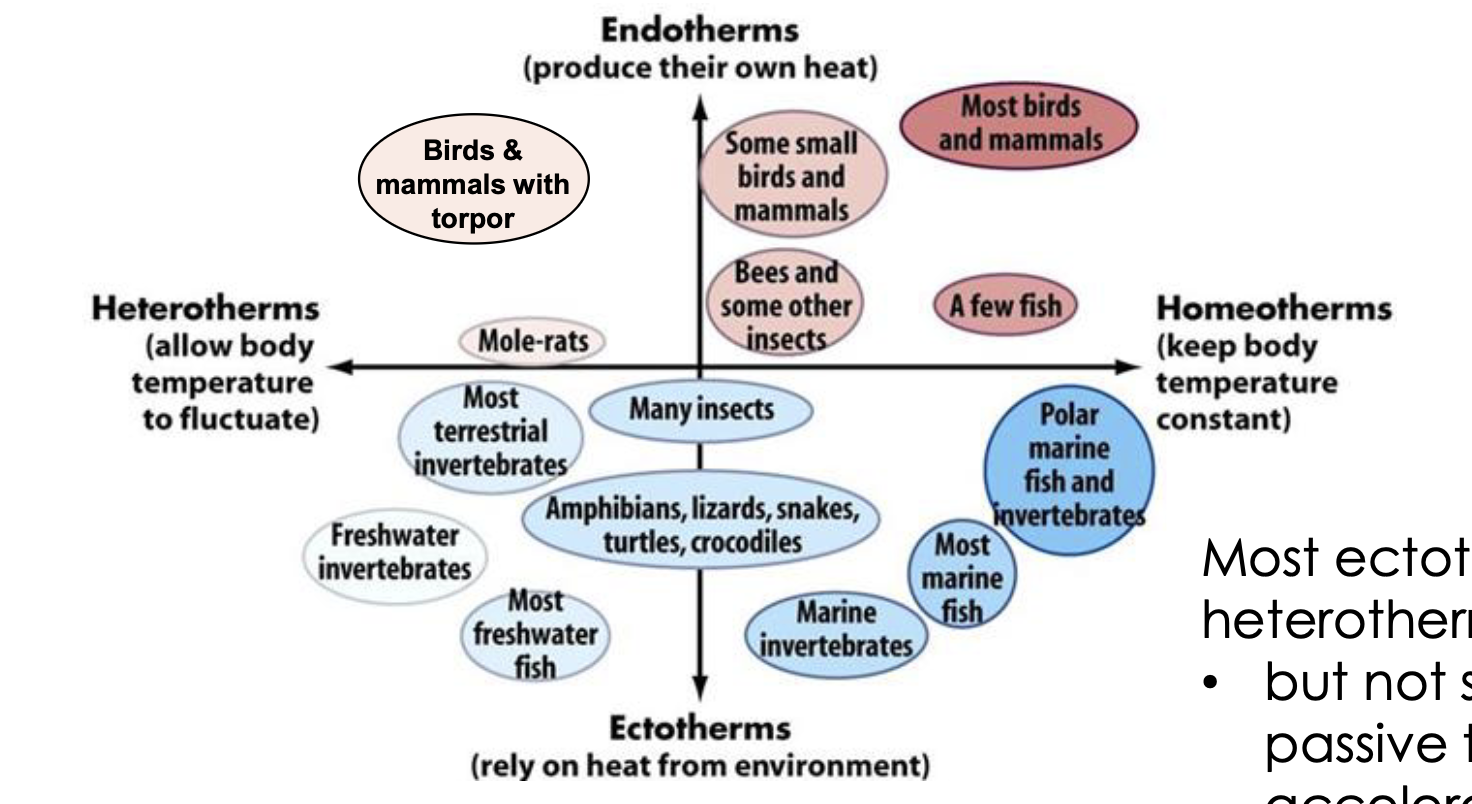
Ectotherm
An animal that relies on environmental heat
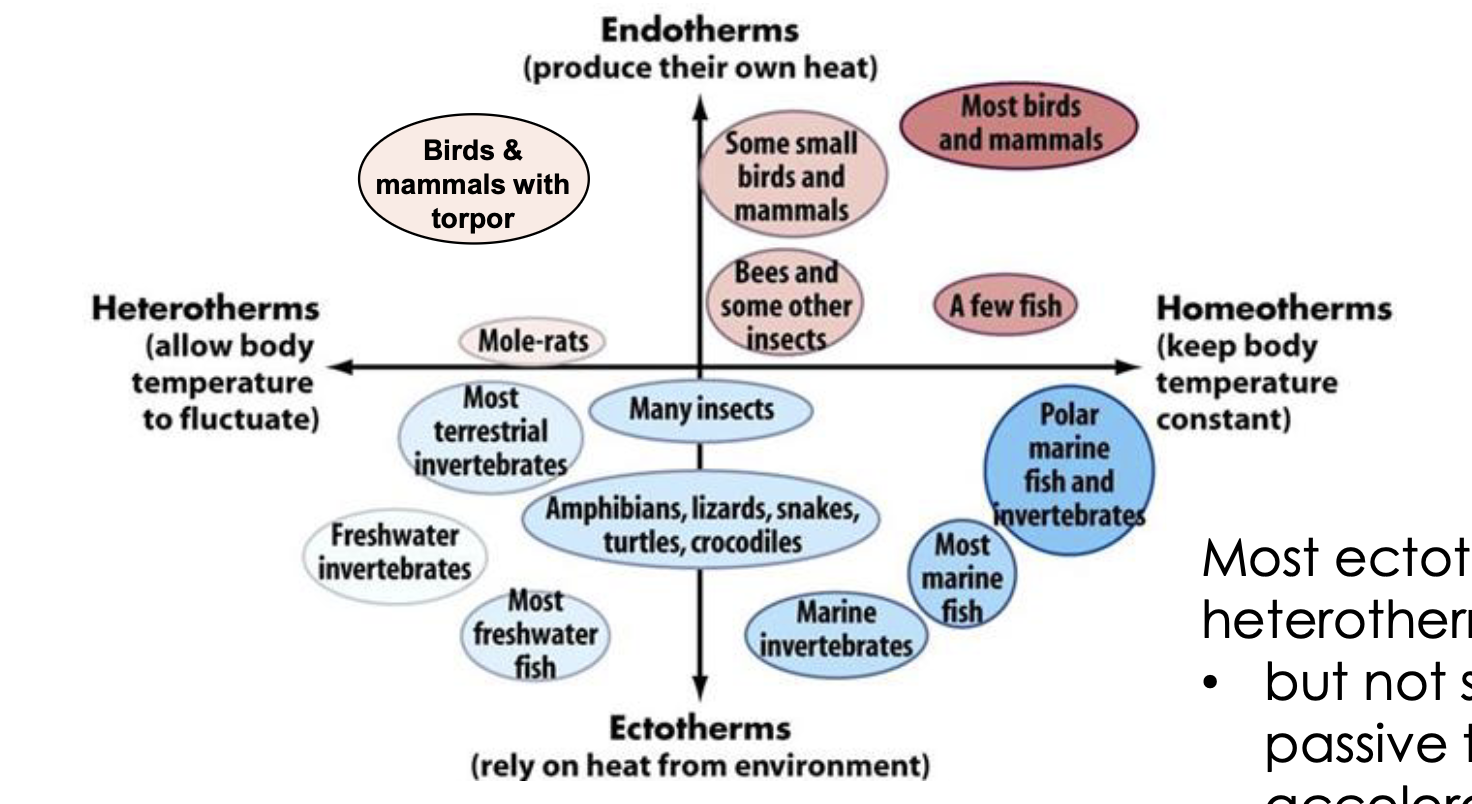
Homeotherm
An organism that maintains a relatively constant body temperature.
Heterotherm
An organism whose body temperature fluctuates significantly.
Radiation (heat exchange)
Emission of electromagnetic waves that transfers heat between surfaces.
Conduction (heat exchange)
Heat transfer by direct contact; depends on medium (water conducts heat better than air).
Convection (heat exchange)
Heat transfer by movement of a fluid or gas over a surface.
Evaporation (heat exchange)
Phase change from liquid to gas that extracts heat (latent heat) from the body.
Thermal Neutral Zone (TNZ)
Range of ambient temperatures where metabolic cost to maintain body temperature is minimal.
Lower Critical Temperature (LCT
Ambient temperature below which an endotherm must increase metabolic heat production or reduce heat loss.
Upper Critical Temperature (UCT)
Ambient temperature above which an endotherm must expend energy to increase heat loss.
Insulation (thermoregulation)
Structural features (fur, feathers, blubber) that reduce heat exchange with the environment.
Pilo/ptiloerection
Fluffing of hair or feathers to increase insulation.
Shivering thermogenesis
Heat production via involuntary muscle contractions.
Non-shivering thermogenesis
Heat production via metabolic activity in brown fat.
Metabolic rate vs. ambient temperature curve (endotherm)
U-shaped relationship showing minimal MRin TNZ and increased MR below LCT and above UCT.
Topt (ectotherm)
Temperature at which physiological performance is maximal.
CTmax
Critical thermal maximum: temperature above which performance falls to zero.
CTmin
Critical thermal minimum: temperature below which performance falls to zero
Behavioral thermoregulation
Ectotherm strategies like basking, shade-seeking, posture changes to control body temperature
Vasoconstriction
Narrowing of blood vessels near the skin to reduce heat loss.
Vasodilation
Widening of blood vessels near the skin to increase heat loss
Counter-current heat exchange
Arrangement where heat transfers from outgoing warm arteries to incoming cool veins to conserve core heat.
Phase change (biological context)
Temperature-driven state changes (e.g., membrane lipid phase) that affect function.
Diet-induced thermogenesis
Heat produced as a result of digestion and metabolism of food
Which of the following is an incorrect pairing of the organismal water budget exchange and an adaptation to reduce water loss?
a.Respiration: increased surface area of nasal
concha/turbinal bones
b.Evaporation: increased sweating
c.Feeding: selecting prey with more water content
d.Excretion: increased urine osmolarity
b, increased sweating does not reduce water loss
Osmoregulation
Physiological processes that maintain water and solute balance by compensating for water loss/gain and keeping proper solute concentrations.
Solute
A substance dissolved in a solvent (e.g., salts, sugars).
Solvent
What dissolves solutes (typically water)
Electrolyte
A solute that dissociates into ions in water (e.g., Na+, K+, Cl-)
Osmolyte
Low-molecular-weight organic compound (e.g., urea, sugars) that affects the properties and osmotic balance of biological fluids.
Homeostasis (water/ions)
Regulation to avoid excess water gain or loss and to maintain appropriate ion concentrations for cellular function
Osmolarity
Total concentration of dissolved particles in a solution; determines net water movement across membranes (measured in mOsm).
Osmosis
Passive movement of water (solvent) from regions of low osmolarity to regions of high osmolarity across a semipermeable membrane.
Hypo-osmotic (hypotonic)
A solution with lower osmolarity than the cytosol; water enters cells causing swelling.
Hyper-osmotic (hypertonic)
A solution with higher osmolarity than the cytosol; water leaves cells causing shrinkage.
Cytosol osmolarity
Typical intracellular osmolarity (~300 mOsm in many animal cells)
Diffusion
Passive movement of solute particles from high to low concentration driven by random motion (Brownian motion)
Fick’s first law
Mathematical expression that diffusion flux depends on diffusion coefficient, membrane area, and concentration gradient (J = KA(C1–C2)).
Passive transport
Movement of molecules down their concentration gradient without metabolic energy (includes simple and facilitated diffusion)
Simple diffusion
Passive transport of small nonpolar molecules (e.g., O2, CO2, lipids) directly across lipid bilayers
Facilitated diffusion
Passive transport of ions or polar molecules via membrane proteins (e.g., channels, carriers, aquaporins)
Aquaporin
A membrane channel protein that facilitates rapid water movement across cell membranes
Active transport
Energy-dependent transport of solutes against their concentration gradient using membrane proteins (e.g., pumps)
Na+/K+-ATPase (sodium-potassium pump)
Primary active transport pump that uses ATP to move Na+ out and K+ into cells, establishing electrochemical gradients
Ionocyte (mitochondria-rich cell)
Specialized epithelial cell with abundant active transporters for uptake or secretion of ions (common in gills)
Water budget
The net balance of water gained and lost by an organism through ingestion, respiration, metabolism, excretion, and evaporation
Respiratory water loss
Water lost during breathing; greater in warm, humidified air and significant for endotherms
Turbinate bones / nasal conchae
Nasal structures that humidify and warm inhaled air, reducing respiratory water loss.
Freshwater (hypo-osmotic) fish strategy
Do not drink; gain water by osmosis across gills; actively uptake Na+ and Cl-; excrete large volumes of dilute urine
Marine (hyper-osmotic) fish strategy
Drink seawater; actively secrete excess Na+ and Cl- across gills; excrete small volumes of concentrated urine.