Likharev Boxed Formulae Ch. 6-8
 Call Kai
 Learn
Learn Practice Test
 Spaced Repetition
 Match
Match Flashcards
 Knowt Play
1/131

Earn XP
Description and Tags
ELECTRODYNAMICS
Name | Mastery | Learn | Test | Matching | Spaced | Call with Kai | Chat |
|---|
No analytics yet
Send a link to your students to track their progress
132 Terms
Faraday induction law integral form

Lenz rule
the magnetic field of an induced current I provides a partial compensation of the change of the original flux in time - so increase the flux through a loop, you get an induced current that works against you
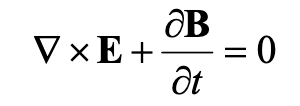
Faraday induction law differential form
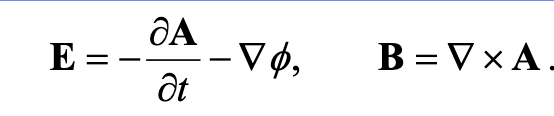
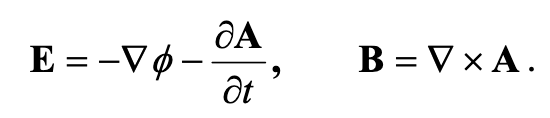
How do the potentials change in electrodynamics? What happens to the scalar potential is it still usable?
It’s not usable anymore!
Variation in magnetic energy

Gibbs potential energy (here you have an external magnetic field)

Quasistatic approximation of electromagnetism Maxwell equations

Skin effect equation and origin
An Ohmic conductor self-shields from an AC magnetic field! This is the skin depth equation, it gives the penetration of the AC magnetic field and the eddy currents j into a conductor only to a finite depth. The electric field is Faraday-induced by the external AC magnetic field and drives the eddy currents j, which in turn induce their own magnetic field that eventually compensates the external one around the skin depth.

Total time-averaged Ohmic power loss (Joule heating) per unit area induced in a conductor by an AC magnetic field

What is the boundary condition relating surface current density to the magnetic field?

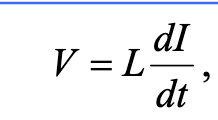
Voltage drop on an inductance coil and where it comes from
Current generates B in the coil, then you get a total magnetic flux, and from Faraday’s law some changing flux with time as you ramp up the current gives you the BACK EMF, which is this V but negative. To push current through the coil against this back-EMF, an external circuit must supply a voltage given by this equation with positive L dI/dt.
What are the Node and Loop rules, and how do they apply to DC vs. AC circuits?
Node: Sumj Ij = 0
Comes from conservation of charge, sum of currents into a node equals zero.
Loop: Sumj Vj = 0
Comes from conservation of energy and a conservative electric field (curl of E = 0)
In AC, it applies to instantaneous values or complex phasors, but strictly requires the lumped-element (quasistatic) approximation.
What is the displacement current density term and what did Maxwell add it to and why?
Well, clearly the quasistatic Maxwell equation curl(H) = j cannot be true in electrodynamics because if you take the divergence of both sides you get div(j)=0 which (continuity equation) doesn’t let us describe charge buildup! So Maxwell proposed adding a term to j, the displacement current, which makes this work.
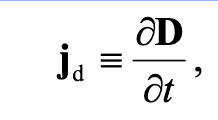
DYNAMIC macroscopic Maxwell equations (and what happens in quantum mechanics to them? How do you get the microscopic equations from them?)
In quantum mechanics, these equations are believed to be strictly valid as relations between the Heisenberg operators of the electric and magnetic fields!
To get the microscopic relations you replace D = ε0E, H = B/μ0

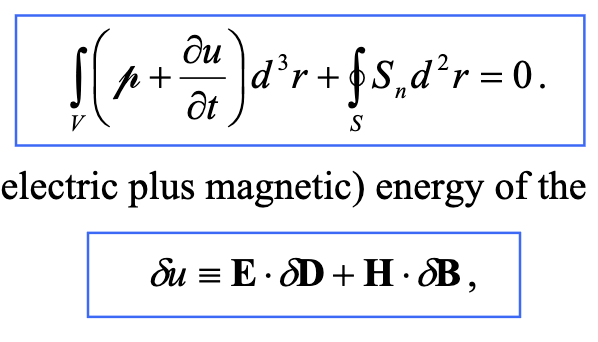
Poynting theorem and what all the letters in it mean, and what the integration of δu becomes when you have a linear, isotropic, dispersion-free medium.
The cursive P is the Ohmic heat dissipation term (j dot E, where j is FREE current), Sn is the NORMAL component of Poynting vector E x H (outward-pointing unit normal vector here from surface S) and it describes the rate of energy escaping through the volume’s surface.
It becomes u = E dot D/2 + H dot B/2 = εE2/2 + B2/2μ
What is the integral form of the Maxwell-Ampere Law, and what specific physical inconsistency does the displacement current term resolve?
For purely static Ampere's Law, the enclosed current must be identical for any surface S bounded by contour C. If C loops around a wire charging a capacitor, a flat surface cuts the wire (Current = I), but a "ballooned" surface passing between the capacitor plates cuts no physical wire (Current = 0). With the displacement current, the integral becomes mathematically independent of the choice of surface limited by the contour C!
Definition of Poytning vector

Definition of the density of the linear momentum of the electromagnetic field and explain its implications
The total momentum of a system is always conserved - say you have a mechanical body with some charge or current and fields due to that; then if the physical sources are turned off, neutralized, or destroyed then the fields detach and propagate away into space as electromagnetic waves. When the field "leaves," the mechanical body that previously anchored it must recoil, it experiences an equal and opposite physical push!

What is the Lorentz gauge condition?
This is a generalization of the Coulomb gauge

What does the Lorentz gauge reduce the dynamic macroscopic Maxwell equations to in terms of the potentials φ, A?

Dynamic Maxwell equations in uniform linear media WITHOUT any field sources

EM wave equations and how they are derived from the source-less dynamic Maxwell equations in uniform linear media, what is the velocity?
It’s very easy, you just take the curl of the original source-less Maxwell equations and use the famous vector identity.
v2 = 1/εμ

Solutions to the source-less wave equations are of the form….

Are the wave equations for E, H in source-less media independent? What about their solutions?
The equations are absolutely independent but the SOLUTIONS are not! If you plug them into the original Maxwell equations you get these conditions.
Z = impedance = E/H = (μ/ε)1/2
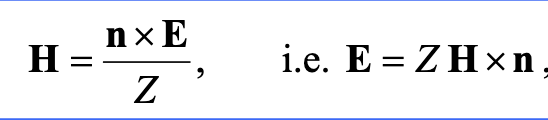
Wave impedance of free space

Energy density and power (per unit area) of a wave in isotropic, linear, source-less medium
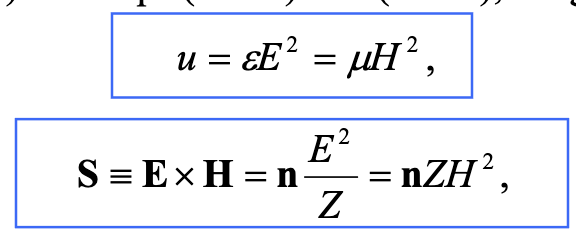
Monochromatic plane wave
fω is complex amplitude, k = 2π/λ and ω = 2π/T where T is time period

In dispersion-free linear, isotropic medium what is the dispersion relation?
It’s linear
Write the formulae for linear, circular, and elliptical polarization
Linear: arguments of complex amplitudes of Eωx and Eωy are equal and so the magnitudes of the complex amplitudes are not equal but the real field components have the same phase.
Circular: the magnitudes of the complex amplitudes are equal but the phases are shifted by either -π/2 or π/2, with left-polarized being ei(φ+π/2) and right-polarized being ei(φ-π/2)
Elliptical: arbitrary complex amplitude magnitude and phase difference

What does the macroscopic polarization of a linear isotropic medium become in electrodynamics?
This IMPLIES that t’ <= t it’s a matter of cause and effect. G is a temporal Green’s function
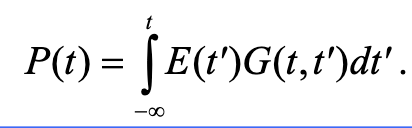
General properties of the temporal Green’s function
For systems without infinite internal “memory”, G should tend to zero at t – t’ —> infinity
If the parameters of the medium do not change in time, the polarization response to an electric field pulse should be dependent not on its absolute timing, but only on the time difference t – t’ between the pulse and observation instants
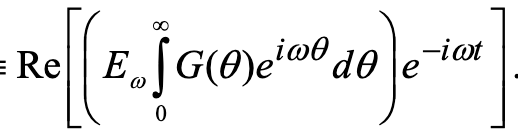
Time dependent polarization P(t) =
The term in parenthesis is Pω and θ = t - t’
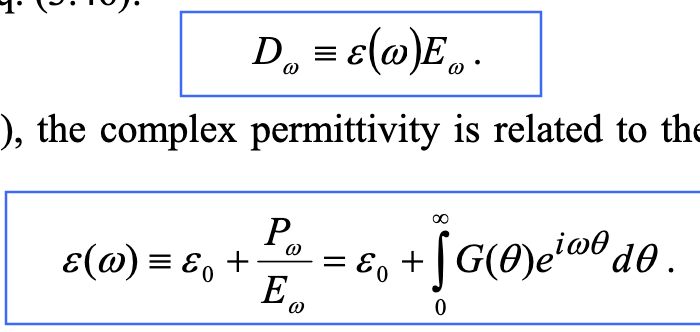
What do electric susceptibility and polarization become in electrodynamics?

What do electric susceptibility and polarization become in electrodynamics?

Frequency-dependent permittivity equations
What are the equations for the wave impedance Z(ω) and wavenumber k(ω) for a monochromatic wave propagating in a linear, isotropic, dispersive medium?

Is the energy density u = E dot D/2 + H dot B/2 = εE2/2 + B2/2μ valid for dispersive media? What about k = ω/v? Is the dispersion relation still linear?
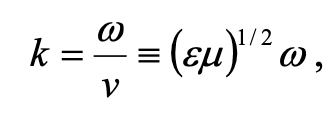
NO. The k = ω/v is still true, but the full dispersion relation is NOT still linear, since now k = ω(με)1/2 where ε=ε(ω) and μ=μ(ω)!
What does k(ω) = k’(ω) + ik’’(ω) physically describe?
k’’(ω) describes the wave attenuation in the medium at ω, and k’(ω) describes the dispersion
Lorentz oscillator model
Atomic or molecular systems respond to Eext especially strongly when the frequency is close to one of the frequencies ωj of quantum interstate transitions in a single atom/molecule. This is the response of externally driven classical harmonic oscillators, generally with non-zero damping. So you solve m(x’’ + 2δ0x’ + ω02x) = qE(t) for xω and use pω = nxω to get the polarization and permittivity.

What is ε(ω) in a plasma?

What does ε(ω) become in the Lorentz oscillator model of charge carriers when you have ω » ωj and δj?

If you have a plasma or a diluted fermi liquid/gas where ω » ωj and δj, what is the dispersion relation and what happens in the two different cases of ω?
ω < ωp : then the permittivity is negative and you get a fully imaginary k and therefore a fully reflected wave
ω < ωp : then the wave is able to pass through

Give the AC conductivity (generalized Drude formula)
This is accurate almost up to optical frequencies.

Kramers-Kronig dispersion relations and what does ε’, ε’’ mean physically?
These are much more general than the Lorentz oscillator model results and require ONLY a causal linear relation between E and P
ε’ gives dispersion/refraction, ε’’ gives absorption/loss/dissipation

If a medium has a sharp absorption peak at some frequency ωj then what is ε’, ε’’?
ε’ gives dispersion/refraction, ε’’ gives absorption/loss/dissipation

For a monochromatic wave at normal incidence, the total reflected wave in the region before it hits the interface is what?
It’s a standing wave!

General monochromatic form for the electric field before and after striking an interface and how do you convert that to the magnitude of the magnetic field?
Divide by Z(ω) the impedance in either region to get the magnetic field, very simple. This applies to BOTH dispersive and lossy media.

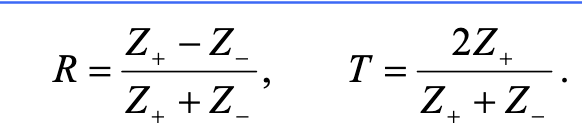
What are the reflection and transmission coefficients in terms of impedance (normal incidence)? How do they change when you have NON-NORMAL impedance?
For TE waves (electric field perpendicular to plane of incidence), Z becomes Z/cos(θ) or Z/cos(θr) for the reflected side
For TM waves (electric field parallel to the plane of incidence), Z becomes Z/sin(θ) or Z/cos(θr) for the reflected side
Remember: - is always incidence, + is in the new medium
Draw a picture of the Fresnel angles θ, θ’, θr. What is refraction?
Refraction is when the transmitted wave CHANGES DIRECTION in the second medium.

Give the two main angle formulae for optics, one is Snell’s law.
θ = incident, θ’ = reflected, r = refracted angle

Index of refraction and what is the physical meaning of its real and imaginary parts n’ and n’’?
n’ describes the phase speed (vp = ω/k = c/n), n’’ is the extinction coefficient and gives the exponential decay of the wave as it propagates

If a wave propagates from a medium with a higher index of refraction to that with a lower one (n- > n+), what is the incident angle at which the refraction angle hits exactly 90 degrees?
The critical angle θc gives you evanescent waves. Then at angles larger than θc you actually get TOTAL INTERNAL REFLECTION since the boundary conditions cannot be satisfied.

What is Brewster’s angle?
This physically gives when the reflected wave’s amplitude goes to zero. The angle is ANGLE OF INCIDENCE. Evaluating the top (TE) branch yields a mathematically impossible result, meaning no real angle exists that prevents reflection UNLESS you are dealing with TM polarized light.

Fresnel equations for polarization of electric field perpendicular to plane of incidence (TE)

Fresnel equations for polarization of electric field parallel to plane of incidence (TM)

2D Helmholtz equations for transmission lines
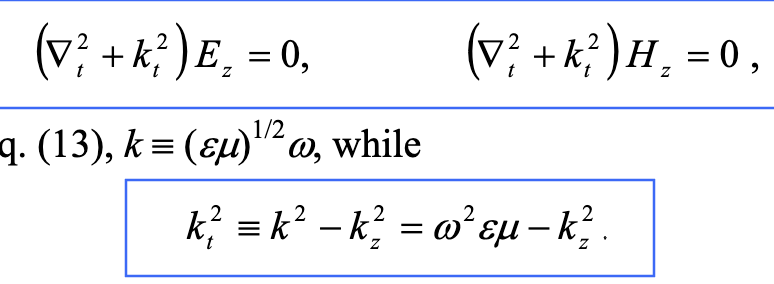
What are the particular solutions to the 2D Helmholtz equations for transmission lines?

Telegrapher’s equations and what they apply to? When are they consistent?
They apply to two conductor transmission lines, here these are the mutual capacitance and inductance per unit length. ONLY consistent if L0C0 = k2/ω2 =εμ.C

Coaxial cable transmission line mutual capacitance/inductance per unit length

What is the universal dispersion relation for uniform metallic waveguides filled with a single homogeneous medium and what is the cutoff frequency physically?
Below the cutoff frequency ωc of each particular mode, the wave cannot propagate in the waveguide

Boundary conditions for metallic waveguides filled with a single homogenous medium
TM mode: here Hz = 0 and therefore Ez|sidewall = 0
TM mode: here Ez = 0 and therefore dHz/dn|sidewall = 0
Angular momentum of E&M field

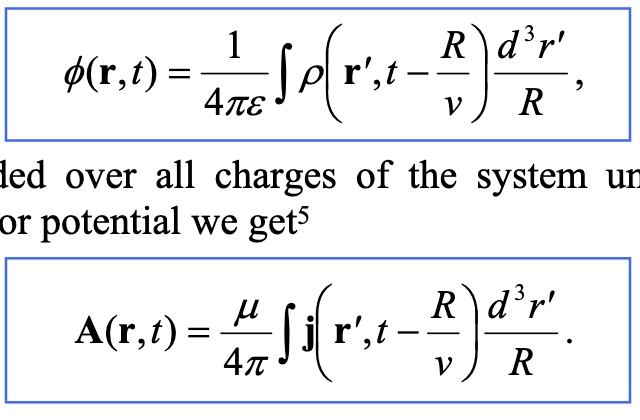
Give the retarded potentials and what the different quantities mean in them
R = r - r’
v is the phase speed of the electromagnetic wave in the medium
Group vs phase velocity, which one is the speed at which information travels?
vp = ω/k and is the rate at which the individual ripples propagate through space
vg = dω/dk and is the speed at which the wave packet, information, and energy propagates
How are Jefimenko’s equations derived?
You take the retarded potentials and plug them into the dynamic scalar and vector potential equations here.
How do you simplify the retarded potentials for the case of a localized source with linear dimensions a << r that has a time-dependent distribution of charges and/or current?
R also becomes approximately r - r’ dot n where n is the unit vector directed toward the observation point
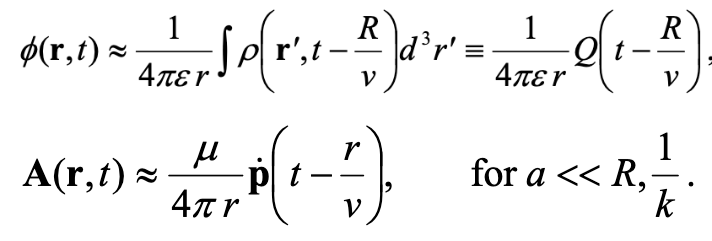
In the far-field zone what is the magnetic field of an oscillating localized source with linear dimensions a << r?

What is the radial component of the electric dipole radiation Poynting vector for an oscillating localized source with linear dimensions a << r? What about the power due to this radial component (known as the Larmor formula) and why is it important?
Here Θ is the angle between d2p/dt2 and n. The power is Z(d2p/dt2)2/6πv2 and the average power is Zω4|pω|2/12πv2 this is important because it is the dominating component of radiation by a localized system of charges

What is the Born approximation for scattering? When is it valid?
The scattered wave field’s effect on the scattering object is assumed to be much weaker than that of the incident wave and is neglected. It is only valid when σ « λ2
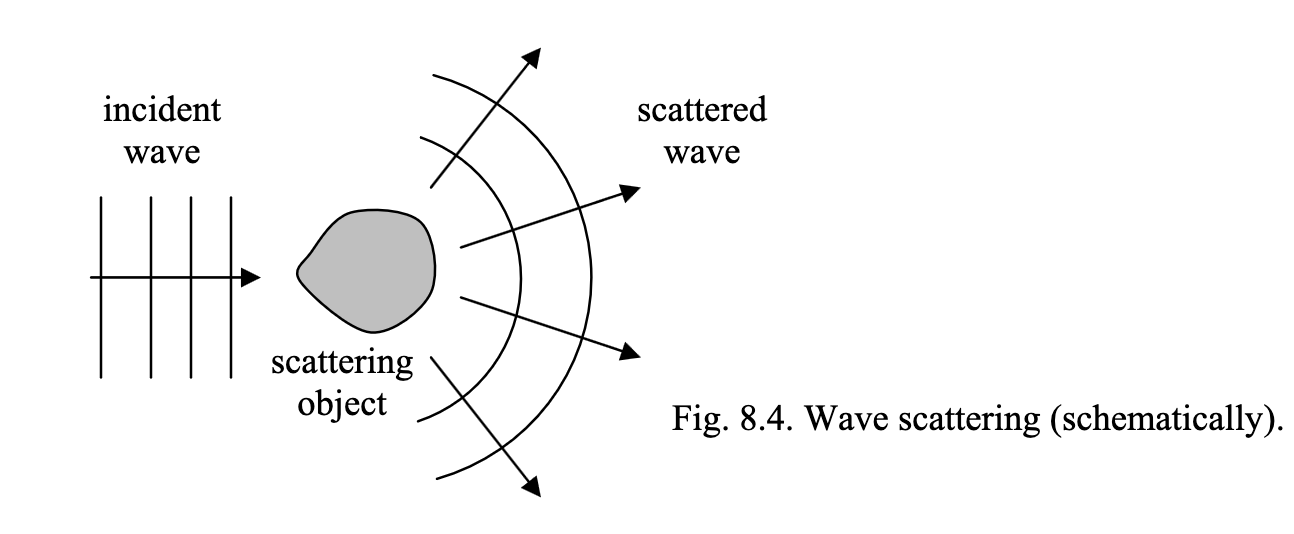
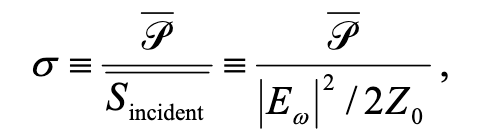
How do you characterize the scattering ability of an object in free space?
Using the total cross section given here (this is the Larmor formula average power). Physically, the cross-section represents the ratio of the total power scattered by the particle to the time-averaged intensity of the incident electromagnetic wave (measured in Watts per square meter). The cross-section represents the effective target area the wave is able to "hit."
What’s the average power from the Larmor formula for a free, charged, classically moving particle in free space?
For a free charged classical particle, d2p/dt2 = q2E(t)/m since md2x/dt2 = qE(t) which is how you get this.

What’s the total cross section for a free, charged, classically moving particle in free space?
It’s the Thomson scattering formula

Does Thomson scattering hold for bound charges like electrons in gas molecules?
Yes but only if the wave frequency ω is much higher than the frequencies ωj of the most important quantum transitions
What is Rayleigh scattering?
Thomson scattering exclusively requires free charges, Rayleigh scattering describes the radiation from bound charges (like electrons within gas molecules), if the number density n is relatively low, where ω « ωj, then approximately p = αE. Then you get an attenuation constant formula here that depends on the dielectric constant κ and the density of molecules.

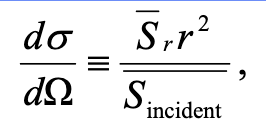
What is interference and diffraction? What describes it?
Both are due to phase difference factors. It is described by the cross section differential, r is the distance FROM the scatterer here and Ω the solid angle.
For a localized source with linear dimensions a << r that has a time-dependent distribution of charges and/or current, when does the dipole magnetic radiation or the quadrupole electric radiation become important? What’s the far-field magnetic field when the dipole magnetic radiation becomes important?
They become important when the dipole moment p becomes zero!

What is the radial component of the magnetic dipole radiation Poynting vector for an oscillating localized source with linear dimensions a << r?
Θ is angle between the direction toward the observation point and the second time derivative of the vector m

For a localized source with linear dimensions a << r that has a time-dependent distribution of charges and/or current, what’s the radiation field of the electric quadrupole radiation?
Here Qj = sumj’=1 to 3 Qjj’ nj’ and these Qjj’ are from Qjj’ = sumk qk(3rjrj’ - r2δjj’)k
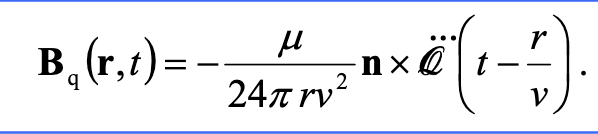
The total power of the electric quadrupole radiation for a localized source with linear dimensions a << r that has a time-dependent distribution of charges and/or current is always…

Galilean transform
PRIMED IS MOVING AT v

Lorentz transform
PRIMED IS MOVING AT v

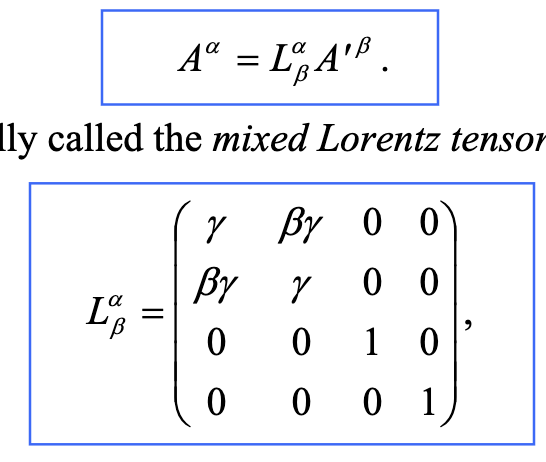
Relativistic parameters β, γ

Length contraction
An object is always the longest (has the so-called proper length l) if measured in its rest frame

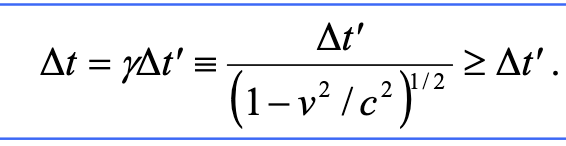
Time dilation
A time interval is longer if measured in a frame (in our case, frame 0) moving relative to the clock, while that in the clock’s rest frame is the shortest possible – the so-called proper time interval
Say your reference frame S’ travels at v (which is only in the x direction) but you have a moving point traveling at u in the rest frame and u' in frame S’, how do you calculate u’?
Here uy will give the same formula for uz

Spacetime 4-vector and the Lorentz transform it obeys
{ct, r} where all the components are x0 = ct, x1 = x, x2 = y, x3 = z and you Lorentz transform them via xj = sumj’=0 to 3 Ljj’ x’j’ but for a general 4-vector you just have {A1, A2, A3, A4}

Lorentz invariance condition for a 4-vector’s norm

Is the scalar product Lorentz invariant and what is it?
YES.

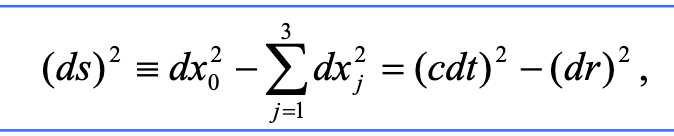
For a 4-vector corresponding to a small interval between two close world events, what is its norm and why is it Lorentz invariant?
Because the norm of a 4-vector IS Lorentz invariant
How do you form a 4-vector from the velocity u of a point?

Action of a free particle (relativistic) and what is action?
The action in classical mechanics is a mathematical functional that assigns a single scalar value to a physical system's entire trajectory through space and time. It represents the accumulated dynamics of the system between an initial and final state and acts as the foundational quantity used to derive the system's equations of motion. Classically action is S = integralt1t2 L(q, qdot, t) dt

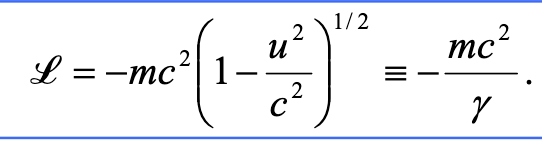
Lagrangian of a free particle
Relativistic momentum and mass

Relativistic relationship between a free particle’s mass and energy

4-vector of energy-momentum
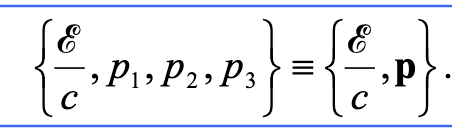
Relationship between the relativistic energy and momentum

Contravariant and covariant 4-vector forms
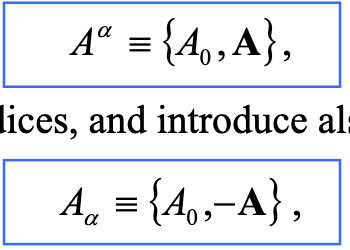
Scalar product in terms of contravariant and covariant parts of a 4-vector

What is required for the norm of a spacetime 4-vector to be conserved?
ALL the components must also be conserved too
How do the contravariant components of 4-vectors change under the Lorentz transform?