pharmacology exam 1
 Call Kai
 Learn
Learn Practice Test
 Spaced Repetition
 Match
Match Flashcards
 Knowt Play
1/150

There's no tags or description
Looks like no tags are added yet.
Name | Mastery | Learn | Test | Matching | Spaced | Call with Kai | Chat |
|---|
No analytics yet
Send a link to your students to track their progress
151 Terms
FDA
part of the US department of health and human services (HHS) that is responsible for how new drugs are researched and brought onto market
grants approval for marketed drugs and sets standards for quality control in drug manufacturing plants
regulates the trade practices of drug companies and determines which can be sold by perscription or OTC
prohibits the false advertising of foods, non prescription (OTC) drugs, and cosmetics
DEA
part of the department of justice
regulates the manufacture and distribution of substances that have a potential for abuse, including opioids (narcotics), stimulants, and sedatives
administers the controlled substances act of 1970
FTC
how things are marketed (truth-not falsely advertising
seuqence of drug development
drug discovery
animal testing (preclinical trials to determine acute and chronic toxicity)
clinical trials (Phase I-IV)
FDA approval
phase I of clinical studies
small and then increasing doses are administered to a limited number of healthy human volunteers
determines biologic effects, metabolism, safe dose range in humans, and toxic effects of the drug
phase II of clinical studies
larger groups of humans are given the drug
adverse reactions are reported to the FDA
phase III of clinical studies
clinical evaluation involving a large number of patients who have the condition for which the drug is indicated takes place
safety and efficacy must be demonstrated
dosage is determined
phase IV of clinical studies
post marketing surveillance
toxicity that occurs in patients taking the drug after it is released is recorded
clinical evaluation of a drug
animal studies begin my measuring both acute and chronic toxicity
process if the preclinical phase and lasts about 3 years
in total takes almost 12 years and $350 million the the time a drug is synthesized in the laboratory to its availability on the pharmacy shelves
Harrison Narcotic Act
1914
federal control of narcotics
established regulations governing the use of opium, opiates, and cocaine
pure food, drug, and cosmetic act
1952
made certain drugs required to be sold by prescription only
controlled substances act
1970
replaced Harrison narcotic act and sets current requirements and standards for writing prescriptions
Omnibus budget reconciliation act (OBRA)
OBRA
pharmacists must provide patient counseling and a prospective drug utilization review (DUR) for Medicaid patients
schedule I controlled substances
heroin
LSD
hallucinogens
no accepted medical use
schedule II controlled substances
Oxycodone
morphine
amphetamine
secobarbital
hydrocodone immediate-release with acetaminophen
ibuprofen hydrocodone extended-release
written prescription with providers signature only, no refills, some states allow for the electronic prescribing
schedule III controlled substances
Codeine (Tylenol 3), buprenorphine (Suboxone), anabolic steroids
prescriptions may be faxed or sent electronically to the pathway, no more than five prescription refills in 6 months
schedule IV controlled substances
Diazepam (Valium), tramadol (Ultram)
prescriptions may be faxed or sent electronically to pathway, no more than five prescriptions in 6 months
schedule V controlled substances
some codeine-containing cough syrups
can be bought over the counter in some states
generic name
“official” nonproprietary name
ex ibuprofen
trade (brand) name
always capitalized and registered trademark intended for easy recognition and marketing purposes
ex Motrin
chemical name
determined by the chemical structure of the compound
code name based on chemical structure
typically used while medication is still undergoing research or being investigated
one
each drug only has _ generic name(s) but may have several trade names (brand names)
drug name categories
chemical name
trade name (brand name such as Motrin, Advil so it is always capital)
generic name (official nonproprietary name - ibuprofen)
labeled use
indicated that the FDA has approved the drug for specific use
off label use
is use outside the stated FDA indications
manufacturer CANNOT mention to practitioner, patient, nor marketing
characterization of drug action
dose-response curve
log dose effect curve
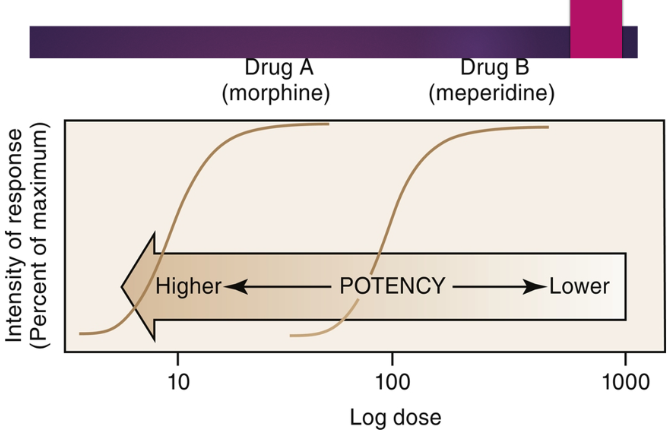
potency
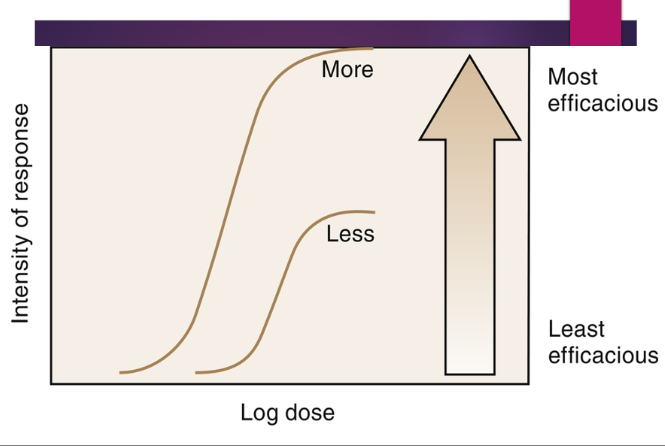
efficacy
potency of drug
the amount of a drug required to produce an effect
more of a less _ drug is needed to produced a desired effect equivalent to that of a more _drug
review proper dose of each drug before prescribed
efficacy
the maximum intensity of effect or response that can be produced by a drug
aka the maximum effect a drug can produce
administering more drug will NOT increase effect but WILL increase the probability of an adverse reaction
not
efficacy and potency of a drug are _ related
therapeutic index
ratio of median lethal dose (LD) to median effective dose (ED)
the greater (wider) the index, the safer the drug is when preventing overdose
= LD50 / ED50
lethal dose (LD50)
is the dose that causes death in 50% of test animal
effective dose (ED50)
is the dose required to produce the desired clinical effect in 50% of test animals
pharmacokinetics
is the study of how a drug enters the body, circulates within the body, is changed by the body, and leaves the body
membrane composed of
lipids
proteins
carbohydrates
physiochemical properties of drug that influence membrane crossing
modes of drug transfer across membrane
physiochemical properties of drugs that influence membrane crossing
lipid solubility
degrees of ionization
molecular size and shape
absorption
Process by which drug molecules are transferred from site of administration to the circulating blood.
Influenced by the following factors
Physicochemical factors
Site of absorption, determined by route of administration
Drug’s solubility. Drugs in solution absorbed more rapidly
factors that affect drug absorption and clinical pharmacokinetics
presence of infection
dose form
drug solubility
blood flow at injection site
disruption
tablet coating or capsule shell
is the passage of drugs into various body fluid compartments such as plasma, interstitial fluids, and intracellular fluids
manner determines how rapidly it produces desired response, duration of response, and in some cases if any response is elicited
drugs move to various sites of the body including site of action and areas where no action is desired
disintegration
tablet or capsule contents break apart
dispersion
concentrated drug particles spread through stomach and intestines
dissolution
drug dissolved in gastrointestinal fluid
oral absorption of drug
absorption takes place primarily in GI tract
rate of absorption dependent upon dose form
disruption, disintegration, dispersion, and dissolution necessary for tablet or capsule
a drug in solution skips these steps and usually has a quicker onset of action
absorption from injection site
Dependent on the solubility of the drug
Lower water solubility slower absorption
Dependent on blood flow at site
Affected by dosage form
Drugs in suspension absorbed more slowly
Drugs in solution absorbed more quickly
Suspension: Solute does not completely dissolve
Solution: Solute completely dissolves in solvent
Drugs that are least soluble will have longest duration of action
distribution of drug is determined by
size of organ
blood flow to the organ
solubility of the drug
plasma-protein binding capacity
presence of certain barriers (blood brain, placenta)
distribution by plasma
Biologic activity of drug is related to concentration of the free, or unbound, drug in the plasma
drugs bound reversibly to plasma proteins
albumin
globulin
Drug bound to plasma protein does not contribute to intensity of drug action. It is considered a storage site. Only unbound, free portion, of the drug is active
If a more highly bound drug administered it can displace the first bound drug increasing it's effect
blood brain barrier
For a drug to enter the CNS must cross
Related to the drug's lipid solubility and degree of ionization
to diffuse transcellularly, the drug must cross the endothelial and basement membrane cells
Must be highly lipid-soluble
placenta
drugs cross by simple diffusion in accordance with their lipid solubility
Most drugs pass easily across the barrier
Therefore, when drugs administered to pregnant mom, they are also administered to the fetus.
drug metabolism
also known as biotransformation, is the body’s way of changing a drug so that it can be more easily excreted by the kidneys
many drugs undergo metabolism in the liver
active to inactive
inactive to active
active to active
first pass effect
When drugs are administered orally, are absorbed through intestines, and then pass through the hepatic portal circulation, which can inactivate some drugs. The drug passes through the liver first, then it circulates systemically. The amount of metabolization varies.
Drugs with a high first pass effect require a larger oral to parenteral dose ratio.
half life
The time it takes for the concentration of a drug to fall to one-half (50%) of its original blood level
It takes 4-5 half-lives for a drug to be considered eliminated from the body because 3%-6% remains after 4 or 5 half-lives
Conversely it takes 4-5 half-lives of repeated dosing for a drug level to build up to a steady state.
Steady state the point at which the rate of drug input equals the rate of drug elimination.
steady state
the point at which the rate of drug input equals the rate of drug elimination.
cytochrome p-450 induction and inhibition
A microsomal enzyme system
Can be induced to speed up drug metabolism
Can be inhibited to reduce or slow down drug metabolism
Divided into isoenzymes
Induction (decreases drug levels)
Inhibition (increases drug levels)
induction
stimulates production of microsomal enzymes for a certain drug, thus decreasing that drugs effectiveness
decreases drug levels by increasing metabolism
inhibition
Slow or block metabolism of certain drugs. Blood levels and action of the drugs metabolized by these enzymes are increased
increase drug levels by decreasing metabolism
enterohepatic circulation
Most drugs absorbed by intestines, distributed through serum, pass to specific and non-specific sites of action, arrive in liver, are metabolized, and excreted by the KIDNEYS
With enterohepatic circulation all of these steps are the same UNTIL the drug is metabolized. The metabolite is secreted by the bile into the intestines. The metabolite is broken down by enzymes which release the drug, then reabsorbed, and process repeats losing a small amount of drug each time
major excretory organs
kidney
liver
lungs
adverse effects
clinically undesirable reactions
Undesirable response to drug; potentially harmful; occurs at usual therapeutic doses
toxic reaction
excessive desire reaction
predictable
dose-related
acts on target organs
extensions of pharmacologic effects
side effect
dose related, not part of desired therapeutic outcome
predictable
acts on non target organs
idiosyncratic reaction
genetically related abnormal response
drug allergy
immunologic response resulting in rash or anaphylaxis
clinical manifestation of adverse reactions
Exaggerated effect on target tissues
Effect on nontarget tissue
Teratogenic effect
Local effect
Drug interactions
Hypersensitivity
Idiosyncrasy
Interference with natural defense mechanisms
factors that affect drug metabolism
impaired liver function (liver disease)
Hepatic portal circulation (kidney disease)
Drugs and environmental substances
Inhibitors of cytochrome P450
factors affecting drug action
Liver disease
Kidney disease
Age
Body weight
Genetics
Drug interactions
teratogens
are agents that cause congenital malformations and development abnormalities if introduced during gestation
drugs safe to use during pregnancy
penicillin
erythromycin
acetaminophen
local anesthetic lidocaine
drugs contraindication during pregnancy
tetracycline
nonsteroidal antinflammatory agents
benzodiazepines
metrodiazole
hypersensitivity reactions
allergic reactions
occurs when the immune system of a patient responds to the drug administered
neither dose dependent nor predictable
type I hypersensitivity reaction
immediate hypersensitivity: anaphylaxis
IgE (histamine) mediated
anaphtlactic shock, rhinitis, asthma, urticaria, dermatitis, hypotension, bronchospams, laryngeal edema, cardiac arrythmias
type II hypersensitivity reactions
cytotoxic/cytolytic
complement-dependent reactions involving either immunoglobulin G (IgG) or immunoglobulin M (IgM) antibodies
onset is within hours or a couple of days
type III hypersensitivity reaction
arthus, immune complex, serum sickness
usually mediated by IgG antibodies
develop 4-10 days after exposure, and can become chronic if continued exposure to antigen
manifested as serum sickness, urticarial skin eruptions, arthralgia, arthritis, lymphadenopathy, and fever
type IV hypersensivity reactions
delayed hypersensitivity
reactions are mediated by sensitized T lymphocytes and macrophages
time of onset is 2-3 days
contact dermatitis caused by topical drug, poison ivy, metal allergies
autonomic nervous system anatomy
sympathetic autonomic nervous system (SANS - fight or flight)
parasympathetic autonomic nervous system (PANS- rest and digest)
both consist of
consists of afferent (sensory) fibers (whats happening)
central integrating areas (lets coordinate info)
efferent (peripheral) motor preganglionic fibers (what is happening)
postganglionic motor fibers (heres what needs to happen)
sympathetic autonomic nervous system anatomy
Thoracic (T1) to lumbar (L2)
Adrenal medulla (kidneys)
Epinephrine
Norepinephrine (NE)
Preganglionic fibers exit spinal column and join sympathetic chain on either side of vertebral column
Forms multiple synaptic connections with post ganglionic cell bodies
Produces a more diffuse effect
parasympathetic autonomic nervous system anatomy
(head and butt)
cell bodies in the CNS give rise to preganglionic fibers
cranial nerves
III oculomotor nerve
VII facial nerve
IX glossopharyngeal nerve
X vagus nerve
sacral (S2-S4) segments of spinal cord
preganglionic fibers extend almost to innervated organ
PANs and SANs relationship
The divisions of the ANS tend to act in opposite directions
PANS is concerned with conservation of body processes
SANS is designed for emergencies (fight-or-flight response)
Almost all body tissues are innervated by the ANS, with many parts receiving both parasympathetic and sympathetic innervation
autonomic nervous system
is part of the peripheral nervous system and regulates involuntary body functions including
heart rate, blood pressure, breathing, digestion, salivation, pupil size, and sweating
automatic modulating system for many bodily functions
help maintain homeostasis (stable internal environments) in which the body is always trying to achieve
sympathetic nervous system
prepares the body for stress
increases heart rate
dilates pupils (mydriasis)
decreased salivation (transforms it to thicker, viscous saliva)
inhibits digestion
dilates bronchi
norepinephrine is the neurotransmitter released from post ganglionic nerve
short preganglionic nerve
parasympathetic nervous system
maintains normal body functions and promotes recovery
conserves energy
decreases heart rate
constricts pupils
increases salivation (copious watery saliva)
stimulates digestion
constricts bronchi
releases the acetylcholine neurotransmitter at both pre and postganglionic fibers
adrenergic receptors (sympathetic system)
Alpha-1 (a1)
Beta- 1 (B1)
Beta- 2 (B2)
Alpha-1 adrenergic receptor
stimulation results in smooth muscle excitation or contraction causing vasoconstriction
located in skin and skeletal muscle
vasoconstriction
increased blood pressure
pupil dilation
Beta-1 adrenergic receptors
located in the heart
increases heart rate
increased cardiac output overall
excitation causes stimulation of the heart muscle
Beta- 2 adrenergic receptors
stimulation results in smooth muscle relaxation
located in lungs and skeletal muscle
bronchodilation
vasodilation
cholinergic (parasympathomimetic) agents
mimics parasympathetic system by directly acting like acetylcholine at receptor sites
used for xerostomia and sjogren syndrome to increase salivation and sweating, can also be used to treat glaucoma by contricting pupils
examples: Choline derivatives and Pilocarpine (Salagen)
Indirect acting: Causes increase in amount of acetylcholine indirectly
Inhibits acetylcholinesterase (AChE)
overall increase in Ach and causes a mimicked effect of parasympathetic ANS
cholinergic agents adverse effects
S = salivation (excessive)
L = lacrimation
U = urination
D = defecation
Large doses = Neuromuscular paralysis
excessive salivation, sweating, bradycardia, and bronchoconstriction!
toxic doses can result in mental confusion
Pralidoxime and atropine used to treat OD of cholinesterase inhibitors
eye pharmacological effects of cholinergic (parasympathomimetic) agents
Miosis (pupil constriction) cause cycloplegia-paralysis of ciliary muscles and loss of visual accommodation.
Decrease intraocular pressure (treat glaucoma- resting)
parasympathomimetic medications
pilocarpine
cevimeline
contraindications of cholinergic (parasympathomimetic) agents
Bronchial asthma
Hyperthyroidism
GI or urinary tract obstruction
Severe cardiac disease
Myasthenia gravis treated with neostigmine
Peptic ulcer
anticholinergic (parasympatholytic) agents
Cholinergic blocking agents that prevent acetylcholine action at postganglionic parasympathetic nerve endings
examples include atropine and scopalamine
Block acetylcholine action on smooth muscle, glandular tissue, and the heart which mimic effects of sympathetic ANS
Antimuscarinic agents (block muscarinic receptors)
may impose dry mouth, increased heart rate, and reduced secretions
patients may have increased caries risk and require xerostomia management
anticholinergic (parasympatholytic) medications
atropine
scopolamine
adverse effects of anticholinergic (parasympatholytic) agents
Xerostomia
Blurred vision
Photophobia
Tachycardia
Fever
Urinary and gastrointestinal stasis
Hyperpyrexia and hot, dry, flushed skin caused by lack of sweating
Anticholinergic Toxicity>Signs of CNS excitation
Delirium, hallucinations, convulsions, respiratory depression.
contraindications of anticholinergic (parasympatholytic) agents
Glaucoma- angle closure (narrow angle)
Prostatic hypertrophy
Intestinal obstruction
Urinary obstruction or retention
Cardiovascular disease- agents block the vagus nerve, resulting in tachycardia
primary uses of anticholinergic (parasympatholytic) agents
Preoperative medication
Reduce saliva and bronchial mucus
Prevent cardiac slowing from general anesthesia
Treatment of GI disorders
Ophthalmologic examination
Reduction of Parkinson-like movements
Only used occasionally today
Motion sickness
Transdermal patch
mixed acting adrenergic drug
(ex. Ephedrine)
can either directly stimulate the receptor, or release endogenous NE
indirect acting adrenergic drug
(ex. Amphetamine)
release endogenous NE to produce a response
direct acting adrenergic drug
NE, epi, isoproterenol act directly on the receptor site by stimulating the receptor
catecholamine enzymes responsible for epinephrine and NE metabolism
monoamine oxidase (MAO - sits inside nerve endings on outer layer of mitochondria)
catechol-o-methyltransferase (COMT - floats freely in cytoplasm)
Mydriasis
pupil dilation
termination of action of adrenergic drugs
NE is primarily terminated by reuptake into presynaptic nerve terminal
2 enzyme systems involved in metabolism of NE and epinephrine
Mono-amine Oxidase (MAO)
Catechol-O-methyltransferase (COMT)
dental hygiene considerations for adrenergic (sympathomimetic) agents
Take BP and pulse
Take detailed medication/health histories
Lower doses of a vasoconstrictor
adrenergic (sympathomimetic) agents
play important role in the treatment of anaphylaxis and asthma
are added to local anesthetics as vasoconstrictors to prolong action
produce CNS excitation, increase the force and strength of contraction in heart, vasoconstriction, increased blood pressure, mydriasis, relaxation of the bronchial smooth musce (treatment for asthma), mucous secreting cells of submandibular and sublingual glands are stimulated to release small amonuts of thick, biscous saliva