3. Archaea and Eukaryotes: Medical Micro
 Call Kai
 Learn
Learn Practice Test
 Spaced Repetition
 Match
Match Flashcards
 Knowt Play
1/19

There's no tags or description
Looks like no tags are added yet.
Name | Mastery | Learn | Test | Matching | Spaced | Call with Kai | Chat |
|---|
No analytics yet
Send a link to your students to track their progress
20 Terms
Archaea and Eukarya Commonalities with all cellular life?
DNA
Ribosomes
Membrane
Central Metabolism
What sets Archaea apart from them?
Exists in extreme environments
Lipid membrane is structurally different
Methanogenesis
Cell boundary layers: cell membrane, s-layer
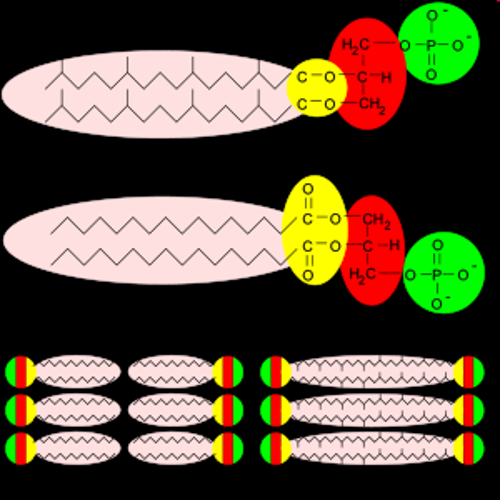
Archaea membrane difference vs bacteria
Archaea:
fatty acid chain have additional branches
may have a lipid membrane that connects all the way instead of a bilayer
Glycerol diethers form lipid bilayers: glycerol tetraethers form lipid monolayers
Bacteria:
Ester-linked phospholipids and hopanoids form a lipid bil-layer
Archaea cell wall vs Bacteria cell wall
Archaea - cell wall is called “s-layer.”
Made up of proteins or glycoproteins
Contains a polymer called pseudomurein
Bacteria cell wall is made up of peptidoglycan
What are methanogens? What is anaerobic?
Methanogens - bacteria that produce methane
Anaerobic - no oxygen
Additional Archaeal structures?
Archaellum
Cannulae
Hami
Archaellum function vs Flagella function: Differences and similarities
Archaellum and Flagella similarities:
Promote movement through the environment
utilize an ion gradient to initiate rotation
Differences:
Archaellum: Solid Structure while flagella is hollow
Archaellum has different subunits while flagella has the same
Archaellum has a less defined hook while flagella has a defined hook
Archaellum will cause a forward and reverse in direction while flagella will cause a tumble when rotating clockwise
Cannulae?
Hollow structure
Unknown function
Grow with cell divison
Aid in production of multicellularity
Hami
Long filaments that has hooks at the end
Biofilm and adhesion formation
Fairly heat stable
Plant cell wall is made up of?
Cellulose (made up of chains of glucose)
Another type of “cell wall” in the eukaryotic domain?
Fungal cell wall: made up of chitin (main exoskeleton of bugs)
Bacteria vs Eukaryote DNA structure
Bacterial DNA:
circular DNA
Single chromosome
Eukaryotic DNA:
Linear
Multiple chromosomes
Eukaryotes Cilia?
Beats back and forth to promote movement

Cellular reproduction of the 3 domains?
Bacteria and Archaea:
Binary fission: asexual reproduction
Eukaryotes:
Mitosis: Chromosomal replication and cell replication
Meiosis: Sexual reproduction
Endosymbiosis meaning? What are some evidence proving this?
Mutually beneficial relationship between two organism where one lives inside the other
Evidence:
Plastids and mitochondria contain circular DNA without histones
Bacterial-type RNA polymerase involved in organelle transcription
70s Ribosomes
Division by binary fission inside the cell
16S rRNA sequence homolgy roots each in particular group of GM - Bacteria
(Mito with aplha-proteobacteria and plastids with cyanobacteria)
Size of DNA molecules in mitochondria and plastids are smaller than free living bacteria due to Genome Reduction. Why?
Many genes were not required any longer within the calm cytoplasm.
How can we treat Malaria?
We target the plastid
80s vs 70s ribosomes
70s is bacterial while 80s is eukaryotes
16s rRNA vs 18s rRNA
16s is bacteria while 18s is eukaryote