universe and the earth pt. 1 (mod #2)
 Call Kai
 Learn
Learn Practice Test
 Spaced Repetition
 Match
Match Flashcards
 Knowt Play
1/53

Earn XP
Description and Tags
🍂
Name | Mastery | Learn | Test | Matching | Spaced | Call with Kai | Chat |
|---|
No analytics yet
Send a link to your students to track their progress
54 Terms
singularity
FORMATION OF THE UNIVERSE:
infinitely small region of space with zero volume and no dimensions;
this was the state of the universe before the Big Bang — it simply “was”
Big Bang Theory (Georges Lemaitre)
FORMATION OF THE UNIVERSE:
first proposed by _______ in the 1920s;
model that describes how the universe expanded from an initial state of extremely high density and temperature

93.5 billion light years
UNDER BIG BANG THEORY:
this is the diameter of the observable universe;
it’s increasing about 1.96 million km/s (6.5x faster than the speed of light)
Hubble’s Law
UNDER BIG BANG THEORY:
Galaxies move away from Earth at speeds proportional to their distance causing redshift
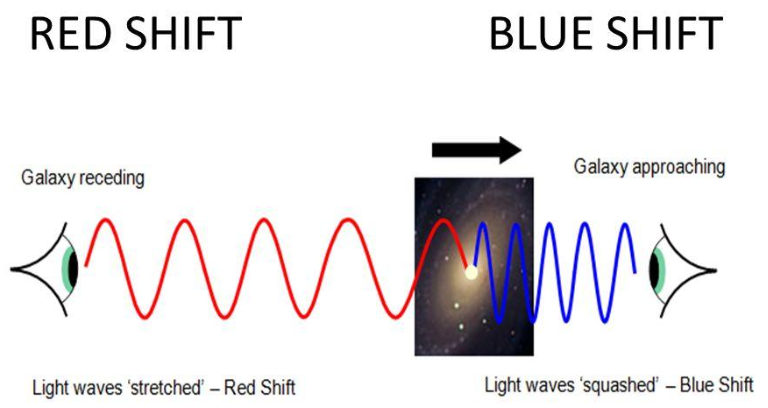
redshift
UNDER BIG BANG THEORY:
according to Hubble’s Law, _____ is the increase in wavelength of electromagnetic radiation from an object
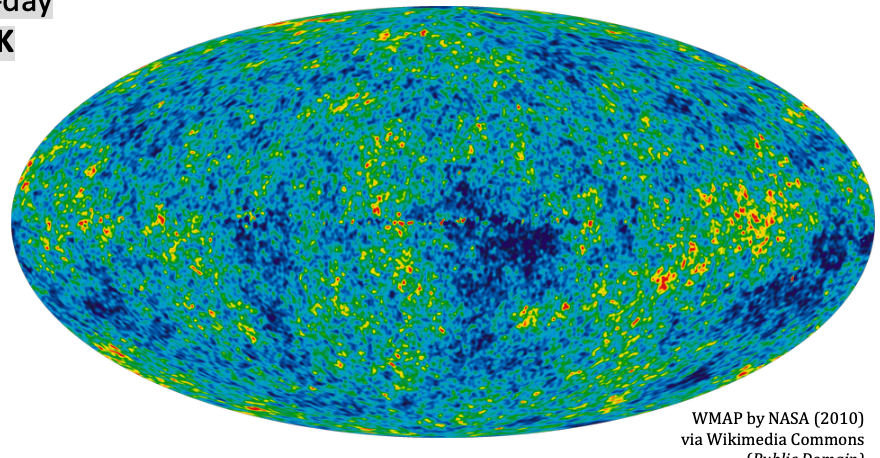
Cosmic Microwave Background Radiation
EVIDENCE OF BIG BANG THEORY:
Relic electromagnetic radiation from the Epoch of Recombination where the universe is 3000 K;
Redshifted to present-day
CMB radiation: 2.725 K
Abundance of Primordial Elements
EVIDENCE OF BIG BANG THEORY:
Hydrogen and Helium make up nearly all the nuclear matter
Big Bang Nucleosynthesis: H, He and trace Be, Li

Nebular Hypothesis (Immanuel Kant & Pierre Simon de Laplace)
FORMATION OF THE UNIVERSE:
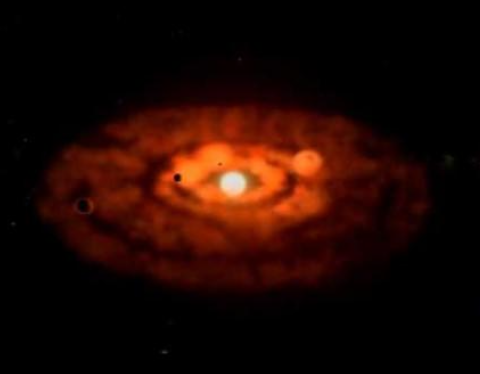
1. Sun, planets and objects in the Solar System formed from nebular material 4.6 (4.571) billions years ago;
Solar System began as a giant cloud of molecular gas and dust;
Nebular Hypothesis, Protoplanetary Disk
FORMATION OF THE UNIVERSE:
this hypothesis contains the following:
3. Rotating gas-dust cloud began to contract due to gravity;
Most material concentrated in the center to later form the Sun;
rest of the matter flattened out into the ________
hydrogen & helium
UNDER NEBULAR HYPOTHESIS:
the Sun is a main-sequence star composed mostly of ___ (~73%) and ____ (~25%) located at the center of the Solar System
comprises 99.86% of the mass of the Solar System

stellar nucleosynthesis
UNDER NEBULAR HYPOTHESIS:
this refers to the ______ of chemical elements by nuclear fusion within stars
H, He → … Fe, Ni
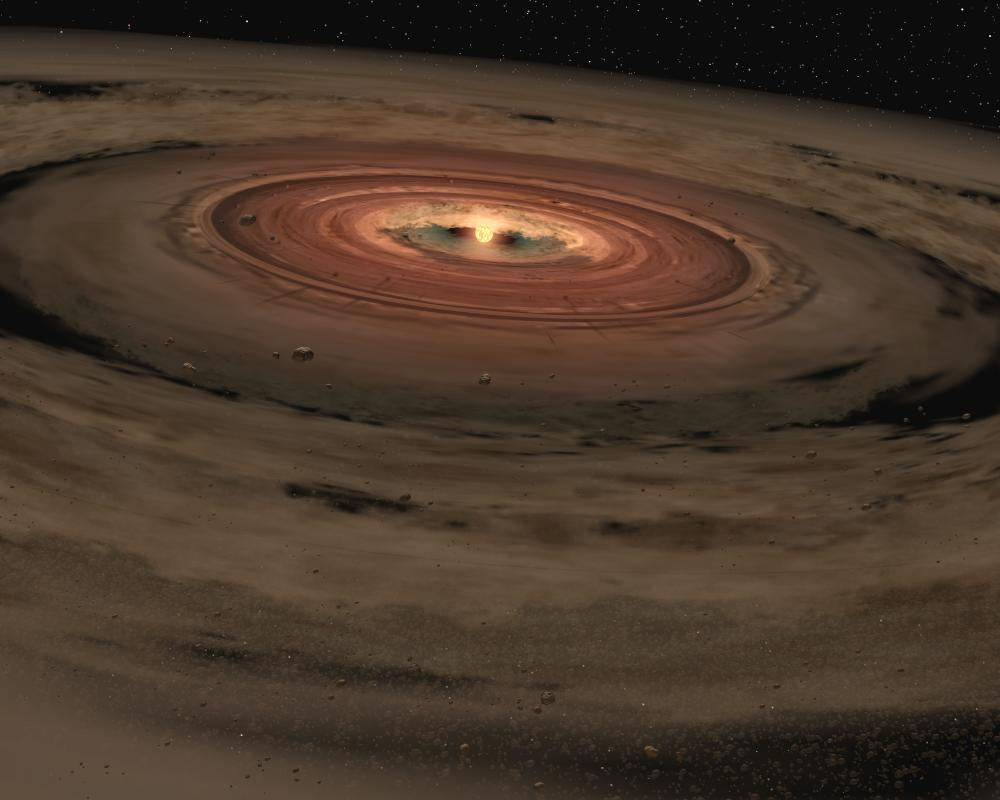
protoplanetary/accretionary disk
UNDER NEBULAR HYPOTHESIS:
refers to a rotating disc surrounding a young newly formed star;
electrostatic & gravitational interaction cause the dust and ice grains to condense and accrete into Planetesimals (kilometer-sized)
Planetisimals, Planetary embryos
UNDER NEBULAR HYPOTHESIS (PROTOPLANETARY DISK):
these are condensed from dust and ice grains due to electrostatic and gravitational interaction;
they then accrete to _____ _____ (moon-sized) that will collide and merge with each other to form the Terrestrial Planets
frost line
UNDER NEBULAR HYPOTHESIS (PROTOPLANETARY DISK):
this is the distance from a central protostar where it’s cold enough for volatiles to condense into solid ice grains
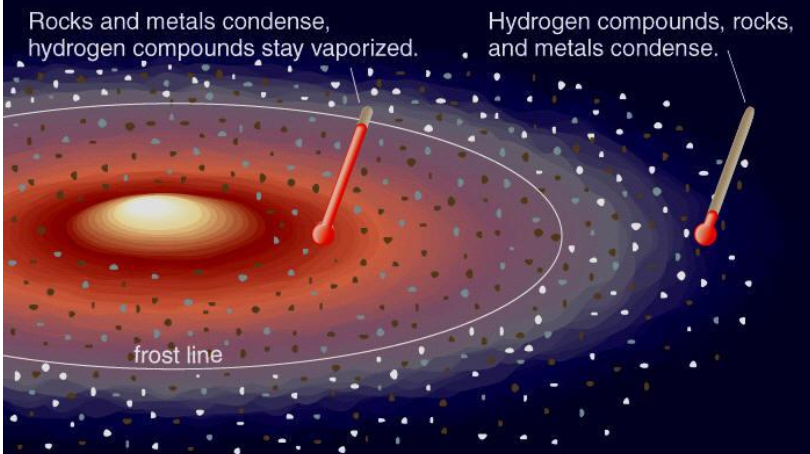
False; should be giant (jovian) planets
TRUE OR FALSE:
Planetary embryos made of ice that are more massive than those in the inner part, after attaining enough mass, begin to accumulate gas from the disk to form the terrestrial (inner) planet.
terrestrial (inner) planets
UNDER NEBULAR HYPOTHESIS (SOLAR SYSTEM):
rocky, composed mostly of silicates (Si, O) and metals (Fe, Ni) and lies within the frost line (less than 5 AU ~ 700 million km)
Mercury, Venus, Earth and Mars

giant (jovian) planets
UNDER NEBULAR HYPOTHESIS (SOLAR SYSTEM):
composed of gases (H, He) and ice, and make up 99% of the mass of objects that orbit the Sun
Jupiter, Saturn, Uranus and Neptune
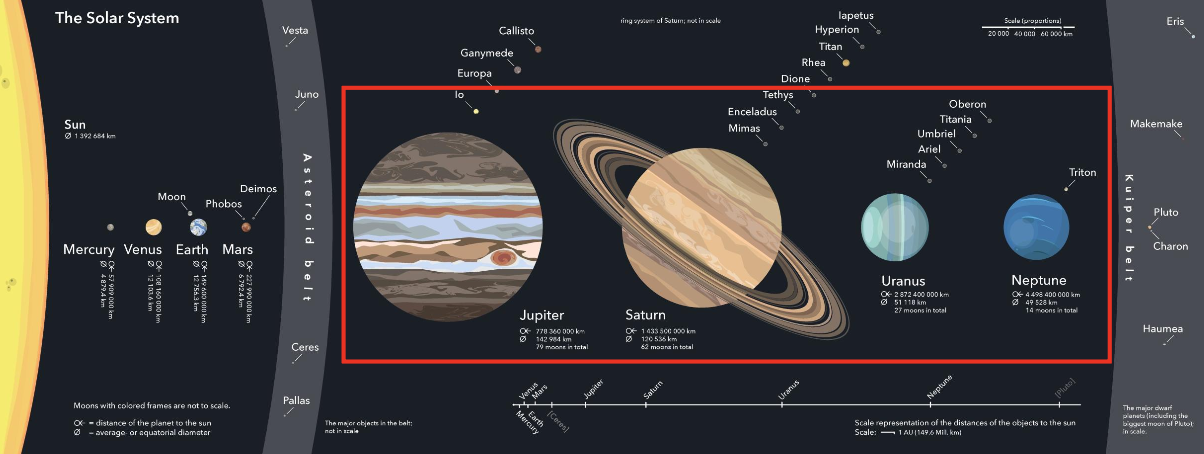
asteroid belt; meteoroid
UNDER NEBULAR HYPOTHESIS (SOLAR SYSTEM):
belt of small bodies composed of refractory rock and metals located between Mars and Jupiter
______: asteroid smaller than 1 m
Kuiper Belt
UNDER NEBULAR HYPOTHESIS (SOLAR SYSTEM):
disk composed of small bodies of rocks and ice (frozen volatiles like water, ammonia and methane) extending from the orbit of Neptune to ~50 AU from the Sun

Proto-earth
FORMATION OF THE EARTH:
this continued to accrete materials from the protoplanetary disk forming a body with relatively uniform composition
True
TRUE OR FALSE:
Heating caused the melting of materials in the protoplanet
Collision of accreting materials
Heat from the Sun absorbed by the Earth
Contraction due to gravity
Decay of radioactive materials.

siderophile, lithophile
FORMATION OF THE EARTH (DIFFERENTIATION):
*500 million years after earth formed (Hadean eon)
Mobilization of denser Fe and Ni (_____) to migrate towards the center of the planet, forming the core – Iron Catastrophe
Lighter and less dense silicates (_______; Si, O with Mg, Al, Ca, Na, K) rose to the surface forming the Mantle and the Crust

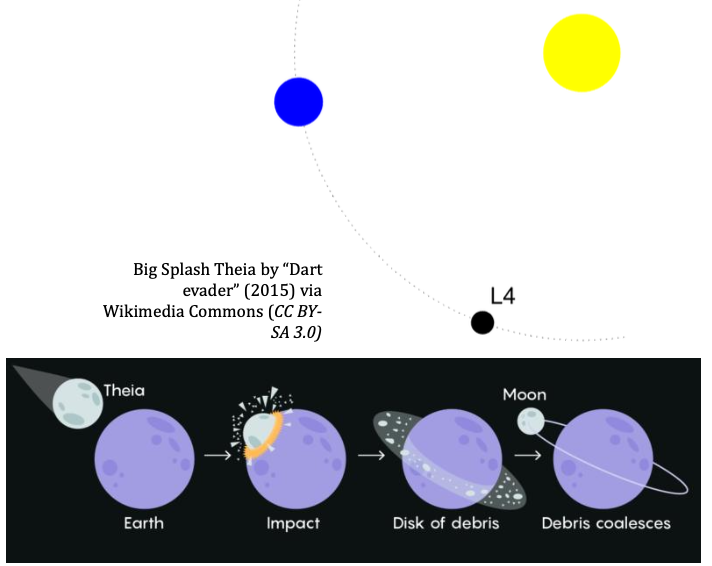
Giant-Impact hypothesis, Theia
FORMATION OF THE MOON:
Moon formed from the collision of the ancient planetesimal _____ with the proto-Earth around 4.5 billion years ago
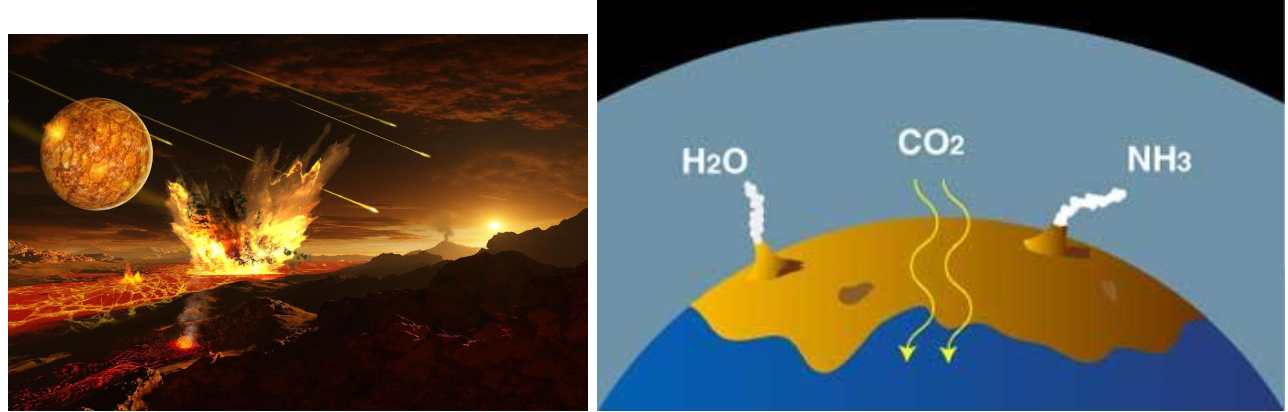
origin of the atmosphere
FORMATION OF EARTH:
another stage of differentiation was the rise of the gasses towards the surface after being trapped in the interior

Step 1: hydrogen & helium (atmophile elements)
ORIGIN OF ATMOSPHERE:
Step ___: 4.5 billion years ago, Primordial gases lost to space due to solar wind;
____ Atmosphere: _____ & _____ (atmophile elements)
Step 2: CO2, NH4, CH4, H2O (GHG)
ORIGIN OF ATMOSPHERE:
Step ___: 4.0 billion years, ago Volcanic venting (venting, outgassing, degassing) and gas capture of volatiles released from icy comets;
____ Atmosphere: _____ & _____ (______ elements)
Step 3: volcanic venting
ORIGIN OF ATMOSPHERE:
Step ___: Steady addition of gases from volcanoes (_____ ____)
Step 4.0: cyanobacteria
ORIGIN OF ATMOSPHERE:
Step ___: 3.5 billion years ago, ______ (blue-green algae) developed photosynthesis and began converting CO2 into O2
Step 4.1: Great Oxidation event
ORIGIN OF ATMOSPHERE:
Step ___: refers to what happened ~2.4 billion years ago where there was a rise of O2 in the atmosphere
comets, volcanic outgassing
ORIGIN OF OCEANS (HYDROSPHERE):
oceans may have began forming around 4.4 billion years ago;
hydrosphere was the result also of volcanic venting and gas capture;
Source of Water: ______, _____ ______
AGE OF EARTH (EARLY ESTIMATES):
Based on biblical accounts (Genesis, Old Testament);
Estimated by Archbp. James Ussher (1650) based on successive generations
AGE OF EARTH (EARLY ESTIMATES):
Proposed by Georges Louis Leclerc, Comte de Buffon (1788);
Based on the cooling rate of heated iron spheres
AGE OF EARTH (EARLY ESTIMATES):
Proposed by William Thomson (Lord Kelvin) (1897);
Based on estimated cooling rate of rocks by conduction
Saltiness of the Oceans → 100 million years
AGE OF EARTH (EARLY ESTIMATES):
proposed by John Joly (1899);
Based on accumulation of Na in the oceans
Sediment Deposition Rates → ~ 500 million years
AGE OF EARTH (EARLY ESTIMATES):
Proposed during the early 19th Century;
Based on total thickness of fossil
radiometric dating
AGE OF EARTH:
technique for dating materials by comparing the abundance of naturally occurring radioactive isotopes to the abundance of decay materials with respect to a known constant rate of decay
Narryer Gneiss Terrane Zircon, Acasta Gneiss
2 of oldest earth rocks
lunar rock, martian meteorites, canyon diablo meteorite, iron meteorite
4 examples of extraterrestrial materials
____ ____ → 4.44 to 4.51 Ga
____ ____ → 4.5 Ga
____ ____ _____ → 4.53 to 4.58 Ga
______ _______ → 4.54 ± 1% Ga
6,371 km, 5.98 × 1024 kg, 23.44°
EARTH STATISTICS:
Radius: _____ km
Mass: ____ x 10___ kg
Density: 5.51 g/cm3
Axial Tilt: ___.__°
Orbital Period: 365.256 days
Distance (Sun): 149.6 million km (8.317 light-minutes)
• Chemical Composition (Bulk): Fe (32.1%), O (30.1%), Si, Mg, S, Ni, Ca, Al (1.4%)
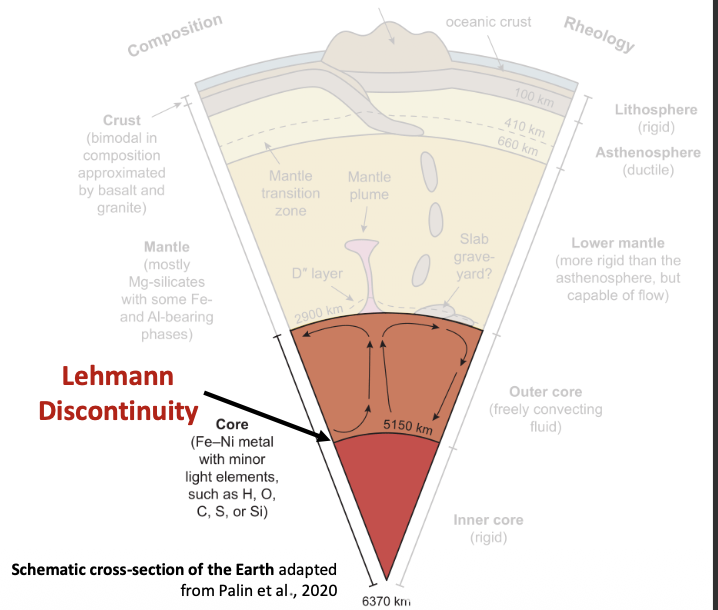
Lithosphere
Asthenosphere
Mantle Transition Zone
Lower Mantle
D” Layer
Outer Core
Inner Core
EARTH STRUCTURE:
Chemical Composition: Crust, Mantle, Core
Mechanical Properties/Rheology
MTZ
(D”)

Crust, Mohorovicic Discontinuity
EARTH LAYER (CHEMICAL COMPOSITION):
Thin and solid outermost layer
Thickness: 5 to 70 km (varies)
0.7% of Earth’s mass
<1% of Earth’s volume
Bounded below by the _____ _____ (Crust-Mantle)
Composed almost entirely of silicates

oceanic crust
2 TYPES OF CRUST:
Covers ~60% of the Earth’s surface
o Thickness: 5 to 10 km (average: 7 km)
o Dense and Homogenous
o Young (<200 Ma)
o Composition (SiMa):
o Silicates (Mg-rich)
o Basalt (Mg, Ca, Fe)
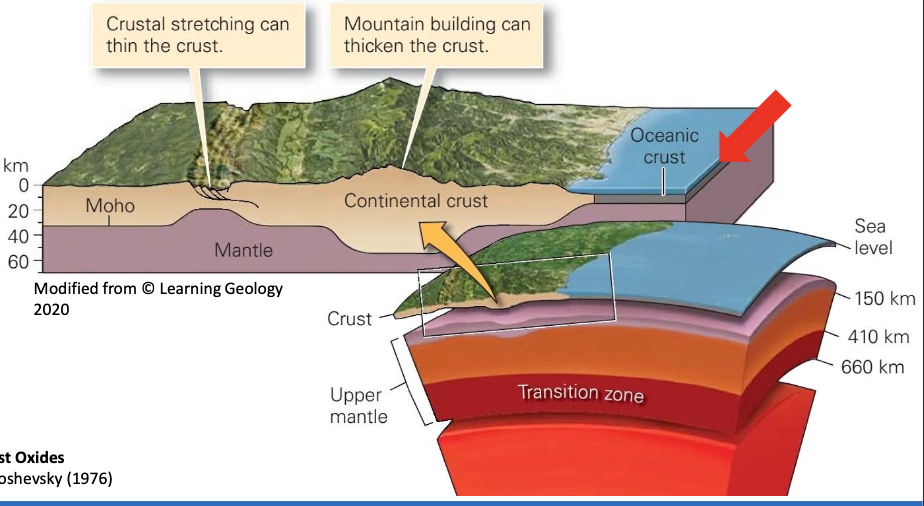
continental crust
2 TYPES OF CRUST:
Covers ~40% of the Earth’s surface
o Thickness: 30 to 70 km, up to 90 km (average: ~40 km)
o Less dense with diverse lithologies
o Old (>3.8 Ga)
o Composition (SiAl):
o Silicates (Alkali-rich)
o Volatiles / Radioactive elements
o Granodiorite
mantle
EARTH LAYER (CHEMICAL COMPOSITION):
Thickness: ~2,800 km
67% of Earth’s mass
84% of Earth’s volume
Bounded by the Mohorovičić Discontinuity (Crust-Mantle) and Gutenberg Discontinuity (Mantle-Core)
Composition:
Silicates (~45%) enriched in Fe-Mg (relative to the Crust)
Ultramafic (Peridotite-upper)
Oxides (Fe, Mg, Al, Ca)
Depleted in volatile and radioactive elements
mantle
EARTH LAYER (CHEMICAL COMPOSITION):
Temperature: 200°C to 4,000°C
o Density: 4.5 g/cm3
o Pressure: 24 GPa to 139 GPa
o Subdivision:
o Upper Mantle
o Transition Zone
o Lower Mantle
core
EARTH LAYER (CHEMICAL COMPOSITION):
Thickness: 3,481 km
o 31 % of Earth’s mass
o 16% of Earth’s volume
o Composition:
o Fe (85.5%) – Ni (4.88%) alloy*
(siderophile elements)
o Minor O, H, C, S, Si (<10%)
o Trace K, U, Th (substantial source of heat)
o Bounded above by the Gutenberg
Discontinuity (Core-Mantle)
o Responsible for Earth’s Geodynamo / Magnetic Field
melting, solidification
EARTH LAYER (RHEOLOGY):
Variability in Mechanical Properties
• Increase in both temperature and pressure
• Increase in temperature: _____
• Increase in pressure: ______
• Response of each layer to dominant variable at a certain depth
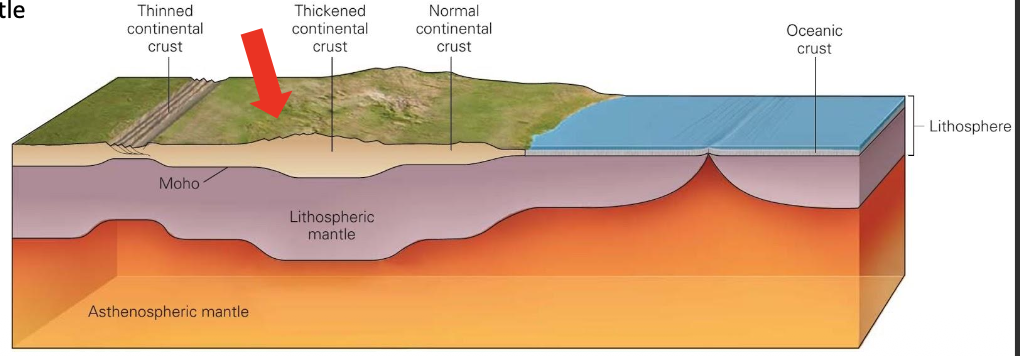
lithosphere
EARTH LAYER (RHEOLOGY):
Hard and rigid outermost shell
• Crust + Uppermost Mantle
• Subdivided into tectonic plates
• Thickness: 50 to 280 km
oceanic lithosphere
2 TYPES OF LITHOSPHERE:
Oceanic Crust + Uppermost Mantle
• Ocean basins, dense and young
• Thickness: 50 to 110 km
• Density: 2.9 g/cm3
• Composition:
• Mafic Crust (Basalt)
• Ultramafic Mantle (Peridotite)

continental lithosphere
2 TYPES OF LITHOSPHERE:
Continental Crust + Uppermost Mantle
• Continents, light and old
• Thickness: 100 to 280 km
• Density: 2.7 g/cm3
• Composition:
• Felsic Crust (Granodiorite)
• Ultramafic Mantle (Peridotite)
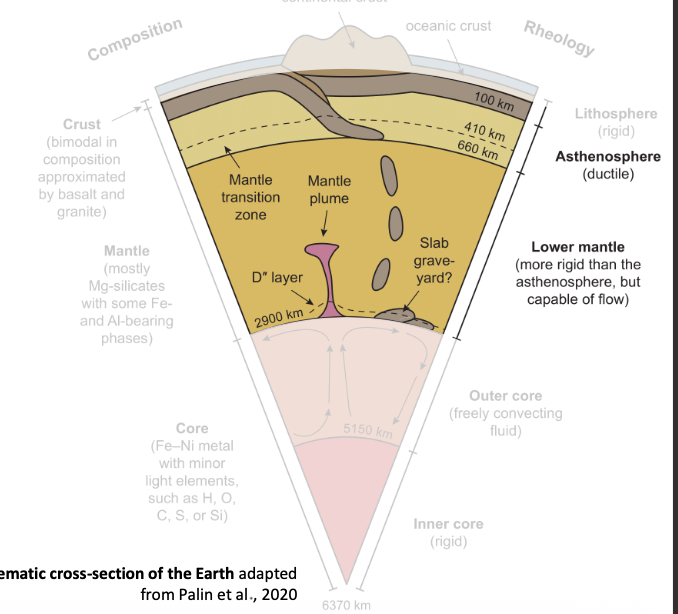
asthenosphere
EARTH LAYER (RHEOLOGY):
o Ductile layer below the lithosphere
o Mechanically weak and viscous
o Depth: 80 to 220 km
• Transition Zone
• Phase transition of olivine to wadsleyite then ringwoodite
• Between 410 to 660 km depth
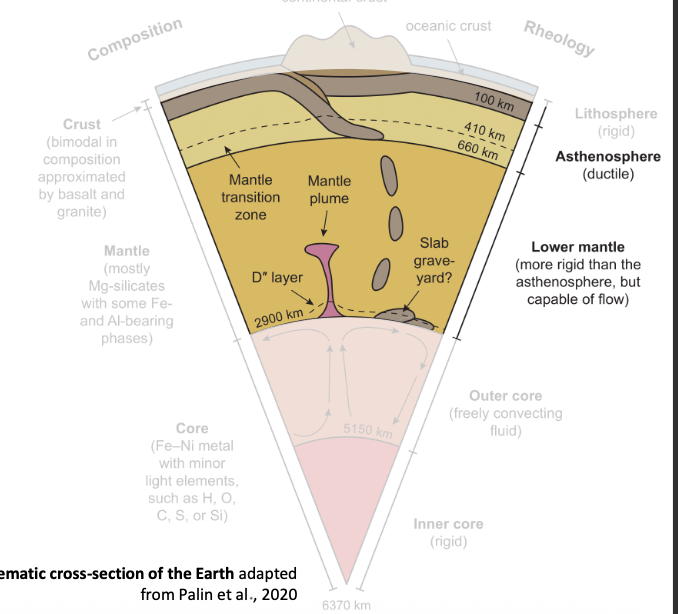
mesosphere
EARTH LAYER (RHEOLOGY):
Rigid, capable of flow
o Between 220 to 2900 km depth
o Bridgmanite (Mg-Perovskite) + Ferropericlase
• D” Layer
200 km thick layer at the Mantle-Core boundary
Hotspot plume source and slab graveyard
Post-Perovskite
outer core
EARTH LAYER (RHEOLOGY):
Molten; low viscosity
o S-waves not transmitted
o Temperature: 2,730 to 4,230 °C
o Density: 9.9 to 12.2 g/cm3
• Lehmann Discontinuity (Outer-Inner Core Boundary)
inner core
EARTH LAYER (RHEOLOGY):
Solid
o S-waves are transmitted
o Temperature: 5,100 to 5,400 °C
o Density: 12.6 to 13.0 g/cm
