IPS1: Dispensing - Part 2 - Introduction
 Call Kai
 Learn
Learn Practice Test
 Spaced Repetition
 Match
Match Flashcards
 Knowt Play
1/51

There's no tags or description
Looks like no tags are added yet.
Name | Mastery | Learn | Test | Matching | Spaced | Call with Kai | Chat |
|---|
No analytics yet
Send a link to your students to track their progress
52 Terms
A
No error, capacity to cause error
a. Category A
b. Category B
c. Category C
d. Category D
B
Error that did not reach the patient
a. Category A
b. Category B
c. Category C
d. Category D
C
Error that reached the patient but unlikely to cause harm (omissions considered to reach patient)
a. Category A
b. Category B
c. Category C
d. Category D
C
Multivitamin was not ordered for admission
a. Category A
b. Category B
c. Category C
d. Category D
D
Error that reached the patient and could have necessitated monitoring and/or intervention preclude harm
a. Category A
b. Category B
c. Category C
d. Category D
D
Regular release metoprolol was ordered for patient instead of extended-release
a. Category A
b. Category B
c. Category C
d. Category D
A
Error that could have caused temporary harm
a. Category E
b. Category F
c. Category G
d. Category H
e. Category I
A
Blood pressure medication was inadvertently omitted from the orders
a. Category E
b. Category F
c. Category G
d. Category H
e. Category I
B
Error that could have caused temporary harm requiring initial or prolonged hospitalization
a. Category E
b. Category F
c. Category G
d. Category H
e. Category I
B
Anticoagulant, such as warfarin, was ordered daily when the patient takes it every other day
a. Category E
b. Category F
c. Category G
d. Category H
e. Category I
C
Error that could have resulted in permanent harm
a. Category E
b. Category F
c. Category G
d. Category H
e. Category I
C
Immunosuppressant medication was unintentionally ordered at one-fourth the dose
a. Category E
b. Category F
c. Category G
d. Category H
e. Category I
D
Error that could have necessitated intervention to sustain life
a. Category E
b. Category F
c. Category G
d. Category H
e. Category I
D
Anticonvulsant therapy was inadvertently omitted
a. Category E
b. Category F
c. Category G
d. Category H
e. Category I
E
Error that could have resulted in death
a. Category E
b. Category F
c. Category G
d. Category H
e. Category I
E
Beta-blocker was not reordered postoperatively
a. Category E
b. Category F
c. Category G
d. Category H
e. Category I
Stages of Medication Error
1. Prescribing error
2. Transcribing error
3. Dispensing error
4. Administration error
Two primary purpose of reporting programs by 1999 Institute of Medicine IOM
1. Hold providers accountable for performance and patient safety
2. Provide information that leads to new knowledge and improved patient safety
A
The best approach is to immediately report an event whether or not it may cause serious harm. An immediate oral report to a supervisor may be more beneficial than a hastily written report.
a. True
b. False
True
Send final reports to risk management within 1 week of the event unless additional time is requested in the report
a. True
b. False
B
Include personal or professional opinions, conclusions, criticisms, accusations, admissions, or patients' names in the report.
a. True
b. False
Customer
person, group, system and organization that one interacts with in his/her day to day function.
A
Those employed or involved in the workplace providing service
a. Internal customers
b. External customers
B
Not part of the organization or not employed in the company who receiving the services being provided.
a. Internal customers
b. External customers
Stages of Change
1. Pre-contemplation
2. Contemplation
3. Preparation
4. Action
5. Maintenance
6. Relapse
A
Introduce the patient scripting method "DRUG"
a. Steve Leuck
b. George Urdang
c. Lowelle Frank
d. Jediael Yanesa
DRUG patient scripting
Dosage
Results
Underlying issuers
General information
A
• Discuss the dose of the medication
• How should the medication be taken?
• Any specific dosage timing issues, and
• What to do if the patient misses a dose
a. Dosage
b. Results
c. Underlying issuers
d. General information
D
• Assess the patient's understanding of the above information
• Discuss how to properly store the medication, what to do about refills, how to dispose of unused meds, and assure that the patient knows who to call for questions
a. Dosage
b. Results
c. Underlying issuers
d. General information
C
• Does this medication have any specific alcohol, grapefruit, or sun sensitivity warnings?
• Does this medication have an effect on any other disease states that the patient may have?
a. Dosage
b. Results
c. Underlying issuers
d. General information
B
Consequences of non adherence
a. Dosage
b. Results
c. Underlying issuers
d. General information
Incident report
Detailed information in case of errors in the practice site
Include information such as the date and time it happened, the personnel involved, details of the incident and actions taken if any
A
ONEISS stands for
a. Online National Electronic Injury Surveillance System for Hospital
b. Online National Extended Injury Surveillance System for Laboratory
c. On-site National Extensive Injury Surveillance System for Hospital
A
A web-based surveillance system that establishes a database registry for the systematic collection, consolidation, analysis, interpretation, and dissemination of injury and injury-related information for epidemiologic studies, policy formulation and development of injury prevention programs
a. ONEISS
b. ENOSSI
c. SSIEON
d. IESSON
B
Content of company policies and regulations
1. Company profile
2. Employee recruitment, termination, retirement
3. Security of tenure
4. Workplace conduct and appearance, health and safety, attendance, absence, punctuality
5. Employees Compensation and benefits
6. Compliance and professional conduct (adherence to the professional laws, policies, rules and regulations)
7. Risk Management Plan
a. 1-5
b. 1-6
c. 1-2 and 4-6
d. 1-7
A
1. Registry number
2. General Data
3. Pre-admission data
4. Hospital/facility data
5. ER/ OPD/ BHS/ RHU
6. In-patient (for admitted cases only)
a. Patient Injury Form
b. Patient Monitoring Form
c. Hospital Injury Form
d. Hospital Recording form
B
TESDA Pharmacy Service program for determining whether a candidate, usually pharmacy assistants is competent.
a. NC II
b. NC III
c. NC IV
d. NC I
A
Basic competencies
a. 22 hours
b. 24 hours
c. 25 hours
d. 802 hours
e. 200 hours
B
Common competencies
a. 22 hours
b. 24 hours
c. 25 hours
d. 802 hours
e. 200 hours
D
Core competencies
a. 22 hours
b. 24 hours
c. 25 hours
d. 802 hours
e. 200 hours
E
Industry exposure or internship
a. 22 hours
b. 24 hours
c. 25 hours
d. 802 hours
e. 200 hours
A
Pharmacy Services NC III total duration
a. 1048 hours
b. 1200 hours
c. 1000 hours
d. 1300 hours
B
How many are the core competencies project?
a. 5
b. 4
c. 8
d. 6
C
Core Competencies Project 1
I. Practice good housekeeping
II. Monitor supply/inventory of pharmaceutical products
III. Arrange and display pharmaceutical products
IV. Perform good laboratory practices
V. Adhere to good manufacturing practices
VI. Handle and control pharmaceutical products
a. I, II, III
b. III, IV
c. I, III
d. V, VI
B
Core Competencies Project 2
I. Practice good housekeeping
II. Monitor supply/inventory of pharmaceutical products
III. Arrange and display pharmaceutical products
IV. Perform good laboratory practices
V. Adhere to good manufacturing practices
VI. Handle and control pharmaceutical products
a. I, III
b. IV, V
c. III, IV
d. IV, V, VI
A
Core Competencies Project 3
I. Practice good housekeeping
II. Monitor supply/inventory of pharmaceutical products
III. Arrange and display pharmaceutical products
IV. Perform good laboratory practices
V. Adhere to good manufacturing practices
VI. Handle and control pharmaceutical products
a. II, VI
b. I, II
c. II, III, IV
d. II only
A
Core Competencies Project 4
I. Practice good housekeeping
II. Demonstrate product knowledge on medicines
III. Dispense pharmaceutical products
IV. Perform good laboratory practices
V. Perform health promotion education, vigilance
VI. Handle and control pharmaceutical products
a. II, III, V
b. I, III, V
c. IV, V, VI
d. II, V
D
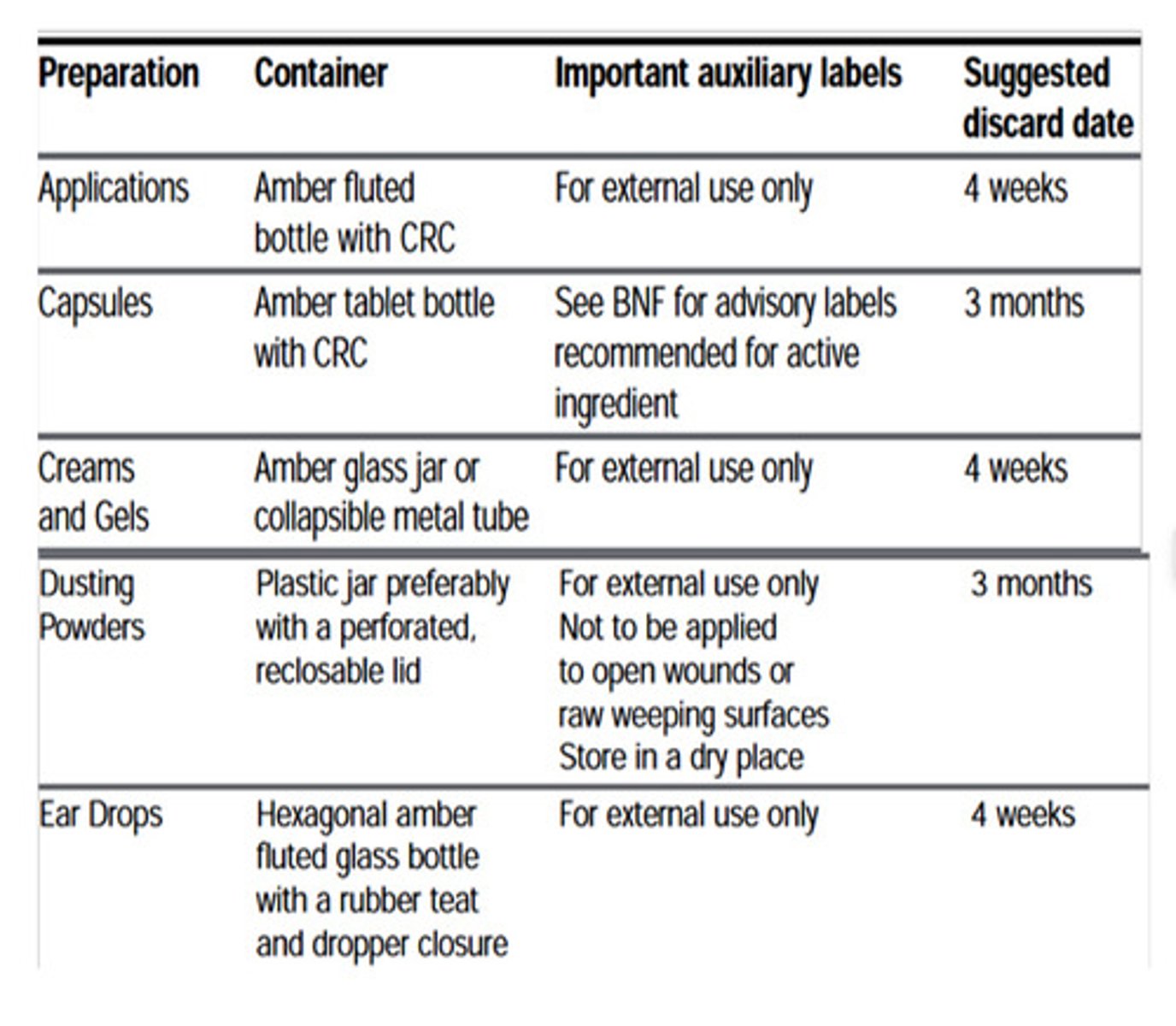
Extemporaneous preparations with discard rate of 4 weeks except
a. Applications
b. Creams and gels
c. Ear drops
d. Dusting powders
A
Suggested discard rate for extemporaneously prepared capsules and dusting powders
a. 3 months
b. 6 months
c. 3 weeks
d. 2 weeks
Auxiliary labels for extemporaneous preparations
A
Average dispensing process duration in the Philippines
a. 10-15 minutes
b. 5-10 minutes
c. 3-5 minutes
d. 10-20 minutes
Patient Medication Profile
is a written summary of all the medicines you take regularly, including over-the-counter and complementary medicines.