Epithelial Tissue and Muscle Tissue Diagram | Quizlet
 Call Kai
 Learn
Learn Practice Test
 Spaced Repetition
 Match
Match Flashcards
 Knowt Play
1/34

There's no tags or description
Looks like no tags are added yet.
Name | Mastery | Learn | Test | Matching | Spaced | Call with Kai | Chat |
|---|
No analytics yet
Send a link to your students to track their progress
35 Terms
epithelial tissue
-protects
-covers organs and cavities
-lubricates
simple
one layer
stratified
more than one layer
squamous
flat and square
cuboidal
cube shaped
columnar
rectangle
pseudostratified columnar
cells in columns that looks stratified, but isn't
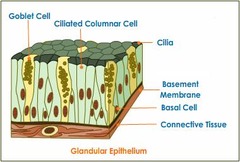
ciliated
has hair
non-ciliated
has no hair
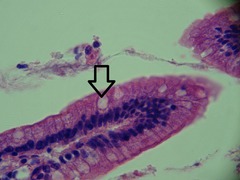
goblet cells
only in columnar
glandular epithelium
produces secretion
endocrine glands
inner glands, goes into blood stream

exocrine glands
outer glands, goes through duct glands

transitional epithelial
stretches out, found in bladder

mucus secretion
thick type of secretion
simple squamous
one layer of flat cells
simple cuboidal
one layer of square cells

simple columnar
one layer of cells in columns

stratified squamous
more than one layer of flat cells

stratified cuboidal
more than one layer of square cells

free surface
Part of the epithelial tissue that is exposed to an open area (either the external environment or to the inside of a hollow organ).
basement membrane (basal lamina)
attaches epithelia to underlying connective tissues
pseudostratified columnar epithelium
linings of respiratory passages
simple columnar epithelium
Function: Absorption; secretion of mucus, enzymes, and other substances; ciliated type propels mucus (or reproductive cells) by ciliated action.
Location: nonciliated type lines most of the digestive tract (stomach to anal canal), gallbladder and excretory ducts of some glands; ciliated variety lines small bronchi, uterine tubes, and some regions of the uterus.
simple cuboidal epithelium
Function: secretion and absorption
Location: Kidney tubules; ducts and secretory portions of small glands, ovary surface.
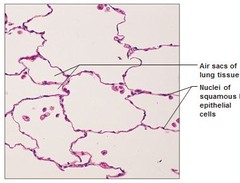
simple squamous epithelium
Function: Allows passage of materials by diffusion and filtration in sites where protection is not important; secretes lubricating substances in serosae.
Location: Kidney glomeruli, air sacs of lungs, lining of heart, blood vessels, and lymphatic vessels; lining of ventral body cavity(serosae)
stratified squamous epithelium
Function: protects underlying tissues in areas subject to abrasion
Location: nonkeratinized type forms the moist lining of the esophagus, mouth, and vagina; keratinized type forms the epidermis of the skin, a dry membrane.
ciliated simple columnar epithelium
lines the lower respiratory tract and uterine tubes; wavelike motion of cilia propels materials through the lumen
lumen
space within a tubular part or organ, such as the space within a blood vessel
cardiac muscle
Involuntary muscle tissue found only in the heart.
skeletal muscle tissue
Voluntary muscle pulls on bones and causes body movements.
skeletal muscle
mulitnucleated, striated and voluntary
cardiac muscle
involuntary, striated, intercalated discs, uninucleated
smooth muscle tissue
In the walls of internal organs; usually involuntarily controlled
smooth muscle
Nonstriated, uninucleated, involuntary