Writing and Spelling
 Studied by 0 people
 Call Kai
 Learn
Learn Practice Test
 Spaced Repetition
 Match
Match Flashcards
 Knowt Play
1/44

There's no tags or description
Looks like no tags are added yet.
Name | Mastery | Learn | Test | Matching | Spaced |
|---|
No study sessions yet.
45 Terms
What is the least researched area of all language skills?
writing bc people see other reasons as more disabling such as speech problems
Name 2 levels of writing
general and specific (spelling and disorders)
What are phonemes?
speech sounds
What are graphemes?
letters on paper
What does research tell us about roots to spelling words?
there are 2
regular spellings - spelled from sound e.g. cat, words which follow rules
irregular spellings - spellings have to be memorised sa yacht
What is the graphemic output lexicon?
stores known spellings
spelling of known words derived from sound and meaning
What is a slip on the pen?
when we know the actual way to spell a word but write down something else instead - might not notice initially
Name some kinds of SOPs?
phonological - slips which happen on basis of how words sound - sa their instead of there - homophone errors - tell us you have not engaged any kind of semantic system (word meaning) - no input from word meaning
Desc a typical dual route model of spelling
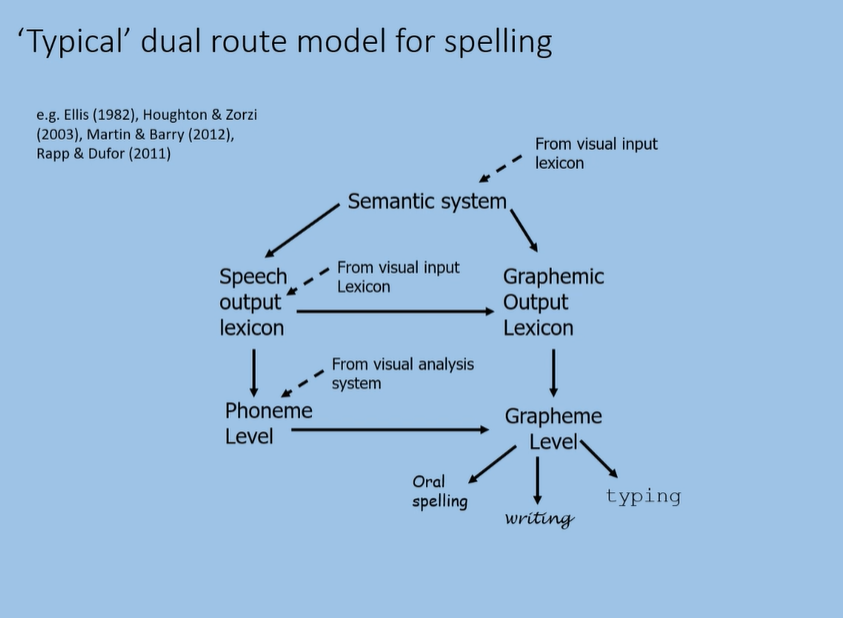
What do you need to avoid homophone errors?
input from semantic system
What are semantic slips?
less frequent SOP where you write something similar in meaning to the thing you actually want to say sa last week instead of next week - havent got sufficient input from how the words shld sound and have more reliance on unreliable meaning
buffer holds graphemes until execution
What is assembled spelling?
something we do for an unfamiliar/unknown word
skilled spellers can assemble plausible spellings based on sound
converting phonemes into graphemes (Patterson, 1982)
What is a regularisation error?
regularise spelling of a word and it will generate something which if read out loud will sound right but looks wrong on page - a feature of children’s spelling
What have researchers become convinced about?
when we spell words - its not just a process of drawing from the output lexicon or computing how the word sounds - might be a link bt those 2 processes
What did Campbell look at? (1983)
what happens when we get ppl to spell words based on what happens when he manipulates previous words they have been asked to spell - can we see an influence of other words that we spelled when we come to write new words - showing there are some interaction bt 2 routes
What are central dysgraphias?
problem with early stages of spelling - surface, phonological and deep
What are peripheral dysgraphias?
problem with later stages of spelling sa output (writing things down) - more about motor processes and less abt cog processes
What is dyslexia about?
reading problems
What is surface dysgraphia?
patients can no longer spell irregular words - make regularisation errors
usually caused by damage to left hemisphere - damage to graphemic output lexicon
What did Hatfield and Patterson (1983) do?
did a case study on patient TP who had a stroke and had damage to lh and asked to spell loads of diff words and made many errors
when asked to write word flood - they wrote flud - can see translation of phonemes to graphemes
struggled to write homophones sa pain bc they have damage to their grapheme output lexicon - hard to get semantic link in same degree
spelt sword as sward - would not typically expect if you are 100% relying on phonemes grapheme conversion processes - may come up with sord instead - shows GOL was damaged but still accessible
What are phonological dysgraphics?
fine with known familiar words even if they are hard but not good when asked to generate an unfamiliar word, non word, even if really easy or short
phoneme level damaged, non lexical route damaged - damage to phoneme to grapheme route
do not make regularisation errors but lexicalisation errors - come up with similar looking familiar word, not based on sound but what it looks like
What did Shallice (1981) do?
case study of PR who was pretty good at spelling known words, could spell our 90% of ones they were given such as coniferous
when asked to spell non word, quite poor, wld get 2/10 correct, made a difference in length of word, longer the harder they found it
What is deep central dysgraphia?
most impaired dysgraphics
might make semantic error - e.g. might write word table when told chair
not good at spelling non words - cant generate words at all
damage to non lexical and lexical route - why there are many errors
damage to route from semantic system to graphemic output lexicon and to phoneme to grapheme route
What is the case study for DD?
Bub and Kertesz (1982) and JC
one of the tests they gave him was spelling dictation - wld say word chair and ask him to write it down and he’d write table and couldnt see error as they were writing it out but cld see it was wrong once on the page
How does writing work at?
several levels
communicating a msg, constructing sentences and spelling indv words
What is the majority of writing research on?
most general level sa planning to write
and most specific lvl sa spelling errors made by patients with br damage
What is Hayes and Flower’s Theory of Writing? (1980, 1986)
identifies 3 stages
planning (pre-write)- gathering info, thinking abt goals in writing, researching - can take 2/3s of writing time
sentence generation (write)
revision (rewrite) - eval what you have written and editing, make sure it aligns with goals
generally in this order but may interact - not sequential process - early stages of writing came under fire for oversimplifying process and saying writing happens as if in steps
What is the planning stage infl by?
task env - what you want to write abt and who is going to read it
long term memory - what you know abt topic and what does your audience know abt your topic
stored plans - stored formulae that you might have abt how you set out writing certain things - think abt main goal
What can expertise do?
create distance from audience
Why is writer’s block caused?
by inflexibility in plan
What do novice writers have?
have less complex, interwoven plans for their writing compared to expert writers who will generate more elaborate plans with more kind of interconnection bt goals and subgoals of their writing
What did Kaufer, Hayes and Flower (1986) do?
studied a writer in action - this method rejected the previous way ppl studied writing which was an introspective approach - abt ppl thinking abt how they wrote after they’d actually written
used protocol analysis - when a writer verbalises their thoughts as they are carrying out a task and recorded what they were saying
compared sentence generation process bt novices and experts
good evidence for 3 stages
What did KHF find?
sentences are composed in parts
ppl expanded a lot on their plans
sentences formed in planning - bits of them were used in final piece
75% of sentence parts accepted and editing process v quick for both novs and exps
exps have more words in their sentence parts (11.2) and 7.3 in novices - exps have use larger building blocks
What did Hayes et al (1985) say?
writing things down leads to new ideas and so you are revising to incorporate these new ideas
Why did Bridwell 1980 say we revise our writing?
bc text dest not match intention of what you wanted to produce
What did Sommers 1980 do and find?
looked at exps and novices and found exps spend longer revising text and they revise diff things
exps restructure writing and how to shape an argument better
novs - indv words and sentences
What did Hayes et al 1985 find?
exps and novices have dfrs in their error detection during revision
exps discover more problems, and correctly identify nature of problem
both rewrite sections w/o identifying nature of problem
What does the monitor do in the Hayes-Flower Model 1980, 86?
the thing that kind of controls all of these stages of writing and switching your attention bt diff processes
does unnecessary inhibition of responses as well
during hard task, more likely to complete sentences in whole before going back and revising and correcting errors - working all the time and more effective when doing easier writing and overall processings demands low
What are the advs of Hayes and Flowers theory?
identification of seperate, interacting sub-processes inv in skilled writing
components noted in model
indicates areas less skilled writers shld concentrate on
What are some limitations of HF’s theory?
we need a process for how sentences are composed in head and how they get out one the page - not inc - misses key processes sa transcription and motivation
no mentions of working memory - inv in generating text
methodology used is problematic - only allows eval of conscious processes (protocol analysis) - there are a lot of subconsc processes inv in writing sa choosing how you are going to write a sentence - no conscious awareness in this rlly
can 3 processes rlly be separated sa planning and sentence generation
What did Chenoweth and Hayes 2003 do?
inc a 4th writing process and changed the names of concepts
proposer = planning
translator = sentence gen
transcriber - new and converts word strings into written or word processed text
evaluator - revision
What did Hayes 2012 do?
make a revised model taking into acct all of the diff critiques made of earlier models sa inc motivation to infl writing, 4 processes, recognises role of WM
needs more precise specification of interactions bt processes - when do writers shift bt processes?
What are lexicalisations
Lexicalisations are when people write down the nearest real word alternative to a nonword
When do REs occur?
when someone applies typical phoneme to grapheme rules to irregular words