Newborn Assessment and Age Calculations
 Call Kai
 Learn
Learn Practice Test
 Spaced Repetition
 Match
Match Flashcards
 Knowt Play
1/44

There's no tags or description
Looks like no tags are added yet.
Name | Mastery | Learn | Test | Matching | Spaced | Call with Kai |
|---|
No analytics yet
Send a link to your students to track their progress
45 Terms
What are the primary objectives of a newborn assessment?
- Understand APGAR scoring
- Classify birthweight and gestational age
- Learn age terminology and calculations
- Differentiate between preterm and full-term development
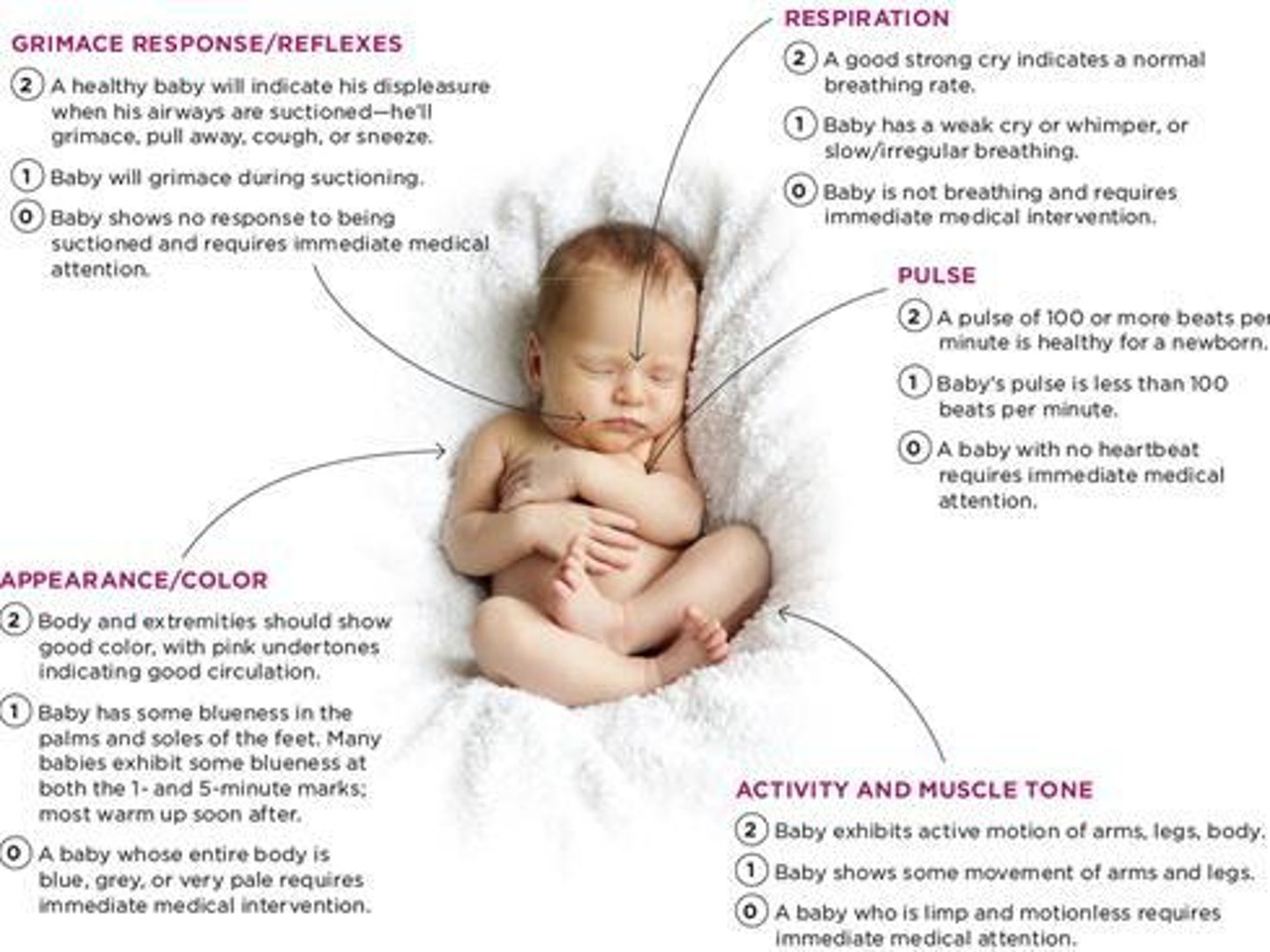
What are the five signs assessed in an APGAR score?
- Color (Appearance)
- Heart Rate (Pulse)
- Reflex irritability (Grimace)
- Muscle Tone (Activity)
- Respiratory Effort
When is the APGAR score typically recorded after birth?
- At 1 minute
- At 5 minutes
When should the APGAR score be reported at 10, 15, and 20 minutes?
- Only if the score is less than 7
What does an APGAR score of 7 to 10 indicate?
- Normal newborn status
What does an APGAR score of 4 to 6 indicate?
- Moderately abnormal status
What does an APGAR score of 0 to 3 indicate?
- Critical low status
What is the primary clinical purpose of the APGAR score?
- To determine the status of the infant
- To identify whether immediate medical care is needed (not for prediction)
How is the Color (Appearance) category scored in APGAR?
- 0 points: Blue, pale
- 1 point: Body pink, extremities blue
- 2 points: Entirely pink
How is the Heart Rate (Pulse) category scored in APGAR?
- 0 points: Absent
- 1 point: Below 100
- 2 points: Over 100
How is the Reflex Irritability (Grimace) category scored in APGAR?
- 0 points: No response
- 1 point: Grimace
- 2 points: Grimace, coughing, sneezing, or crying
How is the Muscle Tone (Activity) category scored in APGAR?
- 0 points: Flaccid, limp
- 1 point: Weak, inactive
- 2 points: Strong, active
How is the Respiratory Effort category scored in APGAR?
- 0 points: Absent
- 1 point: Irregular, slow
- 2 points: Good, crying
What weight threshold defines High Birth Weight?
- Greater than 4000 g (8.8 lb)
What weight threshold defines Low Birth Weight?
- Less than 2500 g (5.5 lb)
What weight threshold defines Very Low Birth Weight?
- Less than 1500 g (3.3 lb)
What weight threshold defines Extremely Low Birth Weight?
- Less than 1000 g (2.2 lb)
What growth measures are used to classify a baby relative to gestational age?
- Weight
- Length
- Head circumference
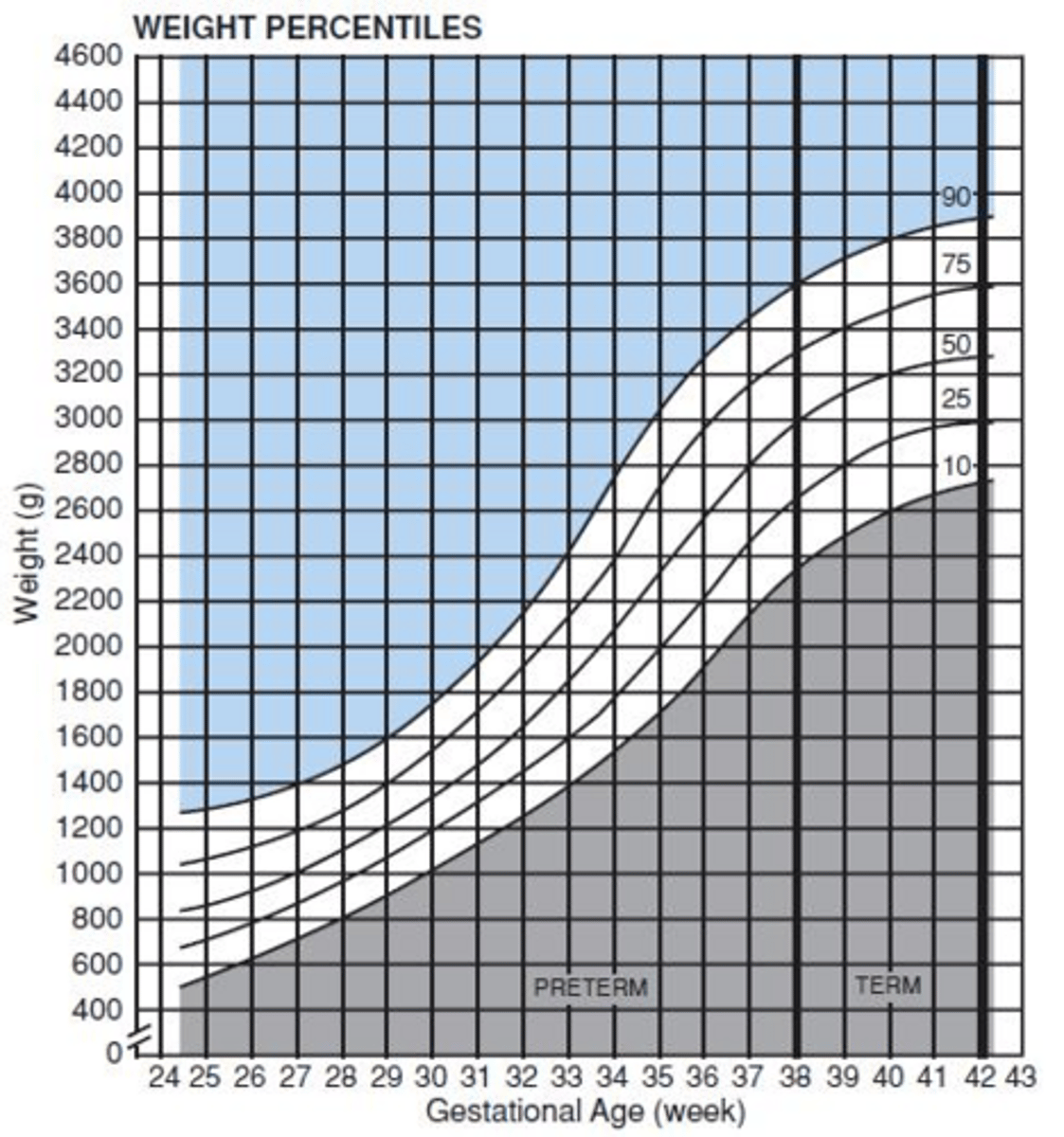
What is Appropriate for Gestational Age (AGA)?
- Growth measures falling between the 10th and 90th percentiles
What is Small for Gestational Age (SGA) and its common associations?
- Growth measures below the 10th percentile
- Associated with smoking, malnutrition, and drug use
What is Large for Gestational Age (LGA) and its common associations?
- Growth measures above the 90th percentile
- Associated with gestational diabetes and post-term infants
How is Preterm gestational age defined?
- Less than 37 weeks GA
How is Early Term gestational age defined?
- 37 to 38 weeks GA
How is Full Term gestational age defined?
- 39 to 40 weeks GA
How is Late Term gestational age defined?
- 41 weeks GA
How is Post-term gestational age defined?
- 42 weeks GA or greater
What is Gestational Age (GA)?
- The time between the first day of the last menstrual period and the day of delivery
What is Chronological Age?
- The time elapsed since birth
What is Postmenstrual Age (PMA)?
- Gestational age + Chronological age
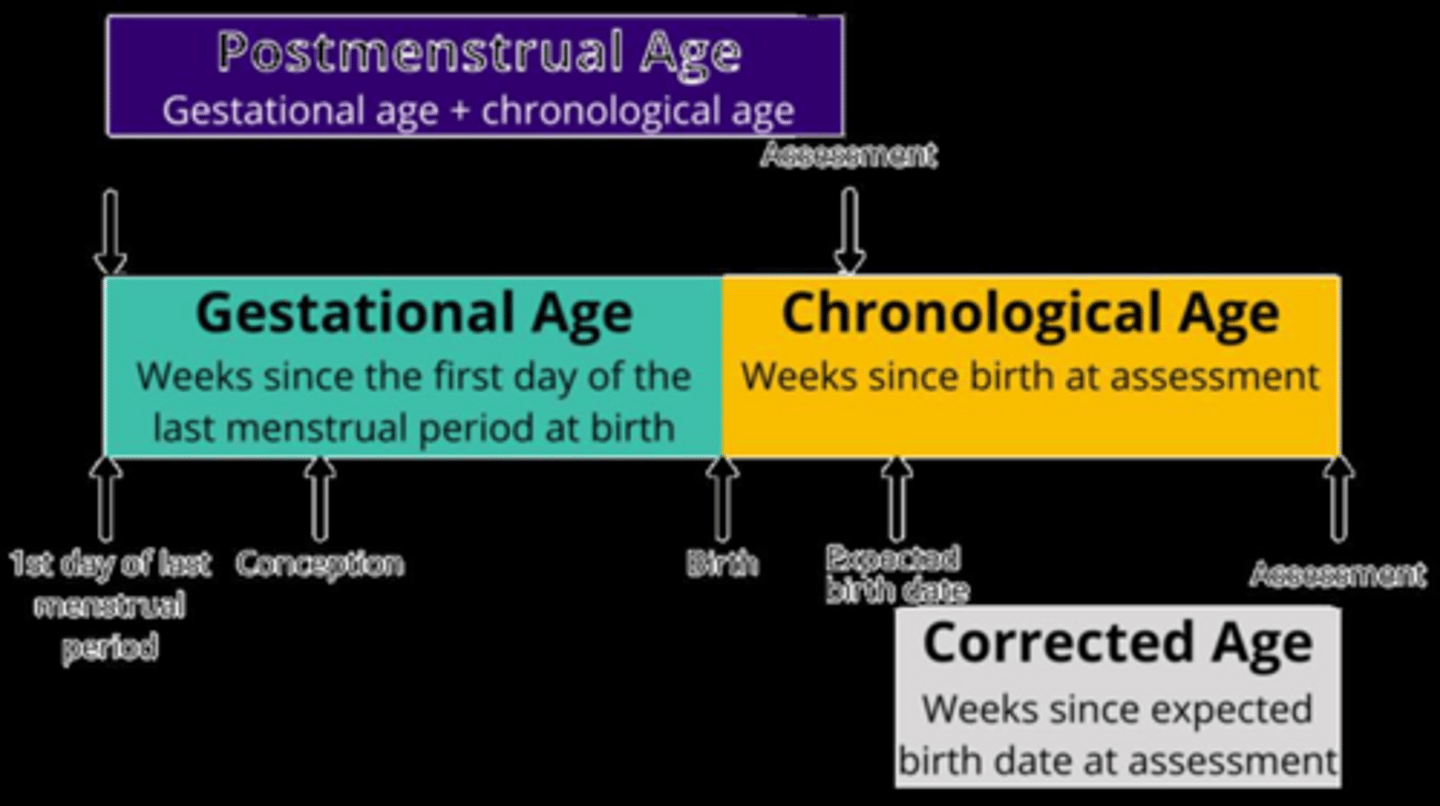
What is Corrected Age?
- The age of the child calculated from the expected date of delivery
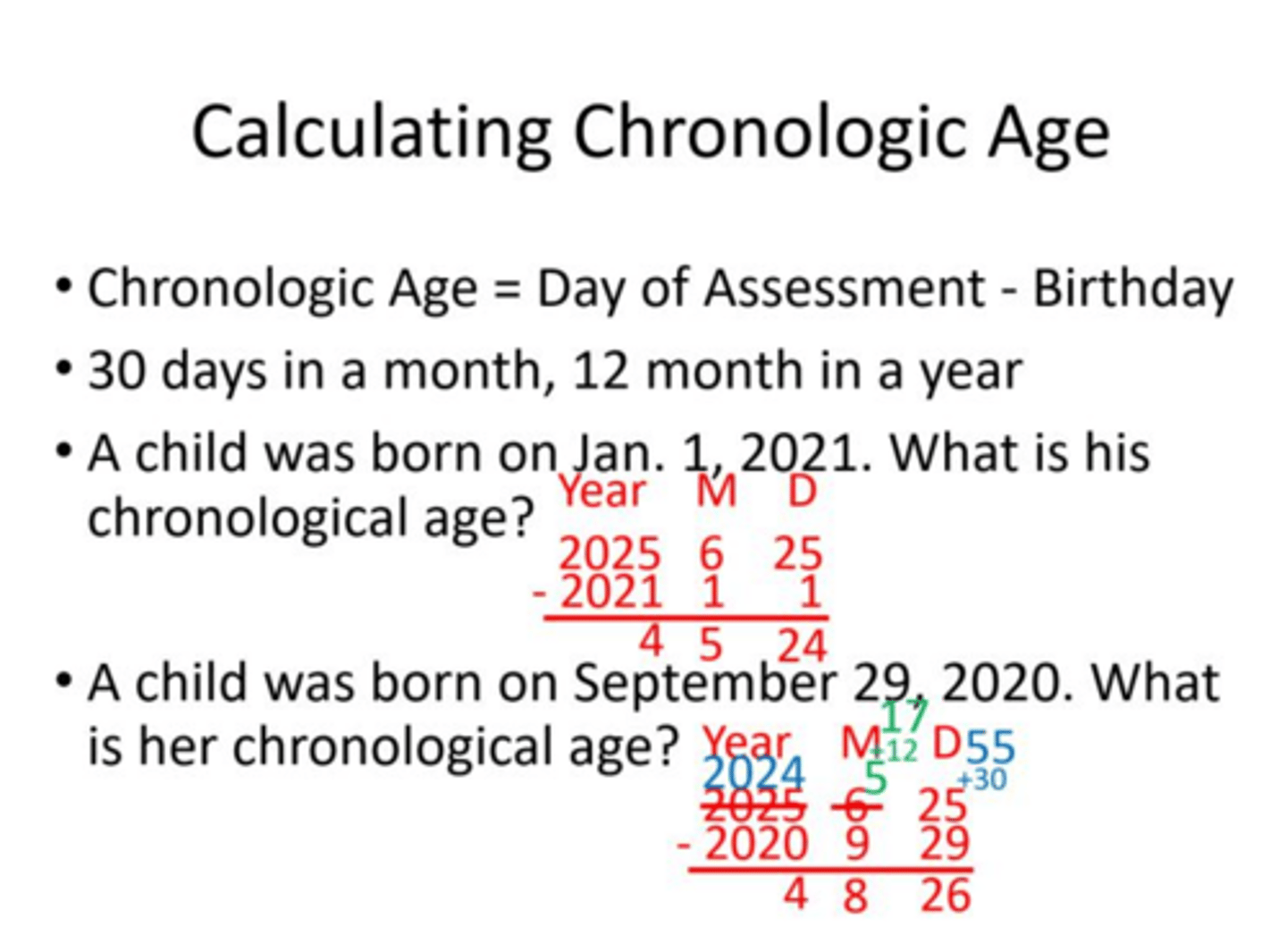
How is Chronological Age calculated?
- Chronological Age = Day of Assessment - Birthday
- Assumes 30 days in a month and 12 months in a year
What is the formula for Corrected Age?
- Corrected Age = Chronological age - weeks preterm
Until what age should Corrected Age be used?
- Until 2 years old, regardless of the amount of prematurity
How do you calculate weeks preterm for age correction?
- Weeks preterm = 40 weeks - Gestational Age (GA)
What is the corrected age of a 6-month-old infant born at 31 weeks GA?
- 3 months 3 weeks (or 15 weeks)
- Calculated as: 24 weeks chronological age - 9 weeks preterm
What is the corrected age of a 2-year-old child born at 28 weeks GA?
- 1 year 9 months (or 21 months)
- Calculated as: 24 months chronological age - 3 months preterm (12 weeks)
What age terminology is appropriate for a baby born at 27 weeks GA assessed 10 weeks after birth?
- Postmenstrual age (37 weeks)
- Corrected age is not used here because the calculation yields a negative value (-3 weeks)
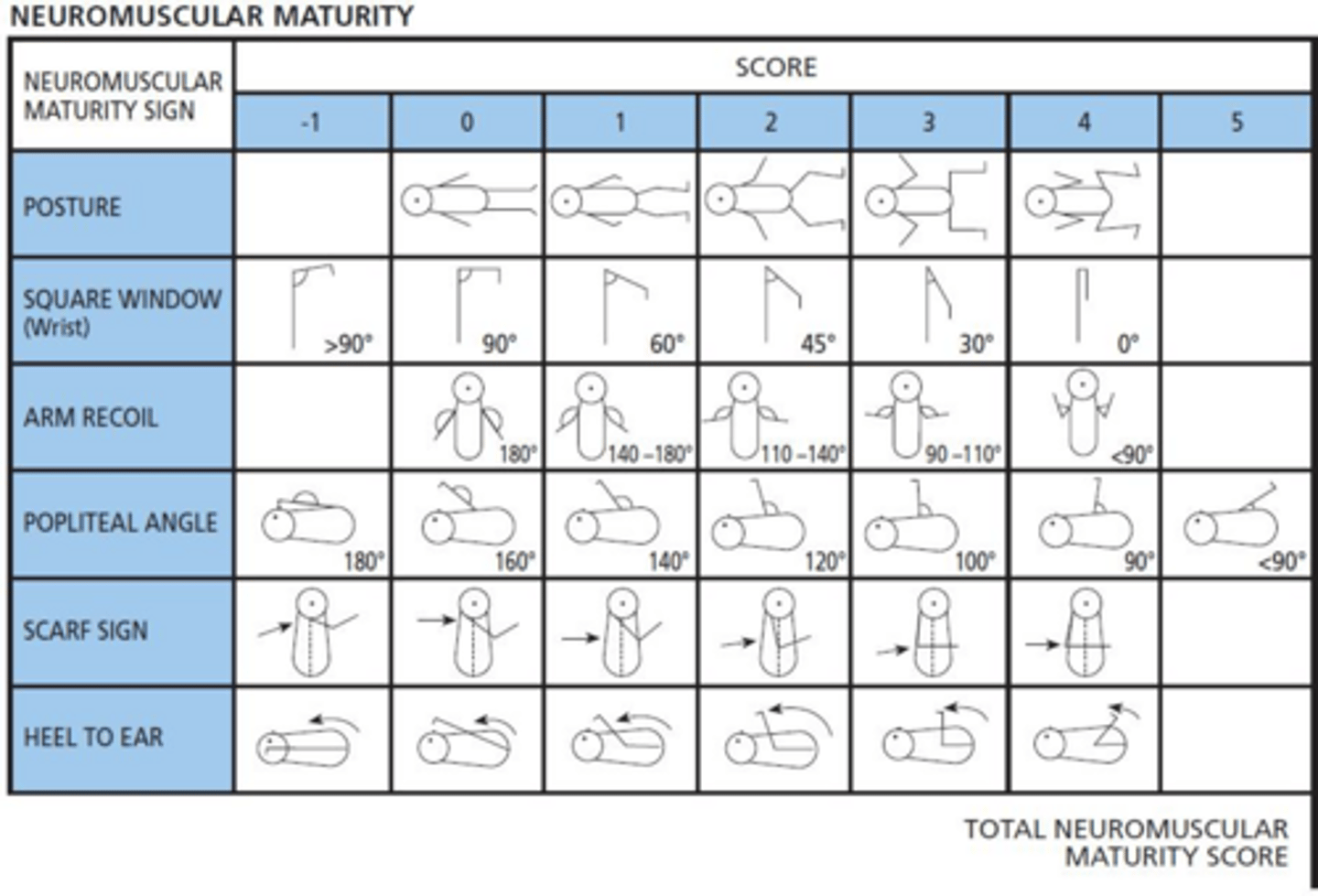
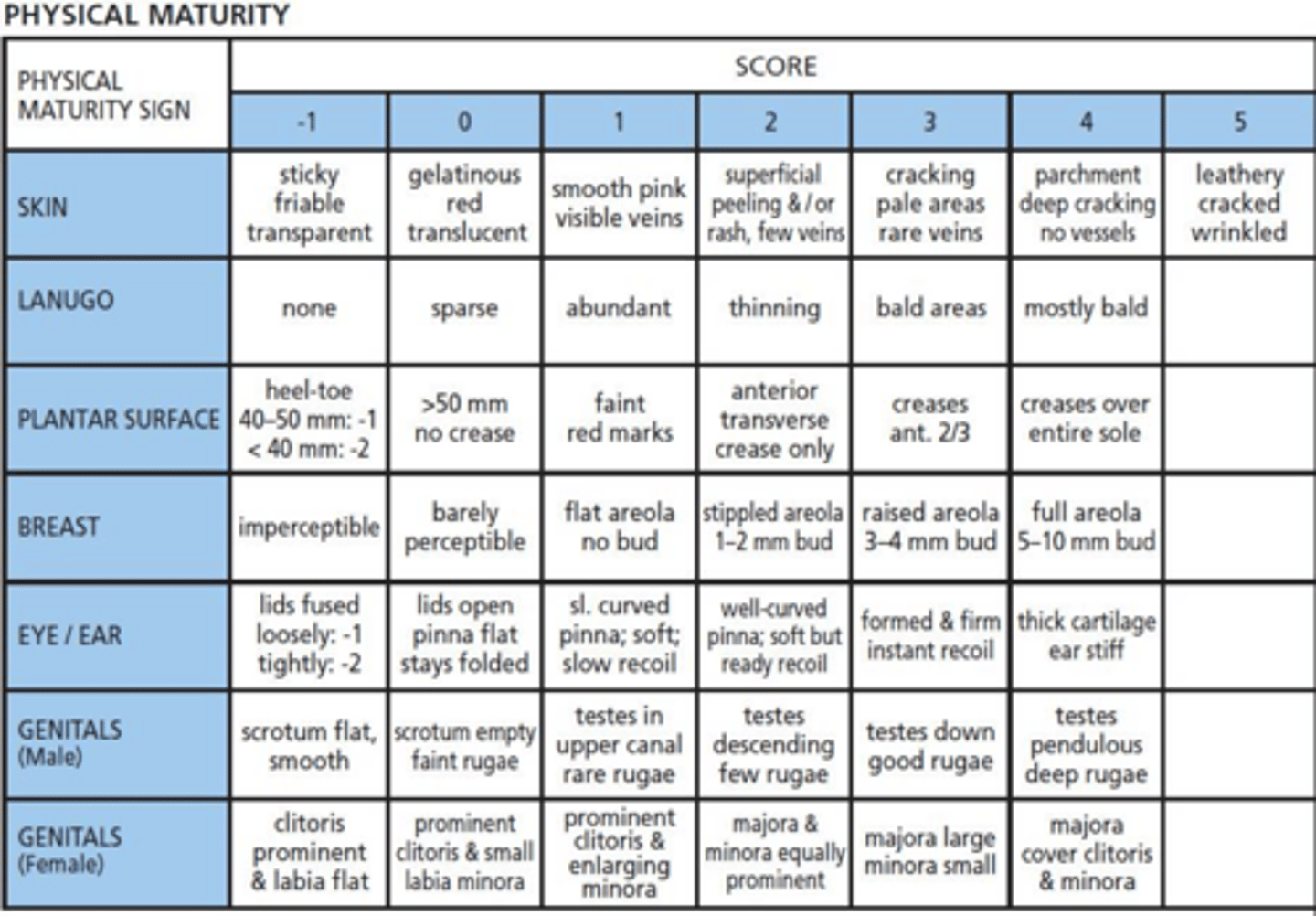
What clinical tool is used for the maturational assessment of Gestational Age?
- The New Ballard Score
What neuromuscular maturity signs are evaluated in the New Ballard Score?
- Posture and square window
- Arm recoil and popliteal angle
- Scarf sign and heel to ear
What physical maturity signs are evaluated in the New Ballard Score?
- Skin and lanugo
- Ear and breast development
- Genital development
How do term and preterm infants differ in weight and length?
- Term: ~3,500 g and 50 cm
- Preterm: 2,500-1,500 g (or less) and much shorter
How do term and preterm infants differ in head circumference and fat pads?
- Term: 35 cm head circumference; fat pads present
- Preterm: Smaller head circumference (but proportionately larger); fat pads absent
How do term and preterm infants differ in passive muscle tone and ROM?
- Term: Flexor dominant; full flexion range
- Preterm: Extensor dominant; wider movement range
How do term and preterm infants differ in resting heart rate and movements?
- Term: Lower resting HR; active movements
- Preterm: Higher resting HR; sluggish movements
How do term and preterm infants differ in visual and auditory responses?
- Term: Shorter periods of looking; body movement response to sound
- Preterm: Look longer; require stronger auditory stimuli