Blood Gas and Buffer Systems: Acid-Base Balance, Interpretation, and Clinical Cases
 Call Kai
 Learn
Learn Practice Test
 Spaced Repetition
 Match
Match Flashcards
 Knowt Play
1/48

There's no tags or description
Looks like no tags are added yet.
Name | Mastery | Learn | Test | Matching | Spaced | Call with Kai | Chat |
|---|
No analytics yet
Send a link to your students to track their progress
49 Terms
What are the three types of chemical buffering systems?
Chemical, Respiratory, and Renal buffering systems.
What are the buffering response times for the chemical buffering system?
Immediate response.
What are the buffering response times for the respiratory system?
Minutes to hours.
What are the buffering response times for the renal system?
Hours to days.
How much more acidic is a pH of 6.0 compared to a pH of 7.0?
A pH of 6.0 is ten times more acidic than a pH of 7.0.
What parameters are used to determine acid-base status in arterial blood gas interpretation?
pH, PCO2, HCO3-, and Base Excess (BE).
What parameters are used to determine oxygenation status in arterial blood gas interpretation?
PO2, SaO2, and hemoglobin levels.
What is the normal pH range for arterial blood?
7.35 to 7.45.
What is the normal range for PCO2 in arterial blood?
35 to 45 mm Hg.
What is the normal range for HCO3- in arterial blood?
22 to 26 mEq/L.
What is the normal range for PO2 in arterial blood?
80 to 100 mm Hg.
What is the normal range for SaO2 in arterial blood?
>95%.
What is the normal range for Base Excess (BE) in arterial blood?
-2 to +2 mEq/L.
What indicates acidosis in terms of pH?
A pH less than 7.35.
What indicates alkalosis in terms of pH?
A pH greater than 7.45.
What causes respiratory acidosis?
Obstructive lung disease, oversedation, neuromuscular disease, hypoventilation, and sleep apnea.
What causes metabolic acidosis?
Kidney failure, increased lactic acid, increased keto acids, diarrhea, and acid ingestion.
What causes respiratory alkalosis?
Hypoxia, anxiety, brain injury, severe anemia, and hyperventilation.
What causes metabolic alkalosis?
Fluid loss from the upper GI tract, diuretic treatment, corticosteroids, and alkali administration.
What is the Anion Gap?
The difference between unmeasured cations and unmeasured anions.
What is the normal range for Anion Gap?
12 to 14 mEq/L, with an acceptable range of 8 to 16 mEq/L.
What is the formula to calculate the Anion Gap?
Anion Gap = [Na+] - ([Cl-] + [HCO3-]).
What does a high Anion Gap indicate?
An increase in unmeasured anions from fixed acids.
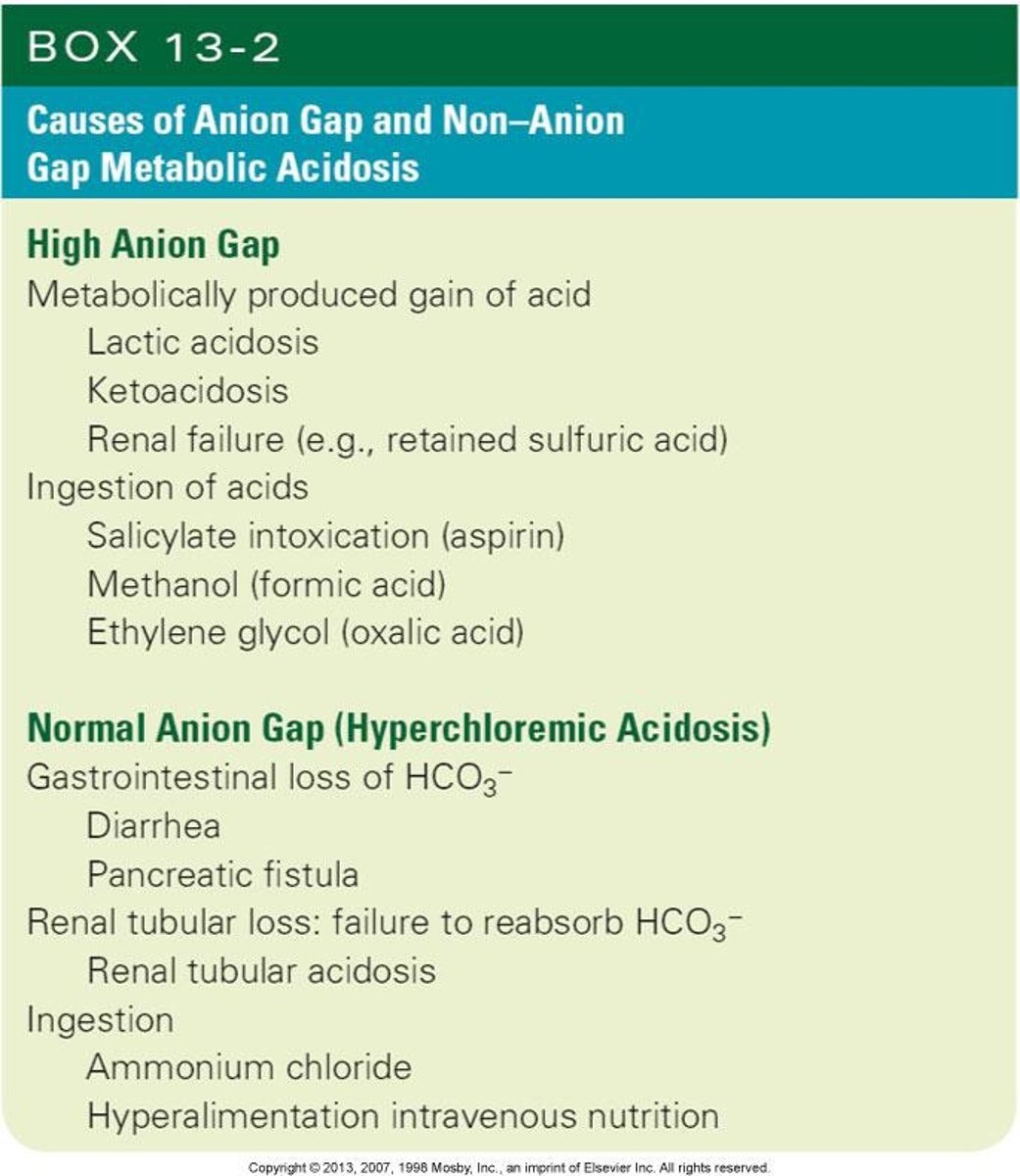
What does a normal Anion Gap indicate?
Hyperchloremic metabolic acidosis due to loss of bicarbonate.
What is the body's attempt to return to normal pH called?
Compensation.
What is the difference between compensation and correction in acid-base balance?
Compensation is the system not causing the imbalance attempting to normalize pH, while correction is the system causing the imbalance returning to normal.
What is the pH level indicating acidosis in the provided blood gas example?
7
What is the PCO2 level in the blood gas example indicating alkalinity?
20 mm Hg
What is the HCO3- level in the blood gas example indicating acidosis?
6 mEq/L
What is the significance of Kussmaul breathing in a patient?
It indicates metabolic acidosis, often seen in diabetic patients.
How do you calculate the anion gap?
Anion Gap = Na+ - (Cl- + HCO3-)
What is the calculated anion gap for the example provided?
34 (calculated from Na+ 145 - (Cl- 105 + HCO3- 6))
What condition is indicated by a high anion gap?
High anion gap metabolic acidosis.
What is the normal range for oxygenation (PaO2) for adults on room air?
80-100 mm Hg
What defines mild hypoxemia in adults?
PaO2 of 60-79 mm Hg
What defines moderate hypoxemia in adults?
PaO2 of 40-59 mm Hg
What defines severe hypoxemia in adults?
PaO2 less than 40 mm Hg
How does age affect the normal oxygenation range for individuals over 60?
Subtract 1 mm Hg from the normal range for each year over 60.
What is the predicted PaO2 for a patient on 30% oxygen?
150 mm Hg (30% x 5)
What indicates a patient would be hypoxic on room air?
If the patient's PaO2 is less than the predicted value.
What is the significance of a PaO2 of 122 mm Hg for a patient on 30% oxygen?
The patient would be hypoxic on room air since 122 < 150.
What is the first step in assessing acid-base balance?
Assess the pH.
What is the second step in determining the cause of acid-base imbalance?
Determine if the cause is metabolic or respiratory.
What should be assessed if there is metabolic acidosis?
Calculate the anion gap.
What is the pH level indicating alkalosis in the third case example?
7
What is the PaCO2 level in the third case example indicating acidosis?
47 mm Hg
What does a bicarbonate level of 13 indicate in the third case?
Acidosis.
What is the base excess (BE) in the third case example?
-11
What should be considered before administering sodium bicarbonate?
The underlying cause of acidosis and whether it is metabolic or respiratory.