CA5103 5.1 Supply Chain and Supply Chain Models
 Call Kai
 Learn
Learn Practice Test
 Spaced Repetition
 Match
Match Flashcards
 Knowt Play
1/11

Earn XP
Description and Tags
At the end of this module, the students should be able to: • Define supply chain. • Describe the nature of supply chain model namely: transportation problems, transshipment problems and assignment problems. • Illustrate the three supply chain models. • Formulate the general linear problem models for the given supply chain problems.
Name | Mastery | Learn | Test | Matching | Spaced | Call with Kai | Chat |
|---|
No analytics yet
Send a link to your students to track their progress
12 Terms
What is Supply Chain
✔ it describes the set of all interconnected resources involved in producing and distributing a product; is designed to satisfy customer demand for a product at minimum cost (Anderson et al., 2024)
✔ it refers to the sequence of organizations--- their facilities, functions, and activities--- that are involved in producing and delivering a product or service (Benton, 2010)
Ware some types of problems in supply chain models /network flow problems (Anderson et al., 2024)?
⮚ Transportation Problem
⮚ Transshipment Problem
⮚ Assignment Problem
Stevenson (2018) illustrated supply chain
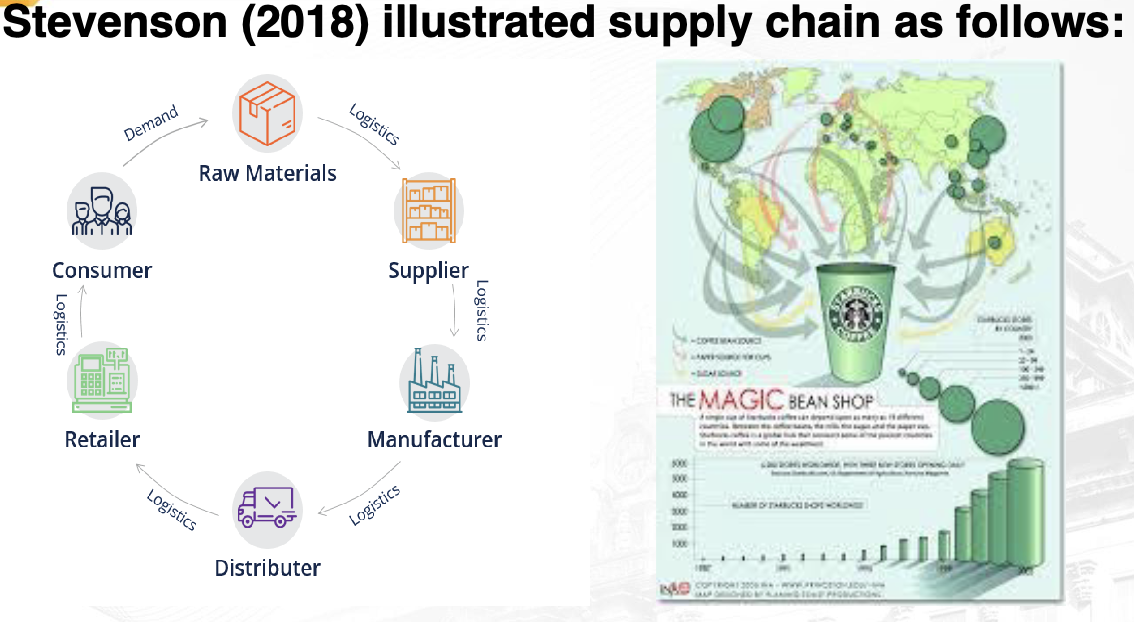
What is Logistics?
✔It is the part of a supply chain involved with the forward and reverse flow of goods, services, cash, and information (Bowersox et al., 2010).
❖ For Anderson et al. (2024), those who manage supply chain must make decisions in terms of:
✔ where to produce the product
✔ how much should be produced
✔ where it should be sent
✔ how to design supply chain to satisfy customer demand for a product at minimum cost
What is Transportation Problem
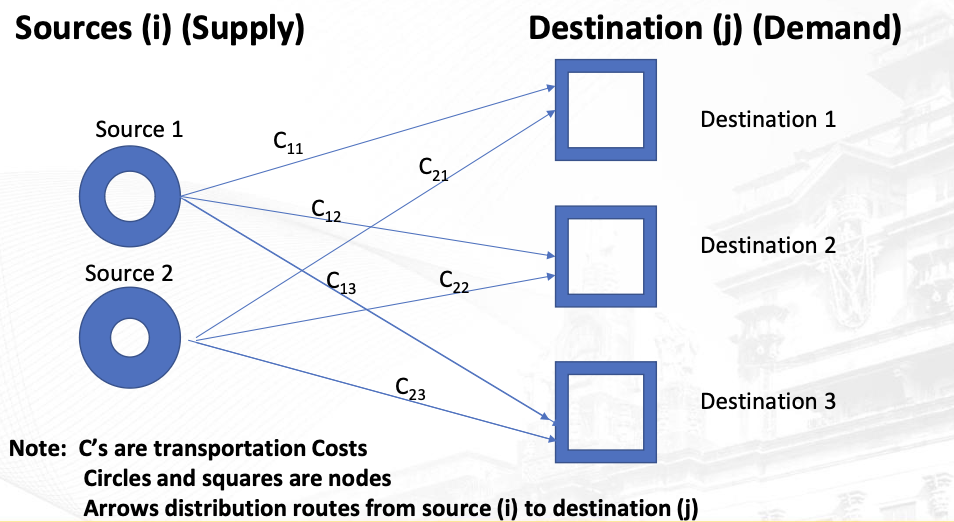
✔ The transportation problem seeks to minimize the total shipping costs of transporting goods from m origins (each with a supply si) to n destinations (each with a demand dj), when the unit shipping cost from an origin, i, to a destination, j, is cij.
✔ The network representation for a transportation problem with two sources and three destinations is given on the next slide.
Network Representation of a Transportation Problem with two sources (supply) and three destinations (demand)
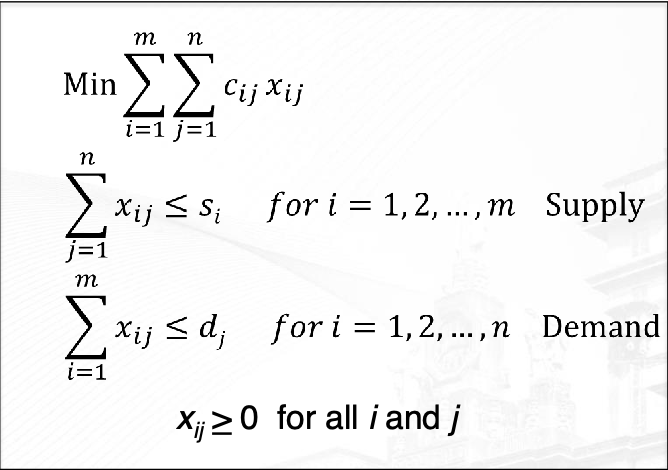
Linear Programming Formulation
Using the notation:
xij = number of units shipped from origin/source i to destination j
cij = cost per unit of shipping from origin/source i to destination j
si = supply or capacity in units at origin i
dj = demand in units at destination j
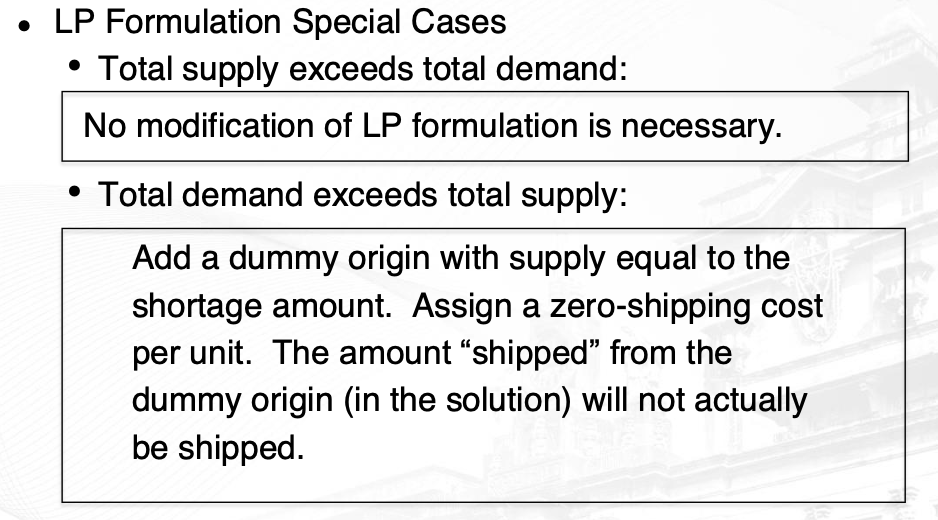
Special Cases of LP Formulation
Acme Block Company has orders for 80 tons of concrete blocks at three suburban locations as follows: Northwood -- 25 tons, Westwood -- 45 tons, and Eastwood -- 10 tons. Acme has two plants, each of which can produce 40 tons per week. Delivery cost (in dollars) per ton from each plant to each suburban location is shown on the next slide. How should end of week shipments be made to fill the above orders?
Define the Objective Function:
Minimize the total delivery cost.
Min: (delivery cost per ton from each plant to each suburban location) x (number of tons delivered from each plant to each suburban location).
Min Z: 24x11 + 30x12 + 40x13 + 30x21 + 40x22 + 42x23
Define the Constraints
Supply Constraints:
(1) x11 + x12 + x13 ≤ 40
(2) x21 + x22 + x23 ≤ 40
Demand Constraints:
(3) x11 + x21 = 25
(4) x12 + x22 = 45
(5) x13 + x23 = 10
Non-negativity of variables:
xij > 0, i = 1, 2 and j = 1, 2, 3
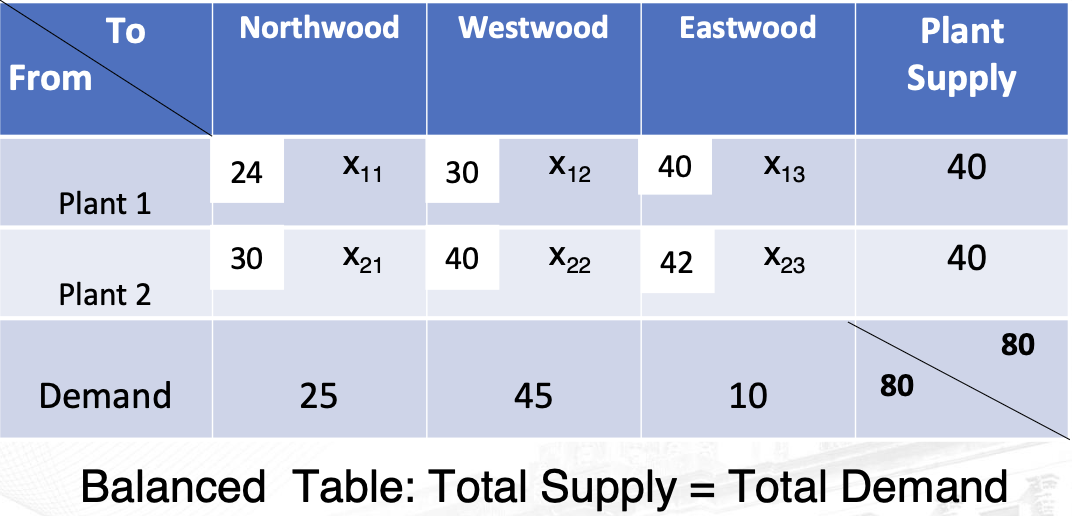
What are the steps in solving transportation problem (Minimization)?
Read and understand the problem and its given conditions.
Set up a balanced transportation table. (Note: If unbalanced "total supplies not equal to total demand" create a dummy variable with a transportation cost equal to "0").
Represent the Transportation Problem with a network model.
Formulate the General Linear Programming Model.
Solve the problem. (Solution to transportation problem will be discussed in the next module)