B5a Homeostasis
 Call Kai
 Learn
Learn Practice Test
 Spaced Repetition
 Match
Match Flashcards
 Knowt Play
1/47

There's no tags or description
Looks like no tags are added yet.
Name | Mastery | Learn | Test | Matching | Spaced | Call with Kai | Chat |
|---|
No analytics yet
Send a link to your students to track their progress
48 Terms
What is the definition for Homeostasis?
Homeostasis is the regulation of conditions inside your body (and cells) to maintain a stable internal environment in response to changes in both internal and external conditions.
How does a negative feedback loop counteract when a level is too low?
Receptor detects a stimulus - level is too low
The coordination centre receives and processes the information, then organises a response.
Effector produces a response, which counteracts the change and restores the optimum level.
It does this by increasing the level
What is the Central Nervous System (CNS)?
In vertebrates (animals with backbones) this consists of the brain and spinal cord only.
In mammals, the CNS is connected to the body by sensory neurones and motor neurones.
What are the sensory neurones?
These carry information as electrical impulses from the receptors to the CNS.
What are motor neurones?
These carry electrical impulses from the CNS to the effectors.
What are receptors?
These are the cells that detect stimuli.
There are many different types, such as taste receptors on the tongue and sound receptors in the ears.
Receptors can form part of larger, complex organs e.g. the retina of eye is covered in light receptor cells.
What are effectors?
All your muscles and glands, which respond to nervous impulses and bring about change.
Effectors respond in different ways. Muscles contract in response to a nervous impulses, whereas glands secrete hormones.
What is the order that the CNS coordinates a response?
Stimulus —> Receptor —> Sensory Neurone —> CNS —> Motor Neurone —> Effector —> Response
What is the connection between two neurones called?
Synapses
How do nerve impulses transfer across neurones?
The nerve signal is transferred by chemicals, which diffuse across the gap.
These chemicals then set off a new electrical signal in the next neurone.
What is a reflex?
Reflexes are rapid, automatic responses to certain stimuli that don’t involve the conscious parts of the brain — they can reduce the chances of being injured.
What is the passage of a reflex arc?
Stimulus (e.g. a painful bee sting) is detected by receptors (e.g. a pain receptor).
Impulses are sent along a sensory neurone.
Impulses reach a synapse between the sensory and relay neurones. This triggers chemicals to be released causing the impulses to be passed along a relay neurone in the CNS.
Impulses reach a synapse between the relay and motor neurones. Chemicals are released causing impulses to be sent along the motor neurone.
Impulses travel to the effector, which responds (e.g. a muscle contracts and moves your hand away from the bee).
Where do the neutrons in reflex arcs go through?
The neurones in reflex arcs go through the spinal cord or through an unconscious part of the brain. Since you don’t have to think about the response (which takes time) its quicker than normal responses.
What is the method when investigating reaction time?
The person being tested should sit with their arm resting on the edge of the table (this should stop them moving their arm up or down during the test).
Hold a ruler vertically between their thumb and forefinger. Make sure that the zero end of the ruler is level with their thumb and finger. Then let go without giving any warning.
The person being tested should try to catch the ruler as quickly as they can.
Reaction time is measured by the number on the ruler when it’s caught. The number should be read from the top of the thumb. The further down the ruler its caught (i.e. the higher the number), the slower their reaction time.
Repeat the test several times then calculate the mean distance that the ruler fell.
What is the independent variable when investigating reaction time?
The person catching the ruler.
What are the control variables when investigating reaction time?
The people catching both using their dominant hand
The ruler being dropped rom the same height and angle.
Ruler size
What is the dependent variable when investigating reaction time?
Reaction time (measured using the catch distance on a ruler).
What is the role of the cerebral cortex?
This is the outer wrinkly bit.
It is responsible for things like, consciousness, intelligence, memory and language.
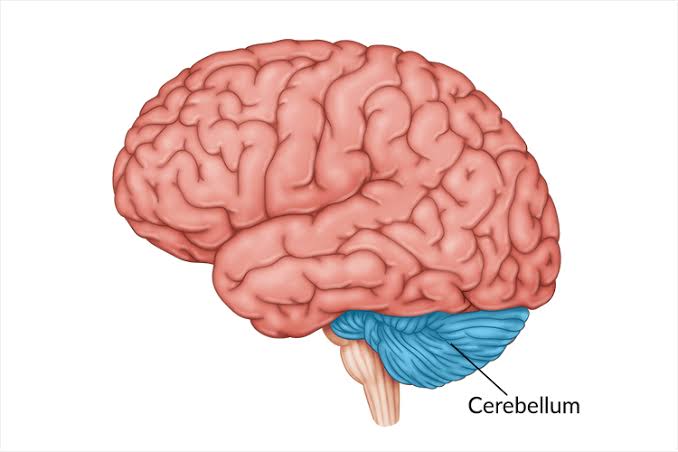
What is the role of the cerebellum?
Responsible for muscle coordinations (movement).
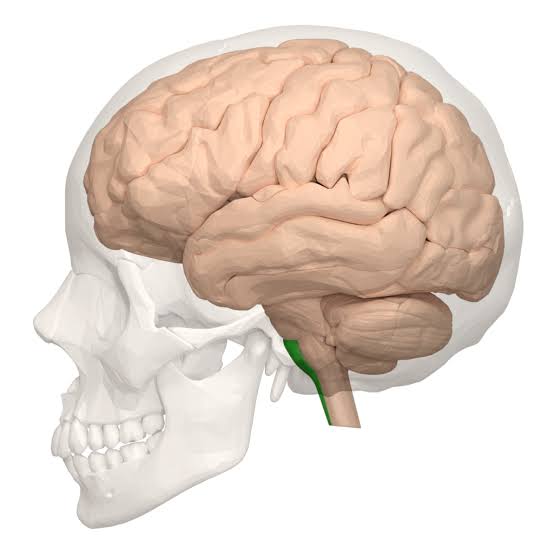
What is the role of the medulla?
Controls unconscious activities (things you don’t have to think about doing) like breathing and your heartbeat.
How can studying patients with brain damage help scientists to study the brain?
If a small part of the brain has been damaged, the effect this has on the patient can tell you a lot about what the damaged part of the brain does. E.g. if an area at the back of the brain was damaged by a stroke and the patient went blind, you know that the area has something to do with vision.
How can electrical stimulation help scientists to study the brain?
Scientists can observe the effect of stimulating different parts of the brain electrically with a tiny electrode to get an idea of what the parts do. E.g. when a certain part of the brain, known as a motor area, is stimulated, it causes muscle contraction and movement.
How can MRI scans help scientists to study the brain?
An MRI scan can produce a very detailed picture of the brain’s structures.
Scientists use it to find out what areas of the brain are active when people are doing things like listening to music or trying to recall a memory.
How can messing with the brain have a positive impact?
Electrical stimulation can help reduce muscle tremors caused by nervous system disorders such as Parkinson’s disease.
How can messing with the brain have a negative impact?
Treatment of brain damage or disease is difficult and carries risks, such as physical damage to the brain or increased problems with brain function.
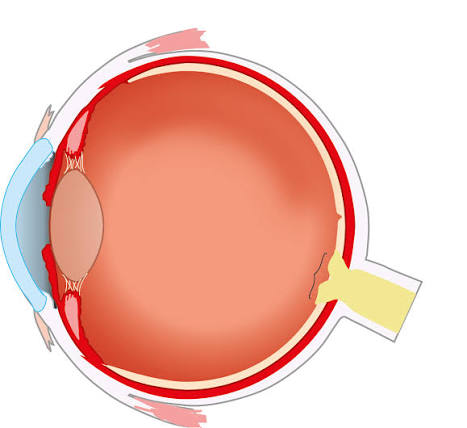
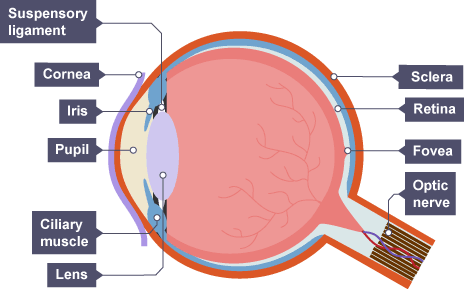
Where are the cornea, iris, pupil, lens, retina, sclera, optic nerve, suspensory ligaments and ciliary muscles located on this diagram?
What is the function of the cornea?
The cornea is the transparent outer layer found at the front of the eye.
It refracts (bends) light into the eye.
What is the function of the iris and pupil?
The iris contains muscles that allow it to control the diameter of the pupil and therefore how much light enters the eye.
What is the function of the lens and retina?
The lens focuses the light onto the retina, which contains receptor cells sensitive to light intensity and colour.
What is the function of the suspensory ligaments and ciliary muscle?
To control the shape of the lens.
What is the function of the optic nerve?
The optic nerve carries impulses from the receptors on the retina to the brain to create a clear image.
What is accommodation?
The eye focusing light on the retina by changing the shape of the lens.
What happens to the ciliary muscles, suspensory ligaments and lens when looking a nearby object?
The ciliary muscles contract, which slackens the suspensory ligaments.
This makes the lens fatter (more curved) which means it refracts light by a larger amount, so it focuses on the retina.
What happens to the ciliary muscles, suspensory ligaments and lens when looking a distant object?
The ciliary muscles relax, which allows the suspensory ligaments to pull tight.
This makes the lens thinner (less curved), which means it refracts light by a smaller amount, so it focuses on the retina.
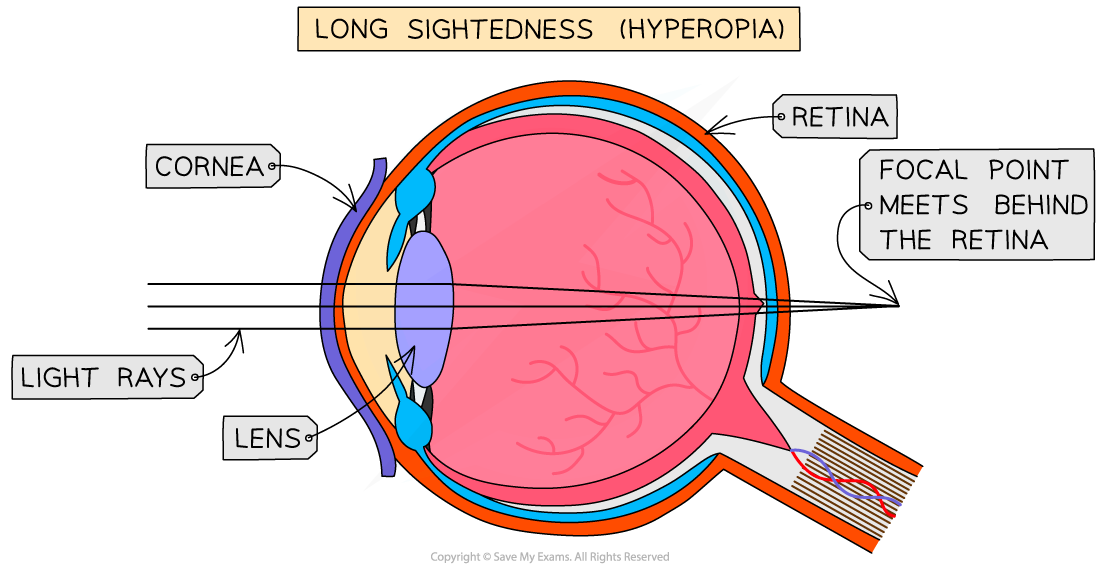
What is hyperopia?
Long-sightedness (where a person can only focus on distant objects).
When does hyperopia occur?
When the lens is the wrong shape and does not refract the light enough or the eyeball is too short.
The images of near objects are brought to focus behind the retina.
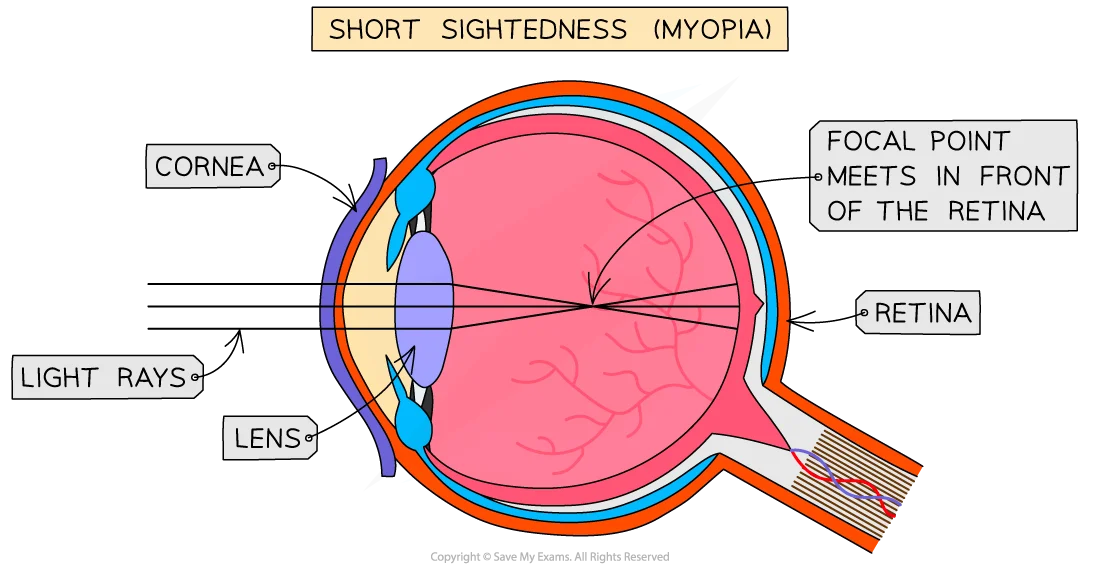
What is myopia?
Short-sightedness (where a person can only see nearby objects).
When does myopia occur?
When the lens is the wrong shape and refracts the light too much or the eyeball is too long.
The images of distant objects are brought into focus in front of the retina.
How can hyperopia be corrected?
You can use glasses with a convex lens to correct it. The lens refracts the light rays to focus on the retina.
How can myopia be corrected?
You can use glasses with a concave lens to correct it.
How can contact lenses correct vision?
They sit on the surface of the eye and are shaped to compensate for the fault of focusing
You can get hard and soft contact lenses
How can laser eye surgery correct vision?
A laser is used to vaporise tissue, changing the shape of the cornea (and so changing how strongly it refracts light into the eye)
Slimming it down makes it less powerful and can improve short sight
Changing the shape so that it’s more powerful will improve long sight
How can replacement eye surgery correct vision?
Long-sightedness can be more effectively treated by replacing the natural lens of the eye with an artificial lens made of clear plastic.
How does your circular muscles, iris and radial muscles react to bright light?
When light receptors detect this bright light, the circular muscles in the iris contract and the radial muscles relax.
This reduces the amount of light that can enter the eye.
How does your circular muscles, iris and radial muscles react to dim light?
The opposite process happens in dim light.
This time, the radial muscles contract and the circular muscles relax.
This makes the pupil wider.
What is the optimum temperature for enzymes inside the body?
37 degrees celsius
How does your body respond when you’re too hot?
Hair erector muscles relaxed.
Sweat is produced by sweat glands and evaporates from the skin. This transfers energy to the environment.
Vasodilation - Blood vessels supplying the skin dilate so more blood flows close to the skin’s surface. This transfers energy from the skin to the environment.
How does your body respond when you’re too cold?
Hairs stand up to trap an insulating layer of air.
Shivering is when your muscles contract automatically. This needs respiration, which transfers some energy to warm the body.
Vasoconstriction - Blood vessels supplying skin capillaries constrict to close off the skin’s blood supply.