K2 Aquatics: Aquatic Ecosystems
 Call Kai
 Learn
Learn Practice Test
 Spaced Repetition
 Match
Match Flashcards
 Knowt Play
1/27

Earn XP
Description and Tags
Btw, the nutrient cycling stuff of K1 form CI manual A is combined in here & there is a bit of K1 for aquatics bc I messed up
Name | Mastery | Learn | Test | Matching | Spaced | Call with Kai | Chat |
|---|
No analytics yet
Send a link to your students to track their progress
28 Terms
List the importances of ripairan buffers (3)
eorsion control inc WQI
slows waters = inc infiltration
asthetic - inc property price if next to house
Compare and contrast the characteristics and impacts of turf (as in sterotypical grass lawn) vs native grass. What would you say to someone concerned about the asthetic losses when choosing native over turf?
turf:
short roots + short grass above = inc erosion bc holds ground less and less filtration
requries inc maintanenace → more water needed + fertilizer
native grass:
longer roots, taller body
adapted to climate so doesnt need extra maintenance
protects against invasives
you can still get pretty grass by choosing the right ones for your needs
The place where the atmospheric pressure = water pressure is called the…
water table
How does porosity change as you go down?
Decreases bc of inc pressure from weight
In what situations might the impact of climate change be closer to neutral?
if the species can adapt/migrate fast enough
if humans act now to change their practices, they can mitigate cliamte change
How does climate changes’ impact on temperature impact aquatic ecosystems
alter metabolic rate of aquatic specieies → alter/harm productivity, biodiversity, disrupt life cycles
dec in cold water predators = inc in nuissance plants/organisms
How will climate changes impact habitats
Shifts them upwards; inc habitat for warm water fish, dec for cool. If organisms lack dispersal corridors or physical ability to migrate, they may face extinction/exctirption (eg crabs cant move far)
How does changes in ice melt due to climate change impact aquatic ecosystem
dec in ice melt in spring & dec in permafrost = lower water table =…
lower stream discharge
dier wetlands = inc risk of peat fires = CO2 released
drier boreal peats release CO2 + methane bc due to decomposition or burning
Inc sea levels = risk of flooding coastal wetlands
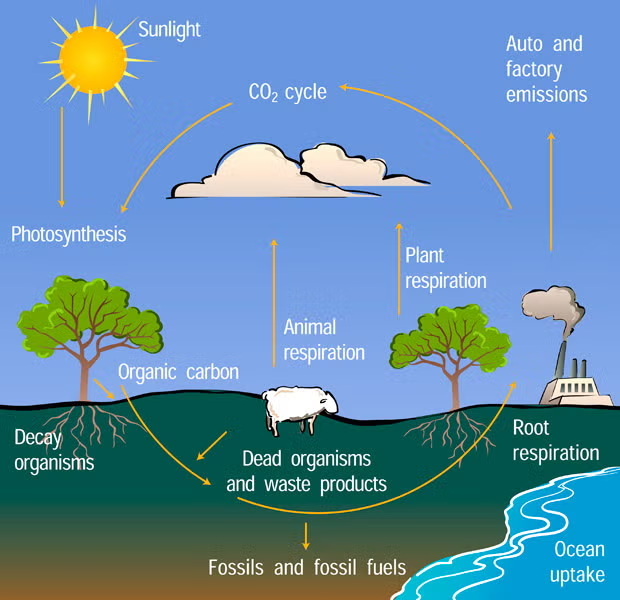
Describe + draw the parts of the carbon cycle. Include the ocean.
CO2 → photosynthesis → primary producer → up the food chain —. plants/animals die → return carbon to ground → turns into CO2 during decomposition or burned as fossile fuel
Respiration → CO2 into atmosphere
In ocean:
CO2 dissolved into water creating carbonic acid
shell making organisms create shells out of calcium carbonate → org die and shells settle to floor → create limestone
for areas with coral reefs (must be shallower waters), same thing
Limestone in ocean subducts / undergoes metamorphism → releases CO2 into atmopshere
Describe nitrogen fixation
N2→NH3→NH4+ (when NH3 reacts with water)
^occurs via…
lightening (requires high amount of energy to break apart N2 diatomic molecule)
N2 + O2 → NO2 => +H2O = HNO3-
haber bosch process → industrial fixation: high pressure + catalyst @400-500*C
processd into urea and ammonium nitrate (NH4NO3)
N2 + 3H2 ←→ 2NH3
via nitrogen fixating bacteria (rhizobia): symmbiotic relationship with legumes (eg beans, soybeans, termites, shipworms, peas, cloves, alafa) living in balls called nodules on the roots
rhizobia fix nitrogen into ammonia, legumes give sugars & sends chemical signals to rhizobia in the nodules
What % of the atmosphere is made of N2 and how mcuh of that is actually fixed and why?
85%
5-8% bc of high energy needed to break diatomic molecule
Describe nitrification
NH4+ → NO2- → No3- via aerobic bacteria like cyanobacteria and arachae
Describe denitrification
NO3- → N2 by aerobic denitrficying bacteria (eg Pseudomonas; where NH3 is used as an energy source and NO3- as the oxidizing element)
Note: in deep sediment/hypoxic conditions, ammonia accumulates
Describe leaching
NO3- leached from rainwater (leached more than NH4+ bc of higher CEC)
describe ammonification
microrganisms/deocomposers turn organic nitrogen into NH4+
volatilization
In places with pH > 7: urease OR when fertilizer/manure is left on the surface, it turns into NH3 gas
describe assimilation
NO3- and NH4+ → organic nitrogen (taken up by plants)
Urea (CO(NH2)2 will can also be taken up, but it usually turns into NH4+)
List the top two sources of nitrogen by humans
Air pollution
Artifical fertilizers
Describe air pollution’s contrubutions to the nitrogen cycle and its impacts
Combustion of fossil fuels produces nitrogen oxides (nitric oxid (NO) > produced than nitrogen oxide (NO2) in cars)
nitrogen oxide is reddish and poisonous
nitric oxide is flammable but colorless & will turn into NO2 by combining with O2
impact:
creates smog: .2 ppm for smog, 0.01ppm for normal conditions
forms nitric acid when combining with rain water → HNO3
damages aquatic life and trees; erodes marble and limestone
Nitric acid may also be created industrially (NH3+O2 → HNO3 + H2O)
used in fertilizers & explosives
Describe fertilizers’s contrubutions to the nitrogen cycle and its impacts
accounts for half of nitrogen on land
90 megatons of biologically fixated nitrogen = 1 million tons of nitrogen created
impact: causes eutrophication
Describe the phosphorous cycle
List and describe sources of phosphorous
List the two methods of stream ordering and describe them
Strahler (most common): add streams only when they are the same, otherwise carry on with largest order. flaw: basically ignores what little streams are contributing
Shreve’s method: additive; may be referred to as magnitutes rather than order; accounts for little streams
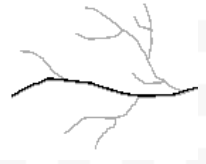
For the follow stream, determine the magnitude using strahler vs shreve’s method
Strahler: 4
Shreve: 9
What orders correspond to diff river continuum sections?
1-3: headwaters
4-6: midreaches
7+: lower reaches
Describe the characteristics of the lower reaches
Describe the characteristics of the mid reaches
Describe the characteristics of the headwaters