Blood Bank Storage & Component Requirements
 Call Kai
 Learn
Learn Practice Test
 Spaced Repetition
 Match
Match Flashcards
 Knowt Play
1/62

There's no tags or description
Looks like no tags are added yet.
Name | Mastery | Learn | Test | Matching | Spaced | Call with Kai | Chat |
|---|
No analytics yet
Send a link to your students to track their progress
63 Terms
RBC shelf life with ACD, CPD or CP2D
a 5 days
b 21 days
c 35 days
d 42 days
21 days
RBC shelf life with CPDA-1
a 5 days
b 21 days
c 35 days
d 42 days
35 days
RBC shelf life with AS 1, 3 or 5
a 5 days
b 21 days
c 35 days
d 42 days
42 days
Packed RBCs are stored at _____ C and transported at _______C
a 1-6 & 1-6
b 1-6 & 20
c 1-6 & 1-10
d 1-10 & 20
c 1-6 & 1-10
Blood products should be transfused within ____ hours of piercing with transfusion set
4 hours
FFP (Fresh Frozen Plasma) can be stored frozen at _____*C for ______ days.
-18* x 365 days
Thawed FFP (Fresh Frozen Plasma) can be stored at _____*C for ______ hours.
1-6*C for 24 hours
If a blood unit with CPD preservative is used in a patient undergoing heart surgery with a heart-lung machine, it must be converted to ______a________ blood by adding ____b_______ and ___c___ must be added to neutralize the CPD.
a heparinized
b heparin anticoagulant
c Ca2+
A blood donation using a "Quad Bag" can have _____ different components made, including:
4
Packed RBCs
Platelets
Cryoprecipitate
Plasma
Packed red cells with CPD or CPD2 and added AS (additive solution) may be stored for _______ days.
a. 21
b. 25
c. 35
d. 42
d. 42
A unit of platelets from WB (40-70mL) should have __________________ platelets at a ph of >/=_____.
5.5 X 10^10
6.2
Apheresis platelets should contain ___________x_______ platelets at pH >/= 6.2.
3.0 x 10^11
Cryoprecipitate is required to have >____ IU of _____ and _____mg of _______________________.
> 80 IU of FVIII
150 mg of Fibrinogen
When stored red cells exhibit storage lesion, levels of 2,3 DPG ______a________, leading to _________b___________ release of O2 to tissues.
a. increase/decrease/remain the same
b. increased/reduced/remain the same
a decrease
b reduced
A patient with a platelet count of 15,000/uL is given a unit of random donor platelets. What is the expected platelet count post transfusion?
20,000-25,000/uL
increase of 5-10k
A patient with a platelet count of 15,000/uL is given a unit of apheresis donor platelets. What is the expected platelet count post transfusion?
45,000-75,000
increase of 30-60k
Leukoreduced blood products should not exceed _____________ WBCs to be acceptable.
5x10^6
RBC storage lesion increases:
- Lactic Acid
- Plasma Hgb
- Plasma [K+]
- Microaggregates
RBC storage lesion decreases:
- pH
- ATP
- 2,3-DPG
- Glucose
- Na+
- Labile coagulation factors
- Viable cells
- Antigen expression: Fya/Fyb, M, P1, Kna/McCa, Bg
What pathway produces the majority RBCs ATP?
Emden-Meyerhof (Anaerobic Glycolytic)
What pathway generates 2,3 GDP?
Luebering-Rapaport Pathway
What pathway generates G-6-PD?
Phosphogluconate Pathway (oxidative)
What pathway cycles methemoglobin to hemoglobin and back?
Methemoglobin Reductase Pathway
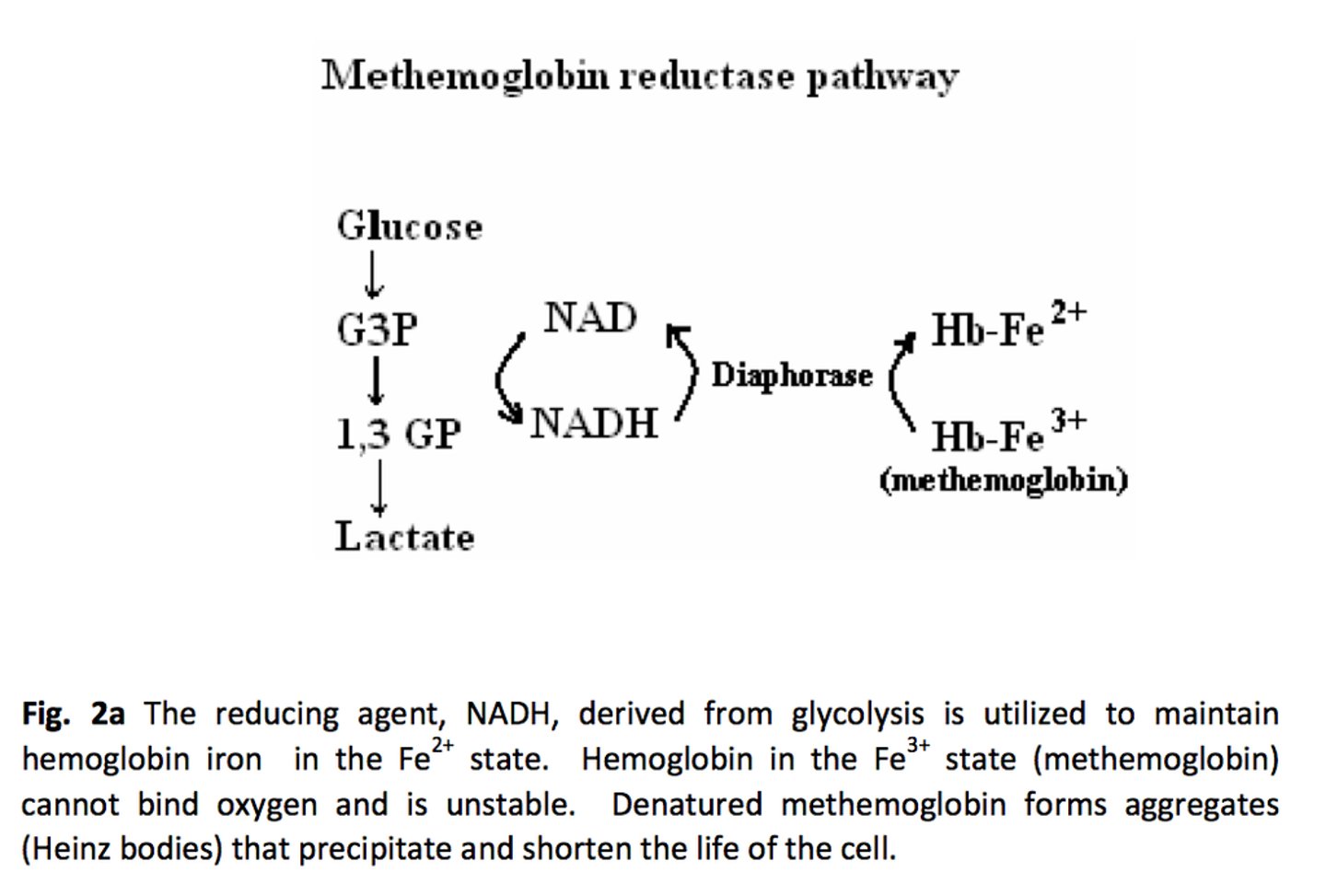
What percent of RBCs should be present after transfusion?
75% of transfused rbc must be present 24 hr after transfusion
Cryoprecipitate contains what 4 coagulation proteins?
- fibrinogen/Factor I
- Factor VIII
- von Willebrand's Factor
- Factor XIII
What are the 1st and 2nd preferred blood component used in a patient with Hemophilia A or vWD?
1. Recombinant Factor VIII-vWF
2. Cryoprecipitate (VIII:vWF, FXIII, Fibrinogen)
Cryoprecipitate is made from _________________ by what process:
FFP (Fresh Frozen Plasma)
1. Thawing at 1-6*C
2. Centrifuge
3. Freeze precipitate at -18*C or below
Thawed cryoprecipitate must be transfused within __a___ of thawing or within __b___ of pooling.
a. 6 hours
b. 4 hours
Blood component labels must have what information in accordance of FDA & AABB regulations:
- Unique donor ID number
- Name of blood component (packed red cells/whole blood/platelets/etc)
- Collection facility
- Exp date (time if applicable)
- Approx volume
- Name/Vol of additives/anticoagulants
- Storage temp (*C)
- ABO & Rh Type
- Transfusion instructions
- "Volunteer Donor"
- Modifying facility (if applicable & modifications are performed eg irradiated)
- Specificity of unexpected Abs
Blood component labels that have been crossmatched and ready for dispensing must have an additional label attached including:
Patient's full name
Patient's ID Number
Donor Unit Number
Compatibility Test Interpretation (Compatible)
Blood (whole/packed red cell) returned to the blood bank for reissue must have:
System remained closed
Blood temp is between 1-10C (if facility regards transport cooler as storage 1-6C)
1+ segment(s) are still attached to unit
unit passes visual inspection
What temperature are single/random donor platelets stored at?
How long?
20-24*C x 5-7 days
Pooled platelets must be kept at ____-____*C and used within _________hours.
20-24*C
4 hours
Whole blood with CPDA-1 is stored at ___-___*C for _________ days.
1-6*C x 35 days
Whole blood or Packed RBCs with ACD, CPD or CPD2 is stored at ___-___*C for _________ days.
1-6*C x 21 days
Whole blood or packed red blood cells with additive solution (AS-1, 3, etc)
are stored at ___-___*C for _________ days.
1-6*C x 42 days
Irradiated whole blood (or packed cell aliquots) expire ___ days after irradiation or the original expiration date; whichever is shortest.
a. 3
b. 5
c. 21
d. 28
e. 35
d. 28
Frozen, glycerolized RBCs can be stored
for ________ years at _______*C
10 years x -65*C
What blood components have a 4 hour shelf life?
Tapped units (open system)
Pooled Platelets
Pooled Cryoprecipitate (open system)
What blood components have a 6 hour shelf life?
Thawed Cryoprecipitate (single donor)
What blood components have a 24 hour shelf life?
RBC aliquots (open system)
RBC, Leukoreduced (open system)
RBC, Washed
RBC, Deglycerolized
Granulocytes
Granulocytes, Irradiated
What 3 blood components have a 5-7 day shelf life?
Platelets, WB-derived random donor
Platelets, Apheresis single donor
Platelets, Leukoreduced
Liquid plasma has a shelf life of ______ days past the expiration of the Whole Blood it was derived from.
5 days
If Whole Blood was collected on March 2nd and has additive CPD, what is the expiration date for the liquid (never frozen) plasma obtained?
March 28
CPD = 21 days + 5 additional days for plasma + 2 days of month = 28th
What 5 blood components have a shelf life of 12 months at -18*C?
FFP
FP24
AFFP
Cryoprecipitate
Cryo-reduced Plasma
What 3 blood components can be stored at or below -65*C; how long can each be stored?
RBCs, Glycerolized x 10 years
FFP x 7 years
FP24 x 7 years
What 6 types of blood components are stored at RT (20-24*C) & for how long can each be kept?
5-7 days: Platelets, depending on bacteria testing
5 days: Platelets, irradiated
24 hours: Granulocytes & Irradiated Granulocytes
6 hours: Thawed Cryoprecipitate
4 hours: Thawed, Pooled Cryoprecipitate
4 hours: Platelets, Pooled
Thawed, deglycerolized RBCs are stored at ______*C and expire ____ ________ later.
a. 1-6*C x 6 hours
b. 1-10*C x 6 hours
c. 1-6*C x 24 hours
d. 1-10*C x 24 hours
e. 1-6*C x 72 hours
f. 1-10*C x 4 hours
c. 1-6*C x 24 hours
FFP (fresh frozen plasma) is stored at _______*C for _________ months.
=/< -18*C x 12 months
FFP (fresh frozen plasma) that has been thawed at 35-37*C is stored at ___a____*C for __b___ ______c________.
1-6*C x 24 hours
Frozen, glycerolized blood can be stored at _______*C for ____ ______________.
-65*C x 10 years
A patient with a HGB of 9 g/dL and platelet count of 50,000 was given 4 units of packed cells (RBCs) and 3 apheresis units of platelets. What is their expected HGB and platelet count assuming bleeding and hemolysis are controlled for.
HGB = 13 g/dL (an increase of 1 mg/dL per unit)
PLT = 140k-230k/uL (an increase of 30-60k per unit)
A unit of packed red cells will increase the HGB ___a___ g/dL and HCT __b__% per unit.
a 1 g/dL
b 3%
What type of platelets are recommended for a refractory patient whose PLT count fails to rise after transfusion?
HLA matched (so they aren't destroyed) & irradiated (prevent GVHD)
*most commonly apheresed and matched from a relative
Apheresis granulocytes are required to have at least _________________ granulocytes for quality control
a. 3x10^11
b. 3x10^10
c. 1x10^12
d. 1x10^10
d. 1x10^10
Which of the following antibodies is usually clinically insignificant?
A. anti-P
B. anti-P1
C. anti-Pk
D. anti-p
B. anti-P1
In a random population, 16% of the people are Rh-negative (rr). What percentage of the Rh-positive population is heterozygous for r?
A. 36%
B. 48%
C. 57%
D. 66%
B. 48%
Of the following blood components, which one should be used to prevent HLA alloimmunization of the recipient?
A. Red Blood Cells
B. Granulocytes
C. Irradiated Red Blood Cells
D. Leukocyte-Reduced Red Blood Cells
D. Leukocyte-Reduced Red Blood Cells
Which of the following is a potential complication of massive transfusions?
A. citrate toxicity with hypercalcemia
B. heparin-induced thrombocytopenia
C. hypothermia due to 1 - 6°C storage temperature of red cells
D. iron overload from donor red cells leaking intracellular iron
C. hypothermia due to 1 - 6°C storage temperature of red cells
A group B, Rh-negative patient has a positive DAT. Which of the following situations would occur?
A. all major crossmatches would be incompatible
B. the weak D test and control would be positive
C. the antibody screening test would be positive
D. the forward and reverse ABO groupings would not agree
B. the weak D test and control would be positive
A positive DAT will interfere with weak D testing causing both the patient and control to demonstrate positive results. Any positive result in the control tube invalidates any results.
Given the following serologic reactions, what is the most likely A subgroup?
A. A1
B. A2
C. A3
D. Ax
C. A3
What A subgroup is associated with a mixed field reaction?
A. A1
B. A2
C. A3
D. Ax
C. A3
When the main objective of an exchange transfusion is to remove the infant's antibody-sensitized red blood cells and to control hyperbilirubinemia, the blood product of choice is ABO compatible:
A. Fresh Whole Blood
B. Red Blood Cells (RBC) washed
C. RBC suspended in Fresh Frozen Plasma
D. heparinized Red Blood Cells
C. RBC suspended in Fresh Frozen Plasma
For exchange transfusion, antigen-negative Red Blood Cells are typically resuspended in ABO-compatible thawed Fresh Frozen Plasma.