CH 04 – Protein, structure, and function
 Call Kai
 Learn
Learn Practice Test
 Spaced Repetition
 Match
Match Flashcards
 Knowt Play
1/30

Earn XP
Description and Tags
EXAM 1: homework problems + iclicker
Name | Mastery | Learn | Test | Matching | Spaced | Call with Kai | Chat |
|---|
No analytics yet
Send a link to your students to track their progress
31 Terms
Which type of noncovalent interaction can involve either the polypeptide backbone or amino acid side chains?
HYDROGEN BONDS
The backbone of the polypeptide consists of uncharged polar covalent bonds. Because the bonds in the backbone are neither charger nor hydrophobic (i.e. nonpolar), hydrophobic forces and electrostatic interactions do not involve the backbone. Hydrogen bonds, however, are formed between atoms in the polar covalent bonds found in both amino acid side chains and in the carboxyl group and amino groups of the polypeptide backbone.
A folded protein structure with which free-energy (G) value would likely have the most stable conformation?
1
Free energy is designated by the letter G. If the free-energy value decreases during protein folding, the reaction is energetically favorable. Proteins generally fold along the most energetically favorable pathway, so the conformation with the lowest free-energy (G) value, 1, is the correct answer.
If protein folding is determined by the sequence of amino acids in the polypeptide chain, why are chaperone proteins needed to assist folding in the cell?
PROTEINS CAN EASILY AGGREGATE WITH OTHER PROTEINS
All proteins can fold on their own without assistance due to the energetically favorable interactions between amino acid side chains and/or the polypeptide backbone. However, the cytoplasm is crowded and some proteins can form favorable interactions with other proteins before they have a chance to fold. These aggregates could impede proper folding.
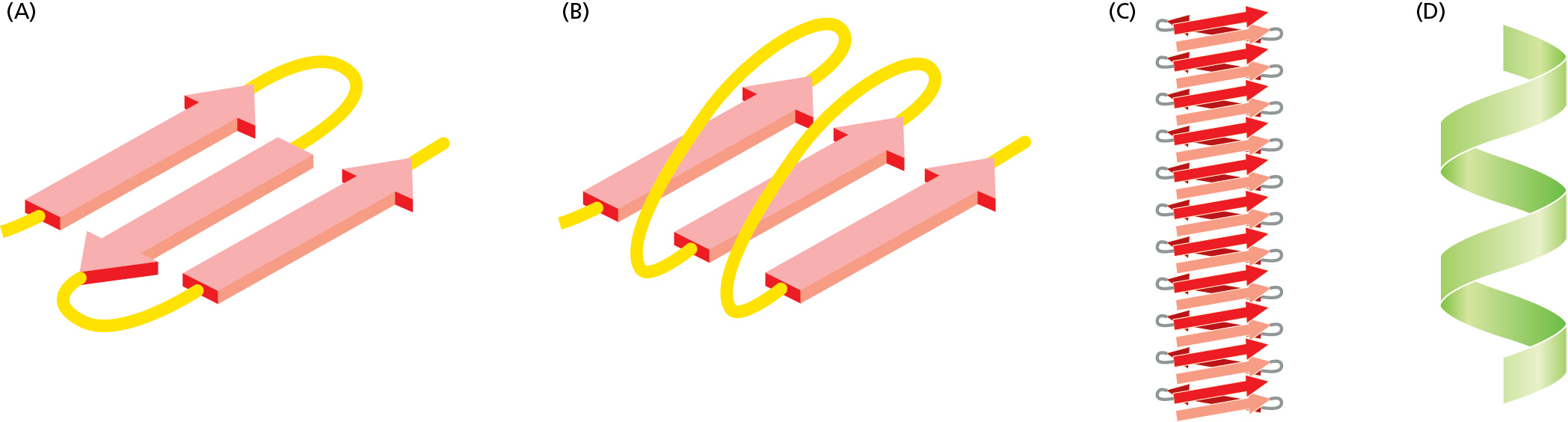
Hydrogen bonding between N–H and C=O groups of every fourth amino acid within a polypeptide chain results in which type of folding pattern?
ALPHA HELIX (D)
The hydrogen bonds that form a β-pleated sheet structure occur between the N–H and C=O groups of amino acids in different segments of a single polypeptide chain lying side by side. Amyloid structures are β sheets that interlock with each other through their side chains. The α helices are formed by hydrogen bonds between every fourth amino acid in the primary structure.
Which of the following is true about amyloid protein structures?
CONSIST OF STACKED B PLEATED SHEETS
Amyloid protein structures are β sheets that interlock with each other through their side chains and form stacks. Since they are made from many β sheets, they form strong structures that have many roles in the cell, including formation of important cellular compartments. However, some amyloid structures, but not all, are abnormal and cause disease.
A stretch of amino acids in a polypeptide chain that is capable of independently folding into a defined structure is called a
DOMAIN
A domain is a sequence of amino acids in a polypeptide chain that adopts a defined folding pattern based on the interactions of the side chains, as well as contributions from the polypeptide backbone molecules. This is distinct from a subunit, which is a term used for a single, complete polypeptide chain that can interact with other subunits to form a larger complex.
Which of the following levels of protein structure involves the interaction of more than one polypeptide chain into a three-dimensional structure?
QUARTNARY
Primary structure is the linear order of amino acids in a polypeptide chain. The secondary structure is the formation of organized arrangements to form segments like α helices and β sheets. The tertiary structure is the overall three-dimensional shape of a protein. The quaternary structure is the assembly of multiple folded polypeptide chains into a larger complex.
Which of the following shows protein organizational units in the correct order from smallest to largest?
DOMAIN < SUBUNIT < COMPLEX
A domain is a portion of an amino acid sequence that folds into a three-dimensional structure and is the smallest of the organizational units. A subunit is a single, complete polypeptide chain and may be made up of one or more domains. Two or more subunits can assemble into a complex.
A binding site on the surface of a protein interacts specifically with another protein through
MANY WEAK NONCOVALENT INTERACTIONS
Covalent interactions are rarely used between protein molecules because they are difficult to break, often requiring an enzyme. Interactions between proteins and their partners need to be reversible but very specific. A specific interaction, but one that is able to be altered, can be achieved through formation of many weak noncovalent interactions between proteins and their binding partners.
Disulfide bonds stabilize protein shape outside the cell by
COVALENT BONDS BETWEEN CYSTINE GROUPS
Using mechanisms such as noncovalent bonds between charged side chains, proteins fold into their final conformation based on their amino acid sequence inside the cell. However, in the harsh environment outside the cell, this structure needs to be stabilized to keep its final form and function. Disulfide bonds are covalent cross-linkages between cysteine groups juxtaposed in the three-dimensional structure, and they act to hold the shape of the protein.

The figure below shows a depiction of an antibody. Which label correctly identifies the region(s) of the antibody that contains variable amino acids for binding of a specific antigen?
A
Unique antigen-binding sites in antibodies are formed by varying the terminal amino acid sequences in the heavy chain and the light chain, which come together into a unique three-dimensional conformation for specific side-chain interactions with the antigen. Since each antibody is made up of two heavy chains and two light chains, there are two antigen-binding sites per antibody.
The Michaelis constant (KM) of an enzyme is a measure of
BINDING STRENGHT OF ENZYME TO SUBSTRATE
Enzyme activity is measured using two values. The first is the rate at which the enzyme converts the substrate to product, which is called Vmax. This value is determined by measuring the rate of product formation in conditions where all enzyme binding sites are occupied by substrate. The Michaelis constant measures the relative binding strength of the enzyme to substrate, determined by the concentration of substrate at which the enzyme operates at half of its Vmax.
The Michaelis constant (KM) of an enzyme is a measure of
REDUCE FREE ENGERGY OF THE PRODUCTS OF THE REACTION
Enzymes lower activation energy of a reaction by promoting changes in the substrate that will encourage the reaction to occur. This can include changes in shape, alignment of two substrates, or changes in the electron density to encourage bond breakage and formation. Enzymes do not change the overall free energy of the reaction.
The Michaelis constant (KM) of an enzyme is a measure of
TURN OFF SYNTHESIS WHEN IN ABUNDANCE
Feedback inhibition keeps the cell from accumulating unnecessarily large amounts of biological compounds by reversibly inhibiting an enzyme in the biosynthetic pathway for that compound. These mechanisms shut down the enzymes early in the pathway so that wasteful intermediates do not accumulate.
When a ligand binds to an allosteric enzyme’s regulatory site, it changes the activity of that enzyme by
INDUCING CONFORMATIONAL CHANGE
Once a regulatory molecule or ligand binds to a regulatory site, an allosteric protein undergoes a conformational change that is transmitted to the active site. Inducing the conformational change can change the activity of the enzyme, but it does NOT directly block the active site.
How does phosphorylation of a protein affect its activity?
COULD INCREASE OR DECREASE ACTIVITY
Phosphorylation of amino acid side chains in a protein changes their charge to a negative charge. It could lead to changes in conformation of the protein, differences in binding to partners, and either increased or decreased activity of an enzyme. Thus, the effects of protein phosphorylation are particular to the protein itself.
How does binding of GTP to a GTP-binding protein affect its activity?
ALWAYS ACTIVATES THE PROTEIN
Proteins in the GTP-binding protein family are always in their active conformation when GTP is bound, in contrast to phosphorylation of a protein, which can activate or inactivate a protein. The hydrolysis of GTP to GDP returns the protein to the inactive state.
How does binding of GTP to a GTP-binding protein affect its activity?
SIDE CHAINS
The chemical modification of phosphorylation and acetylation occurs on the side chain of the amino acid and can affect how proteins interact with other proteins or components of the cell. This effect can occur through the direct alteration of binding sites if the phosphorylation and acetylation occur on an amino acid in a binding site, or through a conformational change that indirectly alters the binding site.

Shown below is the ATP hydrolysis cycle of a motor protein. What sentence BEST describes the state of the motor protein in "C"?
HYDROLYSIS OF ATP TO ADP CAUSED CONFORMATIONAL CHANGE
(A) is the state where no ATP or ADP is bound. The protein is bound to the filament with one of its two filament-binding domains, while the other binding domain is unbound. (B) shows that upon ATP binding, a conformational change moves the unbound domain forward one step to interact with the filament. In (C), ATP is hydrolyzed to ADP, creating a conformational change to release the rear filament-binding domain and bring it forward.
Biochemical subcompartments that form inside the nucleus are distinct from their immediate surroundings because of the
HIGH CONC. OF INTERACTING PROTEINS + RNA
Biochemical subcompartments can form inside of organelles by the aggregation of interacting proteins, RNA, and protein complexes that perform a concerted function. These "intracellular condensates" are simply concentrations of molecules; they are not bound by a membrane, nor are they hydrophobic droplets.
Which method is used for separating proteins based on specific interactions with other molecules?
AFFINITY CHROMATOGRAPHY
Affinity chromatography separates proteins from one another by using a known molecular interaction with the protein of interest. Gel electrophoresis and mass spectrometry separate protein fragments by size and charge. X-ray crystallography is a method for determining the three-dimensional structure of a protein; it is not used for separation.
Which method is most suitable for determining the three-dimensional structure of an extremely large integral membrane protein complex?
CRYOELECTRION MICROSCOPY
Large proteins produce confounding signals on NMR spectra, and large integral membrane complexes are hard to crystallize for x-ray crystallography. Structural studies of large integral membrane protein complex could be performed with cryoelectron microscopy. In this method, the purified protein complex is embedded in ice and a beam of electrons is used to collect projected images in multiple orientations.
What is a protein family?
A STRUCTURALLY RELATED GROUP OF PROTEINS
A protein family is a set of proteins that have similar primary structures (amino acid sequences) and thus have related three-dimensional structures. If the structure of one member of a protein family is determined, it can be used to make predictions about the structure of other members of the protein family.
Choose the most accurate statement(s).
a. The peptide bond polymerizes amino acids via a non-covalent bond.
b. The formation of a peptide bond releases a water molecule.
c. Among the 20 common amino acids, 10 are polar (potentially hydrophilic), and 10 are non-polar
(potentially hydrophobic).
d. The core of globular proteins is usually formed by polar amino acids.
e. Protein folding is driven mostly by non-covalent bonds, such as hydrogen bonds, electrostatic
interactions, and van der Waals attractions.
B, C, E
Choose the most accurate statement(s).
a. Proteins tend to fold to minimize their free energy, reaching their native state.
b. Protein folding is not energetically favorable (not spontaneous) and, to occur, must be coupled to
favorable reactions.
c. Chaperones assist/guide the folding of other proteins.
d. The action of chaperones to assist protein folding never requires ATP.
e. Some chaperones form chambers that isolate the protein from the rest of the cell to facilitate its
folding.
A, C, E
Choose the most accurate statement(s).
a. The secondary structures alpha helices and beta sheets form by establishing bonds between the
side chains of amino acids.
b. The secondary structures alpha helices and beta sheets form by establishing hydrogen bonds
between different parts of the protein backbone.
c. Alpha helices form by connecting amino acids that are 10 positions apart in the amino-acid
sequence.
d. In beta sheets, the distance of amino acids in the amino-acid sequence can be very different
depending on the protein.
e. Alpha helices and beta sheets are the only known secondary structures.
B, D
Choose the most accurate statement(s).
a. The quaternary structure of a protein refers to the structure associated with the protein complex it
forms with other protein subunits (identical or different).
b. Protein complexes formed by multiple proteins are used to store proteins in the cell but do not
carry biological functions.
c. Alpha helices are very uncommon in proteins that are bound to membranes.
d. The biological function of protein complexes depends strongly on their geometrical configuration
and interaction bonds between subunits in the complex.
e. Once assembled into a complex, a protein can never adopt an alternative conformation.
A, D
Choose the most accurate statement(s).
a. Proteins carry out their function mostly in their unfolded state; when proteins are folded, they are usually inactive
b. Ligands are very specific to specific proteins due to the possibility of establishing several non-covalent interactions accurately distributed throughout a region of the protein.
c. Ligands must interact with proteins using covalent bonds in the protein's active site for the
association to be functional.
d. Antibodies are proteins that can recognize antigens in pathogens as part of the immune response system of animals and plants.
e. The overall structure (topology) of antibodies is highly conserved, but the antigen-binding site is hyper-variable in sequence and structure.
B, E
Choose the most accurate statement(s).
a. Enzymes are proteins that interact with substrates, catalyzing reactions and often remaining
active after the reaction occurs, so they can be recycled to interact with more substrate.
b. The action of enzymes never requires the use of ATP.
c. Kinase catalyzes the removal of a phosphate group from a molecule, while phosphatase
catalyzes the addition of a phosphate group from a molecule.
d. Assuming that an enzyme is not limiting, the rate of reaction increases indefinitely with the
substrate concentration.
e. The Michaelis-Menten constant, KM, estimates the substrate concentration required to reach half
of the maximum reaction rate.
A, E
Choose the most accurate statement(s).
a. Until degraded, enzymes always remain active to interact with their specific substrate and
catalyze reactions.
b. Proteins may require non-protein molecules (cofactors) to carry out their function.
c. Enzymes have been selected in cells such that for each substrate that the cell needs to process,
there is one enzyme that generates the final product needed for the cell.
d. Molecular scaffolds (made, for example, of protein or nucleic acids) often coordinate the action of
different enzymes and substrates, defining local functional regions in cells.
e. Enzymes can only be regulated at their active site.
B, D
Choose the most accurate statement(s).
a. Proteins in cells are usually studied by modifying cells genetically so the protein of interest is expressed on the cell surface and can be easily collected for analysis.
b. The high rotation speeds of a centrifuge help separate the components of the cell; the
supernatant contains the coarser components, and the pellet contains the smaller components.
c. Ion-exchange chromatography, gel-filtration chromatography, and affinity chromatography are three commonly used chromatography methods.
d. In electrophoresis, electric fields are applied to a sample, and proteins can be separated by size in a gel.
e. X-ray crystallography is the only method that can currently provide molecular information about protein structure.
C, D