Week 4 Monday: Plant Mineral Nutrition 2 (9/21)
 Call Kai
 Learn
Learn Practice Test
 Spaced Repetition
 Match
Match Flashcards
 Knowt Play
1/24

There's no tags or description
Looks like no tags are added yet.
Name | Mastery | Learn | Test | Matching | Spaced | Call with Kai | Chat |
|---|
No analytics yet
Send a link to your students to track their progress
25 Terms
Apoplastic movement
Through cell walls and intercellular spaces.
Symplastic movement
Through the cytoplasm and connected via plasmodesmata.
Casparian strip
Hydrophobic band made of lignin that surrounds the vasculature of roots. Forces the flow of water and anything else through the plant symplast to be subjected to transport proteins
Suberin lamellae
Layers of waxy hydrophobic suberin on the inner surface of cell walls just outside the plasma membrane
Passage cells
Thin-walled, unsuberized cells in the root endodermis and exodermis that allow water and mineral ions to pass into the vascular cylinder (so they’re inside the root)
Root cap
Protects the meristematic cells at the growing tip, guides root growth, and plays a signalling role
What must water do to be transported to the top of the plant?
In order to be transported to the top of the plant, minerals must pass through the Casparian strip and the suberin lamellae
Is apoplastic movement into the vasculature possible?
The lignified Casparian strip and the suberinized suberin lamellae prohibit apoplastic movement into the vasculature. ▪ Therefore, mineral elements must pass symplastically through passage cells, which are highly selective for what can and cannot enter.
Active transport
Against/up the concentration gradient (low to high concentration), energy required
Passive transport
Down/with the concentration gradient (high to low concentration), no energy required
Primary vs. secondary active transport
Primary active transport directly uses chemical energy from ATP to move molecules across a membrane, while secondary active transport uses an electrochemical gradient created by primary active transport to move molecules without directly using ATP
(for example, using a symport to move H+ along its concentration gradient and another molecule against its concentration gradient)
Symport
Pumps two molecules in the same direction
Antiport
Pumps two molecules in the opposite direction
Uniport
Pumps one molecule in one direction
Steenberg effect
Adding a deficient nutrient to a plant temporarily causes its internal concentration of that nutrient to decrease
This happens because the initial application of the missing nutrient triggers a massive, rapid burst of plant growth and biomass production that outpaces the rate of nutrient uptake, effectively diluting the nutrient within the plant's tissues
Michaelis-Menten
A mathematical model of enzyme action with two parameters: Vmax and Km
Vmax: maximum velocity of the enzymatic reaction
Km: substrate (the molecule the enzyme reacts with) concentration at which half of the enzyme’s active sites are occupied by substrate
Km and affinity
Low Km is high affinity
High Km is low affinity
Competitive inhibition effect on Km and Vmax
Same Vmax
Increases the apparent Km value
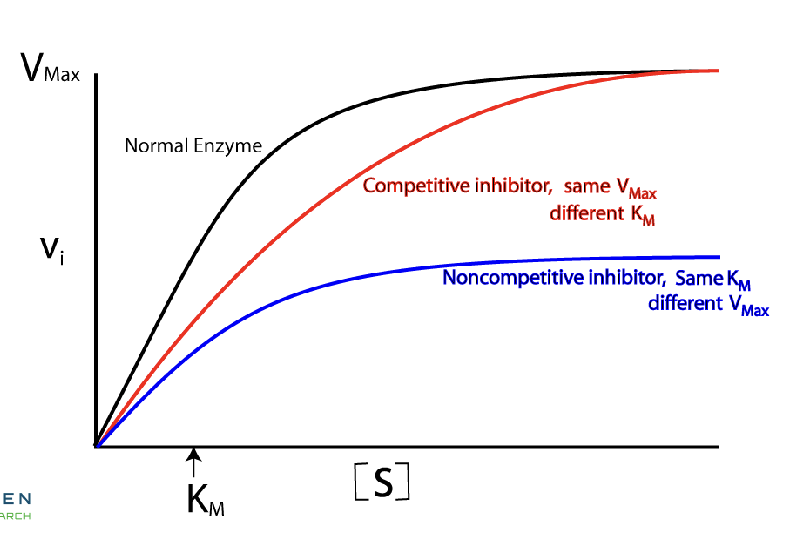
Noncompetitive inhibition effect on Km and Vmax
Different Vmax
No change to Km
Noncompetitive inhibitors bind to an allosteric site, making the enzyme unable to bind to the substrate. This means a portion of the enzymes no longer work and Vmax is decreased. Km stays the same because the same substrate concentration is required to bind to 50% of the enzymes

Mechanism I vs II nutrient uptake
Mechanism I (High-Affinity Transport System/HATS): Operates at low nutrient concentrations. High affinity (Low Km), low Vmax
Mechanism II (Low-Affinity Transport System/LATS): Operates at high nutrient concentrations. Low affinity (high Km), high Vmax
High affinity = low Km because it requires a low concentration of the nutrient to start working
Is nitrate uptake active or passive?
Active
Is ammonium uptake active or passive?
Mostly passive through ion channels, but can also use K+, Mg2+, and Ca2+ uptake routes
Calcium
Immobile, and leads to disorders even when it is provided in adequate amounts
Strategy I iron uptake: who uses it and what steps does it have?
Who uses it? Most non-graminaceous plants, including dicots and non-grass monocots
Acidification, reduction, and transport
Strategy II iron uptake: who uses it and what steps does it have?
Who uses it? Graminaceous plants (grasses, such as maize, rice, barley, and wheat
Chelation and direct uptake of complexes