Comprehensive Guide to Entrepreneurship Types and Concepts FROM QUIZLET
 Call Kai
 Learn
Learn Practice Test
 Spaced Repetition
 Match
Match Flashcards
 Knowt Play
1/314

There's no tags or description
Looks like no tags are added yet.
Name | Mastery | Learn | Test | Matching | Spaced | Call with Kai | Chat |
|---|
No analytics yet
Send a link to your students to track their progress
315 Terms
What is the definition of entrepreneurship?
The process of discovery, evaluation, and exploitation of opportunities to introduce new goods and services.
What are entrepreneurial opportunities?
Situations in which new goods, services, raw materials, markets, and organizing methods can be introduced through the formation of new means, ends, or means-ends relationships.
What does 'new means' refer to in entrepreneurship?
Discovering novel ways to achieve existing goals, such as using technology to make processes more efficient.
What does 'new ends' refer to in entrepreneurship?
Identifying new goals or purposes, such as creating products or services for unmet needs.
What are 'new means-ends relationships'?
Redefining the connection between resources (means) and goals (ends), such as finding new uses for existing resources.
What are the three types of entrepreneurship according to Baumol?
Productive, Unproductive, and Destructive Entrepreneurship.

What is productive entrepreneurship?
Activities that contribute positively to economic growth, innovation, and societal well-being by creating value for others.
What is unproductive entrepreneurship?
Activities that do not contribute to societal value or economic growth and may involve exploiting resources for personal gain.
What is destructive entrepreneurship?
Activities that actively harm societal progress or economic well-being, such as unethical behaviors or harmful innovations.
What are some potential benefits of productive entrepreneurship?
Innovation, economic development (jobs), and social welfare.
What is the origin of the term 'entrepreneur'?
The term comes from the French word 'entreprendre', meaning 'to undertake'.
Who initially defined the concept of 'entrepreneur'?
Richard Cantillon in the 1750s.
What is the role of entrepreneurs according to Cantillon?
Intermediaries who assume the risk of buying goods at certain prices and selling them at uncertain prices.
What are the Big Five Personality Traits relevant to entrepreneurs?
Neuroticism, Extraversion, Openness to Experience, Agreeableness, and Conscientiousness.
How does high Neuroticism affect an entrepreneur?
Individuals high on Neuroticism tend to experience negative emotions such as anxiety and impulsiveness.
How does high Extraversion characterize an entrepreneur?
Individuals high on Extraversion are dominant, energetic, and enthusiastic, often seeking excitement and stimulation.
What does high Openness to Experience indicate in an entrepreneur?
It indicates intellectual curiosity and a tendency to seek new experiences and explore novel ideas.
What does high Agreeableness suggest about an entrepreneur's interpersonal orientation?
It suggests they are trusting, forgiving, caring, and have cooperative values.
nothing
nothing
1
1
2
2
0
0
4
4
What is the significance of the entrepreneurial process?
It involves the identification and exploitation of opportunities for innovation and economic growth.
What is the role of an entrepreneur in the economy?
To create value, drive innovation, and contribute to economic development.
What is agreeableness in the context of personality traits?
An individual's willingness to be cooperative and accommodating in social situations.
How does conscientiousness relate to goal accomplishment?
It reflects an individual's achievement motivation and dependability, indicating they are organized and methodical.
What trait distinguishes entrepreneurs from managers in terms of openness?
Entrepreneurs are higher on Openness to experience, exploring new ideas and creative problem-solving.
How does conscientiousness differ between entrepreneurs and managers?
Entrepreneurs are higher on conscientiousness, as their work is more discretionary and self-directed.
Why are entrepreneurs typically lower on agreeableness compared to managers?
Entrepreneurs often drive hard bargains and prioritize self-interest due to limited resources.
What is the significance of neuroticism in entrepreneurs compared to managers?
Entrepreneurs are lower on neuroticism, indicating they handle stress and risk better than managers.
Define the need for achievement in entrepreneurship.
It is the desire for significant accomplishment and mastery of skills, motivating individuals to pursue entrepreneurship.
What is an internal locus of control?
It is the belief that one's own decisions and actions control their life outcomes.
How does self-efficacy influence entrepreneurship?
Individuals with high self-efficacy believe they can perform tasks and fulfill roles, making them more likely to start a business.
What does innovativeness entail in the context of entrepreneurship?
It involves the ability to introduce new products, services, or methods, indicating a keen eye for innovation.
What is the propensity for risk-taking?
It is an individual's willingness to engage in activities that involve uncertainty and potential failure.
What is entrepreneurship defined as?
The process of discovery, evaluation, and exploitation of opportunities to introduce new goods and services.
What are disruptive technologies?
Technological advances that create opportunities for new products, services, or business methods.
Give an example of a disruptive technology.
The rise of artificial intelligence has created opportunities for startups like OpenAI.
How can industrial and regulatory changes create entrepreneurial opportunities?
Changes in laws or regulations can open markets or create demand for new products and services.
What impact did the legalization of cannabis have on entrepreneurship?
It created opportunities for businesses like Aurora Cannabis and Canopy Growth.
What role do social and demographic changes play in creating opportunities?
Shifts in societal norms and consumer behaviors can create new markets and needs.
How did the aging population influence entrepreneurship?
It has driven demand for eldercare services and healthcare startups.
What economic changes can disrupt markets and create opportunities?
Conditions like recessions or inflation can lead to new business models and innovations.
How did the 2008 financial crisis influence entrepreneurship?
It led to the emergence of Airbnb as a low-cost alternative to hotels.
What are market gaps or inefficiencies?
Unmet consumer needs or inefficient markets that provide opportunities for entrepreneurs.
Give an example of a market gap that led to entrepreneurship.
The lack of affordable transportation options in developing countries led to ride-sharing platforms like Gojek.
What is the difference between accidental discovery and purposeful search in opportunity discovery?
Accidental discovery is passive and results from alertness, while purposeful search is a deliberate effort to seek new information.
What factors influence opportunity discovery?
Factors include individual traits, market conditions, and environmental changes.
What is entrepreneurial alertness?
The ability to notice and act upon opportunities that others have overlooked or not yet identified.
Define entrepreneurial awareness.
The propensity to notice and be sensitive to information about objects, incidents, and patterns of behavior in the environment, especially regarding maker and user problems, unmet needs, and novel resource combinations.
How does prior knowledge affect opportunity discovery?
It triggers recognition of the value of new information, as people tend to notice information related to what they already know.
What is Domain 1 knowledge in entrepreneurship?
Knowledge in an area of special interest that an entrepreneur engages in autodidactic learning to deepen their capabilities.
What is Domain 2 knowledge in entrepreneurship?
Knowledge accumulated over years while working in a specific job, market, or industry.
How do social networks influence opportunity recognition?
Weak ties are more likely to provide unique information than strong ties.
What are weak ties in the context of entrepreneurship?
Casual acquaintances or coworkers that provide general information leading to opportunity identification.
What are strong ties in entrepreneurship?
People with whom an entrepreneur has long-term, stable relationships, but who are not partners in the venture.
What is the definition of entrepreneurship as a process?
The process of discovery, evaluation, and exploitation of opportunities to introduce new goods and services.
What are the three main processes in entrepreneurship?
Discovery of opportunities, evaluation of opportunities, and exploitation of opportunities.
What does the discovery of opportunities involve?
Identifying situations where new goods, services, raw materials, or organizational methods can be introduced.
What is involved in the evaluation of opportunities?
Assessing the feasibility, desirability, and potential profitability of discovered opportunities.
What actions are taken during the exploitation of opportunities?
Acquiring resources, organizing efforts, and creating or modifying ventures to bring products or services to market.
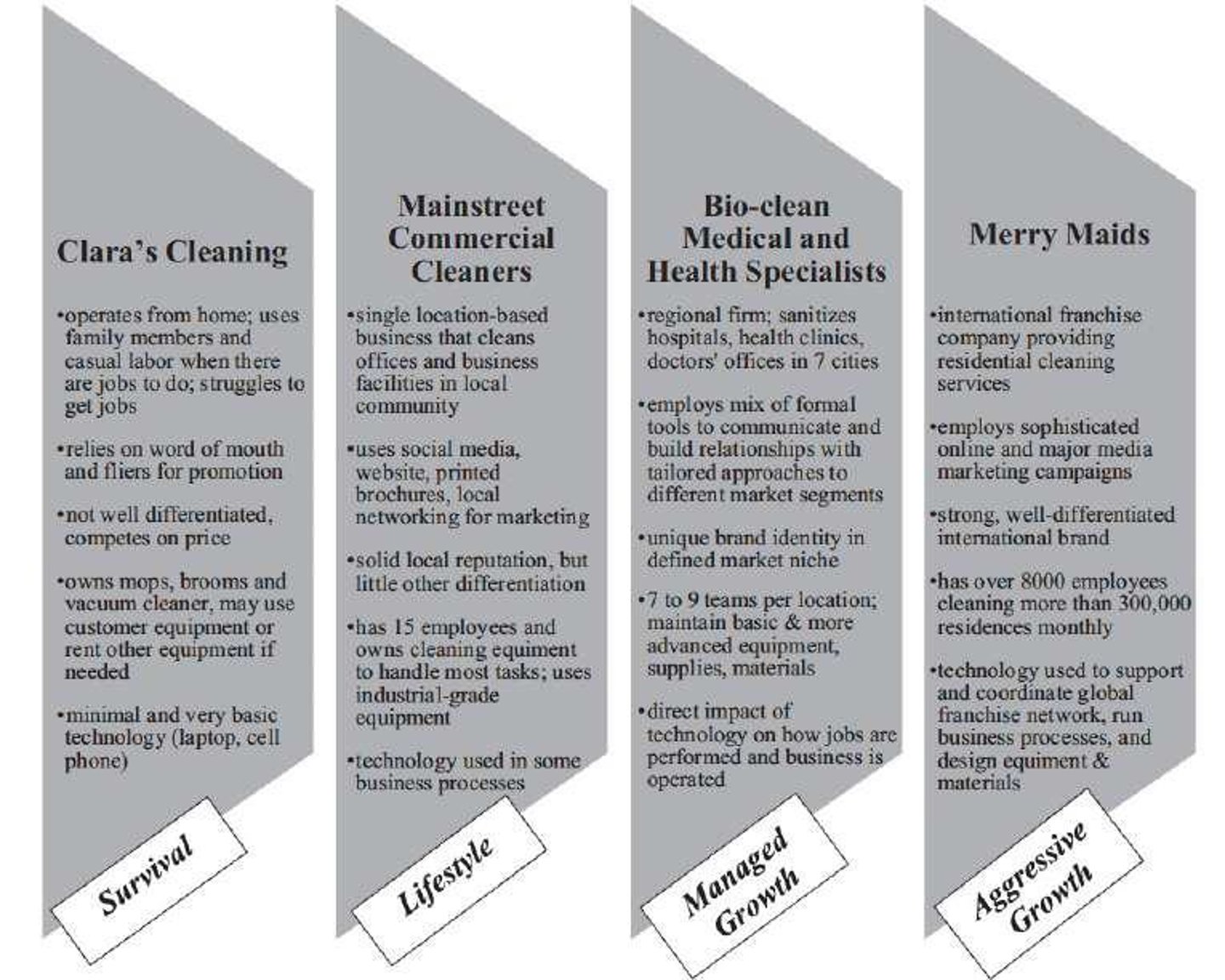
Describe Clara's Cleaning as an entrepreneurial venture.
A small, home-based cleaning business serving residential clients, relying on word-of-mouth referrals and lacking formal contracts or business infrastructure.
What distinguishes Mainstreet Commercial Cleaners from Clara's Cleaning?
It is a mid-sized cleaning company with employees, contracts, and a formal marketing strategy.
What is unique about Bio-clean Medical and Health Specialists?
It is a woman-owned and veteran-owned company specializing in cleaning medical facilities with a strong regional brand.
What is Merry Maids known for?
Being the world's largest home cleaning franchise network with over 1,400 franchises and a focus on eco-friendly practices.
What are survival ventures?
Businesses that provide basic subsistence for the entrepreneur and their family, often operating informally and on a cash or barter basis.
What is the role of autodidactic learning in entrepreneurship?
It allows entrepreneurs to deepen their knowledge and capabilities in areas of special interest.
How do entrepreneurs typically discover opportunities?
Through their networks, prior knowledge, and sensitivity to unmet needs and problems.
What is the significance of weak ties in entrepreneurship?
They often provide unique information that can lead to opportunity recognition.
What is the importance of social networks in opportunity evaluation?
They can shape the evaluation process by providing diverse perspectives and information.
What are the potential benefits of productive entrepreneurship?
Creating jobs, fostering innovation, and contributing to economic growth.
What is the relationship between entrepreneurial opportunities and market needs?
Opportunities often arise from unmet needs and problems in the market that entrepreneurs can address.
How does entrepreneurial alertness differ from entrepreneurial awareness?
Alertness is about noticing and acting on opportunities, while awareness involves sensitivity to information and patterns in the environment.
What characterizes a Survival Venture?
Operates on a cash or barter basis, has no formal registration, and exists to meet basic personal financial needs.
What is a common example of a Survival Venture?
Lawncare service, handyman, or Uber driver.
What defines a Lifestyle Venture?
Provides stable income without seeking significant growth, typically has a single location and a constant number of employees.
Give an example of a Lifestyle Venture.
Local bar, hair salon, or auto repair shop.
What is the goal of a Managed Growth Venture?
To achieve stable growth through new products, market entries, and ongoing reinvestment.
Name an example of a Managed Growth Venture.
Custom boat manufacturer or multi-location medical clinic.
What distinguishes Aggressive Growth Ventures?
They seek exponential growth, often in technology, and are funded by equity capital.
What is a common trait of Aggressive Growth Ventures?
They are often candidates for initial public offerings or acquisitions.
What annual growth rate is typical for Survival Ventures?
Nominal or insignificant growth.
What is the time horizon for Lifestyle Ventures?
Weekly to monthly management focus.
What type of management style is common in Managed Growth Ventures?
Strategic management focused on controlled growth.
What is the entrepreneurial orientation of Aggressive Growth Ventures?
High entrepreneurial orientation with a focus on innovation.
What type of finance sources do Aggressive Growth Ventures typically use?
Bank loans, angel investors, venture capital, and public markets.
What is the exit approach for Managed Growth Ventures?
Sell, merge, or transfer the business.
What is the primary economic motive for Lifestyle Ventures?
Income substitution.
How do Survival Ventures typically manage their resources?
With few, simple, and formative resources.
How significant is the liability of smallness for Managed Growth Ventures?
Less significant compared to Survival and Lifestyle Ventures.
What percentage of new ventures in developed economies are Survival and Lifestyle businesses?
Approximately 85 percent.
What is the relationship between Managed Growth and Aggressive Growth Ventures and job creation?
They produce a disproportionate amount of job and wealth creation.
Do all types of entrepreneurial ventures evolve into one another?
Not necessarily; ventures tend to remain within their original type.
What is the management focus for Aggressive Growth Ventures?
Scalability and proactive management.
What is a common management skill for Lifestyle Ventures?
Operational skills and basic planning.
What is the reward emphasis for Aggressive Growth Ventures?
Equity and capital gain.
What is the typical structure of a Survival Venture?
Little to no formal structure.
What type of technology investment is common in Aggressive Growth Ventures?
Robust and complex technology investments.