Chemistry:alkenes and polymers ,structure and bonding
 Call Kai
 Learn
Learn Practice Test
 Spaced Repetition
 Match
Match Flashcards
 Knowt Play
1/5

There's no tags or description
Looks like no tags are added yet.
Name | Mastery | Learn | Test | Matching | Spaced | Call with Kai | Chat |
|---|
No analytics yet
Send a link to your students to track their progress
6 Terms
Explain why solid sodium carbonate cannot conduct electricity but a solution of sodium carbonate can conduct electricity.(3)
ionic lattice
so ions are fixed
in solution ions can move
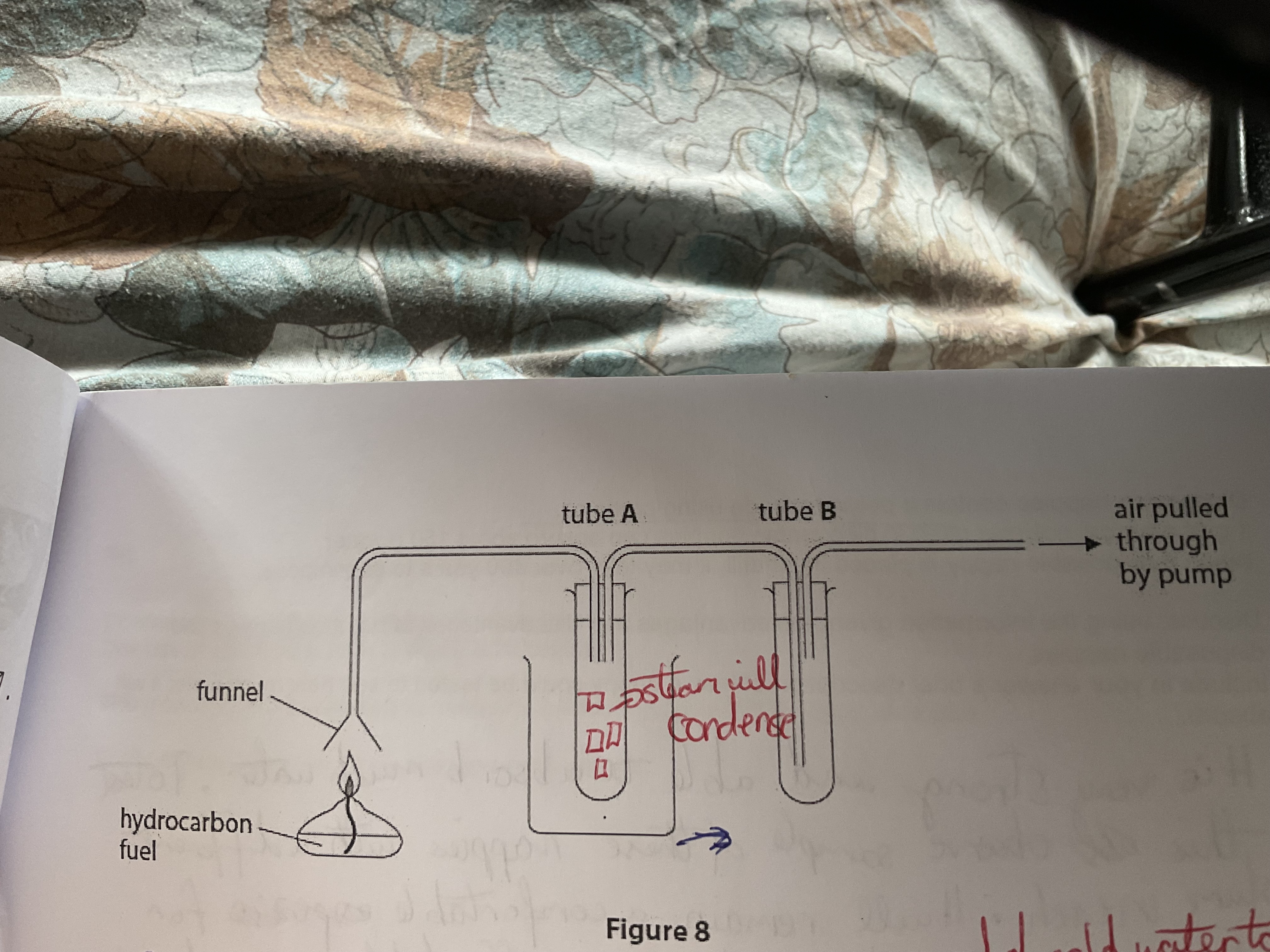
Describe what needs to be done to the apparatus in the figure to collect the water and show that CO2 has been produced.(2)
add cold water to the beaker
go cloudy if CO2 is present
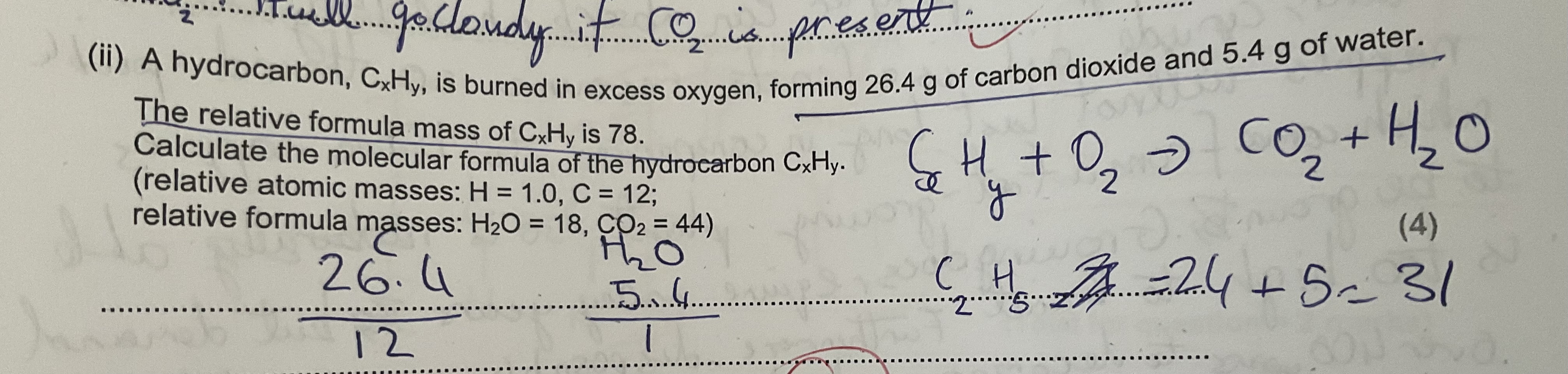
(4)
moles of carbon = 264=0.6
moles of H2 = (2×5.4)= 0.6
ratio = 1:1
C6H6
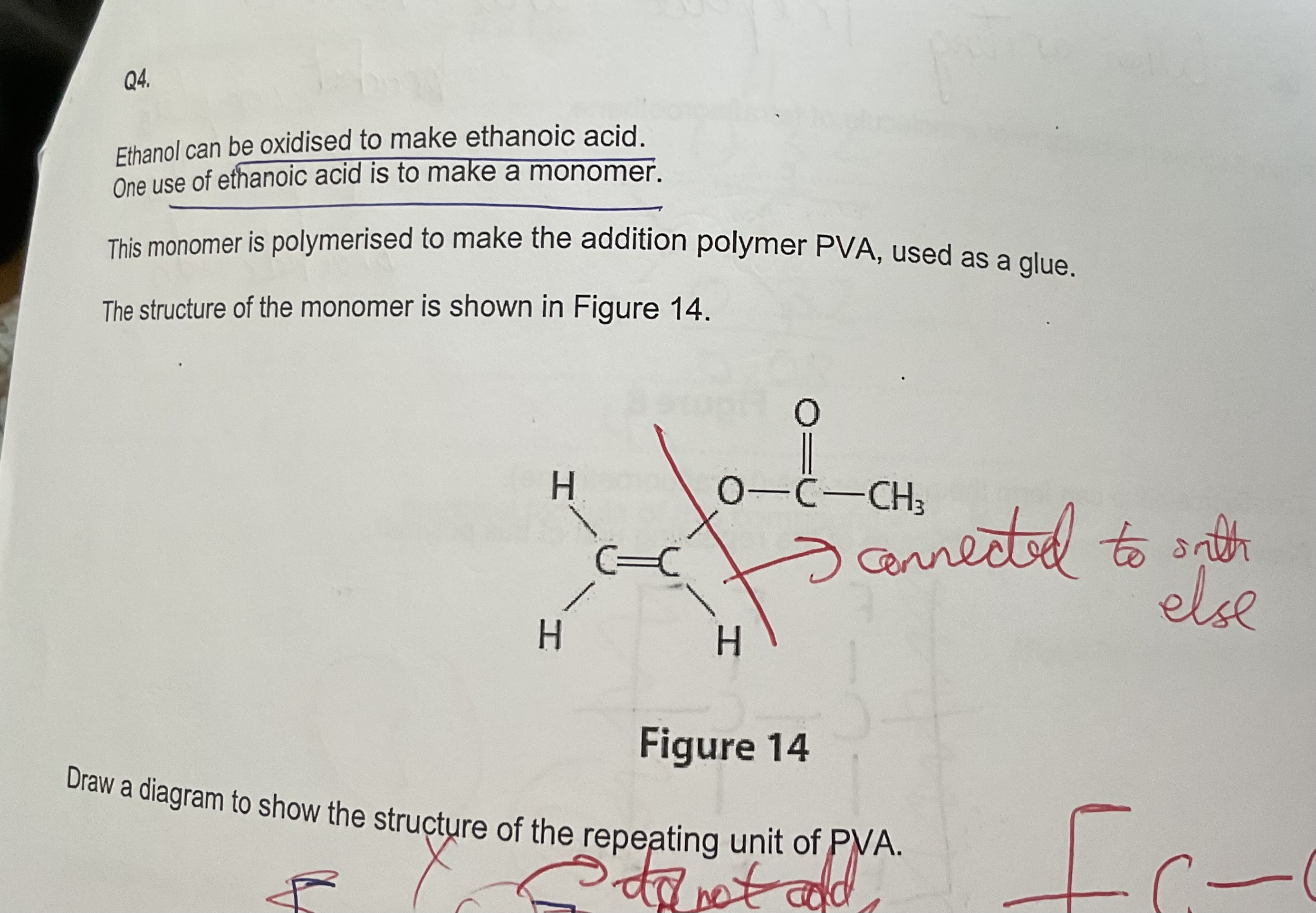
Draw a diagram to show the structure of the repeating unit of PVA.(2)
—[-C-C-]—-n
Explain in terms of structure and bonding these properties of diamond and graphite.(6)
D has many strong covalent bonds held together but G is soft and flaky as it is formed of layers
G layers can slide over each other but cannot for D
in D each atom is covalently bonded to 4 atoms so no delocalised electrons so poor conductor of electricity but for G only covalently bonded to 3 carbon atoms so 1 delocalised electron so good conductor of electricity
in 3D lattice , require lots of energy to overcome
comparison of of hardness:weak forces between layers layers can slide
Explain why solid magnesium carbonate cannot conduct electricity but solid magnesium can.(3)
delocalised electrons
held in a GIANT IONIC LATTICE
electrons are mobile