family assessment and interventions - lecture 2 - exam 1
 Call Kai
 Learn
Learn Practice Test
 Spaced Repetition
 Match
Match Flashcards
 Knowt Play
1/57

There's no tags or description
Looks like no tags are added yet.
Name | Mastery | Learn | Test | Matching | Spaced | Call with Kai | Chat |
|---|
No analytics yet
Send a link to your students to track their progress
58 Terms
family
All the descendants of a common ancestor.
A group of individuals living under one roof and usually under one head
A group consisting of parents and children living together in a household
The basic unit in society traditionally (?) consisting of two parents rearing their children
- also: any of various social units differing from but regarded as equivalent to the traditional family (e.g., a single-parent family)
family
Defined by reciprocal relationships in which persons are committed to one another
Protect
Provide
Preserve
nursing diagnoses related to family
nursing diagnoses related to family
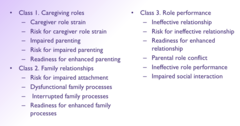
incorporating the family into the patient's care plan
Research indicates that ....... helps promotes positive outcomes. Families are sometimes more reliable informants than the patients.
benefits of family involvement
Joint Commission requirement
Education of the family is criterion for accreditation.
65% of those with mental illness live with their families.
Family Support
is one of the strongest predictors of recovery for persons with SMI
Bias against families
Sometimes viewed as part of problem, especially if history of ineffective collaboration
barriers to family involvement
bias against families
Unhealthy family dynamics/functioning
Ethical concerns that alliance with family will endanger confidentiality and threaten therapeutic alliance with patient
Administrative/insurance restraints, where services to families (as non-patients) receive lowest priority
heredity and environment
Families are at risk for mental illness based on ..
stress in the environment
Spouses escape the heredity factor, but at risk due to..
modeling
loudest person in the house is heard vs talking civilly
largest
Families are the ________ group of caregivers for the mentally ill.
Families
nourish each other physically, mentally, emotionally, and spiritually. Families exist so that human beings can develop and thrive.
harm individual family members.
A family system is dysfunctional when it fails to perform it's necessary functions and starts to ...
Single Parent Family
Children living with a single adult of any gender.
Unmarried Biological or Adoptive Family
Children living with two unmarried parents who are the biological/adoptive parents to all the family's children.
Nuclear Family/traditional family
Children living with two parents who are married to each and are each the biological or adoptive parents to all the children in the family
Blended Family
Children living with one biological/adoptive parent and that parent's spouse.
Cohabitating Family
Children living with one biological/adoptive parent and that parent's unmarried partner.
Extended Family
Children living with at least one biological/adoptive parent and at least one related nonparent adult such as grandparent or adult sibling
Multi-parent Family
Children living with and who have more than two adoptive/biological parents
"Other" Family
Children living with related or unrelated adults who are not biological or adoptive parents. This includes children living with grandparents and foster families
family
Bear in mind, "_______" is a self-defined concept. Your clients may identify various kinship networks as family, including unrelated friends and housemates. Also, not all families include children.
functioning in other intimate relationships, the workplace, culture, and society in general
A healthy family provides its members with tools to guide effective functioning within the family and extends to....
Management activities
Boundary delineation
Communication patterns
Emotional support
Socialization
These tools are acquired through activities associated with family life and include:
Management activities
Boundary delineation
Communication patterns
Emotional support
Socialization
Management activities
includes rule-making, planning, allocation of financial and other resources
Boundary delineation
organizing family members into a hierarchy; developing member roles.
Communication patterns
Are messages being communicated in a clear and comprehensible way? Is assertiveness valued or aggression/passivity?
Emotional support
Are emotional needs met in healthy and role-appropriate ways?
Socialization
What kind of socialization occurs among family members and between the family and the outside world?
characteristics of functional families
Complete life tasks
Capacity to tolerate conflict and adapt
Emotional contact is intergenerational
Fusion or over-closeness is avoided
Dyad solves internal problems
Differentiation
There are age-appropriate responsibilities
Positive emotional climate
Open communication and interactions
helicopter parent
the label used for parents who hover over their emerging adult children
disengaged parent
parents who are low in both demandingness and responsiveness
Triangulation
Indirect communication through a 3rd party; may occur when tension increases within dyad
Enmeshment
Overly close generations with poor lines of authority
Role reversal
e.g., Children raising children with ineffective parents in the home
normal modes of being
Addictions, lying, violence, or emotional abuse, neglect as ...
Scapegoating
A less powerful family member is blamed for another family member's distress.
Manipulating
Using dishonesty to support one's agenda
Distracting
Introducing irrelevant details into problematic issues in order to avoid functional problem solving and conflict resolution
Generalizing
Using global statements ("always" and "never") instead of dealing with specific problems and areas of conflict
Blaming
Attributing failure, error, or negative consequences to others in order to deflect the focus from oneself
Placating
Taking responsibility (even if not truly responsible) in order to keep the peace at all costs
Diffuse boundaries
obscure family roles, lines of authority and lead to enmeshment (over-involvement; over-concern for others leads to loss of autonomous development and/or role reversal)
Rigid boundaries
exist when rules and roles are completely inflexible; leads to isolation
Codependent
Excessively reliant on another person for one's own sense of identity
Enabler
family member who helps make it possible for another to engage in self-destructive behavior
Scapegoat
family member who receives blame for something they are not fully culpable for (displacement)
Perfect Child
perceived to have no problems and utilized by family as an ideal representation; hero
Lost Child
an overlooked family member who tends who tends to avoid conflicts and self-isolate.
Self-Assessment
Biases regarding family structure
Transference and counter-transference
genogram
information about relationships and interactions between family members, while a family tree only depicts lineage.
SO MUCH MORE INFO THAN A FAMILY TREE

nursing interventions
nursing interventions
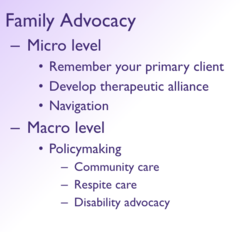
nursing interventions
nursing interventions
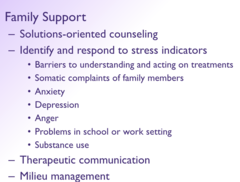
Psychoeducation
teach the family about the client's illness, prodromal symptoms, and treatment rationales. Use psychoeducation as a stepping stone to involving the family in Relapse Prevention Planning.
Family Teaching
Psychoeducation
Anticipatory guidance
Coping skills
Medication adherence
community resources
Caregiver support groups (look to advocacy groups like NAMI or hospital-affiliated groups)
Respite care
Personal care attendants and Medicaid waiver programs
c. Generalizing
A nurse visits a client at his home to discuss the client's concerns regarding medication side effects. During the course of the conversation, his mother interjects that the client never washes the dishes after he cooks something. This is an example of
a. Placating
b. Blaming
c. Generalizing
d. Distracting