Antimicrobials
 Call Kai
 Learn
Learn Practice Test
 Spaced Repetition
 Match
Match Flashcards
 Knowt Play
1/57

There's no tags or description
Looks like no tags are added yet.
Name | Mastery | Learn | Test | Matching | Spaced | Call with Kai | Chat |
|---|
No analytics yet
Send a link to your students to track their progress
58 Terms
Bacteriostatic
Inhibits bacterial growth
Targets bacterial protein synthesis and metabolic pathways
What changes a drug’s properties
Pathogen type
Dose
Length of the drug regimen
Pathogen load
Route of administration
Bactericidal
Kills bacterial growth
Targets bacterial cell wall/cell membranes and nucleic acids
Is bacteriostatic or bactericidal more effective
Bactericidal is more effective, but it kills normal microbiota and can lead to deadly bacterial toxin release (e.g. LPS)
What is S. Griseus effective against
Tuberculosis (TB)
What drug changed modern medicine
Alexander Fleming’s penicillin.
He studied S. Aureus and noticed a plate was contaminated w/mold
S. Aureus were NOT able to grow near the mold
Mold excreted a compound called Penicillin
Broad spectrum
Effective against both Gram-negative and Gram-positive bacteria
Narrow spectrum
Target a limited range of bacteria
Better than broad because they present fewer disruptions to the normal microbiota
Antimicrobial drugs
Therapeutic compounds that kill microbes or inhibit their growth
Antibiotics
Naturally occurring antimicrobial compounds (compounds that kill or inhibit their growth)
Synthetic antimicrobials
Manufactured by chemical processes
Semisynthetic antimicrobials
Chemical modification of naturally occurring antibiotics
Can be modified by chemical means, such as adding R groups
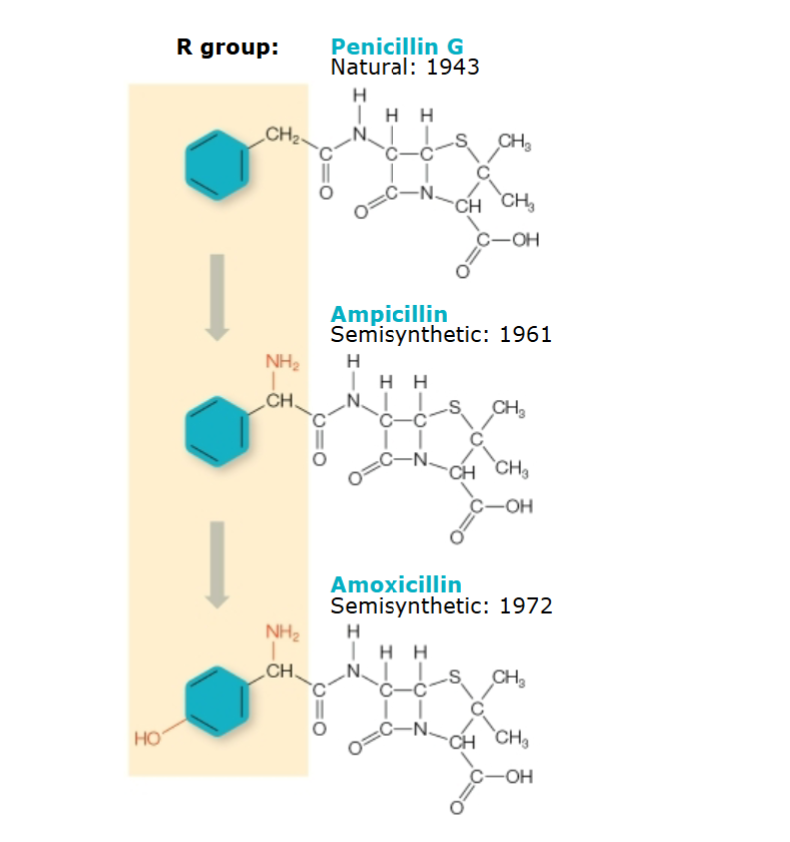
First-generation drugs
Result from a first round of chemical modification
Second-generation drugs
Drugs resulting from a second round of chemical modification
What happens to drugs after second generation
Drugs in later generations have expanded capabilities over their predecessor such as an extended spectrum, increased stability, and the ability to circumvent resistance mechanisms
How is the therapeutic index defined?
Ratio of the maximum tolerated (safe dose) to the minimum effective (therapeutic dose)

Difference between a high and a low TI?
A high therapeutic index is safer than a drug w/narrow therapeutic index as it shows a greater gap in case of an overdose
Therapeutic drug monitoring (TDM)
Used to ensure well-being and/or assess the therapeutic benefit of a drug
Measuring drug concentrations in blood
Monitoring patient parameters
2 antibiotics associated w/superinfection
Superinfection
What is selective toxicity
An antimicrobial drug inhibits or kills the targeted microbe without damaging host cells
Toxic to pathogens but harmless to the patient’s own cells
2 organs most affected by antimicrobials?
Kidneys and the liver
How are they affected
They metabolize and eliminate drugs
Susceptible to damage by certain drugs
If damaged, nephrotoxicity and hepatotoxicity may occur
Nephrotoxicity
Kidney-toxic
Antimicrobials may cause drug-associated nephropathy
Aminoglycosides and nonsteroidal anti-inflammatory drugs (NSAIDs)
Hepatotoxic
Liver damage/toxic
Antimicrobials may be the leading agents of drug- induced liver injury (DILI)
Liver recovers after the drug regimen stops
DILI is the leading reason for removing a drug or discontinuing drug development
Oral administration
Stable in the acidic environment of the stomach
Sufficiently absorbed in the intestines
Parenteral administration (injection or infusion)
Injected through IV, IM, or SUBQ
What is the half-life for an antimicrobial drug?
The time it takes for half of a dose to be eliminated or deactivated by the body
How does half-life affect drug usage?
Half-life determines the frequency of administration
Half-life of penicillin
30 minutes
Take every 4 hours for 7-10 days
Half-life of azithromycin
68 hours
Take every 24 hours for 3-5 days
Penicillin/ ampicillin/ amoxicillin (penicillins)
Natural→ Narrow spectrum
Semisynthetic→ broad spectrum
Beta-lactam superfamily
Target cell wall synthesis/ bactericidal
Cephalosporin (cephalosporins)
Broad spectrum
Beta-lactam superfamily
Targets cell wall synthesis/bactericidal
Bacitracin (Miscellaneous non-beta-lactam antimicrobials)
Narrow spectrum
Target cell wall synthesis
Bactericidal
DOES NOT TARGET mycobacterium
Vancomycin (glycopeptides)
Narrow spectrum
Target cell wall synthesis
Bactericidal
Glycopeptides
Isoniazid/ethambutol (miscellaneous non-beta lactam antimicrobials)
Narrow spectrum
Different from Bacitracin as they DO target mycobacteria
Target cell wall synthesis
Bactericidal
Chloramphenicol (phenicols)
Broad spectrum
Target ribosome (protein synthesis)
Bacteriostatic
Streptomycin/ neomycin/ gentamicin (aminoglycosides)
Narrow spectrum
Target ribosome (protein synthesis)
Bacteriostatic
Tetracycline (tetracyclines)
Not recommended during pregnancy for nursing mothers
Broad spectrum
Target ribosome (protein synthesis)
Bacteriostatic
tigecycline
Erythromycin/ azithromycin. clarithromycin (macrolides)
Broad spectrum
Macrolides
Daptomycin
Rifampin (Rifamycins)
Broad spectrum
Inactivates oral contraceptives
Target nucleic acids
Bactericidal
Ciprofloxacin (quinolones)
Targets nucleic acids
Bactericidal
Levofloxacin is an example
Broad spectrum
Sulfa/TMP
Natural penicillin
Narrow spectrum
Semisynthetic derivatives
Broad spectrum
What is a beta-lactam ring
A four-sided ring that is part of the active chemical structure of beta-lactam antimicrobials
beta-lactam antimicrobials
Penicillins
Cephalosporins
Carbapenems
Monobactams
All antimicrobials above work against bacteria by blocking cell wall construction
How do beta-lactam antibiotics work
They bind to transpeptidase enzymes (builders of peptidoglycan), preventing the formation of protein cross-links that bind peptidoglycan’s carbohydrate chains together
What are beta-lactamases
Enzymes produced by bacteria that inactivate beta-lactam drugs.
Beta-lactamase inhibitors can be administered w/beta-lactam antibiotics to prevent inactivation of the drug and its effects
Inhibitors include: Clavulanate, sulbactam, or tazobactam
What is MRSA
Methicillin-resistant Staphylococcus aureus strains (MRSA)
Alter their transpeptidase enzymes so that beta-lactam drugs cannot target it, making the bacteria resistant to beta-lactam antibiotics.
3 antibiotics used against MRSA
Polymyxin E
Tigecycline
Ceftaroline
3 antimycobacterial antibiotics
What are the antimycobacterial mode of action
Name an antibiotic associated w/superinfection and teeth discoloration
What antibiotics make up the triple ointment (neosporin)
Why do sulfa drugs adversely impact only bacteria cells