the gas laws
 Call Kai
 Learn
Learn Practice Test
 Spaced Repetition
 Match
Match Flashcards
 Knowt Play
1/6

There's no tags or description
Looks like no tags are added yet.
Name | Mastery | Learn | Test | Matching | Spaced | Call with Kai | Chat |
|---|
No analytics yet
Send a link to your students to track their progress
7 Terms
The five variables
pressure - p
volume - v
temperature- T
number of molecules- N
number of moles - n
Avogadros law
volume is proportional to amount of gas (number of molecules)
constant temperature and pressure
V1/N1 = V2/N2
Boyles law
volume is inversely proportional to pressure
fixed amount of gas at constant temperature
P1V1 = P2V2
each curve on p against v graph is an isotherm - isothermal change
higher temp - graph shifts upwards
negative curve
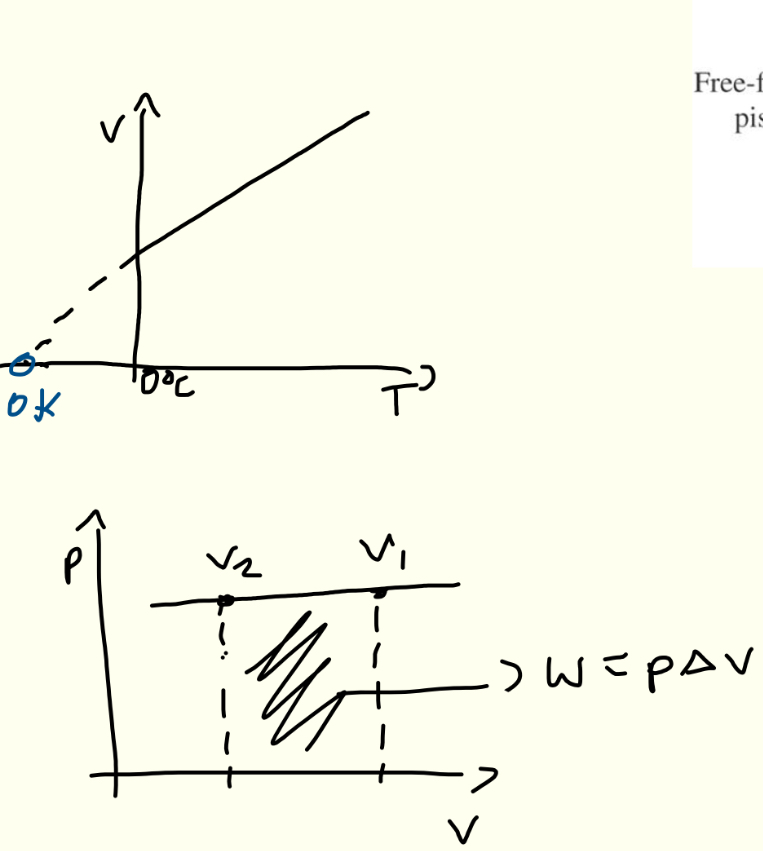
Charles’ law
volume directly proportional to absolute temperature
fixed mass and constant pressure
V1/T1 = V2/T2
The pressure law
pressure is directly proportional to absolute temperature
constant volume and fixed mass
The ideal gas equation
moles - pV = nRT (R - molar gas constant)
molecules - pV =NkT (k - Boltzmann constant)
Why do these laws not always apply
Gases obey gas laws well at moderate pressure/ densities/ volumes
Less well at higher pressures and densities
Because of attractive electrostatic forces between gas molecules which can cause a gas to become a liquid