Openstax Microbiology Chapter 10
 Call Kai
 Learn
Learn Practice Test
 Spaced Repetition
 Match
Match Flashcards
 Knowt Play
1/41

There's no tags or description
Looks like no tags are added yet.
Name | Mastery | Learn | Test | Matching | Spaced | Call with Kai |
|---|
No analytics yet
Send a link to your students to track their progress
42 Terms
Mouse injected with R strain
Mouse lives because of nonvirulent strain
Mouse injected with heat- killed S strain
Mouse Lives because of dead strain
Mouse injected with R strain and heat killed S strain
Mouse dies because of transformation
Mouse Injected with transformed R strain
Mouse Dies
A mouse injected with dead S strain virus and R strain with no addition of enzymes
The mouse will die
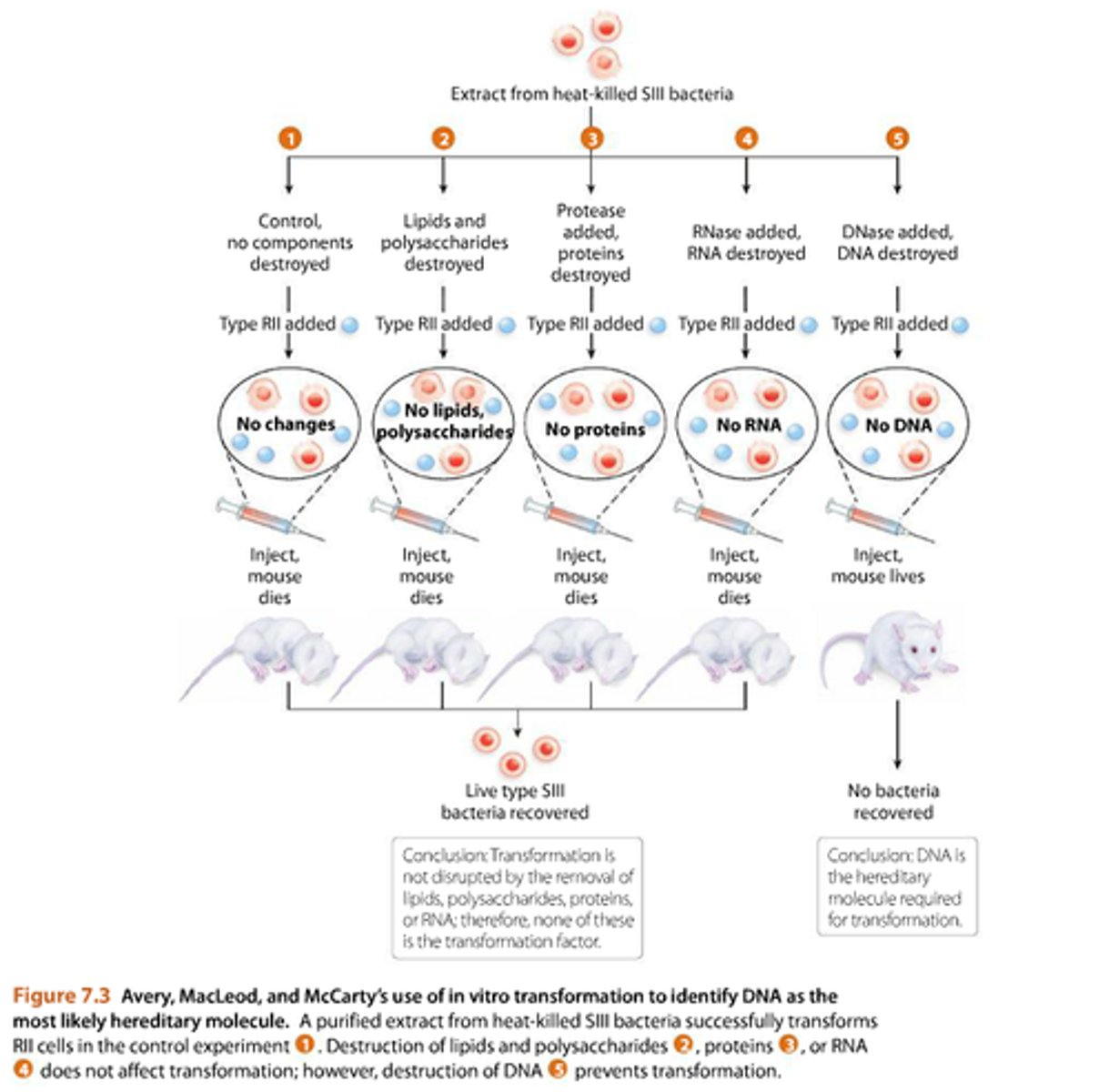
A mouse injected with dead S strain virus and R strain with addition of protein enzymes
The mouse will die because only proteins were degraded.
A mouse injected with dead S strain virus and R strain with addition of ribonuclease enzymes.
The mouse will die because only RNA was degraded.
A mouse injected with dead S strain virus and R strain with addition of deoxyribonuclease enzymes.
The mouse will live because DNA is degraded proving transformation.
P Labeled Phages DNA Infect bacteria
Phages within bacteria contained the protein labeled DNA.
S labeled Protein coat Phages infect bacteria
Phages within the bacteria do no contain the labeled protein coat.
What does DNA consist of?
A deoxyribose sugar, a phosphate group and a nitrogenous Base. There is a -OH group on the 3' and an H on the 2'.
Pyrimidines
cytosine and thymine (single ring)
Purines
Adenine and Guanine (2 rings)
Phosphodiester Bonds
Linkages where the phosphate group is attached to the 5' of the sugar and the 3' of the next sugar.
Nucleotide
Monomer of Nucleic Acid. In DNA 1 phosphate group, in cytoplasm 3 phosphates like ATP!
Anti-parallel
The opposite arrangement of the sugar-phosphate backbones in a DNA double helix.
Hydrogen Bonds
Connect the base pairs within the double helix structure.
Denaturation
The process of splitting a double stranded DNA into single strands.
Renaturation
The process of reconnecting two complimentary strands of DNA. Also known as re-annealing,
Vertical Gene Transfer
transfer of genes from an organism to its offspring
DNA replication
The process in which DNA makes a duplicate copy of itself.
What does RNA consist of?
A ribose sugar, a phosphate group and a nitrogenous base. On both the 2' & 3' pf the sugar there are -OH groups.
Uracil
a nitrogen-containing base found in RNA (but not in DNA) and derived from pyrimidine
Protein Synthesis with mRNA & tRNA
1. Large and small ribosomal units surround the mRNA and begin to read the strand.
2. tRNA enters the large ribosomal sub unit with an amino acid attached.
3. A second tRNA enters and receives the amino acid from the first and a polypeptide chain begins.
What is the structure of tRNA?
A three-dimentsional shape with an amino acid end and an anticodon end.
mRNA
Structure: short and unstable. RNA corresponds to the gene encoded within the DNA.
Function: An intermediary between DNA and protein.
A track for the ribosome to direct the synthesis of proteins.
rRNA
Structure: Long and stable. 60% of ribosome mass.
Function: Ensures proper alignment of mRNA, tRNA, and ribosome. During protein synthesis rRNA catalyzes the peptide bond formation between the added amino acids.
tRNA
Structure: short (70-90 nucleotides) and stable. This RNA has extensive intramolecular base pairing. Amino acid and anti codon binding sites.
Function: Carries the correct amino acid to site of protein synthesis within the ribosome.
RNA can be hereditary information for
Viruses
Rhinoviruses, influenza, Ebola, and HIV
Single stranded RNA viruses
Double stranded RNA viruses
Rota-viruses and immune-compromised individuals
Indicator of viral infections in humans
Double stranded RNA. It is uncommon in Eukaryotic Cells.
Genome
all of an organism's genetic material
Gene
Segments of DNA molecules that contain the instructional code necessary for synthesizing proteins, enzymes or RNA
Genotype
genetic makeup
Phenotype
the set of observable characteristics of an individual resulting from the interaction of its genotype with the environment.
A ribosome acts as a
Translator
What percentage of prokaryotic DNA is non coding?
12%
Prokaryotic cells are
haploid
What percentage of Eukaryotic DNA is non coding?
98%
Extra-chromosomal DNA
Additional DNA outside of the chromosome
Eukaryotic cells are
diploid