Evidence for Evolution
 Call Kai
 Learn
Learn Practice Test
 Spaced Repetition
 Match
Match Flashcards
 Knowt Play
1/27

There's no tags or description
Looks like no tags are added yet.
Name | Mastery | Learn | Test | Matching | Spaced | Call with Kai | Chat |
|---|
No analytics yet
Send a link to your students to track their progress
28 Terms
Evolution
Descent with modification; the idea that living species are descendants of ancestral species that were different from the present-day ones; also defined more narrowly as the change in the genetic composition of a population from generation to generation.
Ancestry
The lineage of successive parents and offspring that leads to an organism or species.
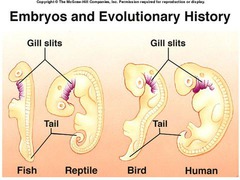
Comparative Embryology
The study of the formation, earth growth, and development of different organisms to determine evolutionary relatedness.

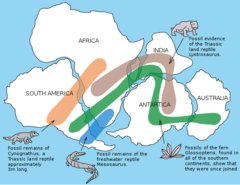
Biogeography
The study of where organisms live and how they came to live where they do
Study of past and present
geographical distribution of species.
Developmental Homologies
Similarities in the ways that organisms grow from zygotes to adults that exist because the organisms share a common ancestor.
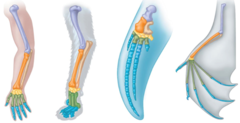
Comparative Anatomy
The study of the body structures (morphology) in different organisms to determine evolutionary relatedness.
Molecular/Chemical Evidence
Examines the nucleotide and amino acid sequences of DNA and proteins from different species to determine evolutionary relatedness.

molecular homologies
Similarities in DNA, RNA, or proteins between organisms that result from common ancestry.

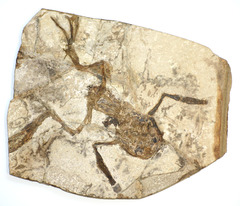
Fossils
A preserved remnant or impression of an organism that lived in the past. Example of geological evidence for evolution
Homology
Anatomical similarities due to common ancestry.

Homologous Structures
Structural features that originated in a common ancestor, similar in structure but may differ in function.

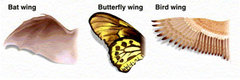
Analogous Structures
Structures that share a common function, but are not similar in structure, demonstrates that species evolved independently of one another; attributed to convergent evolution.
Vestigial Structures
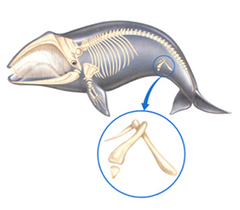
Remnants of functional structures that were once useful in the ancestor of the modern day organism, demonstrates common ancestry.
Extinct
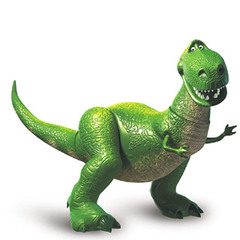
No longer existing or living.
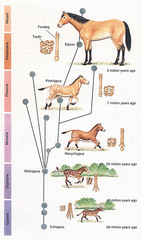
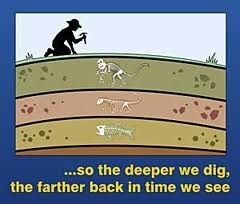
Fossil Record
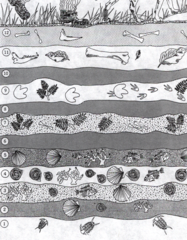
The fossils and their locations in the sedimentary layers of the Earth's crust, which provide information about things that lived in the distant past.
Genetic Code
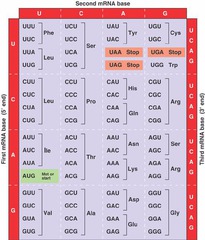
The sequence of nucleotides in DNA or RNA that determines the specific amino acid sequence in the synthesis of proteins. It is the biochemical basis of heredity and nearly universal in all organisms.
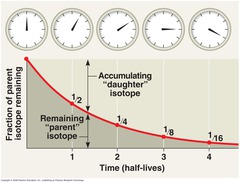
Radiometric Dating
A method for determining the age of fossils and rocks from the ratio of a radioactive isotope to the nonradioactive isotope of the same element in the sample.
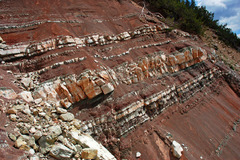
Strata
A layer of sedimentary rock that was formed as sediments of sand and mud were compressed into rock by overlying deposits.
Convergent Evolution
Species from different evolutionary lineages come to resemble each other as a result of living in very similar environments; results in analogous structures.

Evidence of Relatedness of All Life
DNA and RNA are carriers of genetic information, genetic code is shared by all modern living organisms; conservation of common metabolic pathways such as glycolysis.
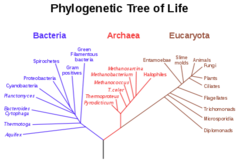
Evidence of Relatedness of All Eukaryotes
Cytoskeleton, membrane-bound organelles, linear chromosomes, and the endomembrane system (includes ER, Golgi apparatus, and nuclear envelope).

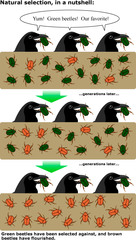
Natural Selection
Differential success in reproduction by different phenotypes resulting from interactions with the environment.
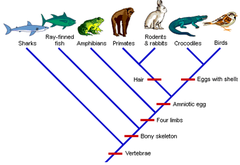
Lineage
A descent line from a common ancestor.

Relative Dating
To estimate of the age of a fossil based on the location of fossils in strata
Stasis
Describes a long period of time in which little or no change occurs within a species

punctuated equilibrium
A mode of evolution characterized by relatively short bursts of rapid evolutionary change interspersed with long periods of little change.

Gradualism
The theory that species evolve slowly and gradually over extended periods of time.

Speciation
The divergence of multiple populations or subpopulations of the same species to the point where they can no longer interbreed to generate fertile offspring.