Carbon: The Basis of Molecular Diversity
 Call Kai
 Learn
Learn Practice Test
 Spaced Repetition
 Match
Match Flashcards
 Knowt Play
1/23

There's no tags or description
Looks like no tags are added yet.
Name | Mastery | Learn | Test | Matching | Spaced | Call with Kai | Chat |
|---|
No analytics yet
Send a link to your students to track their progress
24 Terms
Organic chemistry
The study of carbon-containing compounds
Why is carbon central to biological diversity?
It has 4 valence electrons, so each carbon atom can form 4 covalent bonds, allowing huge variety in molecular shape & size
Valence of carbon
4
Shape of methane
Tetrahedral

Shape around a carbon-carbon double bond
Flat/planar
Hydrocarbons
Organic molecule made up of only carbon and hydrogen
Are hydrocarbons polar or nonpolar?
Nonpolar and hydrophobic, because C-H bonds share electrons equally
Isomers
Compounds with same molecular formula but different structural formula = different properties
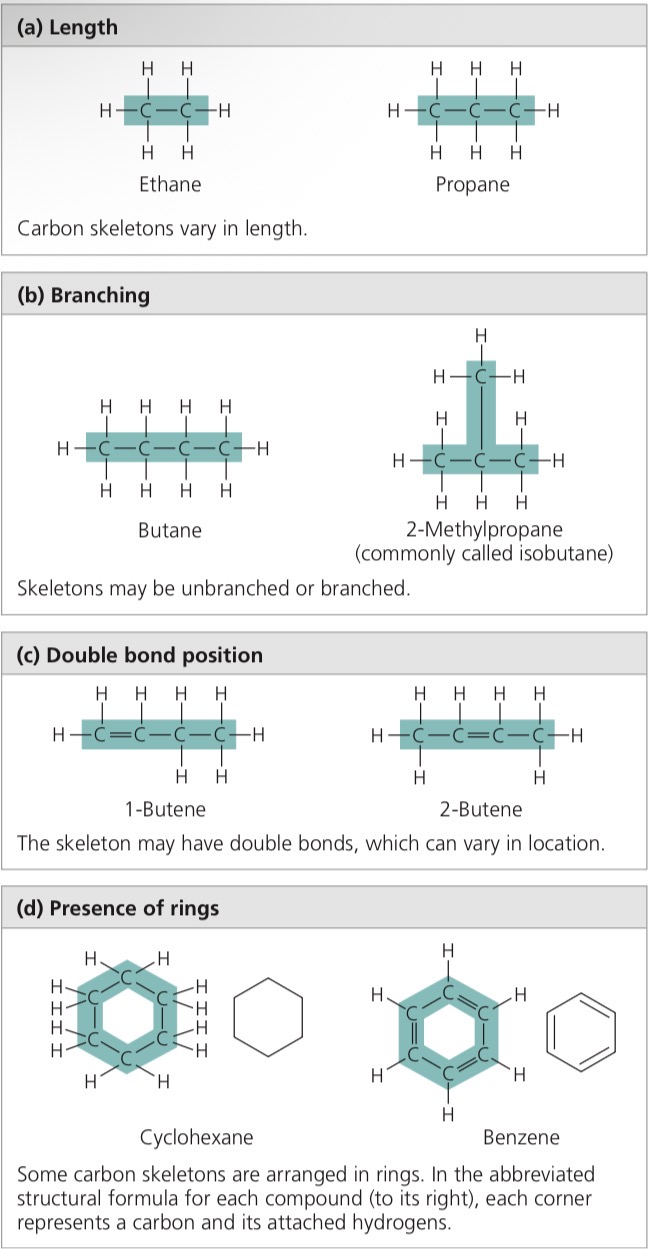
Structural isomers
Isomers that differ in covalent arrangement of their atoms e.g. Straight vs branched
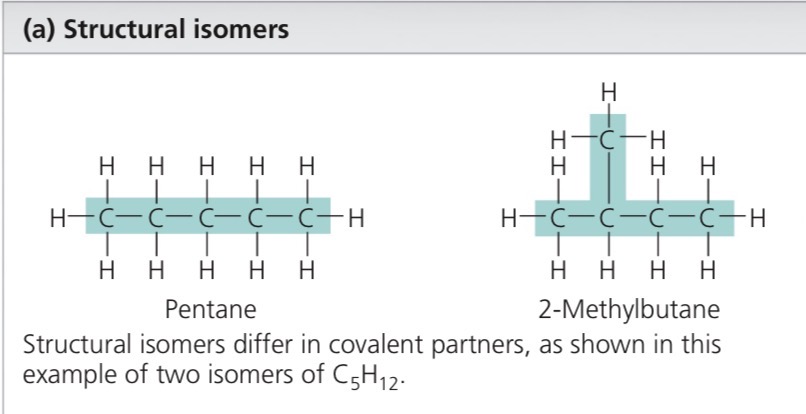
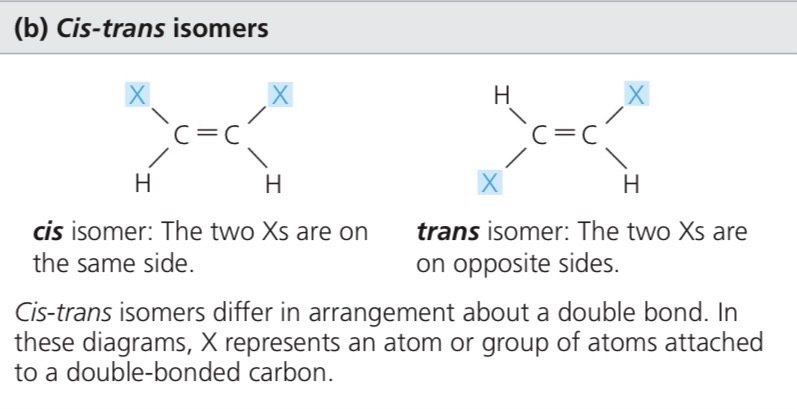
Cis-trans isomers
Isomers with same structural formula but different spatial arrangement around a double bond (rotation is restricted)
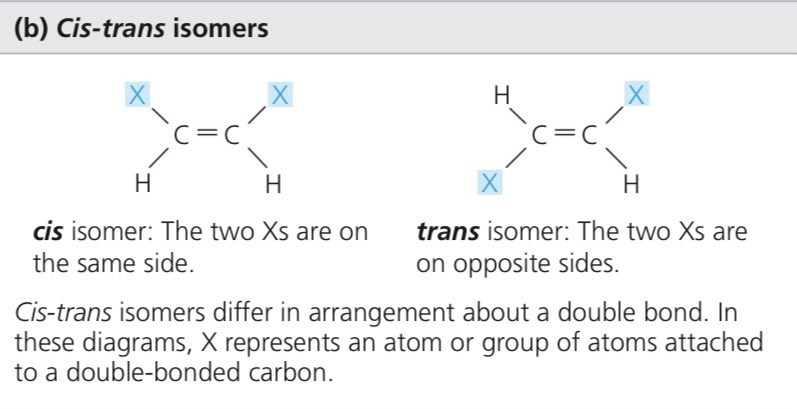
Cis isomer
A double-bond isomer where the two reference groups are on the same side
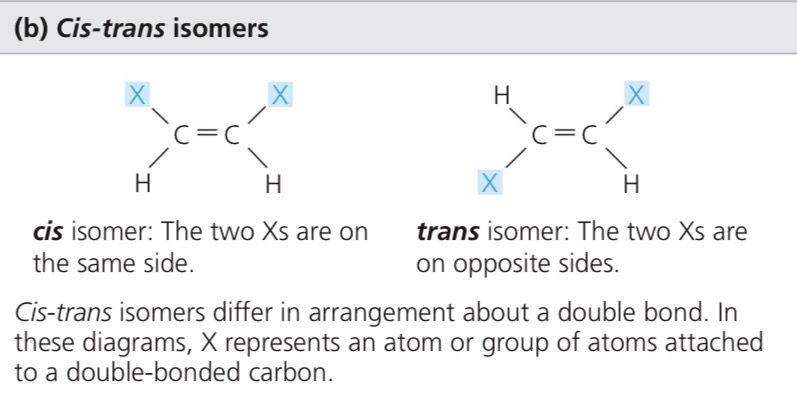
Trans isomer
A double-bond isomer where the two reference groups are on opposite sides
Enantiomers
Isomers that are mirror images of each other, due to an asymmetric carbon
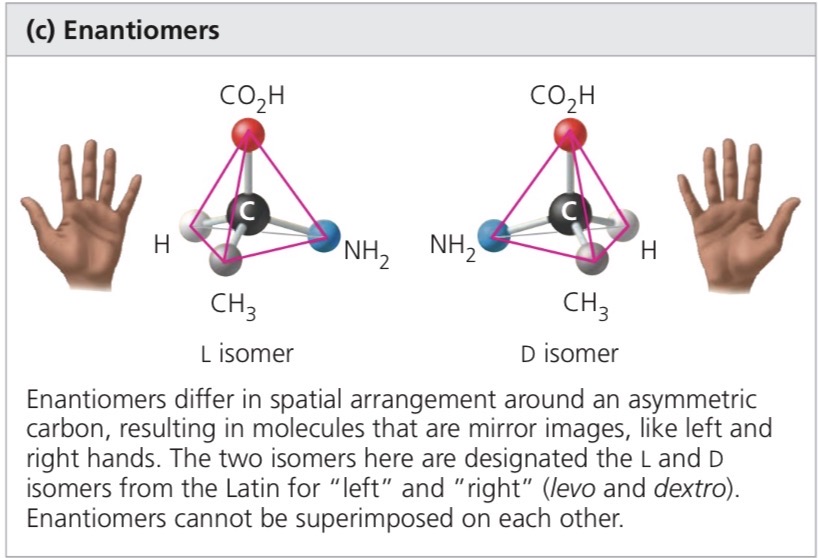
Asymmetric carbon
A central carbon atom bonded to four different groups
Functional group
A group of atoms attached to a carbon skeleton that takes part in chemical reactions and affects the molecule's properties
Hydroxyl group (-OH)
Polar
Found in alcohols
Forms hydrogen bonds with water
Helps dissolve compounds
Carbonyl group (C=O)
Found within a chain in ketones
Found at end of chain in aldehydes
Carboxyl group (-COOH)
Acts as an acid — can donate an H⁺
Found in carboxylic (organic) acids.
Amino group (-NH2)
Acts as a base — can accept an H⁺
Found in amines and amino acids
Sulfhydryl group (-SH)
Found in thiols
Two -SH groups can form a cross-link that stabilises protein structure
Phosphate group (–OPO3²⁻)
Adds negative charge to a molecule
Involved in energy-releasing reactions (e.g. in ATP)
Methyl group (-CH3)
Nonreactive
Acts as a molecular tag that can affect gene expression and molecular shape
ATP (adenosine triphosphate)
Adenosine attached to 3 phosphate groups - the main energy-carrying molecule in cells
What happens when ATP reacts with water?
It loses one phosphate group, becoming ADP + inorganic phosphate (Pi), and releases energy