Pathogenesis of Bacterial Infections
 Call Kai
 Learn
Learn Practice Test
 Spaced Repetition
 Match
Match Flashcards
 Knowt Play
1/60

There's no tags or description
Looks like no tags are added yet.
Name | Mastery | Learn | Test | Matching | Spaced | Call with Kai | Chat |
|---|
No analytics yet
Send a link to your students to track their progress
61 Terms

















Where do bacteria primarily reside in the environment to ensure survival and enhance transmission?
Soil, water, and internal host environments.
What common sources lead to human infection with Salmonella?
Undercooked poultry, eggs, and meat products.
What is the primary animal source associated with human Campylobacter infection?
Chicken.
How is Yersinia pestis transmitted to humans, and what disease does it cause?
Transmitted via rodent fleas; causes plague.
What environment/animal sources transmit Bacillus anthracis, and what disease does it cause?
Transmitted from the environment and infected animal products; causes anthrax.
How can clinical manifestations (e.g., diarrhea, cough, genital discharge) act in disease transmission?
They serve as direct vehicles/sources for spreading microorganisms to other hosts or the environment.
How does Vibrio cholerae spread via clinical manifestations?
Infected stool contaminates water sources and seafood, such as oysters.
How do food products typically become contaminated with Escherichia coli?
Through contamination with sewage containing E. coli.
Where is Staphylococcus aureus commonly carried on the body, and how is it spread?
Carried in the anterior nares (nostrils); spread by rubbing the nose and transferring bacteria to other body parts or other people.
Small molecules of double stranded, helical, non-chromosomal DNA
Plasmids
Small pieces of DNA that encode enzymes that that move from one DNA location to another, either on the same molecule of DNA or on a different molecule
Transposons
Virulence factors can be encoded by genes on mobile genetic elements
Bacteriophages
What plasmid-encoded virulence factors in E. coli are responsible for causing diarrhea?
What plasmid-encoded cytotoxin in E. coli is involved in invasive disease and urinary tract infections?
Heat-labile and heat-stable enterotoxins.
Hemolysin.
Which plasmid-encoded traits do E. coli and Shigella species share?
Adherence factors and gene products involved in mucosal invasion.
What virulence factors of Bacillus anthracis are encoded on plasmids?
A capsule essential for virulence (encoded on one plasmid).
Edema factor, lethal factor, and protective antigen (encoded on other plasmids).
What phage-encoded toxin does Clostridium botulinum produce, and what is its effect?
Botulinum toxin, which causes paralysis.
What phage-encoded toxin does Corynebacterium diphtheriae produce, and how does it act?
Diphtheria toxin
inhibits human protein synthesis.
What phage-encoded toxin does Vibrio cholerae produce, and what condition does it cause?
Cholera toxin, which causes severe watery diarrhea.
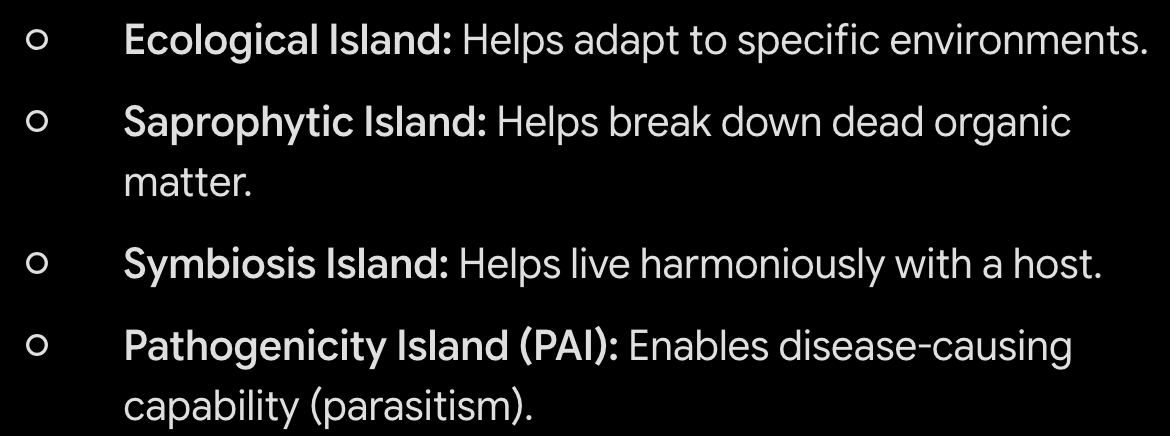
What is a Pathogenicity Island (PAI)?
Large blocks or clusters of genes located on the bacterial chromosome that specifically encode virulence factors.
Pathogenicity islands belong to a broader group called?
Genomic islands
depending on what the acquired DNA makes the bacteria do:
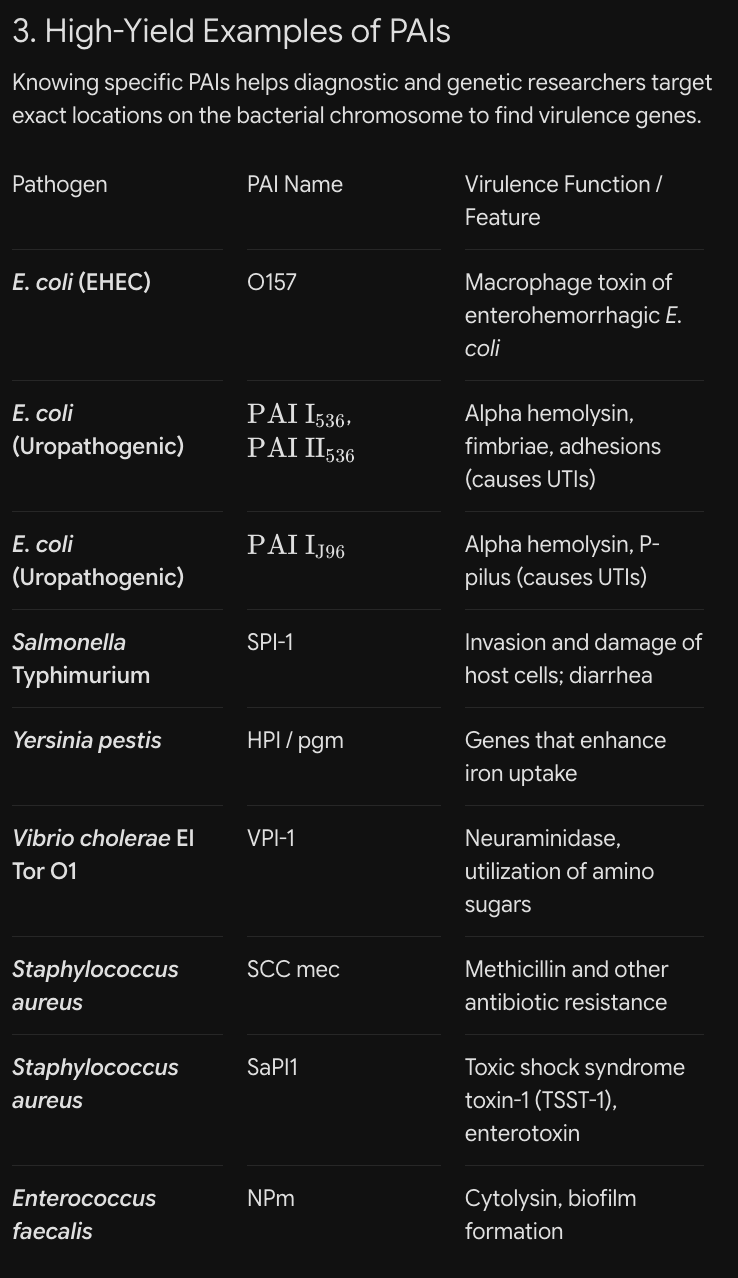
Factors that Determine Virulence or the Ability to Cause Infection and Disease
→ Adherence factors (specific surface molecules that interact w/ host cells)
→ Invasion of Host Cells and Tissues
→ Toxins
→ Enzymes
→ Antiphagocytic Factors
→ Intracellular Pathogenicity
→ Antigenic Heterogeneity
→ Bacterial Secretion Systems
Give 2 kinds of adherence factors
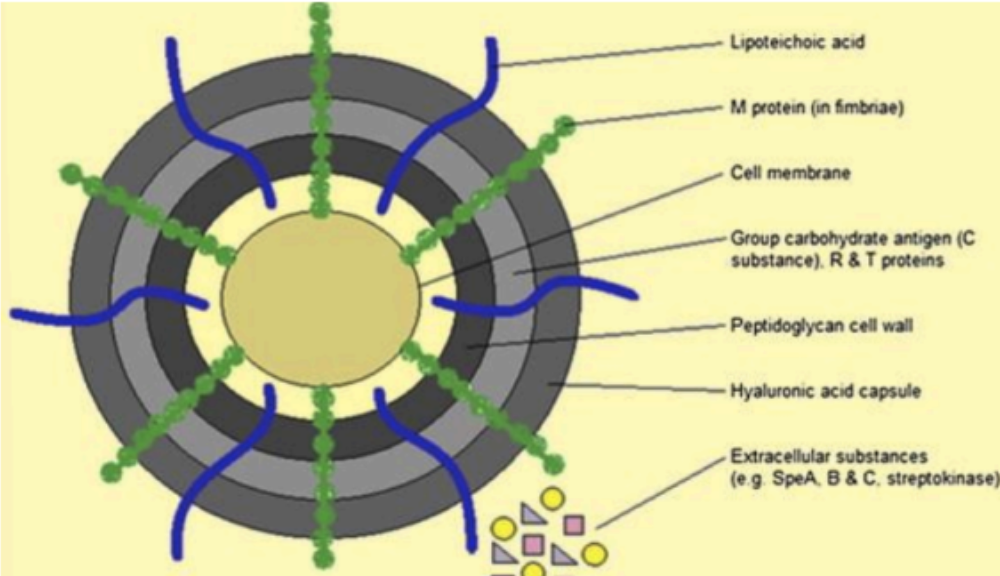
Pili
Thick rod-like appendages
role in movement and adherance
Fimbriae
Hair-like appendages
e.g. M protein
How does Listeria monocytogenes invade their host cells?
Induces engulfment by host cells
Movement within a cell or between cells requires (?) to propel the bacteria.
Actin!
Which are Toxins that can be secreted?
Enterotoxin
Exotoxin
Endotoxin
Enterotoxin
Exotoxin
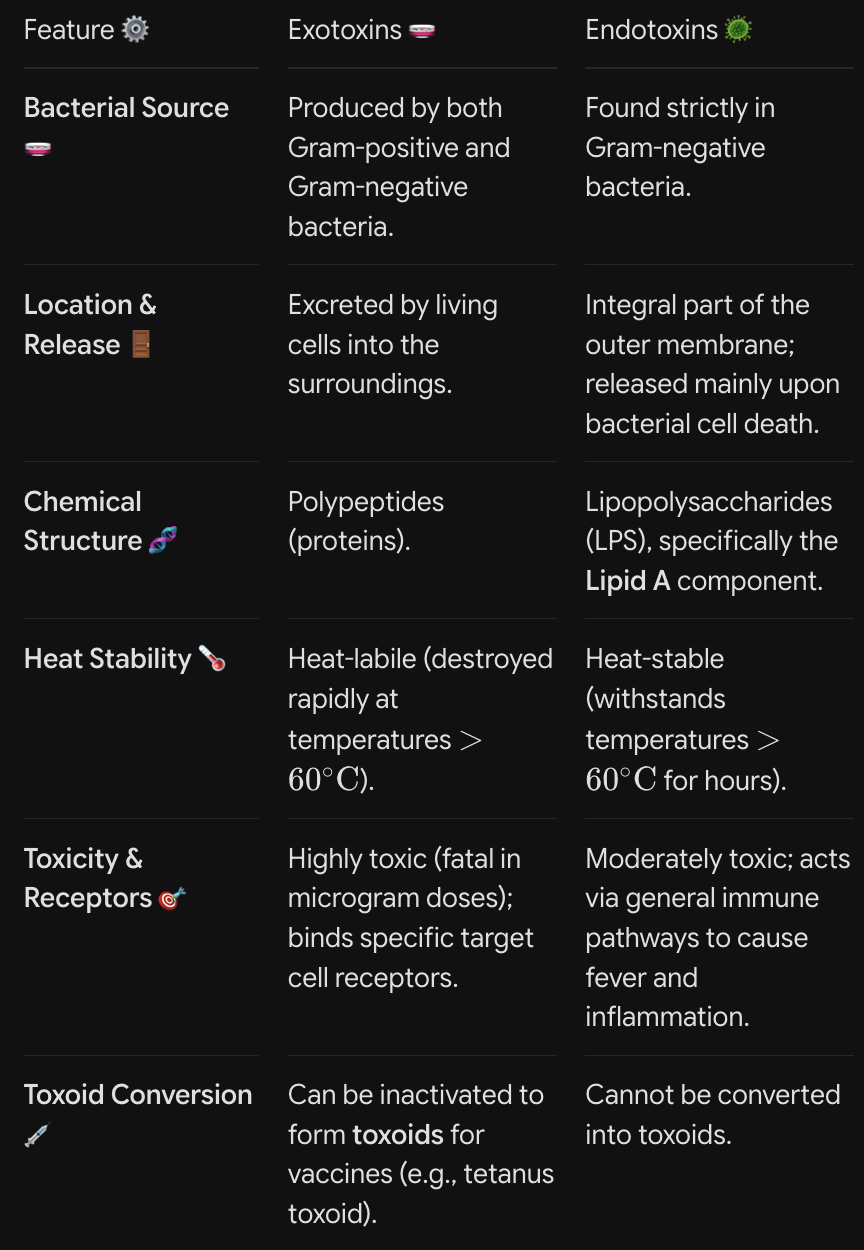
Endotoxin is present in the outer membrane of Gram (-) rods.
Exotoxins are secreted by mostly Gram (+) or (-) bacteria?
Gram +
How are endotoxins liberated?
Lysis
Which one target specific host cellular functions—such as blocking neurotransmitters or halting protein synthesis?
Endotoxin
Exotoxin
Exotoxin
Which one trigger broad inflammatory responses like fever, low blood pressure, and clotting complications.
Endotoxin
Exotoxin
Endotoxin
If a patient develops an infection from a Gram-negative bacterium and receives an antibiotic that destroys the bacterial cell wall, why might there be a sudden temporary spike in systemic inflammation (fever and low blood pressure) right after treatment starts?
Since gram - bacteria tend to have endotoxins which are released upon lysis
What is the mechanism of action for Corynebacterium diphtheriae?
Inactivates EF-2 (elongation factor 2) = stop ribosome protein synthesis.
Causes cell death + gray pseudo-membrane in the throat
What is the different clinical effect of
Clostridium botulinum
Clostridium tetani
Clostridium botulinum → Flaccid Paralysis (no muscle contraction)
Clostridium tetani → Spastic Paralysis (constant muscle contraction)
What is the mechanism of action of Vibrio cholerae?
Continuously activates adenylate cyclase, raising intracellular cAMP and pumping electrolytes into the gut lumen.
Both C. botulinum and C. tetani produce neurotoxins that affect motor function, but they cause completely opposite types of paralysis. Why does blocking an inhibitory neurotransmitter (GABA/glycine) cause spastic paralysis, while blocking acetylcholine causes flaccid paralysis?
It comes down to whether the neurotransmitter acts as an accelerator 🚗 or a brake 🛑:
Acetylcholine is the accelerator at the muscle level 🦾. It gives the direct command for a muscle to contract. When Botulinum toxin blocks ACh, the muscle receives zero signals, leaving it completely limp (flaccid paralysis).
GABA & Glycine are the brakes in the central nervous system 🛑. They prevent motor neurons from constantly sending signals to muscles. When Tetanus toxin blocks these inhibitory signals, the brakes are destroyed. Without brakes, motor neurons fire non-stop, causing continuous, rigid contraction (spastic paralysis).
Unlike exotoxins that directly poison target cells, Endotoxin (Lipid A) triggers an overreaction by our immune system—causing:
Systemic cytokine release (IL-1, TNF), fever, low blood pressure, and clotting issues (DIC).
What do Staphylococcus aureus produce? Endotoxin, Exotoxin or enterotoxins
Enterotoxins
What is the effect of S. Aureus enterotoxin?
Cause Mast cells to release 5-hydroxytryptamine (serotonin precursor)
Quick summary:
Exotoxins vs. Endotoxins: Proteins actively secreted vs. structural LPS (Lipid A).
Exotoxin Mechanisms:
Diphtheria: Stops protein synthesis (EF-2).
Botulinum: Blocks ACh release → flaccid paralysis.
Tetanus: Blocks GABA/glycine release → spastic paralysis.
Cholera: Increases cAMP → "rice-water" diarrhea.
Endotoxin Pathology & S. aureus: Massive immune/cytokine response vs. vagus-mediated vomiting.
What 2 tissue degrading enzymes does S. aureus release and what are their effects?
Hyaluronidase : Cleaves hyaluronic acid that cements host cells together, helping bacteria spread through tissue.
DNAse : Degrades DNA released by dying cells that could otherwise trap bacteria.
What enzyme does C. perfringens utilize and its effect?
Collagenase → Breaks down connective tissue collagen to allow invasion into blood vessels and host tissues.
What enzyme does B. anthracis utilize and its effect?
Phospholipase C → Degrades cell membrane phospholipids to cause cell lysis and breakdown of phagosomes, allowing bacteria to escape into the cytoplasm.
What enzyme does N. gonorrhoeae, N. meningitidis, H. influenzae utilize and its effect?
IgA1 Protease → Splits host IgA1 antibodies at their hinge region to destroy antibody activity.
Mucosal surfaces are heavily defended by IgA antibodies. How does cleaving an antibody specifically at its hinge region impair its ability to protect the host mucosal surface?
An antibody (like IgA) is shaped like a Y 🧬:
Fab arms (the two top prongs): Bind specifically to the invading bacteria.
Fc stem (the base): Signals and recruits other immune defenses to clear the pathogen.
Hinge region: The flexible joint connecting the arms to the stem.
When bacterial IgA1 protease cleaves the hinge region, it snips the arms off the stem:
🚫 No immune signaling: The Fab arms can still stick to the bacterium, but without the Fc stem attached, they cannot signal immune cells to destroy it.
🚫 No clumping: The antibody loses its ability to link multiple bacteria together into clumps so that mucus can sweep them away.
Bacteria use specialized molecular "syringes" called secretion systems to inject toxins and proteins directly into host cells or the surrounding tissue:
💉 Type 3 Secretion System (T3SS): Acts like a needle to inject effector proteins directly into host cells (used by Salmonella, Shigella, and Yersinia).
🧬 Type 4 Secretion System (T4SS): Unique because it can transfer DNA as well as protein toxin substrates (used by Helicobacter pylori and Neisseria gonorrhoeae).
🛡 Type 5 Secretion System (T5SS): Transports proteins like IgA1 proteases to destroy host antibodies.
🔬 Type 7 Secretion System (T7SS): Used specifically by Mycobacterium tuberculosis to transport key antigens.
Why is a contact-dependent system like Type 3 (T3SS) especially effective for pathogens like Salmonella or Shigella compared to just releasing toxins into the surrounding tissue?
Direct injection via a Type 3 Secretion System (T3SS)—often called a "molecular syringe" 💉—offers three major advantages over simply secreting toxins into extracellular space:
🛡 Protection from Host Defenses: Toxins released outside the cell can be recognized and neutralized by circulating antibodies or degraded by enzymes. Direct injection keeps the effector proteins hidden from the immune system.
🎯 Zero Dilution: Releasing toxins into tissue fluids dilutes their concentration. Direct injection delivers a high, concentrated dose straight into the host cell cytoplasm.
⚡ Immediate Cell Hijacking: Effector proteins immediately alter the host cell's internal structure (like rearranging the cytoskeleton to force the host cell to engulf the bacterium) without any delay.
Which of the following statements is correct?
a. The lecithinase of C. perfringens causes diarrhea.
b. Cholera toxin is attached to the flagella of V. cholerae
c. Lipopolysaccharide is a part of the cell wall of E. coli.
d. Toxic shock syndrome toxin-1 is produced by hemolytic strains of S.
epidermidis.
b. Cholera toxin is attached to the flagella of V. cholerae
The following are characteristics of exotoxins EXCEPT:
a. Produced by Gram-negative bacteria only
b. Released extracellularly by microorganisms into the environment
without lysis
c. Proteins in nature and are generally heat-labile
d. Soluble in bodily fluids and can diffuse into the blood
e. Highly toxic and is often fatal
a. Produced by Gram-negative bacteria only
A 15-year old Bangladeshi girl develops severe watery diarrhea. The stool looks like “rice water.” It is voluminous–more than 1L in 90 minutes. She has no fever and seems otherwise normal except for the effects of loss of fluid and electrolytes. The most likely cause of her illness is:
a. Clostridium difficile enterotoxin
b. Vibrio cholerae exotoxin
c. S. dysenteriae type 1 that produces Shiga toxin
d. Enterotoxigenic E. coli that produces heat-labile and heat-stable toxins
e. Staphylococcal enterotoxin F
“Rice water” stools are characteristic of V. cholerae diarrheal
infection.
Which of the following is an example of an endotoxin?
a. A-B toxins
b. Tetanus toxin
c. Diphtheria toxin
d. Heat-stable enterotoxins
e. Cholera toxin
d. Heat-stable enterotoxins