Term 3 - A4.1 Evolution and Speciation
 Call Kai
 Learn
Learn Practice Test
 Spaced Repetition
 Match
Match Flashcards
 Knowt Play
1/16

There's no tags or description
Looks like no tags are added yet.
Name | Mastery | Learn | Test | Matching | Spaced | Call with Kai | Chat |
|---|
No analytics yet
Send a link to your students to track their progress
17 Terms
A4.1.1 Evolution (3)
Evolution: the cumulative change in the heritable characteristics of a population over time (the end result)
Driven by the process called natural selection
Heritable and preferable characteristics that help them survive gets passed down through generations
A4.1.1 Theories of Evolution (4)
Theories of Evolution:
Lamarck suggested that organisms acquired traits when they are alive. These acquired traits are beneficial for survival, and can be passed onto offspring, causing evolution over time
Lamack's theory is not supported by genetics, as acquired traits are not inherited and passed on to future generations
Darwin (and Wallace) suggested that variation exists within a population. Nature selects the individuals with the traits best adapted to survival and reproduction. The favourable traits are passed on to the offspring, causing evolution over time
Darwin's theory is supported by genetics, as variation is present in a population due to the presence of alleles
A4.1.1 Evolution as a Fact and a Theory (3)
Evolution as a Fact and a Theory:
The theory of evolution by natural selection predicts and explains a broad range of observations and is unlikely ever to be falsified, as it is supported by an overwhelming quantity of evidence
However, the nature of science makes it impossible to formally prove that it is true, as all scientific knowledge is provisional, and can be overwhelmed by new evidence
Evolution has and continues to happen, but it is referred to as a theory rather than a fact, despite the overwhelming evidence that organisms evolve by evolution
A4.1.2 Hox Genes (4)
Hox Genes:
A group of genes found in animals with bilateral bodies
Humans also have hox genes (39 Hox genes)
Hox genes can mutate (e.g. leg of fruit fly grows on face)
Are highly conserved and important for development - sequence of amino acids will stay pretty much the same
A4.1.2 Evolution for Evolution - Biomolecules (5)
Evolution for Evolution - Biomolecules:
The biomolecules DNA, RNA, and proteins provide strong evidence for evolution
The same genes are present in organisms which have evolved from a common ancestor
Differences in the base sequences of DNA (and there RNA and proteins) are the result of mutations
Mutations accumulate gradually over long periods of time at a constant rate
Closely related species have very similar gene and protein sequences, as there will be a small number of mutations because they diverged from a common ancestor
A4.1.3 Selective Breeding/Artificial Selection (1)
Selective breeding/artificial selection is the process of humans choosing plants or animals with desirable traits to breed together and produce offspring with more of those desirable traits
A4.1.3 Selective Bree ding vs Natural Selection (1)
Selective breeding vs. natural selection:
Rate of evolution - selective breeding is a lot faster than evolution by natural selection --> humans are actively choosing which animal or plant to breed; nature relies on slow, random environmental changes
A4.1.4 Homologous Structures (2)
Homologous Structures:
Same physical traits/structures found in different organisms that share a common ancestor, but they may serve different functions in different species due to evolution → evidence of divergent evolution
Strongly suggests that organisms have evolved from a common ancestor
A4.1.4 Pentadactyl Limb (3)
Pentadactyl (five fingered/digits) limb:
Pentadactyl limbs are an example of homologous structures
All organisms with pentadactyl limbs have evolved from a common ancestor
The structure of the limb is similar in all species, but has evolved modifications for a variety of purposes, such as carrying tools in humans, running in dogs, flying in birds, and swimming in whales
A4.1.4 Vestigial Structures:
Example of homologous structures: Vestigial structures
No or minimal function (e.g. appendix, wisdom teeth)
A4.1.5 Analogous Structures (4)
Analogous structures have a common function, but do not have a common structure
Analogous structures evolve by convergent evolution
Organisms with analogous structures do not share a common ancestor with the structure
Examples: human and octopus eyes, bee and bird wings
A4.1.5 Convergent Evolution (1)
Convergent Evolution: The process where unrelation species develop similar traits or adaptations because they faced similar environmental pressures
A4.1.6 Speciation and Extinction (4)
Gradual evolutionary change within a species is not speciation, unless the original species evolves into a population of organisms which are no longer able to reproduce with the original population
Extinction occurs when there are no living members of a species remaining
Speciation increases the total number of species on Earth, but extinction reduces the total number of species on the planet
Many species are in danger of extinction due to human activities
A4.1.7 Two requirements for speciation, how to tell when it becomes two diff species, env pressures
Two requirements for speciation: reproductive isolation and differential selection
How to tell when it becomes two diff species: when brought back tgt, cannot produce fertile offspring
When they are separated, the two parts of the island should each have diff env pressures (e.g. presence of diff predator, diff living conditions) - drive species along two diff pathways in terms of evolution
A4.1.7 Reproductive Isolation (2)
Reproductive Isolation:
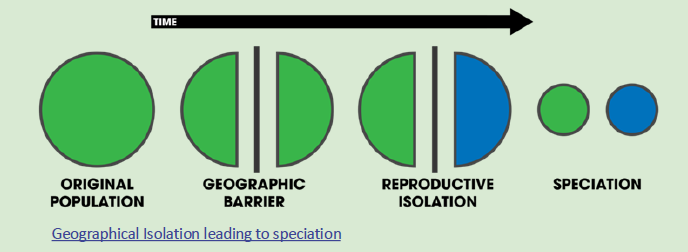
Reproduction isolation occurs when there is a barrier which prevents individuals from reproducing
Speciation can only occur if populations of a species are reproductively isolated
A4.1.7 Geographical Isolation (2)
Geographical Isolation:
Reproduction isolation is often a result of geographical isolation
Geographical isolation occurs when two populations of the same species are prevented from producing because of geographical features such as rivers, mountains, or being on different islands
A4.1.7 Evolution of Chimpanzees and Bonobos
Evolution of Chimpanzees and Bonobos:
A population of apes, which are the common ancestor of chimpanzees and bonobos, lived in central Africa (around 2 million years ago)
The population of the ancestor became geographically isolated into two distinct populations which were separated as the Congo river became wider
The ape populations were reproductively isolated, as members of each population were unable to reproduce with each other
The selection pressures were different on the two sides of the Congo river
Different traits were selected in the apes on the two sides of the Congo river
The two ape populations evolved into two separate species over time: aggressive chimpanzees and peaceful bonobos
Chimpanzees are a different species than bonobos. The two species are not capable of reproducing
The evolution of chimpanzees and bonobos from a common ancestor is an example of speciation