CHEM 1040 - Final Exam Auburn University
 Call Kai
 Learn
Learn Practice Test
 Spaced Repetition
 Match
Match Flashcards
 Knowt Play
1/131

There's no tags or description
Looks like no tags are added yet.
Name | Mastery | Learn | Test | Matching | Spaced | Call with Kai | Chat |
|---|
No analytics yet
Send a link to your students to track their progress
132 Terms
dipole-dipole
attractive forces between POLAR molecules
hydrogen bonding
special type of dipole-dipole that occurs between molecules that contain an H bonded to N, O, or F
dispersion forces
attractive forces from an instantaneous dipole
surface tension
amount of energy required to stretch the surface of a liquid by 1 unit area
capillary action
movement of a liquid up a narrow tube
viscosity
measure of a fluids resistance to flow
(> IMF = > viscosity)
vapor pressure
amount of energy that the liquid is pushing on the gas above its surface
( > VP = > vaporization)
boiling point
temperature at which vapor pressure equals the external atmospheric pressure
melting point
temperature at which the energies of individual particles enable them to break free of their fixed positions in the solid
critical temperature
the temp above which a gas cannot be liquified no matter the pressure
heat capacity
the number of heat units needed to raise the temperature of a substance by 1 degree celsius
fusion
melting
supercooling
when a liquid is cooled below its freezing point
sublimation
the process by which molecules go directly from the SOLID phase to the GAS phase
deposition
the process by which molecules go directly from the GAS phase to the SOLID phase
phase diagrams
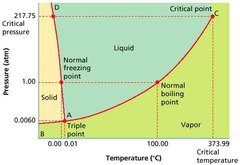
saturated solution
contains the maximum solute particles that can be dissolved into a solvent at a specific temperature
entropy
a measure of how spread out energy is
(gas > liquid > solid)
molarity
mols solute / liters sln
mole fraction
mols of A / total mols
molality
mols solute / kg solvent
percent by mass
(mass solute / total mass) x 100
colligative properties
depend on the number of solute particles in solution but do not depend on the nature of the particles
the colligative properties are:
vapor pressure lowering
boiling point elevation
freezing point depression
osmotic pressure
van't hoff factor (i)
accounts for effect of the number of particles in solution
actual # particles in sln / # formula units initially dissolved
van't hoff factor of non-electrolytes
1
van't hoff factor for strong electrolytes (NaCl, KOH, KBr, HNO3, etc.)
equal to the number of ions
spontaneous process
a process that DOES occur under a specific set of conditions
non-spontaneous process
a process that does NOT occur under a specific set of conditions
process that result in a decrease in energy in a system are often ________________________.
spontaneous
spontaneity is favored by an ________________ in a system's entropy.
increase
in addition to translational motion, molecules exhibit _____________ and ______________.
rotations , vibrations
several process that lead to an increase in entropy include:
melting
vaporization or sublimation
temperature increase
reaction resulting in > # of gas molecules
second law of thermodynamics
for a process to be spontaneous, deltaS of the universe must be positive

third law of thermodynamics
the entropy of a perfect crystalline substance is zero at 0 K (absolute zero)
gibbs free energy
helps express spontaneity

standard free energy of reaction
free-energy change for a reaction when it occurs under standard state conditions

equilibrium
when the rates of the forward reaction and the reverse reaction are EQUAL
reaction quotient
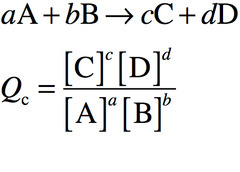
law of mass action
equilibrium constant (Kc) equal reaction quotient (Qc) at equilibrium
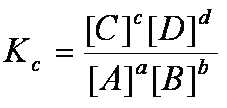
LARGE Kc
products favored
SMALL Kc
reactant favored
only ______________ and ________________ species appear in equilibrium expressions.
gaseous , aqueous
(do NOT include pure liquids and solids)
when an equilibrium expression contains only gases, we can write an alternate form in which the concentrations are expressed as _________________.
partial pressures
(Kp)
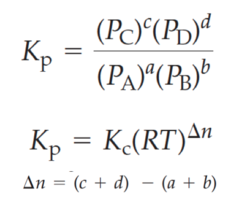
K >> 1
negative deltaG^o
K << 1
postive deltaG^o
Q < K
reaction proceeds to the right
(reactants to products)
Q = K
system is at equilibrium
Q > K
reaction proceeds to the left
(products to reactants)
deltaG determines _______________.
spontaneity

le chatelier's principle
when a STRESS is applied to a system at equilibrium, the system will respond by SHIFTING in the direction that minimizes the stress
le chatelier's principle
STRESSES:
addition of reactant/product
removal of reactant/product
change in volume
change in temperature
bronsted acid
donates proton
bronsted base
accepts proton
hydrohalic acids
HF << HCl < HBr < HI
oxoacids
contains H, O, and central nonmetal
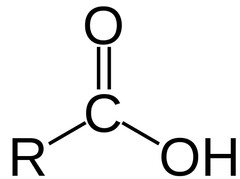
carboxylic acids
amphoteric
a species that can behave as either an acid or a base
auto-ionization of water

Kw

strong acids
HCl
HBr
HI
HNO3
HClO3
HClO4
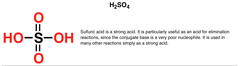
H2SO4
strong bases
LiOH
NaOH
KOH
RbOH
CsOH
Ca(OH)2
Sr(OH)2
Ba(OH)2
salt hydrolysis
occurs when ions produced by the dissociation of a salt react with water to produce either hydroxide ions or hydronium ions
basic salts
conjugates of weak acids
acidic salts
conjugates of weak bases
a cation that will make a solution ACIDIC
conjugate of a weak base
small highly charged metal (not 1A or 2A)
an anion that will make a solution BASIC
the conjugate base of a weak acid
cation that DOES NOT effect pH
a group 1A or heavy 2A
anion that DOES NOT effect pH
conjugate base of a strong acid
buffer
a solution that contains a weak acid/base and its conjugate base/acid
henderson hasselbach equation
for BUFFERS
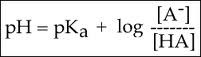
buffer concentrations
must have conjugate acid and base concentrations within a factor of 10
the pH of a buffer cannot be more than ______ pH unit different than the _____ of the weak acid it contains.
1 , pKa
pKa
-logKa
equivalence point
# moles acid = # moles base
pH = pKa when ________
[A-] = [HA]
at the half equivalence point
solubility product constant (Ksp)
gives a quantitative prediction about how much of a given ionic compound will dissolve in water
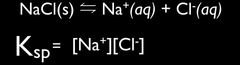
molar solubility
# moles of solute in 1 L of a saturated solution (mol/L)
solubility
the # grams of solute in 1 L of a saturated solution (g/L)
Q = Ksp
Q < Ksp
no precipitate
Q > Ksp
precipitate forms
factors that affect the solubility of ionic compounds
common ion effect
pH
formation of complex ions
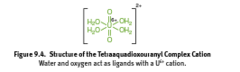
complex ion
an ion containing a central metal cation bonded to one or more molecules or ions
fractional precipitation
the separation of mixtures based on the compounds solubilities
qualitative analysis
uses selective precipitation to identify the types of ions present in solution
redox reaction
a reaction in which there are changes in oxidation states
galvanic cell
experimental apparatus for GENERATING electricity through a SPONTANEOUS reaction
(current flows from anode to cathode)
Ecell =
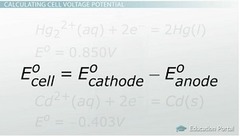
under non-standard conditions, cell potential is calculated with the NERNST EQUATION
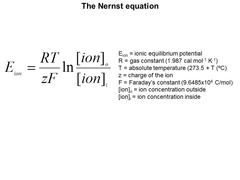
concentration cell
2 half-cells containing the same components but differing ion concentrations
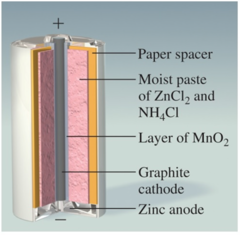
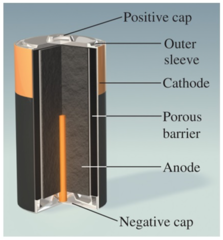
dry cell batteries
no fluid components
zinc container (anode)
graphite cathode
1.5 V
alkaline batteries
basic medium
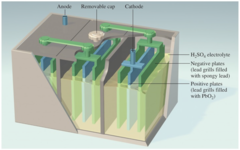
lead storage batteries
6 cells
2 V per cell
12 V total
rechargeable
(CARS)
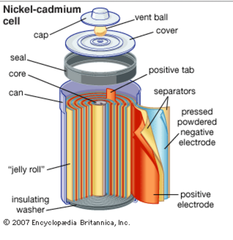
lithium ion batteries
cell potential 3.4 V
rechargeable (many times)
(PHONES, other electronics)
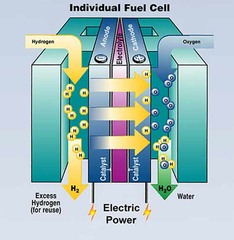
fuel cells
cell potential 1.23 V
~70% efficient
electrolysis
the use of an electric cell to drive a non-spontaneous reaction
electrolytic cell
non-spontaneous
electrical energy is consumed
corrosion
generally refers to the deterioration of a metal by an electrochemical process
kinematics
study of how fast reactions take place
collision theory
the reaction rate is directly proportional to the number of molecular collisions per second