Checkpoint 1 Study Guide
 Call Kai
 Learn
Learn Practice Test
 Spaced Repetition
 Match
Match Flashcards
 Knowt Play
1/27

There's no tags or description
Looks like no tags are added yet.
Name | Mastery | Learn | Test | Matching | Spaced | Call with Kai | Chat |
|---|
No analytics yet
Send a link to your students to track their progress
28 Terms
Law of exponents
10a / 10b = 10(a-b)
10a x 10b = 10(a+b)
(anything)0 = 1
Scientific notation
Single digit number with decimals x 10a
Number of exponent is determined by how many spaces the decimal place is moved to the left (positive) or right (negative)
Relationship between frequency and period
Reciprocals of each other
Period (T) = 1/f
Frequency (f) = 1/T
Key conversions
1 min = 60 s
1 s = 1000 ms
1 kHz = 1000 Hz
Wavelength
λ (lambda) = v or c (speed) / f (frequency)
Higher frequency → shorter period and wavelength
Sound wave properties
Compression = high density (packed particles)
Rarefaction = low density (spaced particles)
Waveform graph vs spectrum graph
Waveform - x-axis = time, y-axis = displacement or amplitude
Spectrum - x-axis = frequency, y-axis = amplitude
Relationship between elasticity and inertia
Elasticity - restoring force that allows recovery from distortion caused by a force
Inertia - the tendency of a body in motion to remain in motion, and a body at rest to remain at rest unless an external force is applied (Newtons 1st Law of Motion)
Hooke’s Law - the father you stretch or compress an object, the stronger the force pulling it back toward equilibrium
Sound wave → amplitude of vibration is proportional to the magnitude of the force being applied
What is sine?
Sine of an angle = opposite/hypotenuse or y/radius

Sound wave
Sound is a form of movement or vibration
Movement or vibration involves change in some quantity overtime
Sounds can be plotted as a change in some quantity overtime (waveform)
Spectrum
Diagrams one point in time or an averaged period of time
Pure tone
Single frequency sound which loses amplitude overtime
One sinusoidal wave
Example - sound produced by tuning fork
Dimensions - frequency, amplitude, phase, period, wavelength
Only frequency, amplitude and phase determine shape of sinusoidal wave
Parts of a soundwave

Birth of sound
Source + medium = sound
Source vibrates and these vibrations are transmitted through a medium
Both the source and medium have…
Mass - amount of matter
Elasticity - restoring force that allows recovery from distortion caused by a force
How do sounds travel great distances?
Sound travels as a wave of energy
Each air molecule vibrates and transfers its energy to neighboring molecules
Creates compressions and rarefactions
Physical properties of sound
Amplitude - amplitude of displacement is proportional to the magnitude of the force applied
Frequency - number of complete cycles in 1 second (cycle/sec = Hz)
Period - time it takes to complete one cycle (sec/cycle = T)
Wavelength - physical distance traveled by the wave during one period
Can be measured be measured as the distance between two consecutive compressions, refractions, crests, or troughs
Simple harmonic motion (SMH)
Motion - something is moving
Harmonic - movement is regular and repetitive
Simple - the farther it goes from equilibrium, the stronger the force pulling back
Examples - tuning fork’s vibrating prongs, pendulum, uniform circular motion
How is SMH sinusoidal?
Quantity varies overtime in a way that can be mathematically described by a sine wave
1 circular cycle = 1 wave cycle

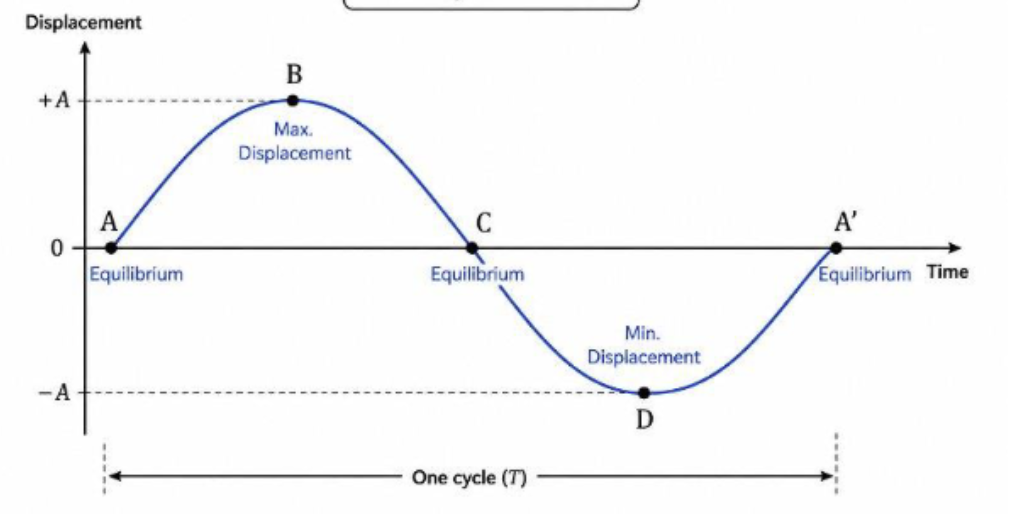
One cycle of vibration
A = equilibrium (0 degrees)
B = max positive displacement (90 degrees)
C = equilibrium (180 degrees)
D = max negative displacement (270 degrees)
E = equilibrium (360 degrees)
Amplitude
Height of waveform
Types
Instantaneous amplitude (v(t)) - displacement of the wave at a particular instant
Maximum amplitude (Amax) - largest displacement of the wave from equilibrium
Peak-to-peak amplitude (Vpp) - total distance from the positive peak to the negative peak
Root Mean Square amplitude (ARMS) - 70.7% of peak amplitude
Root Mean Square amplitude
ARMS = 0.707 x Amax
Units are micropascals
Calculates average sound level
When is Amax better at describing a sound then ARMS?
Impulsive sounds (ex. gun shot)
Instantaneous phase
The angle, in degrees, at a given point in time
Instantaneous phase = starting phase + (360/T) x t
Starting phase
The angle, in degrees, when the rotation begins

Phase relationships
In-phase - two waveforms have same frequency and starting phase
Out-of-phase - two waveforms have same frequency, but different starting phase
Phase
Position, timing, or point of a cycle that a wave has reached as it travels
How fast does sound travel?
343 m/s
Speed equation
Speed = distance/time