quiz 1 : nucl/clon
 Call Kai
 Learn
Learn Practice Test
 Spaced Repetition
 Match
Match Flashcards
 Knowt Play
1/34

There's no tags or description
Looks like no tags are added yet.
Name | Mastery | Learn | Test | Matching | Spaced | Call with Kai | Chat |
|---|
No analytics yet
Send a link to your students to track their progress
35 Terms
what is the purpose of aseptic technique?
avoid contamination while making sure the right specimen reaches the right location
How is media sterilized?
Autoclave
using heat, pressure, and water (steam)
How can you control whether the media is solid or liquid?
By including agar
What is the goal of the streak plate?
Obtaining isolated colonies
what are the pros/cons of liquid broth?
pro: a lot of bacteria like to grow in broth, grows quickly
con: no isolation, can be hard to spot contamination
what are some pros/cons of solid media?
Pro: see different colony morphologies, quick growth, can see contamination
cons: can dry out, can hold limited sample volume
Draw and label a bacterial growth curve
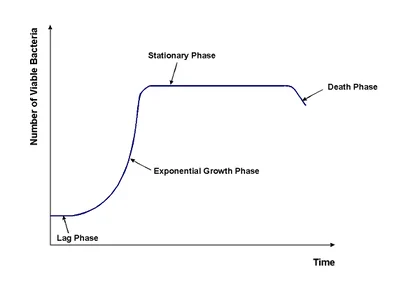
what phase of growth do we want bacterial cells to be in for DNA extraction? Why?
Late log or early stationary
This allows for a high number of cells while avoiding DNA degradation
best for quantity and quality
what phase of growth do we want bacterial cells to be in for RNA extraction? why?
In the middle of log/exponenetial
RNA is not happening constantly
How could you determine what phase of growth your cells are in?
spectrophotometer
How can you determine if your broth culture is pure?
By using a streak plate and seeing if cultures are present
What lysis methods did we use in lab?
mechanical disruption from glass beads
What separation methods did we use in lab?
bind DNA to column
What DNA recovery method did we use is lab?
adding H2O, rinsing off the column
What method did we use to determine whether or not our experiment was successful? (DNA extraction)
nanodrop program
What methods can you use to determine if your DNA extraction was successful?
nanodrop, spectrophotometer, visually checking to see if clear or cloudy (not very reliable)
What do the different wavelength measurements mean, and what are the recommended amounts they should be at?
230 and 260 are used to measure purity
260 is used to calculate the quantity of DNA
260/280 is used to measure protein contamination ( should be greater than 1.8)
260/230 is used to measure salt/chemical contaminants (the higher the better, but should be greater than 2)
Which bond is the hardest to pull apart in nucleic acid? why?
G to C bond because it has 3 bonds
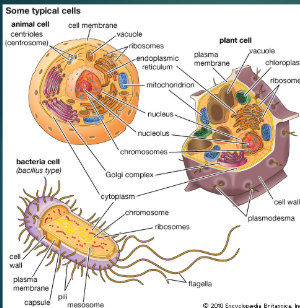
what are some cell types missing from this image?
Archaea, fungi, protists
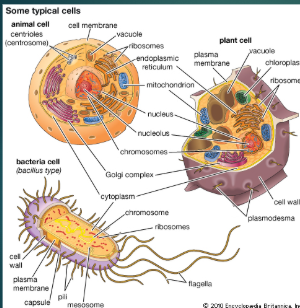
which of these have cell walls? what are the cell walls made of?
animal cell- no cell wall (phospholipid bilayer)
plant cell- has walls (cellulose, other polymers)
bacteria- has cells (peptidoglycan)
archaea- has cell walls (various surface polymers, proteins, polysaccharides)
fungi- has cell walls (chitin)
protists- some have cells walls, some do not
List the different properties of gram positive and gram negative
gram negative: plasma membrane, peptidoglycan, outer membrane
gram positive: plasma membrane, thicker layer of peptidoglycan, no outer membrane
What is the first general step in DNA extraction?
Lysis
what type of cell would be the easiest to lyse? why?
animal cells
no cell walls
List detergents that are used in lysis, what did we use?
SDS, guanidinium salts, lysozome, and protienase K (protease)
we used guandinium salts
List forms of mechanical disruption
glass beads/bead beater, mortar & pestle/ liquid nitrogen, homogenizers, sonication, small gauge needles
What is lysozome? where can it be found? what does it do?
antimicrobial enzyme
can be found in human tears, breast milk, and chicken egg whites
it cleaves bacterial wall polysaccharides
what is peptidoglycan made of? what does this have to do with lysozome?
made of nam-nag
lysozome cleaves nam-nag linkages
What comes after lysis?
Separate DNA from proteins/ other cellular material
What comes after separating the DNA?
Recover DNA
List DNA extraction in order
Lysis
Separate DNA
Recover DNA
What are the different ways you can recover DNA?
column elution or ethanol precipitation
what are the pros and cons of organic extraction?
pros: cheaper
cons: takes a lot longer, more likely to get contamination
what is a part of organic extraction?
Lysis using SDS and Proteinase K
Separation with phenol chloroform
ethanol precipitation
What are some different methods of seperation?
cesium chloride density gradients
anion exchange separation
magnetic particle separation
describe the process of ethanol precipitation
add pure ethanol and salt
spin tube
clear pellet left at bottom (remove liquid)
add in lower ethanol
mix and spin tube
left with clear/small pellet of DNA
add buffer to dissolve (small volume)