REVIEW! Semester 2 AP Psychology 25-26
 Call Kai
 Learn
Learn Practice Test
 Spaced Repetition
 Match
Match Flashcards
1/312

There's no tags or description
Looks like no tags are added yet.
Name | Mastery | Learn | Test | Matching | Spaced | Call with Kai | Chat |
|---|
No analytics yet
Send a link to your students to track their progress
313 Terms
learning
a relatively permanent change in behavior; the process of acquiring new and relatively enduring information from expierence
associative learning
learning that certain events occur together. the events may be two stimuli (classical conditioning) or a response and its consequences (operant conditioning)
stimulus
any event or situation that evokes a response
classical conditioning
a type of learning in which one learns to link two or more stimuli and anticipate events
behaviorism
the view that psychology should be an objective science, examining observable behaviors, and studies behavior without reference to mental processes.
neutral stimulus (NS)
in classical conditioning, a stimulus that elicits no response before conditioning. Becomes the Conditioned Stimulus after learning/association.
unconditioned response (UR)
in classical conditioning, an unlearned, naturally occurring response to an unconditioned stimulus
unconditioned stimulus (US)
in classical conditioning, a stimulus that unconditionally, naturally and automatically, triggers a response
conditioned response (CR)
in classical conditioning, a learned response to a previously neutral stimulus
conditioned stimulus (CS)
in classical conditioning, an originally irrelevant stimulus that, after association with an unconditioned stimulus, comes to trigger a conditioned response
acquisition
in classical conditioning, the initial stage, when one links a neutral stimulus and an unconditioned stimulus so that the neutral stimulus begins triggering the conditioned response. in operant conditioning, the strengthening of a reinforced response
extinction
a diminishing of a conditioned response; occurs in classical conditioning when an unconditioned stimulus (US) does not follow a conditioned stimulus (CS); occurs in operant conditioning when a response is no longer reinforced
spontaneous recovery
the reappearance, after a pause, of an extinguished conditioned response
generalization
the tendency, once a response has been conditioned, for stimuli similar to the conditioned stimulus to elicit similar responses
operant conditioning
a type of learning in which behavior is strengthened if followed by a reinforcer or diminished if followed by a punisher
shaping
an operant conditioning procedure in which reinforcers guide behavior toward closer and closer approximations of the desired behavior
reinforcement
in operant conditioning, any event that strengthens the behavior it follows
positive reinforcement
increasing behaviors by adding a reinforcer, which then strengthens the response
negative reinforcement
increasing behaviors by stopping or reducing undesired/annoying stimulus, which strengthens the response.
modeling
the process of observing and imitating a specific behavior
trial and error learning
Learning that takes place when a child tries several solutions before finding one that works
successive approximations
in the operant-conditioning procedure of shaping, behaviors that are ordered in terms of increasing similarity or closeness to the desired response.
Ivan Pavlov (1849-1936)
Performed pioneering conditioning experiments on dogs. These experiments led to the development of the classical conditioning model of learning.
positive punishment
the administration of a stimulus to decrease the probability of a behavior's recurring
negative punishment
taking away a pleasant stimulus to decrease or stop a behavior
punishment
an event that decreases the behavior that it follows
ADHD
a psychological disorder marked by the appearance by age 7 of one or more of three key symptoms: extreme inattention, hyperactivity, and impulsivity. Heritable
UMAD
Behavior has to be unjustifiable, maladaptive, atypical and disturbing to be considered having a disorder
Medical Model
the concept that diseases, in this case psychological disorders, have physical causes that can be diagnosed, treated, and, in most cases, cured, often through treatment in a hospital.
DSM-5
the American Psychiatric Association's Diagnostic and Statistical Manual of Mental Disorders, Fifth Edition; a widely used system for classifying psychological disorders.
insomnia disorder
condition in which insufficient sleep interferes with normal functioning
Rosenhan Study
Study in which healthy individuals were admitted into mental hospitals after saying they were hearing voices. Once in, they acted normally and still were not labeled as impostors. Brought to light many problems with the system and exposed the process.
Generalized Anxiety Disorder (GAD)
a disorder characterized by chronic, excessive worry accompanied by three or more of the following symptoms: restlessness, fatigue, concentration problems, irritability, muscle tension, and sleep disturbance
Phobia
When a person is intensely and irrationally afraid of a specific object (spiders) or situation (flying)
Panic Disorder
An anxiety disorder marked by unpredictable minutes-long episodes of intense dread in which a person experiences terror and accompanying chest pain, choking, or other frightening sensations.
Social anxiety disorder
intense fear of social situations, leading to avoidance of such. Formally called social phobia.
Agoraphobia
fear or avoidance of situations, such as crowds or wide open places, where one has felt loss of control and panic
obsessive-compulsive disorder (OCD)
an anxiety disorder characterized by unwanted repetitive thoughts (obsessions) and/or actions (compulsions)
post-traumatic stress disorder (PTSD)
an anxiety disorder characterized by haunting memories, nightmares, social withdrawal, jumpy anxiety, and/or insomnia that lingers for four weeks or more after a traumatic experience
posttraumatic growth
positive psychological changes as a result of struggling with extremely challenging circumstances and life crises. EX- going through a breakup and coming out as a stronger person
Mood Disorder
an illness that involves mood extremes that interfere with everyday living. EX- Depression
Major Depressive Disorder
A mood disorder in which a person experiences, in the absence of drugs or a medical condition, two or more weeks of significantly depressed moods, feelings of worthlessness, and diminished interest or pleasure in most activities.
Mania
a mood disorder marked by a hyperactive, wildly optimistic state. EX- depression is slow motion, but mania is hyperactive fast forwarding
Bipolar Disorder
A mood disorder in which the person alternates between the hopelessness and lethargy of depression and the overexcited state of mania. highs and lows rapidly
bipolar 1 disorder
a type of bipolar disorder marked by full manic and major depressive episodes. Extreme highs and lows
bipolar 2 disorder
a disorder characterized by alternating periods of extremely depressed and mildly elevated moods. Basically just less active than bipolar 1.
seasonal affective disorder (SAD)
a mood disorder caused by the body's reaction to low levels of sunlight in the winter months
Persistent Depressive Disorder
It is often milder, lasting at least 2 years. aka dysthimia
Rumination
compulsive fretting; overthinking about our problems and their causes
Schizophrenia
a psychological disorder characterized by delusions, hallucinations, disorganized speech, and/or diminished, inappropriate emotional expression. 4 types, but know paranoia and catatonic.
Paranoia symptoms
most common in schizophrenia, preoccupation with delusions or hallucinations
Catatonic symptoms
immobility (or excessive, purposeless movement), extreme negativism, and/or parrotlike repeating of another's speech or movements
self-defeating beliefs
intensely negative assumptions about themselves, their situations, and their futures lead them to magnify bad experience and minimized good ones
explanatory style
a person's habitual way of explaining events, typically assessed along three dimensions: internal/external, stable/unstable, and global/specific. Can be positive or negative
positive symptoms of schizophrenia
ADDING behaviors. EX- hallucinations and delusions, talk in disorganized, deluded ways and exhibit inappropriate laughter/tears/rage.
negative symptoms of schizophrenia
Absence of appropriate behaviors (SUBTRACTING). EX- toneless voices, expressionless faces, mute or rigid bodies.
Psychosis
Emotional disturbance characterized by inability to cope in real world. Can't function in life
Neurosis
Emotional disturbance characterized by excessive anxiety. Can function in life
Delusions
false beliefs, often of persecution or grandeur, that may accompany psychotic disorders. EX- word salad-- jumbled ideas all in one
Hallucinations
false sensory experiences, such as seeing something in the absence of an external visual stimulus. EX- exclusively senses
Dopamine hypothesis
the idea that schizophrenia involves an excess of dopamine activity
Dissociative disorder
disorders in which conscious awareness becomes separated (dissociated) from previous memories, thoughts, and feelings. EX- Amnesia
Conversion disorder
A rare somatoform disorder in which a person experiences very specific genuine physical symptoms for which no physiological basis can be found. (blindness, paralysis, seizures - psychological causes)
Dissociative Identity Disorder
A rare dissociative disorder in which a person exhibits two or more distinct and alternating personalities. Also called multiple personality disorder. EX- the movie, Split
Eating Disorders
Anorexia nervosa- starvation, Bulimia nervosa- alternating binge eating and purging, Binge eating disorder- over eating constantly w/o purging
Antisocial personality disorder
A personality disorder in which the person (usually a man) exhibits a lack of conscience for wrongdoing, even toward friends and family members. May be aggressive and ruthless. EX- criminals
Psychotherapy
treatment involving psychological techniques; "talk therapy"; consists of interactions between a trained therapist and someone seeking to overcome psychological difficulties or achieve personal growth
Biomedical therapy
prescribed medications or procedures that act directly on the person's physiology
eclectic approach
an approach to psychotherapy that, depending on the client's problems, uses techniques from various forms of therapy. Basically all of them in a nice blend specific to the client.
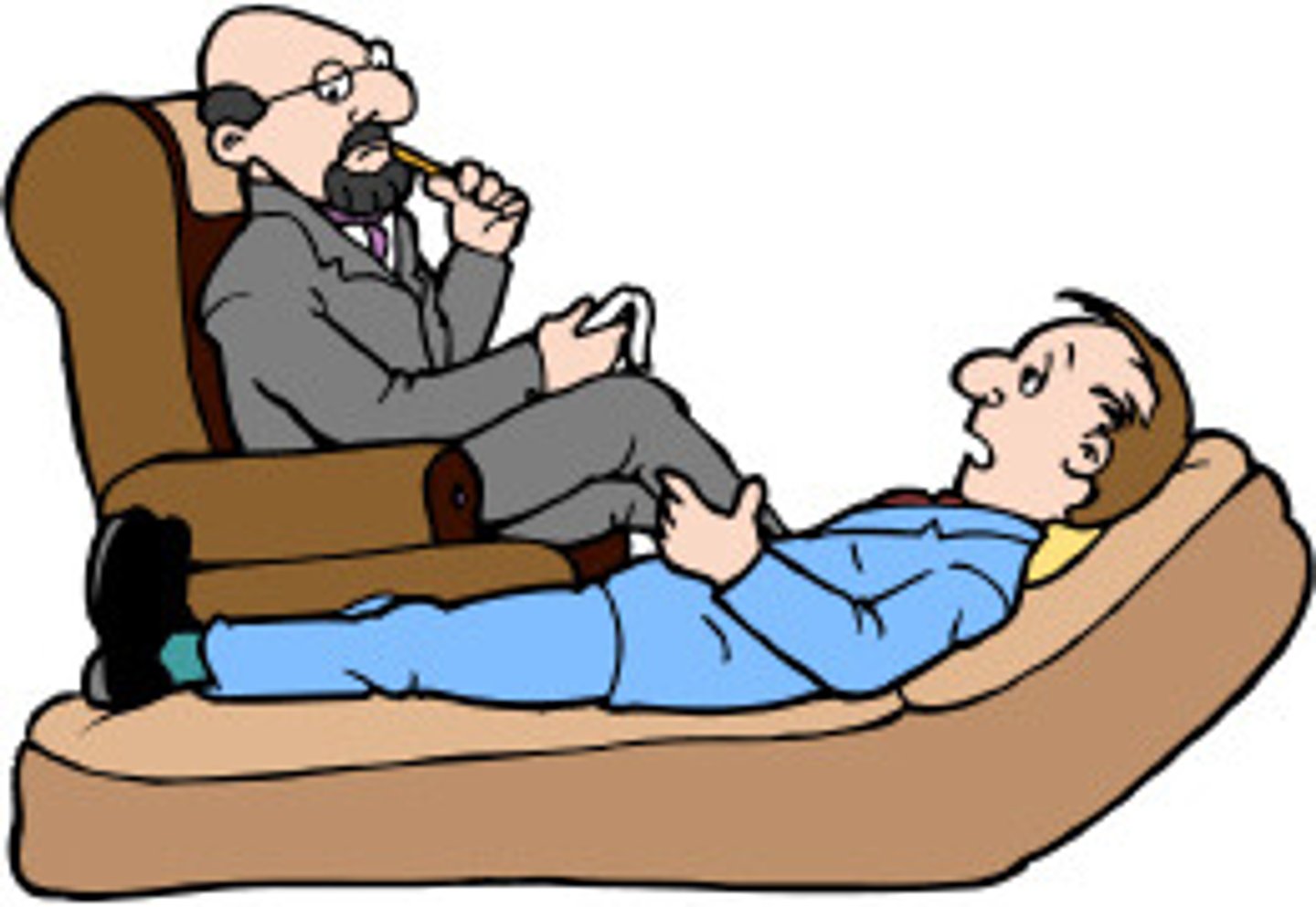
Psychoanalysis
Sigmund Freud's therapeutic technique. Freud believed the patient's free associations, resistances, dreams, and transferences - and the therapist's interpretations of them - released previously repressed feelings, allowing the patient to gain self-insight.
Resistance
in psychoanalysis, the blocking from consciousness of anxiety-laden material. EX- instead of saying "i hate her", which is what is really being thought, compliment them instead. Think of the movie Mean Girls.
Interpretation
in psychoanalysis, the analyst's noting supposed dream meanings, resistances, and other significant behaviors and events in order to promote insight. Basically whatever the therapist thinks.
Transference
in psychoanalysis, the patient's transfer to the analyst of emotions linked with other relationships EX- love or hatred for a parent will reflect on the therapist
psychodynamic therapy
therapy deriving from the psychoanalytic tradition that views individuals as responding to unconscious forces and childhood experiences, and that seeks to enhance self-insight
Insight therapy
a variety of therapies that aim to improve psychological functioning by increasing the client's awareness of underlying motives and defenses. EX- psychoanalytic and humanistic
Active listening
Empathic listening in which the listener echoes, restates, and clarifies. A feature of Rogers' client-centered therapy.
Client centered therapy
a humanistic therapy, developed by Carl Rogers, in which the therapist uses techniques such as active listening within a genuine, accepting, empathic environment to facilitate clients' growth. (Also called person-centered therapy.) Think acronym AGE to remember the 3 techniques.
Unconditional positive regard
a caring, accepting, nonjudgmental attitude, which Carl Rogers believed would help clients to develop self-awareness and self-acceptance. Basically a "ill love you no matter what" philosophy.
Behavior therapy
therapy that applies learning principles to the elimination of unwanted behaviors. Basically, instead of looking for deep underlying causes, this therapy teaches behaviors to combat old ones.
cognitive-behavioral therapy (CBT)
a popular integrative therapy that combines cognitive therapy (changing self-defeating thinking) with behavior therapy (changing behavior). Alters thinking and action.
Exposure therapy
behavioral techniques, such as systematic desensitization, that treat anxieties by exposing people (in imagination or actuality) to the things they fear and avoid
Systematic-desensitization
A type of exposure therapy that associates a pleasant relaxed state with gradually increasing anxiety-triggering stimuli. Commonly used to treat phobias. EX- remember the dissecting research we wrote on this study
counterconditioning
a behavior therapy procedure that uses classical conditioning to evoke new responses to stimuli that are triggering unwanted behaviors; includes exposure therapies and aversive conditioning. Basically just opposite of cc.
Aversive conditioning
a type of counterconditioning that associates an unpleasant state (such as nausea) with an unwanted behavior (such as drinking alcohol)
Token economy
an operant conditioning procedure in which people earn a token of some sort for exhibiting a desired behavior and can later exchange the tokens for various privileges or treats. EX- go to therapy, parents give you chocolate
rational-emotive behavior therapy (REBT)
a confrontational cognitive therapy, developed by Albert Ellis, that vigorously challenges people's illogical, self-defeating attitudes and assumptions. EX- patient says they aren't good enough, therapist asks why, over and over until they essentially prove themselves wrong.
virtual reality exposure therapy (VRET)
a method of exposure therapy that uses virtual reality, in which clients become immersed in computer-generated environments that resemble the situations they fear
Group therapy
therapy conducted with groups rather than individuals, permitting therapeutic benefits from group interaction
Family therapy
therapy that treats the family as a system. Views an individual's unwanted behaviors as influenced by, or directed at, other family members
cognitive therapy
therapy that teaches people new, more adaptive ways of thinking and acting; based on the assumption that thoughts intervene between events and our emotional reactions
Psychopharmacology
the study of the effects of drugs on mind and behavior. EX- studies placebo effect recovery
Antipsychotic drugs
drugs used to treat schizophrenia and other forms of severe thought disorder. For positive schitzo symptoms, because there needs to be a drug ADDED. These drugs are antagonists, which work against. ex: clozapine
Antidepressants
drugs that combat depression, PTSD, OCD, anxiety and other things, by affecting the levels or activity of neurotransmitters in the brain. These drugs are agonists, which means they work to increase a certain neurotransmitter. Several antidepressants are selective serotonin reuptake inhibitors, EX- Prozac
Antianxiety drugs
drugs used to control anxiety and agitation. These depress the central nervous system. EX- xanax
electroconvulsive therapy (ECT)
a biomedical therapy for severely depressed patients in which a brief electric current is sent through the brain of an anesthetized patient. Some memory loss, not permanent, criticized for placebo effect.
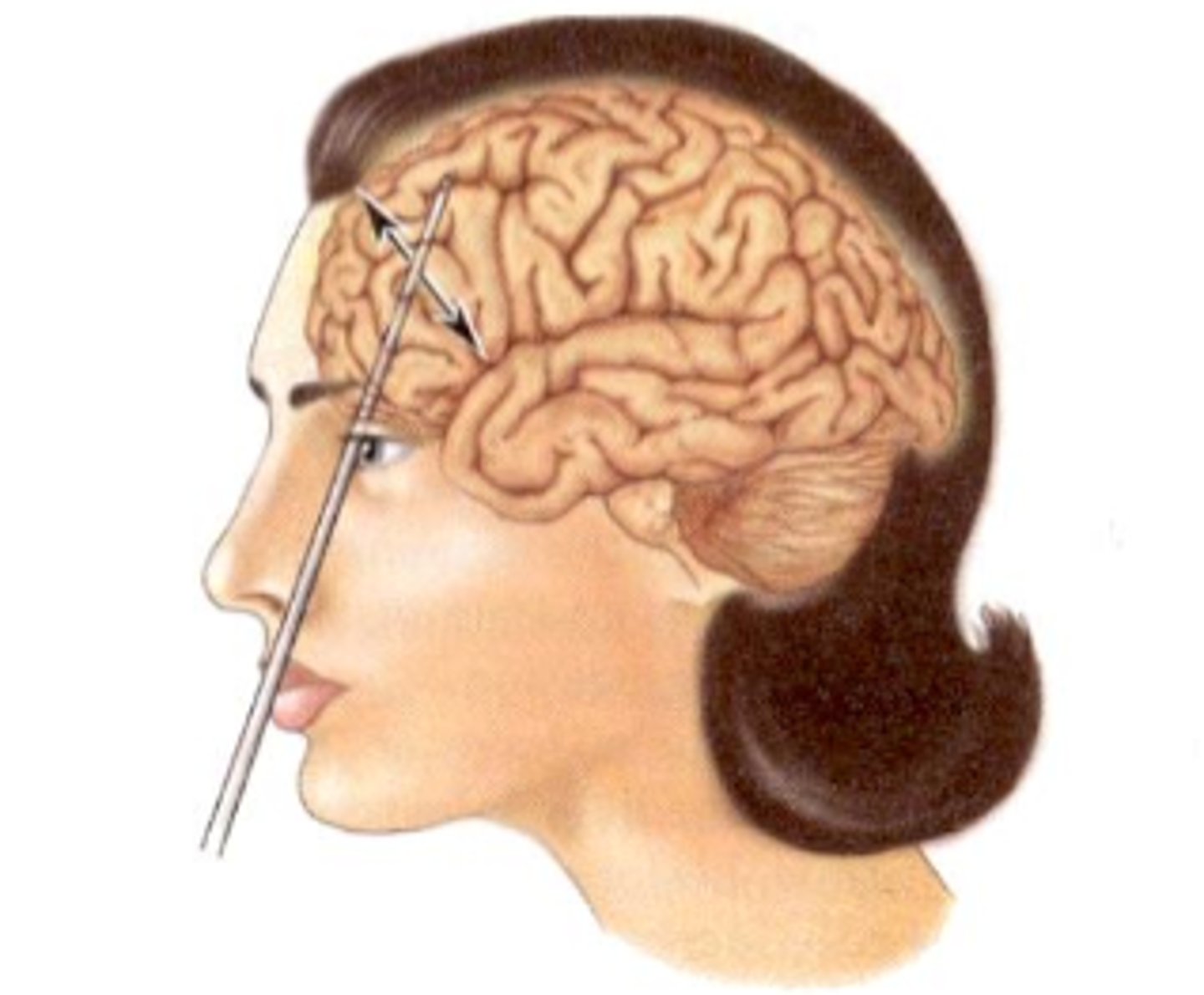
Lobotomy
a psychosurgical procedure once used to calm uncontrollably emotional or violent patients. The procedure cut the nerves connecting the frontal lobes to the emotion-controlling centers of the inner brain. Literally did not work and was used in the 30's-60's cause they didn't know how the brain worked.
personality disorders
inflexible, exaggerated & maladaptive ways of thinking. A general name for all disorders that relate to inflexible/enduring behavior patterns that impair social functioning.
Cluster A
Person seems odd or eccentric. Contains schizoid, Schizotypal and Paranoid personality disorders.
schizoid personality disorder
Withdrawn & lacks feelings for others. Seldom marry (have few relationships)
Schizotypal Personality Disorder
Odd thought, speech and emotional reactions, Impaired social functioning. EX- Luna lovegood