Summer 2026 Prin Macroeconomics Final
 Call Kai
 Learn
Learn Practice Test
 Spaced Repetition
 Match
Match Flashcards
 Knowt Play
1/99

There's no tags or description
Looks like no tags are added yet.
Name | Mastery | Learn | Test | Matching | Spaced | Call with Kai | Chat |
|---|
No analytics yet
Send a link to your students to track their progress
100 Terms
In market-oriented economies (ex. the US and Canada), most of the decisions are made by _________, while in command economies (ex. Cuba, North Korea), most economic decisions are made by __________.
Private citizens (Individuals) and firms; the government
When Antonio is deciding on how much to consume, he will make a choice that maximizes his satisfaction (happiness), also known as _____________; that means, he will make a choice according to his distinct personal preferences.
Utility
Most real-world choices aren't about getting all of one thing or another, instead, most choices involve _________________, which involves comparing the benefits and costs of choosing a little more or a little less of a good.
marginal analysis
Production efficiency is represented by ________ a production possibilities frontier.
all points on
Choices that are best for the individual who makes them.
self-interest.
In countries like _____________ the command economy dominates.
Cuba and North Korea
What is meant by specialization?
When workers/ firms focus on particular tasks in the overall production process for which they are well-suited.
Define the division of labor
The production of a good or service is split up into separate tasks performed by different workers.
Which of the following would shift the production possibilities curve inward?
a decrease in the average number of hours worked per week as the labor force chooses to enjoy more leisure time
Andrew has a budget of $50 a month for movie tickets and restaurant meals. A ticket will cost $5, and a meal costs $10. Which of the following combinations is part of Andrew’s budget constraint?
2 movie tickets and 5 restaurant meals
Marginal utility is _______________ .
the additional satisfaction that a consumer derives from consuming one additional unit of a good
While talking to his friend, Bobby says, "this concerts going to cost me $50 when I buy my ticket." His friend corrects him and says, "actually, it's going to cost you more than $50 since you're skipped work to go." His friend is referring to the _________________.
budget constraint
3 macroeconomic goals are: economic growth, low inflation, and _____________.
Low unemployment
Which of the following is the largest component of GDP as measured by demand (accounting for about two-thirds of total GDP in any given year)?
Consumption
Ghana has a GDP of $80 billion (measured in U.S. dollars) and a population of 55 million. Cuba has GDP of $9 billion (measured in U.S. dollars) and a population of 4 million. Calculate Real GDP per person for each country.
Ghana = $1454.54 / Cuba = $2250.00
Calculate total GDP for this economy given the following components of demand. Round your answer to the nearest tenth and enter the value in trillions of dollars.
Consumption 12.9 Investment 3.8 Government spending 4.2 Exports 3.0 Imports 4.2 Total GDP ?
$19.7 trillion
As the business cycle moves through its phases, it must pass through a low point. Which of the following is the correct term for this low point?
Trough
How are final goods and services valued when measuring nominal GDP?
At current market price
Calculate total GDP for this economy given the following components of supply. Round your answer to the nearest tenth and enter the value in trillions of dollars
Durable goods 3.8 Nondurable goods 2.7 Services 12.2 Structures 2.1 Change in inventories 0 Total ?
$20.8 trillion
The components of supply approach uses data on consumption expenditure, investment, government purchases of goods and services, and net exports of goods and services to calculate GDP.
False
All of the following statements about double counting are true, except:
Double counting is always present in the prices of final products at the end of the production chain
Which of the following statements best describes real value?
Real value is the value of a good or service after adjusting for changes in price
Which of the following is not included in GDP?
Cash income paid to a day laborer that is not reported to the tax authorities
Which of the following policies would support the goals of macroeconomic policy?
an increase in government spending with the intention of stimulating economic growth
a reduction in government spending with the intention of halting the rate of inflation
a policy that reduces payroll taxes with the intention of creating jobs
International trade:
Raises the standard of living in all trading countries
The law of supply states that:
There is a positive relationship between the price of a good and the quantity of it offered for sale by suppliers.
A normal good is a good for which demand increases as:
The income of consumers increases
Which of the following will not cause a change in demand for crackers?
A change in the price of crackers.
The point at which supply and demand cross is
Equilibrium point
A tariff is a:
Tax on an imported product
The law of demand states that, ceteris paribus, price and quantity demanded are:
Inversely related
Assuming coffee and tea are substitute goods, a decrease in the price of tea will cause the demand curve for coffee to:
Shift to the left as consumers switch from buying coffee to tea
A decrease in the price of a good will
Decrease quantity supplied
Any point inside the production possibility curve is:
Inefficient
What happens to the equilibrium price and quantity of a good when there is a decrease in supply?
Price increases, quantity decreases.
Which of the following shifts the supply curve?
Change in technology
The overriding reason why households and societies face many decisions is that
Resources are scarce
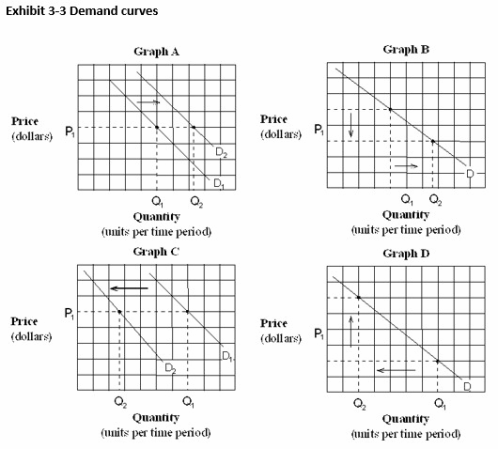
Assume that consumers expect the price of gasoline to rise sharply in the future. Which of the graphs in the image provided depicts this effect?
Graph A
The opportunity cost of an activity means the:
Amount of other activities that must be sacrificed in order to engage in the activity
Which of the following pairs is the best example of substitutes?
Hiking boots and athletic shoes.
When thinking of trade, how should a society choose what to specialize in?
Comparative Advantage
In accordance with the law of supply, both individual and market supply curves are drawn:
Upward-sloping
What is the impact of international trade on the macro economy?
It increases the overall level of output in the economy
If the market price is below the equilibrium price, then:
The quantity demanded will exceed the quantity supplied.
A movement along a demand curve is called a change in:
Quantity demanded
All points on the production possibilities curve are:
Efficient
Which of the following is the best example of an activity that would be undertaken by an entrepreneur?
Starting a new business
A price floor is:
A minimum price set by the government above equilibrium price
People are forced to make choices because of:
Unlimited wants and limited resources
Public investment expenditure for highways, schools, and national defense is included in ____ purchases.
government
All final goods and services that make up GDP can be expressed in the form:
GDP = C + I + G + (X - M).
The expenditure approach for the calculation of GDP includes spending on:
consumption, gross private domestic investment, government spending for goods and services, and net exports.
Which of the following groups of people are members of the labor force?
People over 16 years of age who are employed.
Stephen Moreno reported to the government interviewer that he worked 40 hours last week as a stocker at a Target department store. He is:
a member of the civilian labor force who is employed.
Which one of the following people would not be considered a part of the labor force?
A steel worker who was laid off last week and is seeking work.
A person who has given up searching for work is called:
a discouraged worker.
Unemployment that is of a short duration to allow time to find a new job is:
frictional unemployment.
What is cyclical unemployment?
Unemployment that occurs during a recession
What is inflation?
An increase in the overall level of prices
The current economy of the U.S. would be best described as:
Mixed capitalism
What does it mean when net exports are negative?
Imports > Exports
Who of the following is not included in the Bureau of Labor Statistics' "employed" category?
Those waiting to be recalled to a job from which they had been laid off.
The phase of the business cycle that follows a recession is known as the:
recovery
As a general rule, a recession is a decline in real GDP lasting at least:
six months.
Expenditure approach, GDP equals:
C + I + G + (X - M).
Last year the Jones family earned $40,000. This year their income is $42,000. In an economy with an inflation rate of 10 percent, which of the following is correct?
The Jones' nominal income has increased and their real income has fallen.
If you buy a brand new, American-made laptop computer to use for taking notes in your economics class, then it will be counted as:
C(Consumption)
According to the Bureau of Labor Statistics' survey, which category represents the largest expense for the typical urban family?
Housing
Which of the following purchases would be counted as a final good in the GDP calculation?
A business's purchase of new office equipment.
A nation's standard of living is best measured by its
real GDP per person.
Which of the following is a correct way to measure productivity?
Divide the quantity of output by the number of hours worked.
Which of the following is physical capital?
the equipment in a factory
Human capital is the
knowledge and skills that workers acquire through education, training, and experience.
The inputs into production of goods and services that are provided by nature, such as land, rivers, and mineral deposits are called
natural resources.
If the federal minimum wage grows at a slower rate than inflation, the real value of the minimum wage increases.
False
Which of the following components enter the CPI calculation?
Medical care, apparel, transportation
Which of the following policies would support the goals of macroeconomic policy?
an increase in government spending with the intention of stimulating economic growth, a policy that reduces payroll taxes with the intention of creating jobs, a reduction in government spending with the intention of halting the rate of inflation
Two factors that complicate the calculation of the inflation rate are;
substitution and quality/new product bias
The unemployment rate for men was higher than the unemployment rate for women between 2008 and 2016.
True
Which of the following are inputs for the aggregate production function with GDP per capita as its output?
Physical capital per person, human capital per person, technology per person
The survey of the goods contained in the CPI market basket is conducted?
monthly
Convergence is the idea that _______________.
low-income countries grow faster than high-income countries
The ____________ is based on prices paid for supplies and inputs by producers of goods and services.
Producer Price Index
An increase in the average level of physical and/or human capital per person is also called
capital deepening
Which two of the following are included in the natural rate of unemployment?
frictional and structural unemployment
The Fed:
Serves as the central bank for the United States
One hundred dollars on deposit in a checking account represents the use of money as a:
Store of value
Which of the following is in charge of the buying and selling of government securities by the Fed?
The Federal Open Market Committee
The interest rate which the Fed charges banks that borrow reserves from it the Fed is:
Discount rate
What are the three roles of money?
Medium of exchange, store of value, and unit of account
A cut in government spending, a decrease in income abroad, an increase in taxes, or an expectation that future consumer income will fall will all cause aggregate:
Demand to shift inward
Which of the following would shift the aggregate demand curve to the left?
A decrease in government spending
Changes in the price level affect which components of aggregate demand?
Consumption, investment, and net exports
The Federal Reserve Board of Governors consists of:
7 members nominated by the President and confirmed by the Senate
Which of the following policy action by the Fed would cause the money supply to increase?
An open-market purchase of government securities
What is the aggregate demand curve?
A curve that shows the relationship between the total quantity of goods and services demanded in an economy and the overall price level
What happens to aggregate demand when the price level rises?
Decreases the quantity of real GDP demanded
The wealth effect, interest-rate effect, and exchange-rate effect are all explanations for
The slope of the aggregate-demand curve
Which list ranks assets from least to most liquid?
Fine art, stocks, currency
To decrease the money supply the Fed could
sell government bonds, increase the discount rate, increase the reserve requirement