13/24: Hunger & Thirst
 Call Kai
 Learn
Learn Practice Test
 Spaced Repetition
 Match
Match Flashcards
 Knowt Play
1/27

There's no tags or description
Looks like no tags are added yet.
Name | Mastery | Learn | Test | Matching | Spaced | Call with Kai | Chat |
|---|
No analytics yet
Send a link to your students to track their progress
28 Terms
homeostasis
→ cellular process of actively maintaining internal conditions — particularly with respect to nutrition (available food and water) and body temperature
Animals are able to live in diverse environments thanks to this process
Maintenance:
Nutrition must remain above/within some threshold
Temperature cannot be too polarized (hot or cold) from balance point for too long
unconscious temperature regulations
→ automatic corrective mechanisms (negative feedback) that occur when the temperature of endotherms (warm-blooded organisms) deviate from ~37 ̊C
These mechanisms DON’T apply to ectotherms (cold-blooded organisms), whose functionalities are more contingent on ambient temperature (i.e., that of the environment)
Remedying freezing:
↑ Basal metabolic rate (↑ calories burned to generate heat)
↑ Shivering
↓ Blood flow (↓ heat loss through skin)
Peripheral blood vessels constrict, concentrating blood to the center of the body
Remedying overheating:
↑ Sweating (water evaporation has a cooling effect)
↑ Blood flow (↑ heat loss through dissipation)
Peripheral blood vessels expand, distributing blood away from the center of the body
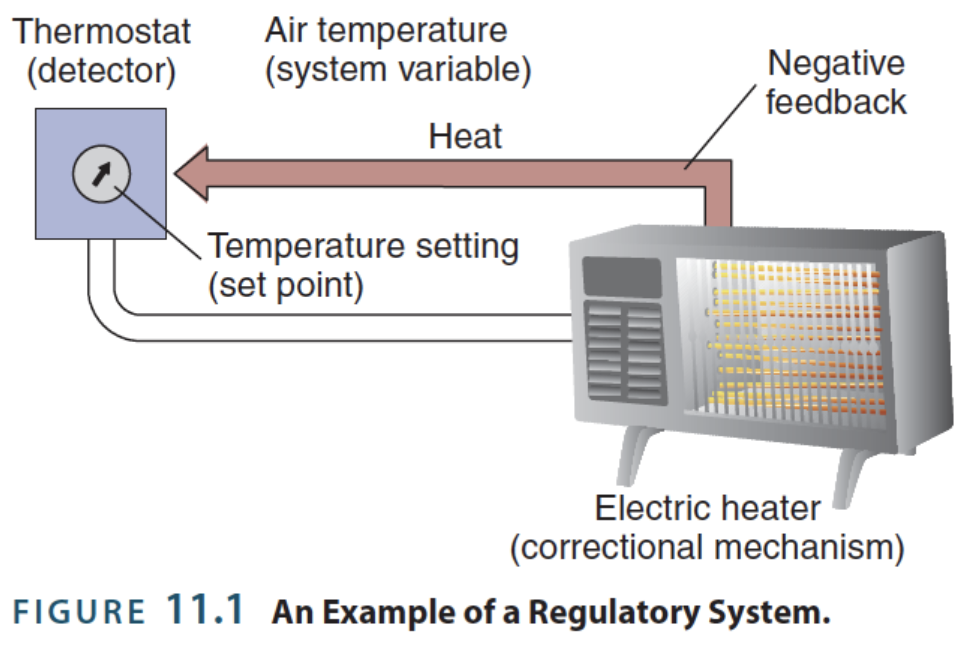
“need” state
→ state that consciously motivates, drives, or pushes us to perform an action to correct a specific problem
Satisfying this state results in some form of relief or pleasure;
Such anticipation is so powerful that it can enable us to take action even in the absence of a corresponding need
ex. Uncomfortable body temperature causes conscious temperature regulation
thirst
→ result of water loss (collectively caused by urinating, sweating, and breathing), mediated by fluid intake
Osmometric thirst
Volumetric thirst
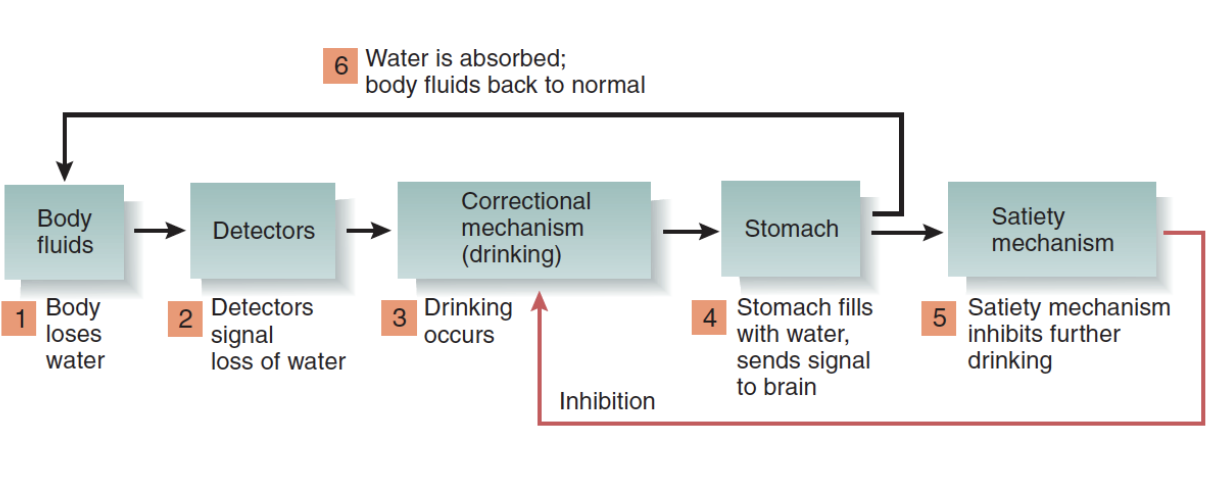
osmometric thirst
→ conscious thirst caused by not enough water inside cells
Result of:
Tonicity (3 conditions)
Diffusion
Osmosis
Applied through:
Body fluids (2 types)
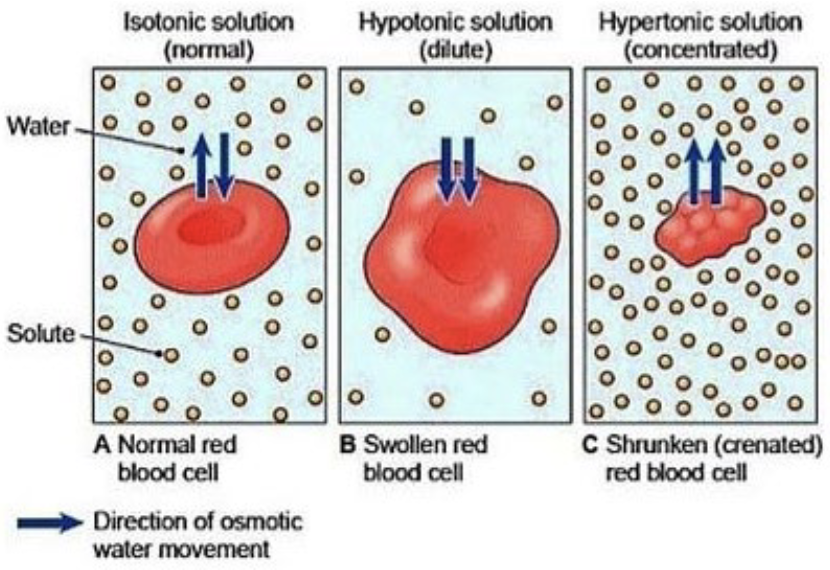
tonicity
→ relative [ ] of dissolved molecules (solute in solvent) on either side of a membrane (that is permeable only to the solution and NOT just the solutes dissolved in it)
Isotonic → equilibrium solution
Similar [ ] of solute and solvent around membrane
Hypotonic → diluted solution
↑ [solute] inside membrane
Solvent will move in
Cells swell
Hypertonic → concentrated solution
↑ [solute] outside membrane
Solvent will move out
Cell shrinks
![<p>→ relative [ ] of dissolved molecules (solute in solvent) on either side of a membrane (that is permeable only to the solution and NOT just the solutes dissolved in it)</p><ul><li><p><strong>Isotonic </strong>→ equilibrium solution</p><ul><li><p>Similar [ ] of solute and solvent around membrane</p></li></ul><p></p></li><li><p><strong>Hypotonic</strong> → diluted solution</p><ul><li><p>↑ [solute] inside membrane</p></li><li><p>Solvent will move in</p></li><li><p>Cells swell</p><p></p></li></ul></li><li><p><strong>Hypertonic</strong> → concentrated solution</p><ul><li><p>↑ [solute] outside membrane</p></li><li><p>Solvent will move out</p></li><li><p>Cell shrinks</p></li></ul></li></ul><p></p>](https://knowt-user-attachments.s3.amazonaws.com/42b18381-d7fb-400c-8ed0-fc489ab6bc0a.png)
diffusion
→ process by which molecules move from areas of ↑ [ ] to areas of ↓ [ ] — whose direction of movement is defined by relative tonicity
![<p>→ process by which molecules move from areas of ↑ [ ] to areas of ↓ [ ] — whose direction of movement is defined by relative <strong>tonicity</strong></p>](https://knowt-user-attachments.s3.amazonaws.com/6b3b84b0-e75e-4bff-8872-9b668af20a9e.png)
osmosis
→ type of diffusion; refers to the movement of solution (aqueous solvent; water) from areas of ↑ tonicity to areas of ↓ tonicity
body fluids
Extracellular fluids → [ ] varies depending on nutrition (cells take in what they need)
33% = 26% interstitial, 7% intravascular (plasma), 1% CSF
↓ Tonicity from drinking water (creates hypotonic environment, hydrating cells)
↑ Tonicity from consuming salt (creates hypertonic environment, dehydrating cells)
Intracellular fluids → [ ] relatively stable
67%
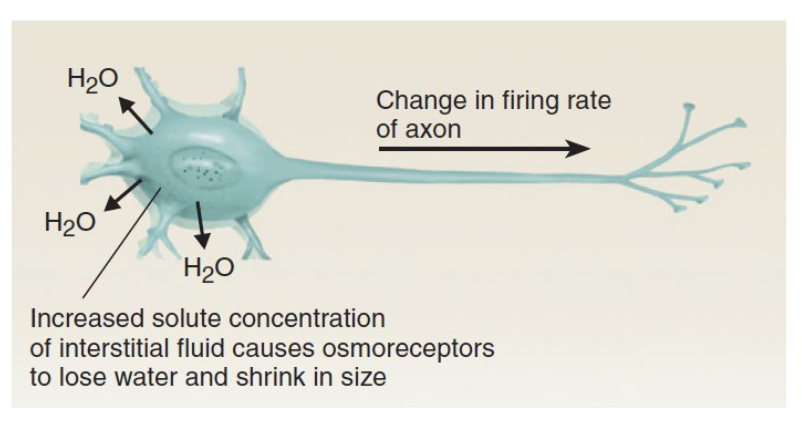
osmoreceptors
→ neurons whose membrane potential is sensitive to the size of the cell — whose release of neurotransmitters relates to the volume of the cell
ex. Hypertonic environment
volumetric thirst
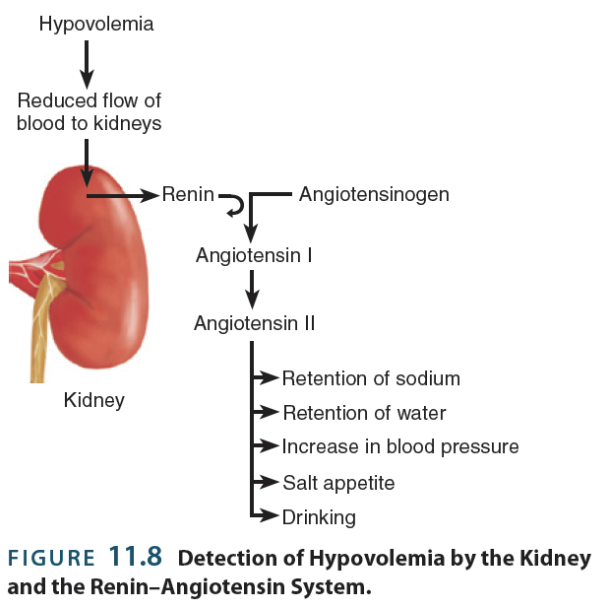
→ conscious thirst caused by not enough blood (liquid component) in circulatory system
Experienced after acute blood loss;
Low blood pressure triggers the release of renin → enzyme from the kidneys that initiates a cascade of chemical reactions to recover blood pressure
blood sugar
→ glucose levels managed by the pancreas and liver
Enzymes:
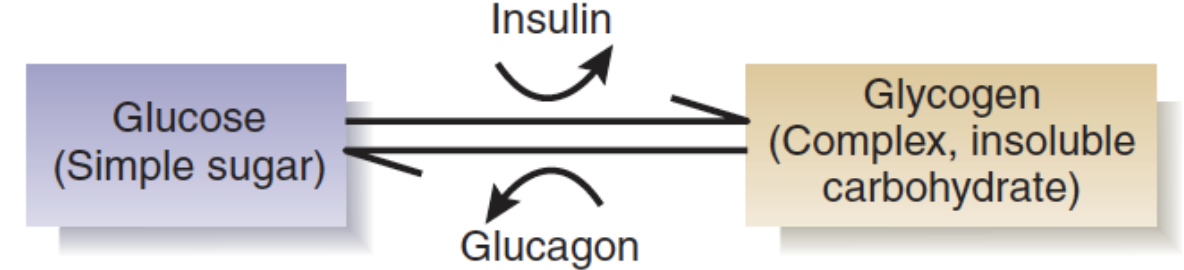
Insulin → pancreatic response to ↑ glucose levels — turns glucose into glycogen
Glucagon → pancreatic response to ↓ glucose levels — turns glycogen into glucose
Cellular absorption:
Glucose transporter → require insulin to function
Always accessible to the brain (prioritized for glucose)
NOT always accessible to cells outside the brain (past 2-hour mark after a meal, the body uses alternative energy sources)
glycogen
“animal starch” → short-term storage units of energy (glucose in liver and muscle cells)
Built up from eating (which triggers insulin release);
Stores up to 2000 calories
Depleted between meals
blood lipids
Storage:
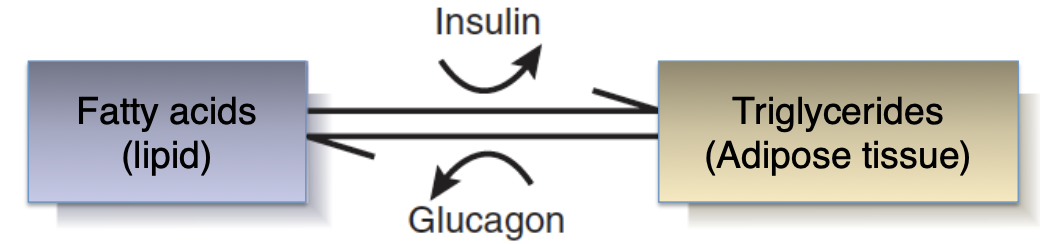
Adipose tissue (fat cells) → holds long-term storage units of energy;
Energy source:
Triglycerides → macromolecule (3 fatty acids + 1 glycerol) hydrolyzed for energy by glucagon
Fatty acids → converts into ketones via liver
Glycerol → converts into sugar via liver
energy usage
Absorptive phase → digestive system contains food → energy extracted via blood sugar system
Immediately uses short-term reservoir
Fasting phase → digestive system does NOT contain food → energy extracted via blood lipid system
Taps into long-term reservoir
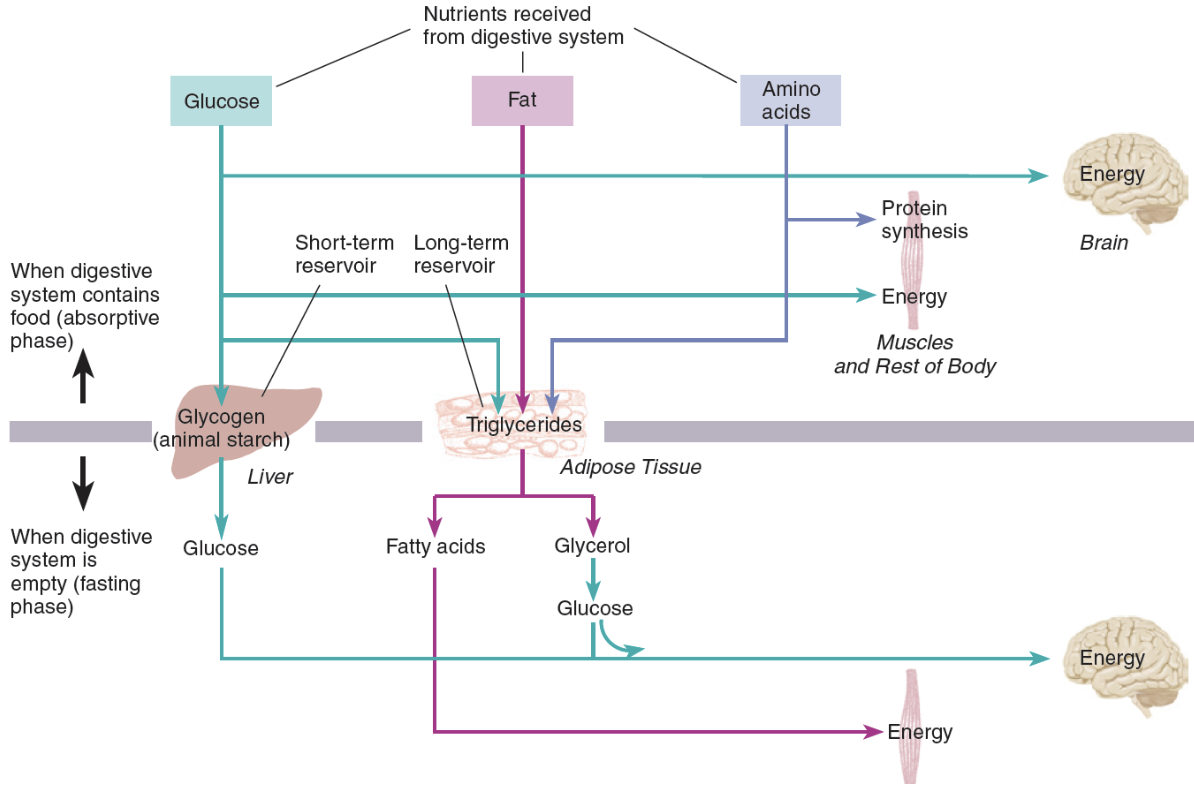
energy homeostasis system
→ IMO encapsulates how the body responds to hunger signals
Liver signals blood sugar levels up 10th cranial nerve (X - Vagus)
Stomach also releases interoceptive signals
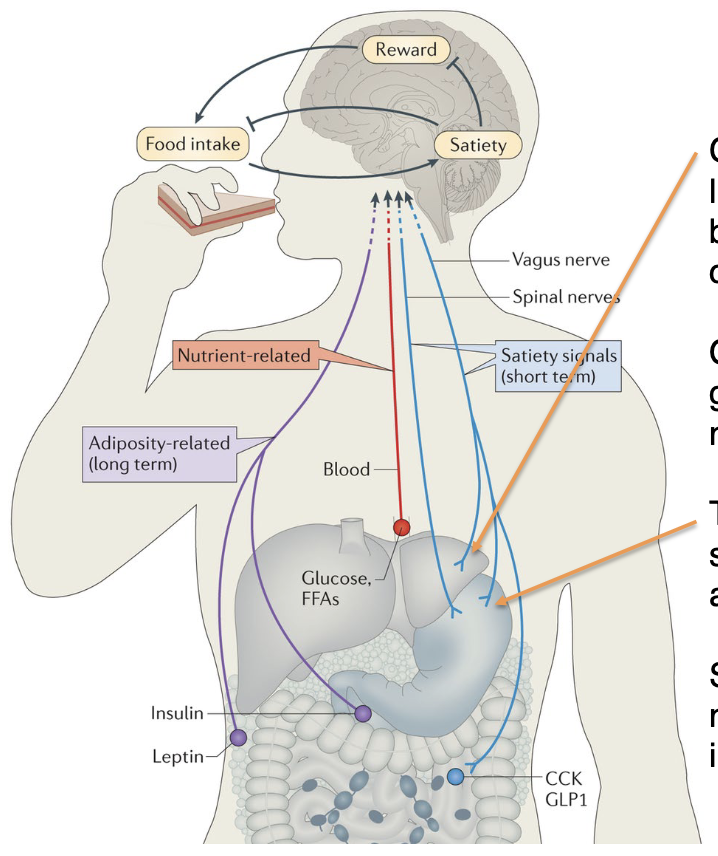
digestive enzymes
→ regulated by the hormones CCK & GLP-1, which elicits satiety in brain
Released from intestines in proportion to # of calories ingested
Exogenous hormone administration:
CCK → doesn’t reliably cause weight loss, but people respond with smaller meal size
GLP-1 → drug agonists proven to be highly effective in reducing hunger and weight
Initially developed to boost insulin signaling in diabetics
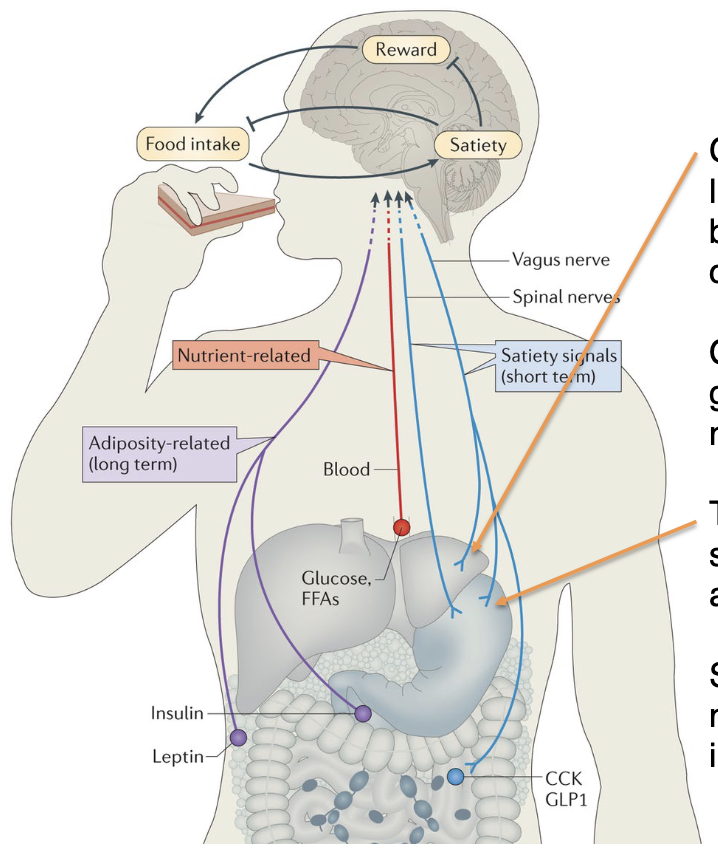
ghrelin
→ hormone/peptide responsible for (empty) stomach hunger signals
[ ] in circulation ↑ with hunger, ↓ with satiation
Exogenous administration: ↑ Hunger, therefore food intake
![<p>→ hormone/peptide responsible for (empty) stomach hunger signals</p><ul><li><p>[ ] in circulation ↑ with hunger, ↓ with satiation</p><p></p></li><li><p><u>Exogenous administration</u>: ↑ Hunger, therefore food intake</p></li></ul><p></p>](https://knowt-user-attachments.s3.amazonaws.com/290426a7-5836-41d2-924a-7953cca10775.png)
force-feeding
→ method to makes a healthy animal control its food intake + manages its long-term fat storage (i.e., the ability to last between meals)
Animal is force-fed to surpass its normal weight and reduce its hunger cravings
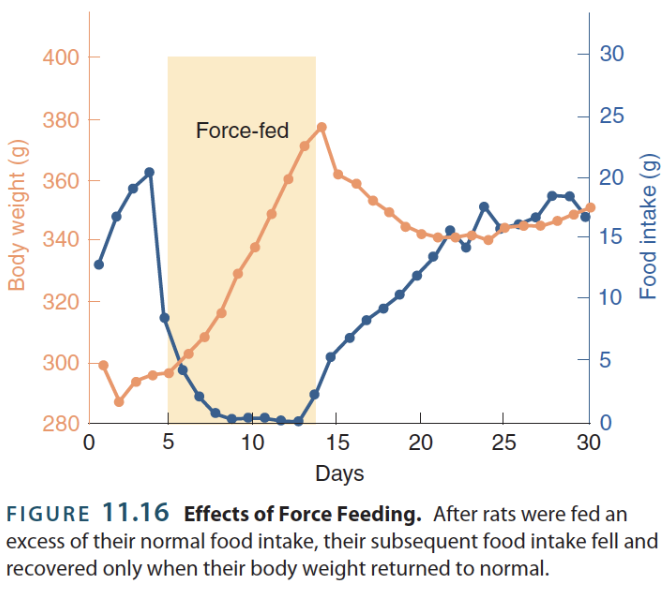
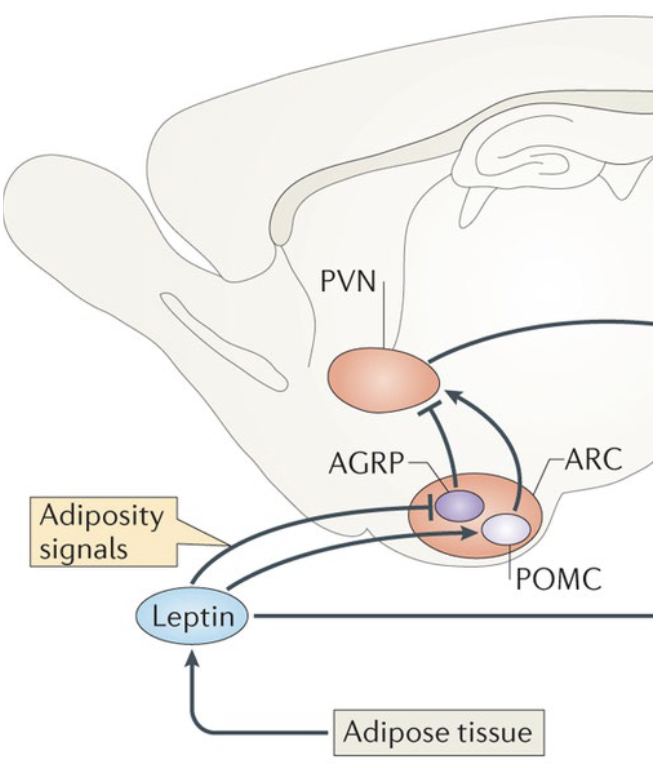
leptin
→ hormone/peptide secreted by fat cells (adipocytes) that take part in regulating the hypothalamic neurons to short-term satiety signals (ex. CCK & GLP-1)
Levels correlate with the amount of fat in an organism’s body (↑ w/ fat cell growth)
Intense hunger felt with low levels below some threshold
Exogenous administration: Short-lived effect to reduce meal size, but a lifesaver for people who can’t produce the hormone (due to congenital leptin deficiency)
Left untreated leads to extreme obesity (ex. Ob mouse)
emergency hunger circuits
→ activated when a critical need (either to eat or not) overrides energy homeostasis circuitry
Glucoprivation (hypoglycemia) → dangerously low sugar levels (due to not enough glucose immediately available in blood)
Can result from excessive insulin signaling or inhibitory drugs
Lipoprivation → dangerously low fat levels (due to not enough fat on body or free lipid monomers in blood)
Can result from inhibitory drugs
emergency hunger
→ refers to when the brain senses dangerous low energy stores and launches a remedy cascade of effects:
Insulin suppressed + glucagon triggers
Short-term satiety overridden
Energy expenditure (basal metabolic rate) slows
Hormones halt
Potent and sustained feeling of hunger takes hold
diabetes
→ condition related to poor insulin usage
Type I → insufficient insulin production/release
Type II → poor insulin absorption (insensitive to insulin signalling)
Consequences:
↑ Blood sugar
Chronic inability to store glucose as fat
Leads to intense thirst and progressive weight loss
↓ Leptin levels, leading to lipoprivation
hypothalamus
→ key regulator of hunger part of the midbrain
2 significant cell populations in arcuate nucleus w/ opposing effects:
AGRP/NPY → neurons that promote hunger
Activated by ghrelin
Inhibited by leptin
POMC → neurons that inhibit hunger
Activated by leptin
Inhibited by ghrelin
Both project to PVN
paraventricular nucleus
PVN → nucleus in the hypothalamus who responds to
May stop firing when the body has dangerous low levels of fat (leptin effect)
Exogenous intervention: Doesn’t reliably influence hunger, but can inhibit some cells that generate an intense hunger (lipoprivation response)
prader-willi syndrome
→ condition resulting from abnormality w/ chromosome 15 (up to 7 genes deleted)
1 of the 7 abnormal genes is critical for the PVN neurons
Lifespan:
Birth: Low muscle mass, little interest in eating
2-8 years: Heightened, permanent, painful sensation of hunger (feeling of starving death)
People of this disorder have no sensations of satiety, so they’re ultra-susceptible to struggling with extreme obesity consequences
30 years: Average life expectancy in the US, deaths usually related to obesity-related causes
obesity
→ modern pandemic that plagues the US (boohoo)
50% of variability in people’s body fat is due to genetic variation
Especially differences in metabolic efficiency
The world is changing faster than humans are evolving, so people’s hereditary background isn’t always well-suited to the current food environment
There’s also a hedonic aspect to food because it’s so delicious…but a lot of people lack self-control
Some people think about food constantly, even with sufficient stores of energy…chat that’s addiction
Current bariatric neuroscience studies surround gut hormones (ex. GLP-1)
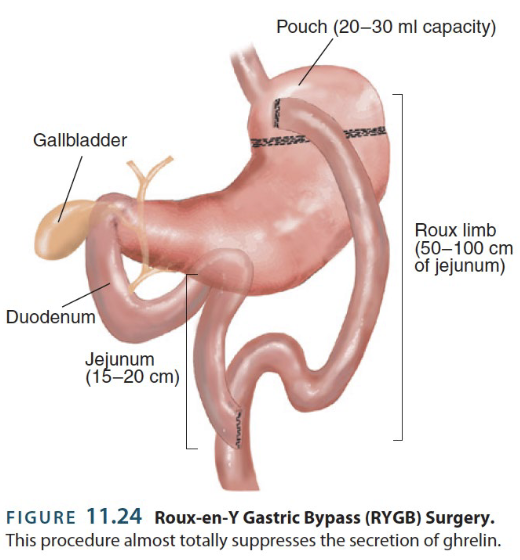
roux-en-y gastric bypass
RYGB surgery → surgical treatment for obesity that involves mechanically limiting the amount of food that can be eaten from a meal (by modifying the GI)
Jejenum (2nd part of small intestine) is cut and attached to top of the stomach
Stomach is stapled
Effectiveness: Reductions in hunger overtime (but they don’t seem to be related to hormonal differences)