5. B-CELLS & T-CELLS (IMMUNO)
 Call Kai
 Learn
Learn Practice Test
 Spaced Repetition
 Match
Match Flashcards
 Knowt Play
1/21

There's no tags or description
Looks like no tags are added yet.
Name | Mastery | Learn | Test | Matching | Spaced | Call with Kai | Chat |
|---|
No analytics yet
Send a link to your students to track their progress
22 Terms
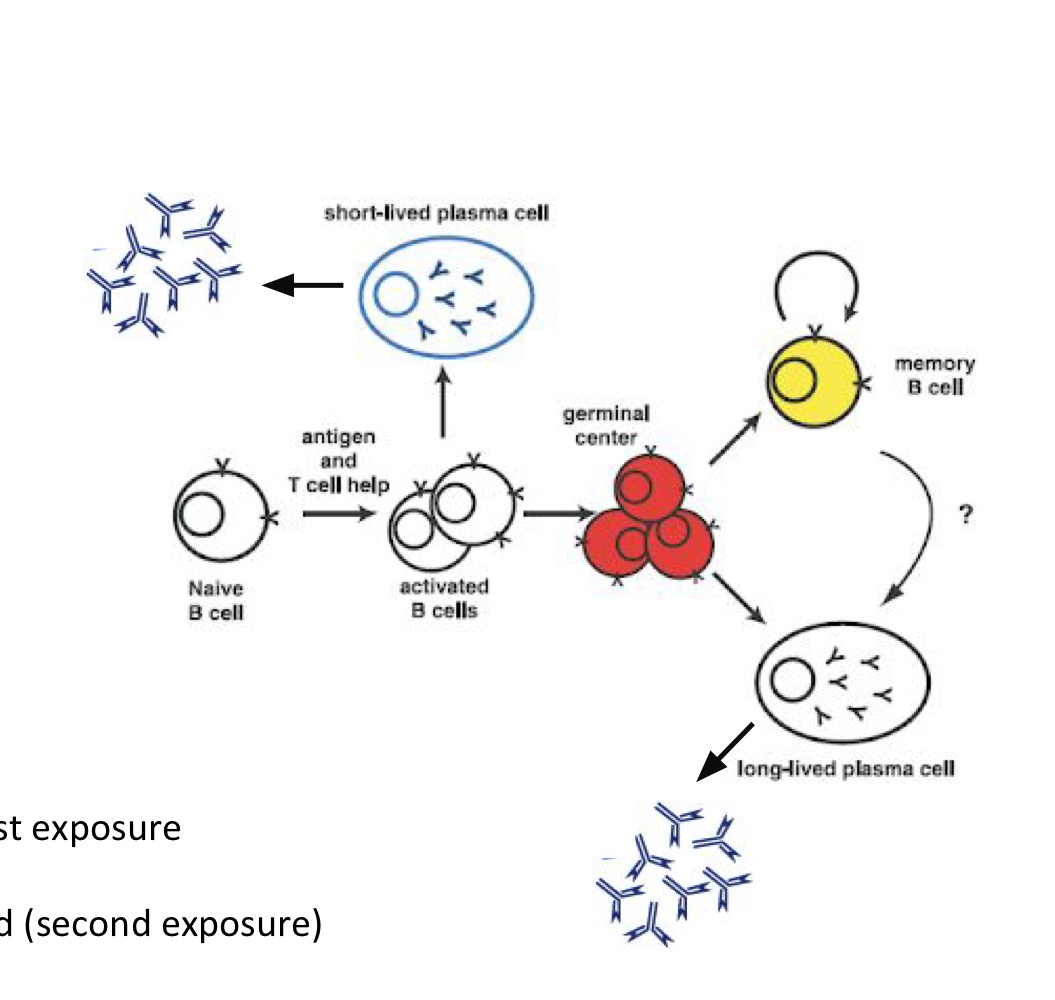
(Slide #1). B-Cells: (CD19 + cells) → Selected clone w/ differenciate + divide into?
1. Plasma cells
A. Short lived plasma cells
Circulating → 60% of plasma cells
Produce antibody, 2,000/sec
Role to clear CURRENT infection
B. Long lived plasma cells
Return to and reside in Bone Marrow
Half ½ life greater than 6 months (last a while, but not entire lifetime)
Continuous synthesis of antibody
Antibody titers/vaccine effectiveness/past exposure
Shared w/ fetus
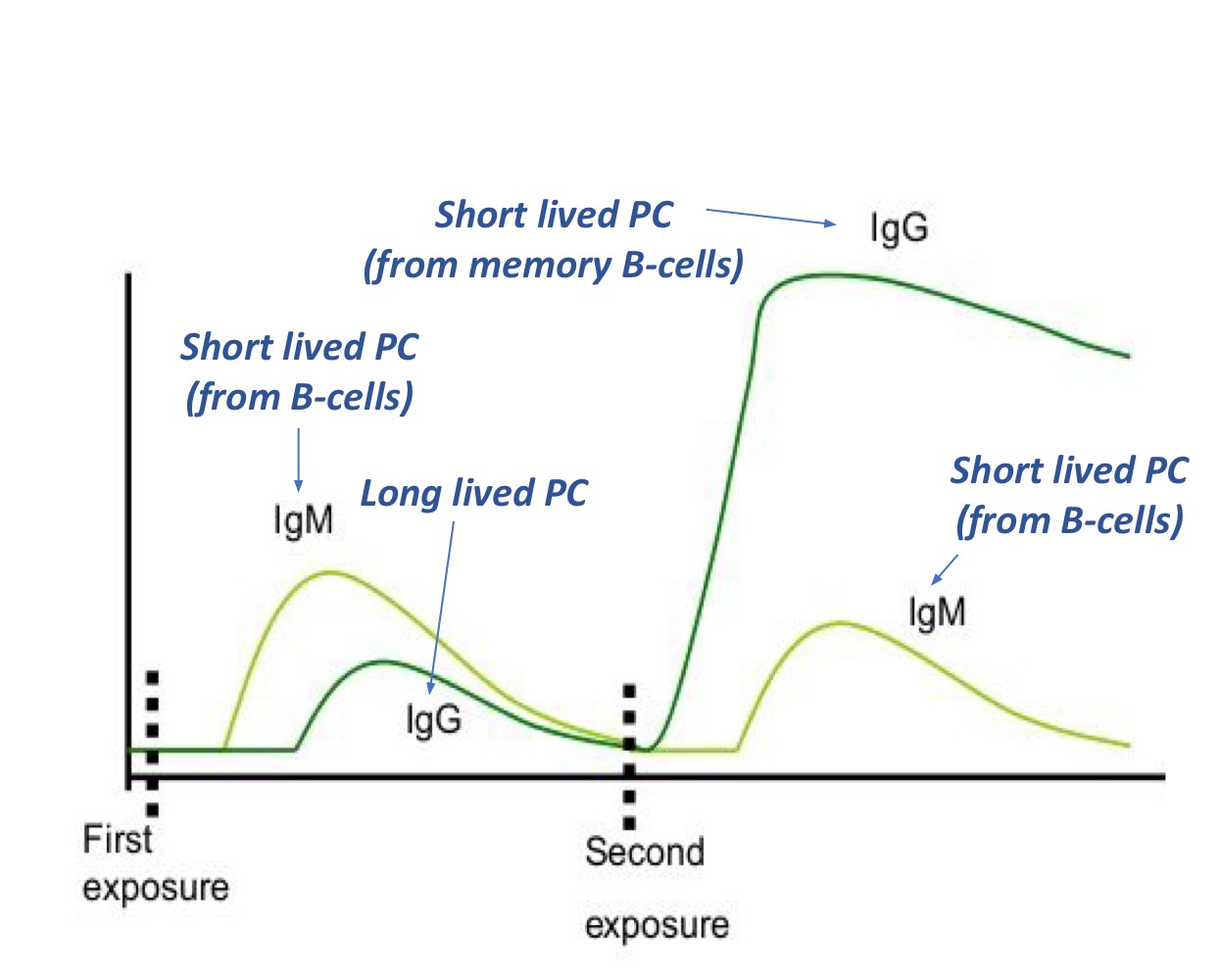
Allows for rapid antibody binding if re-infected (second exposure)
2. Memory B-cells for (future infections)
(Slide #1). B-Cells: (CD19 + cells) → What are the 2nd type of cells?
Memory B-Cells
Require re-stimulation to differentiate and divide (to produce antibody)
(Into short lived PC, long lived PC and more memory cells)
Half-life of 5 years
Produce + secrete antibodies (or IMMUNOGLOBULINS)
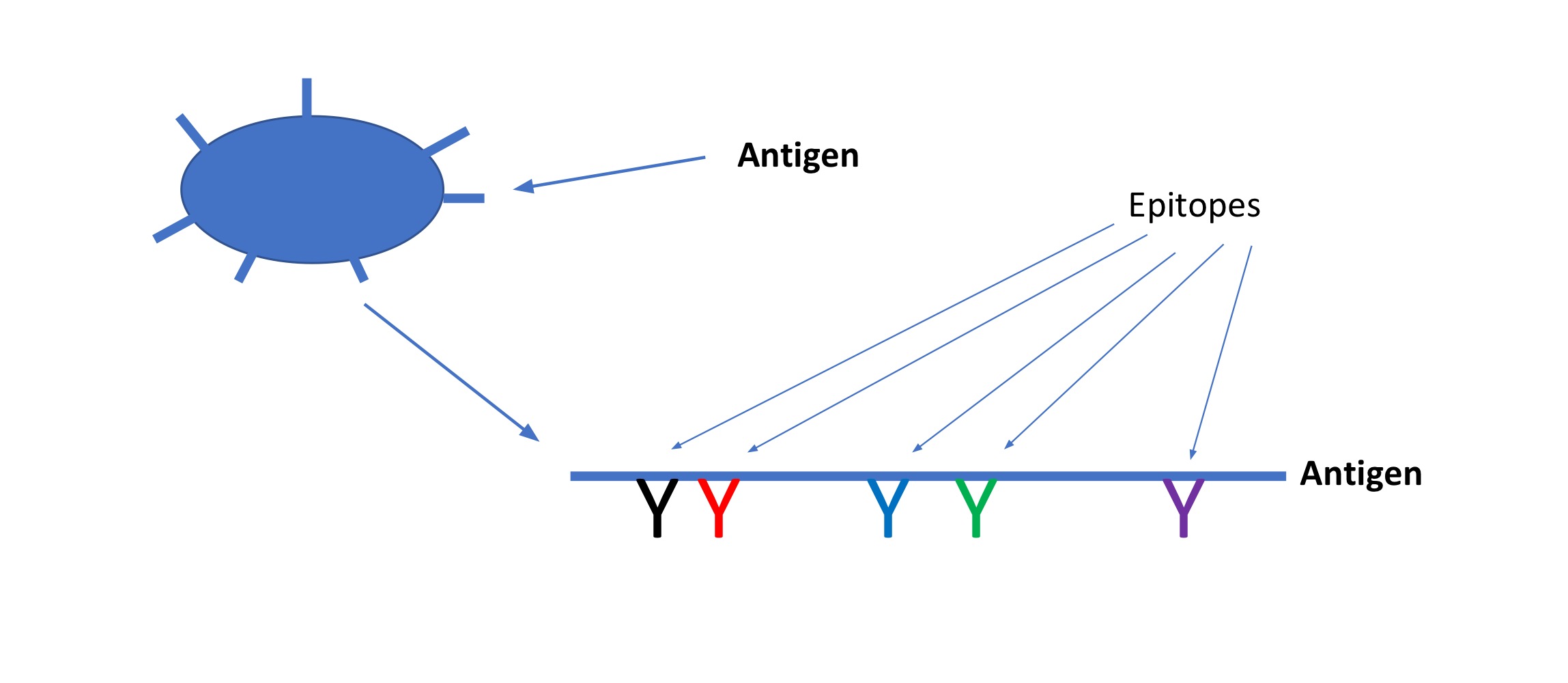
Recognize antigens, more specifically EPITOPES (part of an antigen)
(Region of antigen that antibody recognizes- typically region of 5-26 AA)
An antigen will typically contain may epitopes where antibodies can bind
Idiotype - what binds to the EPITOPE/ANTIGEN
(Slide #2). B-Cells: Produce and secrete what?
Produce + secrete antibodies (or IMMUNOGLOBULINS)
Recognize antigens, more specifically EPITOPES (part of an antigen)
(Region of antigen that antibody recognizes- typically region of 5-26 Amino Acids)
An antigen will typically contain many EPITOPES where antibodies can bind
Idiotype - what binds to the EPITOPE/ANTIGEN
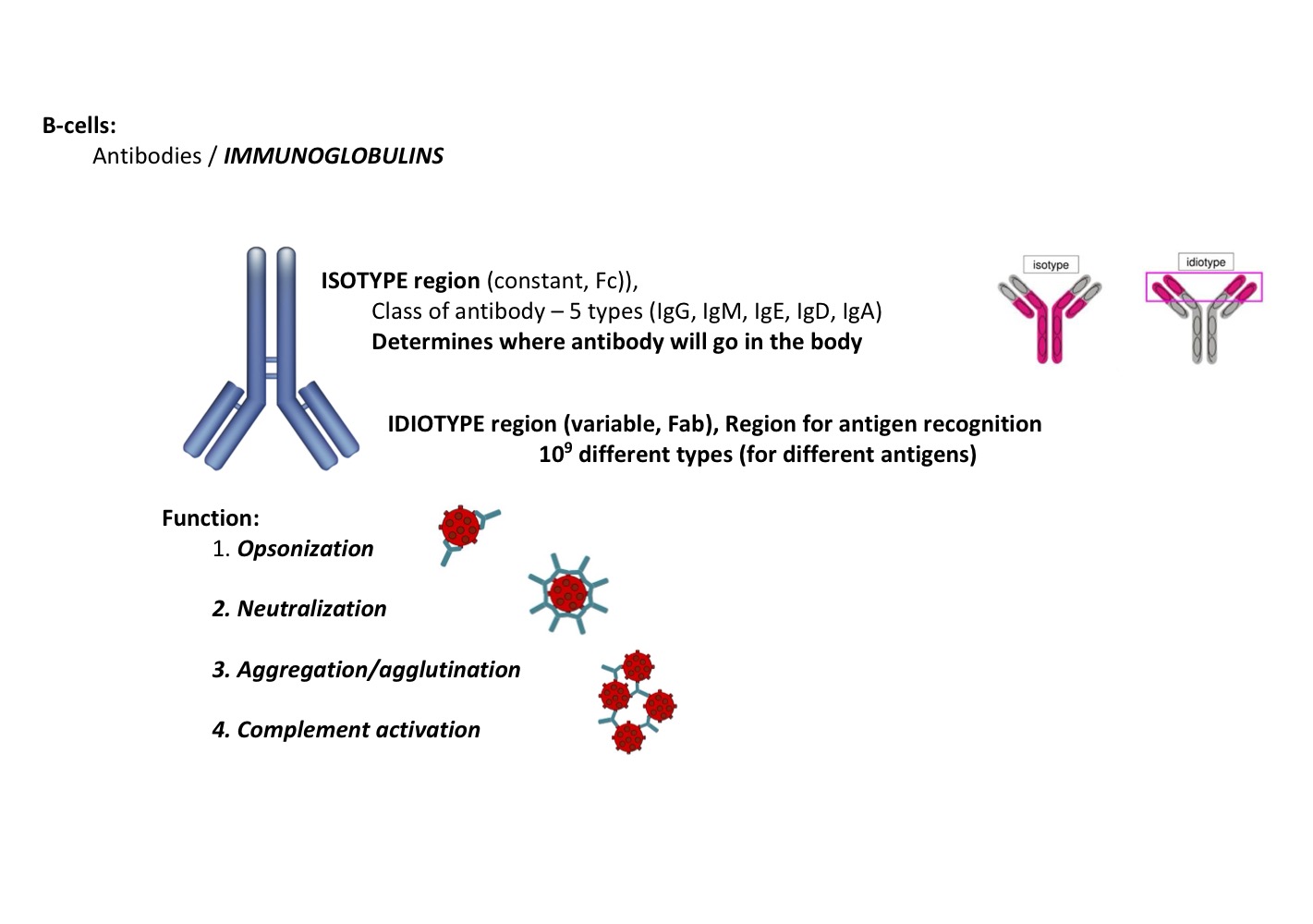
B-CELLS: ANTIBODIES/ IMMUNOGLOBULINS
ISOTYPE region → (a more constant region, Fc)), → what can stick to more different type (NOT binding to antigens)
→ ( Class of antibodies = 5 Types
→ Ex: IgG, IgM, IgE, IgA, IgD) → they come from Short-lived plasma cells (Dr. L)
IDIOTYPE region (variable, Fab)
Region for antigen recognition 10^9 different types (for different antigens)
FUNCTION:
1. Opsonization
2. Neutralization (takes a lot of antibodies to do this)
3. Aggregation/agglutination
4. Complement activation
EX: (Dr. L) → Coughing only on the mucosal surface area, killing → will have isotype like IgA -= musical antibody or if its something in my bloodstream → will actually produce IgG or IgM
Systemic = when a pt goes into sepsis (multi-organ failure)
B-CELLS: What are the types of ANTIBODY ISOTYPES?
IgM:
Antibody produced following FIRST EXPOSURE to antigen (pathogen)
Circulating (blood, extracellular fluid)
Also bonds to surface of B-cell (B-cell receptor)
(Higher on immature B-cells)
Pentameter
IgG:
Antibody produced by memory cells (that become short-lived plasma cells) → during FUTURE EXPOSURES to same antigen → lives in BONE MARROW
Circulatory (blood, extracellular fluid)
Produced by long-lived plasma cells (long-term antibody titers)
75% of antibodies in blood
Can cross the placenta (99% of antibodies in infant after birth, last 6 months)
Four classes: IgG1 for proteins, IgG2 for polysaccharides, IgG3 for proteins, IgG4 for food allergens)
B-CELLS: What are the types of ANTIBODY ISOTYPES?
IgA:
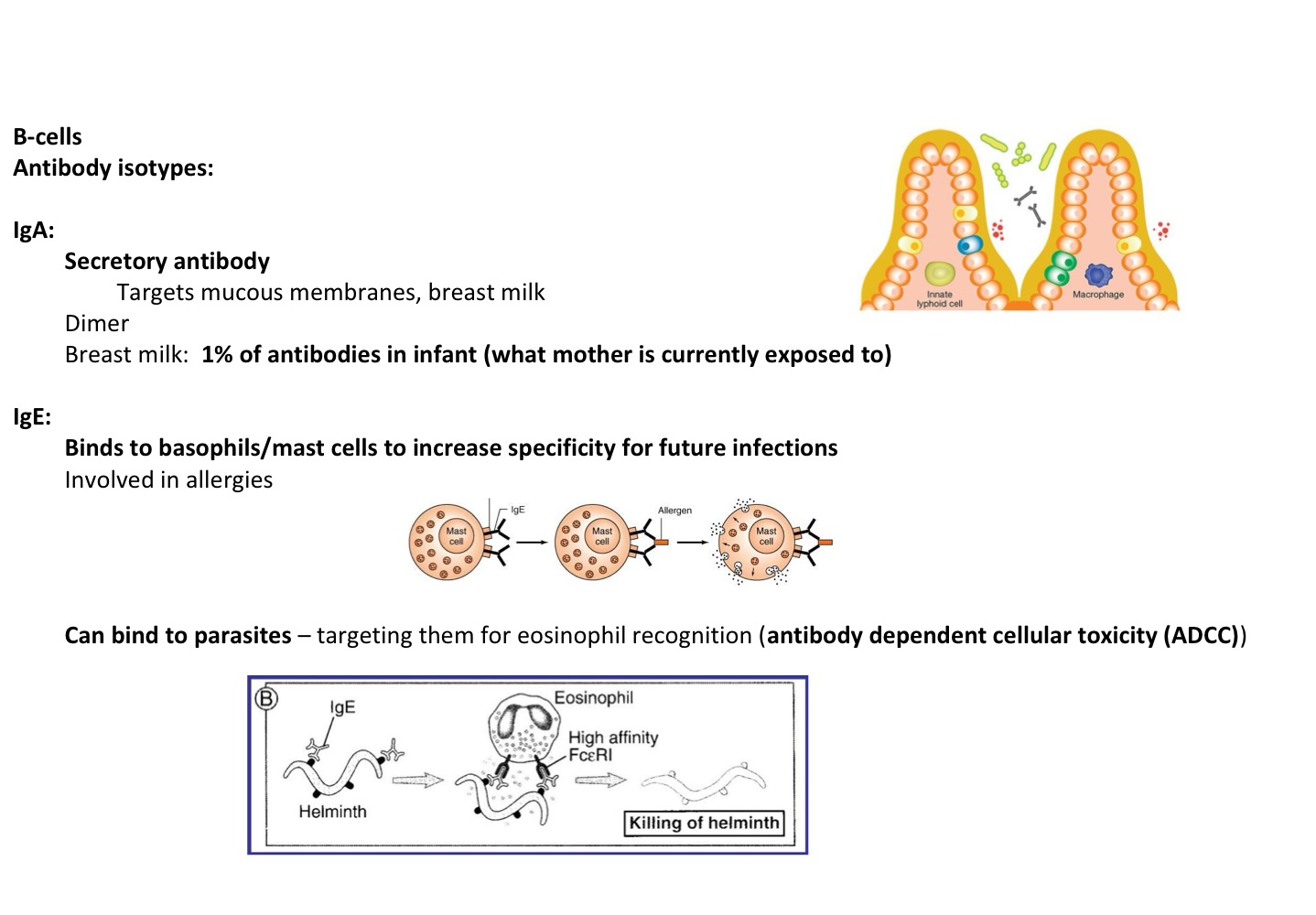
Secretory Antibody
Targets mucous membranes, breast milk Dimer:
Breast milk: 1% of antibodies in infant (what mother is currently exposed to)
IgE:
Binds to basophils/mast cells to increase specificity for future infections → involved in allergies
Can bind to parasites → targeting them for eosinophil recognition (antibody dependent cellular toxicity (ADCC))
Babies are born with antibodies, but they don’t replicate
B-CELLS: What are the types of ANTIBODY ISOTYPES?
IgD:
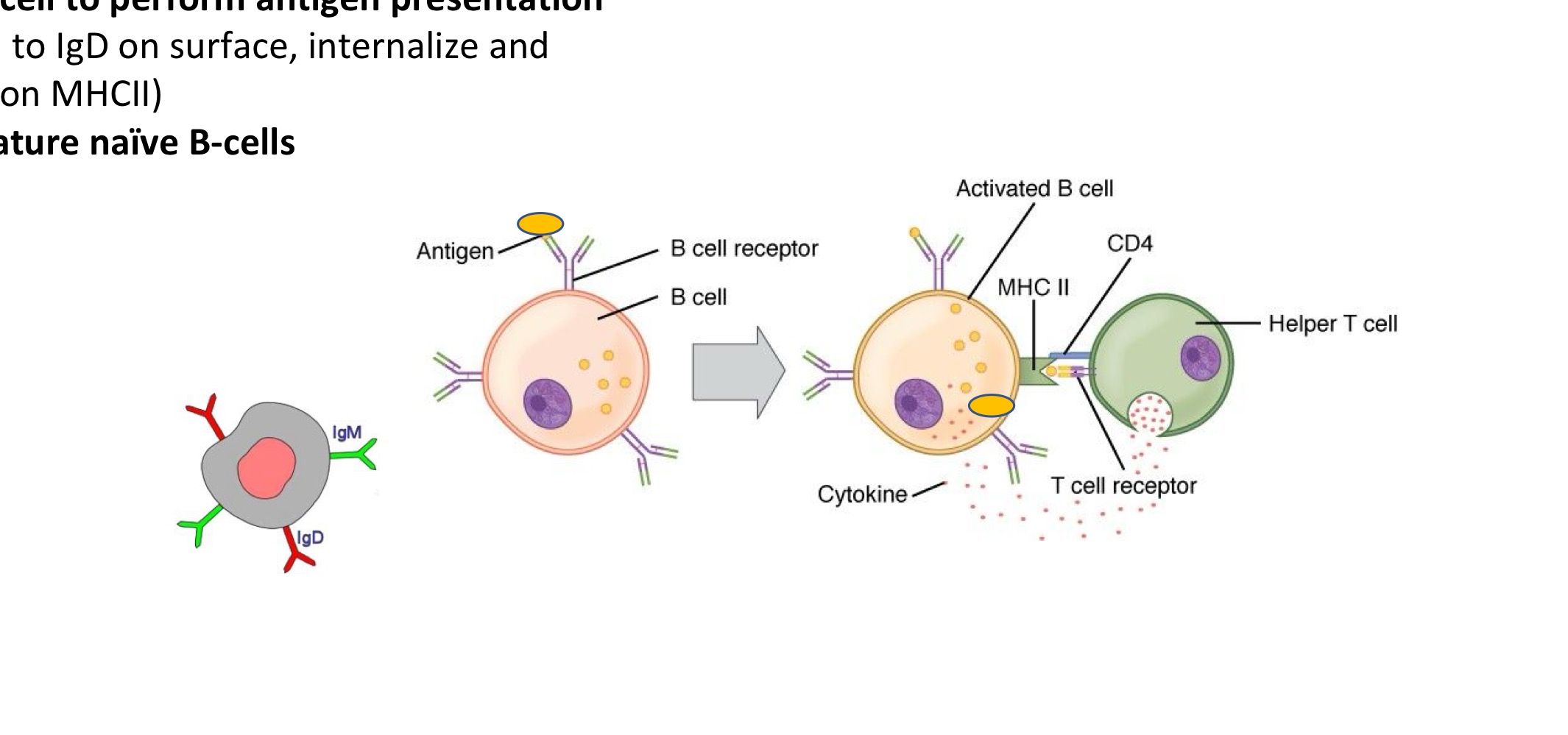
B-cell receptor
For B-cell recognition + activation
Allows for B-cell to perform antigen presentation
(Bind antigen to IgD on surface, internalize + digest, place on MCH II)
Higher on mature naive B-cells
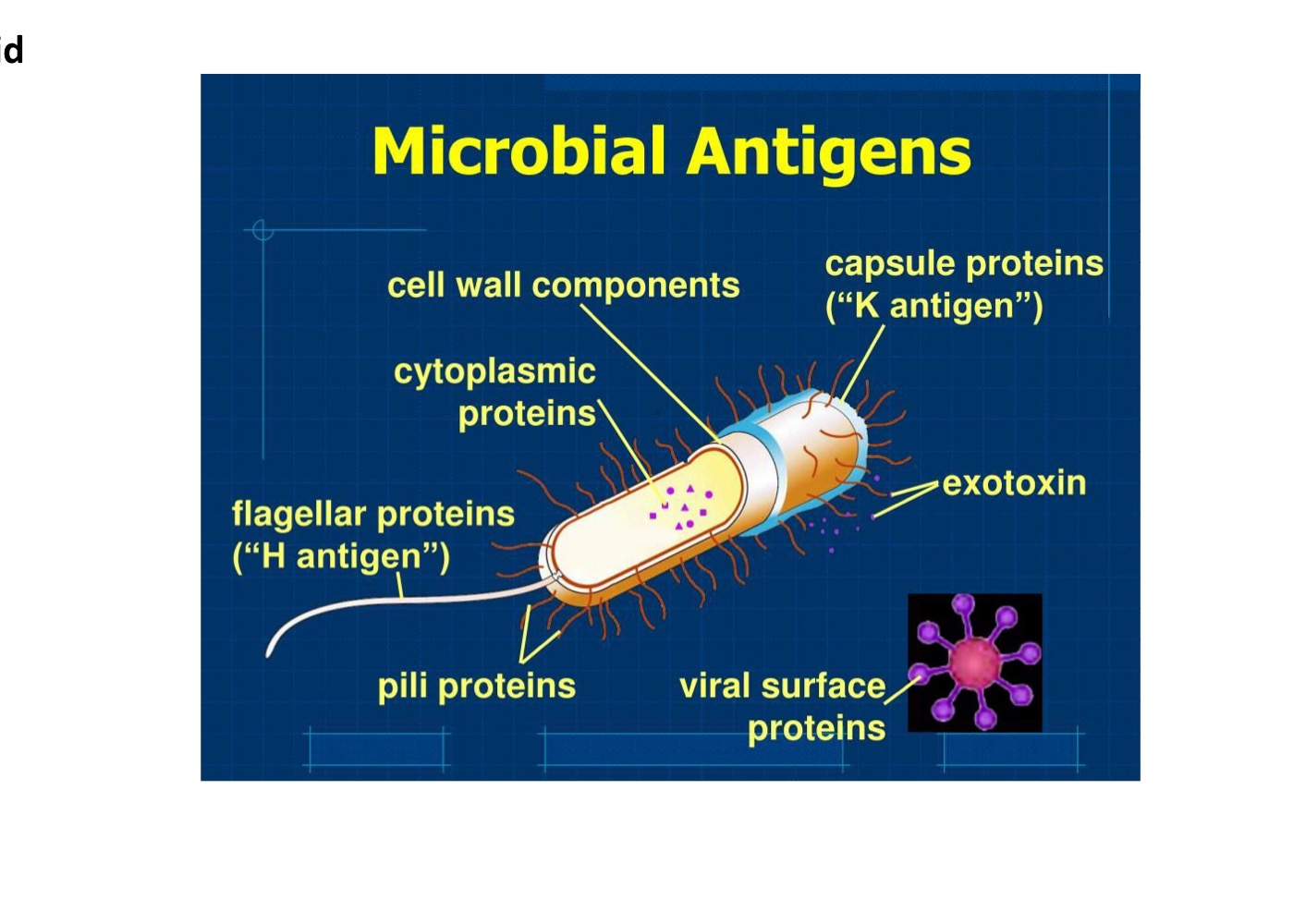
(Slide #7). What are the types of Antigens?
Proteins/Peptides
Lipids (ex: Bacterial lipopolysaccharide membrane)
Sugars (ex: Polysaccarhride capsule of bacteria)
Nucleic Acid
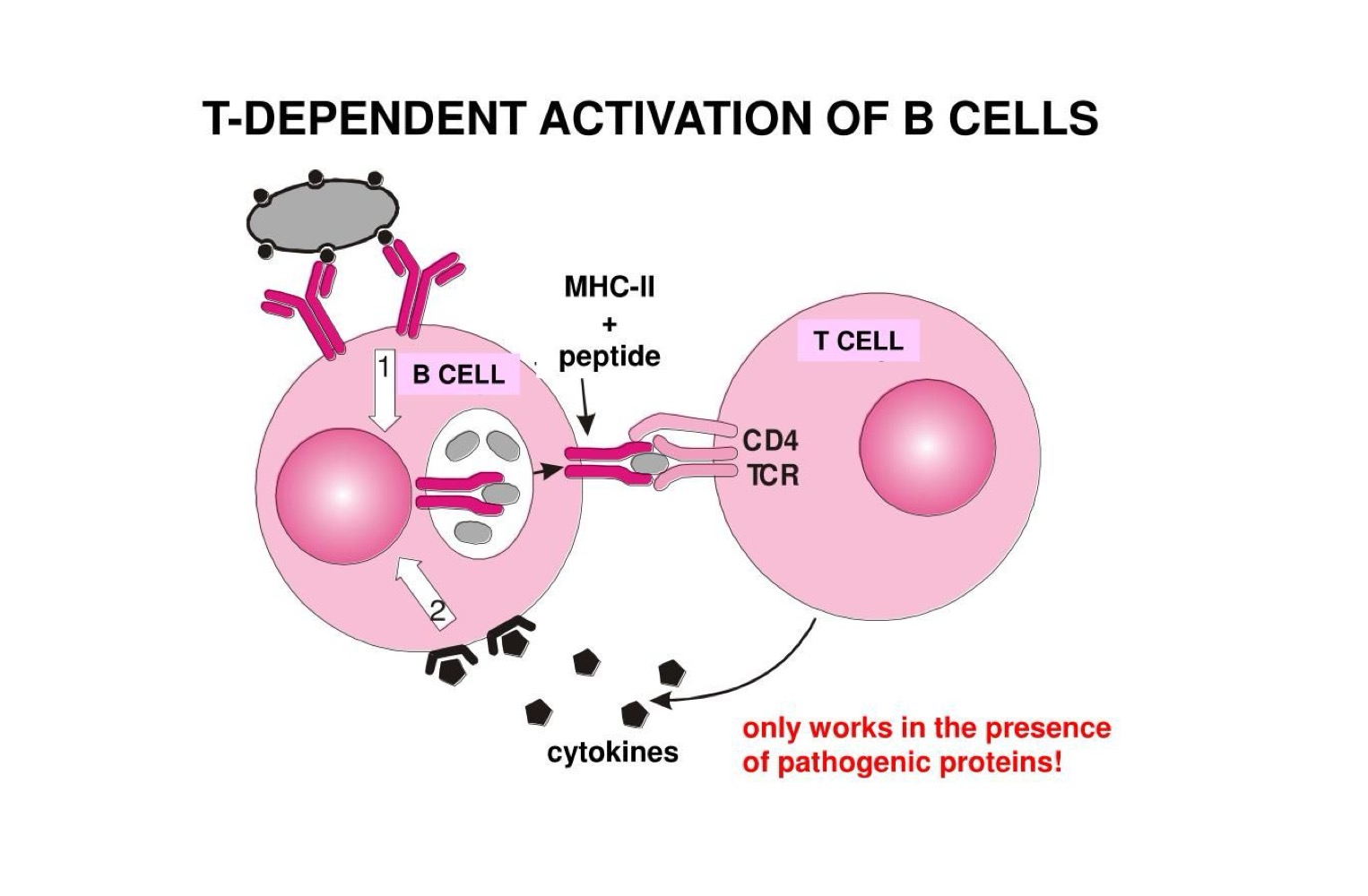
What are Protein Antigens (B-cells)?
B-cell presentation through antigen presenting cell/MCHII (2) to T-helper Cell
B-cells produce IgM/IgG or other antibodies
Memory B-cells formed
What are Non-Protein Antigens (Lipids/Sugars) for B-cells?
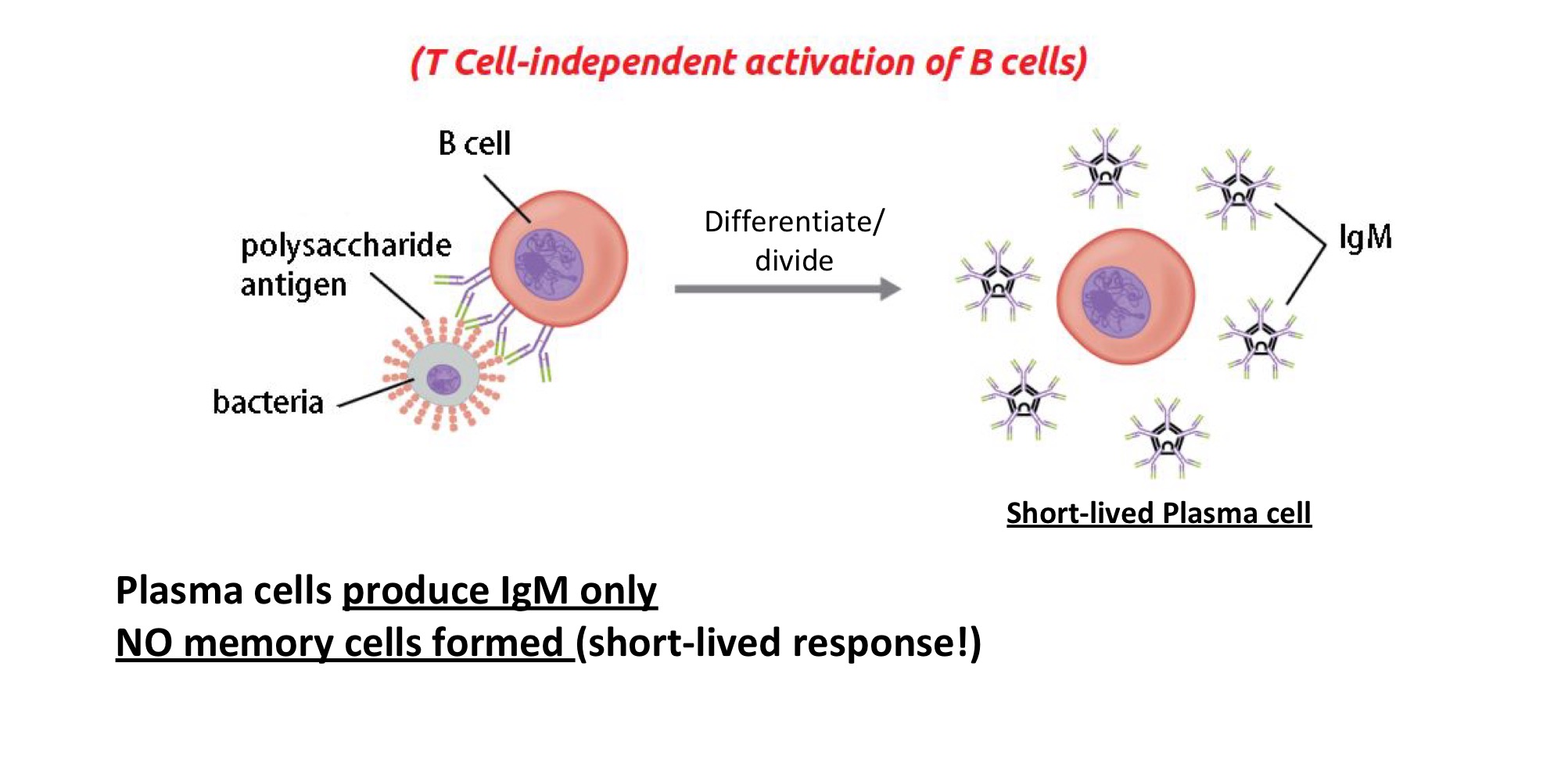
Antigen binds directly to B-cell receptor → (IgD, maybe IgM) → leads to cross-linking of B-cell receptors
Directly activates the B-cell (w/o any antigen presentation) + differentiates into → SHORT-LIVED PLASMA CELLS
Plasma cells produce → IgM (ONLY)
NO memory cells formed (SHORT-LIVED RESPONSE!)
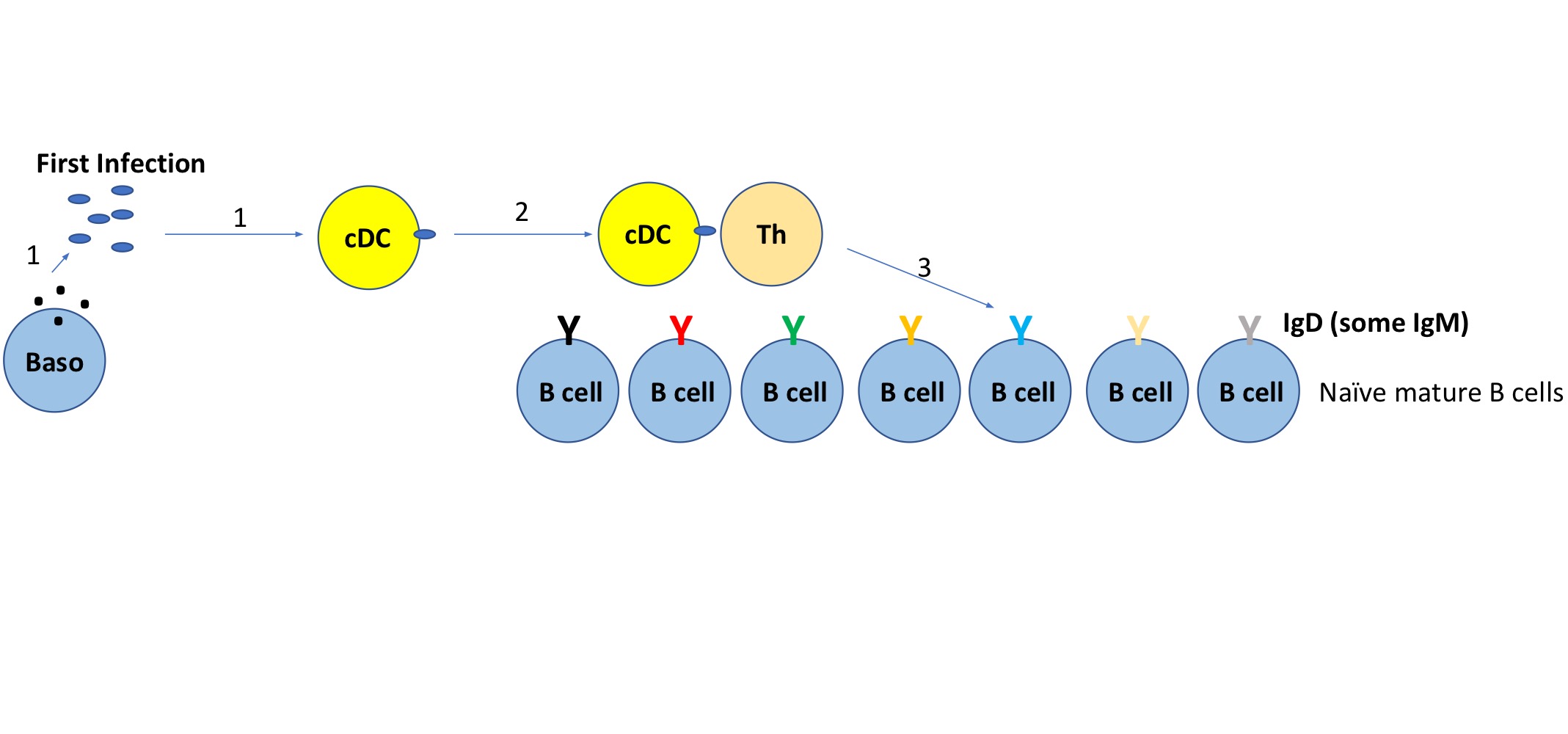
What happens during FIRST INFECTION?
SLIDES 10-18
What happens with FOOD SENSITIVITY & FOOD ALLERGIES?
Food sensitivity / intolerance:
IgG / IgA responses
Delayed response (hours to days)
45% population
Ex: Gluten
Food Allergies:
IgE responses Delayed response
Immediate response
2% adults / 6-8% children
Ex: peanut, shellfish, eggs
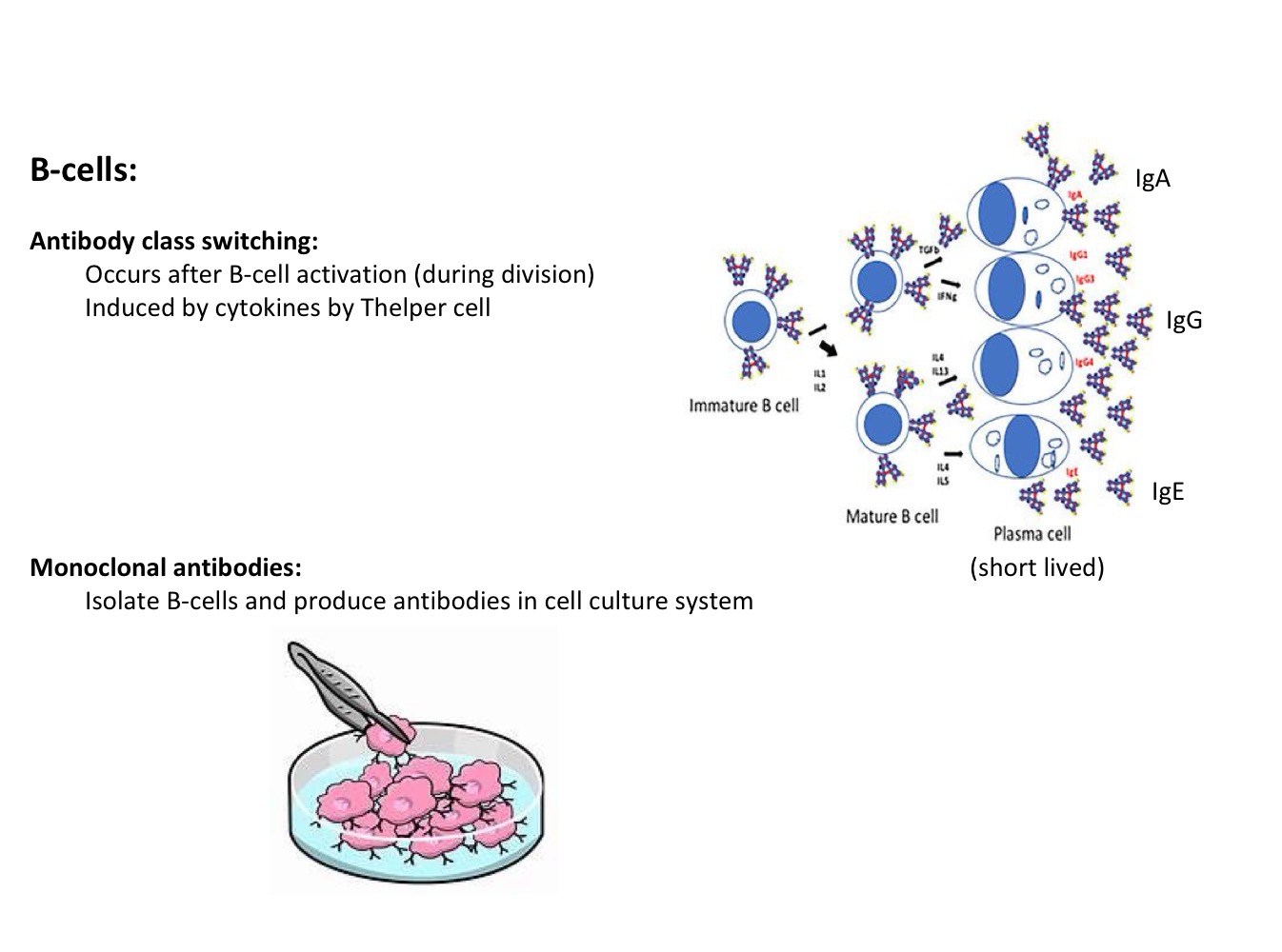
(Slide #20). B-Cells: What kind of Switching and what kind of antibodies?
Antibody class switching:
Occurs after B-cell activation (during division)
Induced by cytokines by T-helper cell
Monoclonal antibodies:
Isolate B-cells and produce in cell culture system
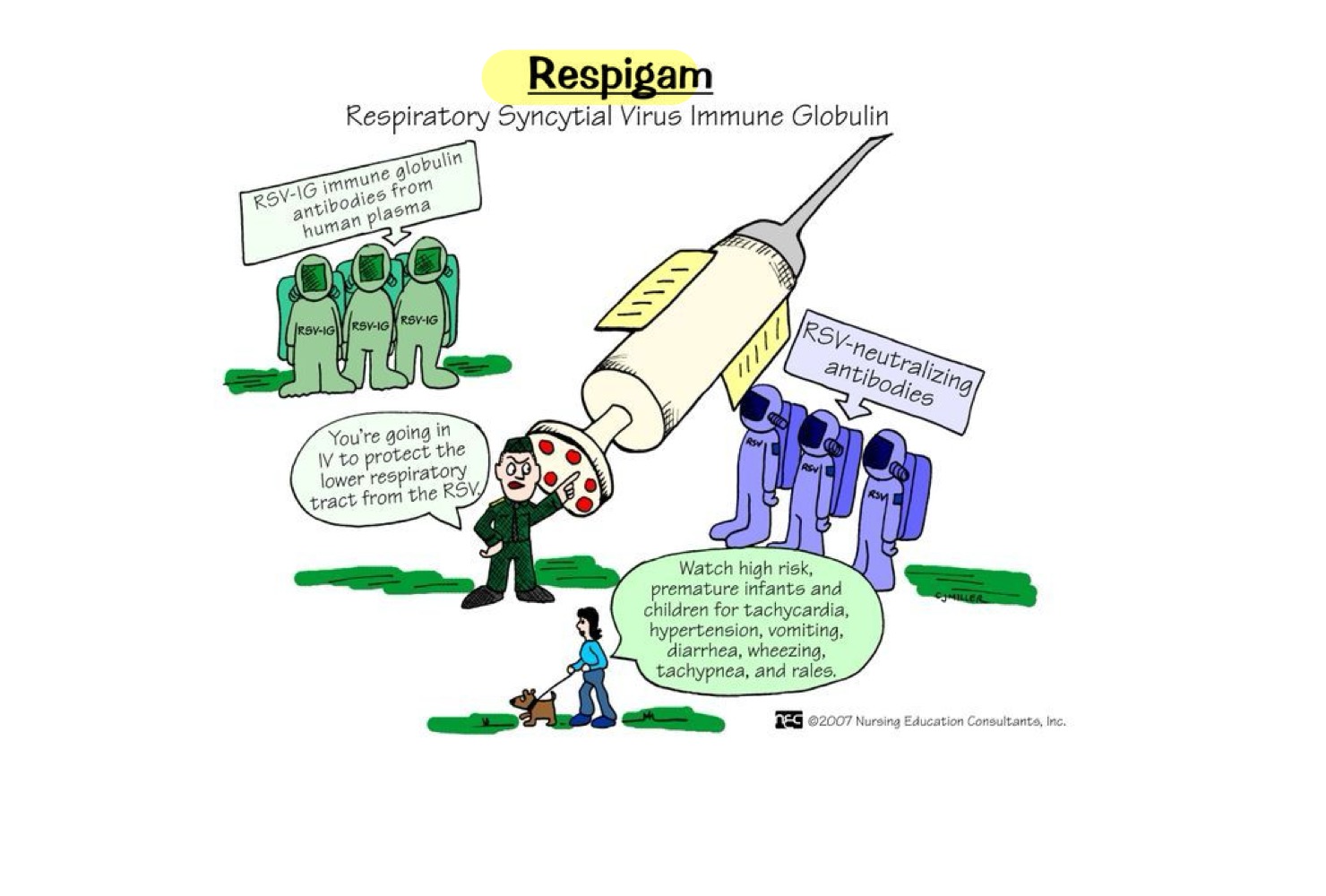
B-cells: What is Gamma Globulin Therapy
Treating a patient by injection of antibodies to a specific antigen
Typically IgG
Typically lasts 3-6 months
Ex: Respiratory Syncytial Virus (RSV), Measles, SARS-CoV2, Rh factor
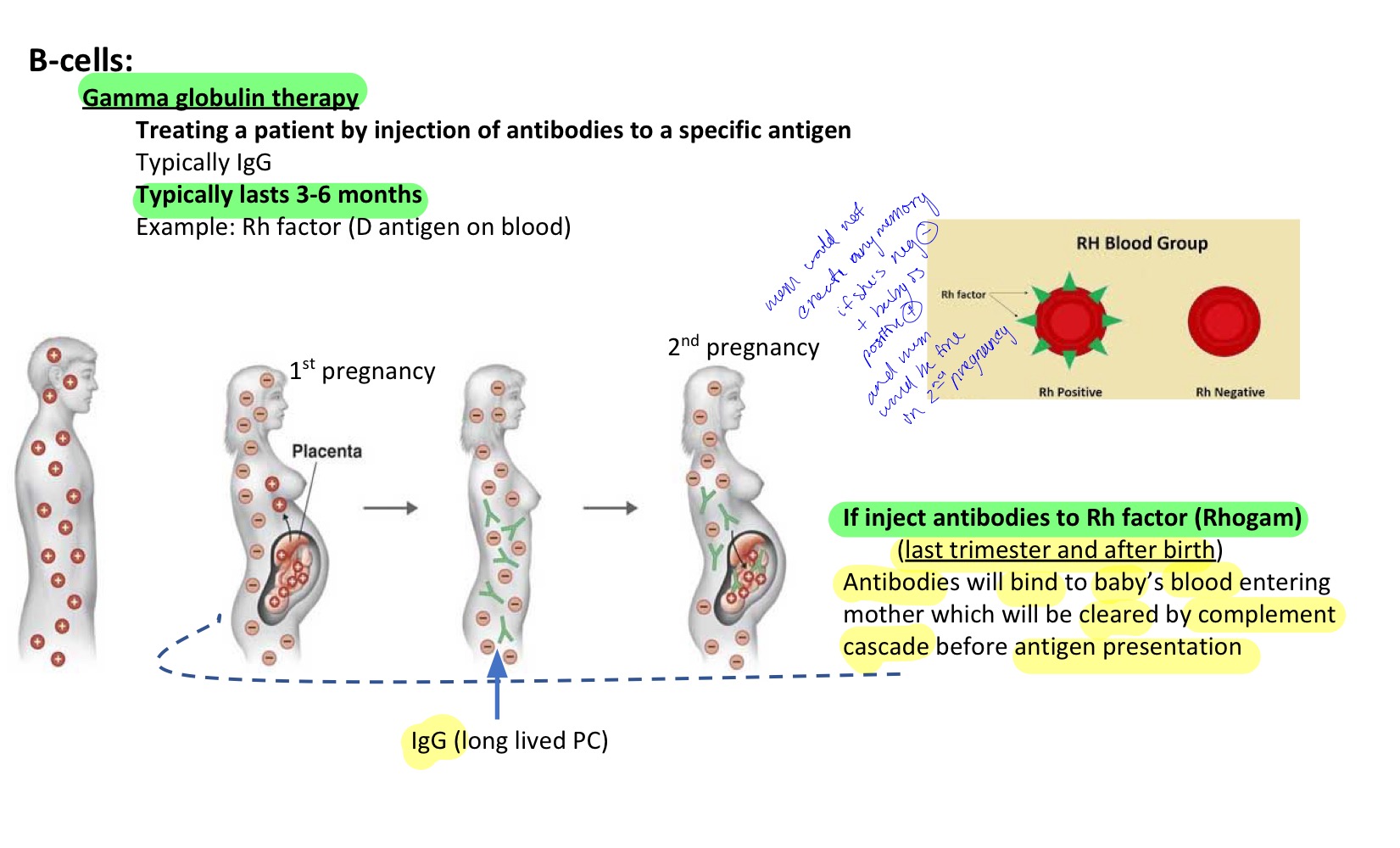
B-Cells: Gamma Globulin Therapy→ What happens during pregnancy?
Treating a pt by injection of antibodies to a specific antigen Typically IgG → (crosses the placenta)
Ex: Rh factor (D antigen on blood)
If inject antibodies to Rh factor (Rhogam)
(Last trimester (3 months + after birth)
Antibodies will bind to baby’s blood entering mother which will be cleared by complement cscade before antigen presentation.
IgG (long lived PC)
It’s going to take 2 wks to get that immune system for the infants
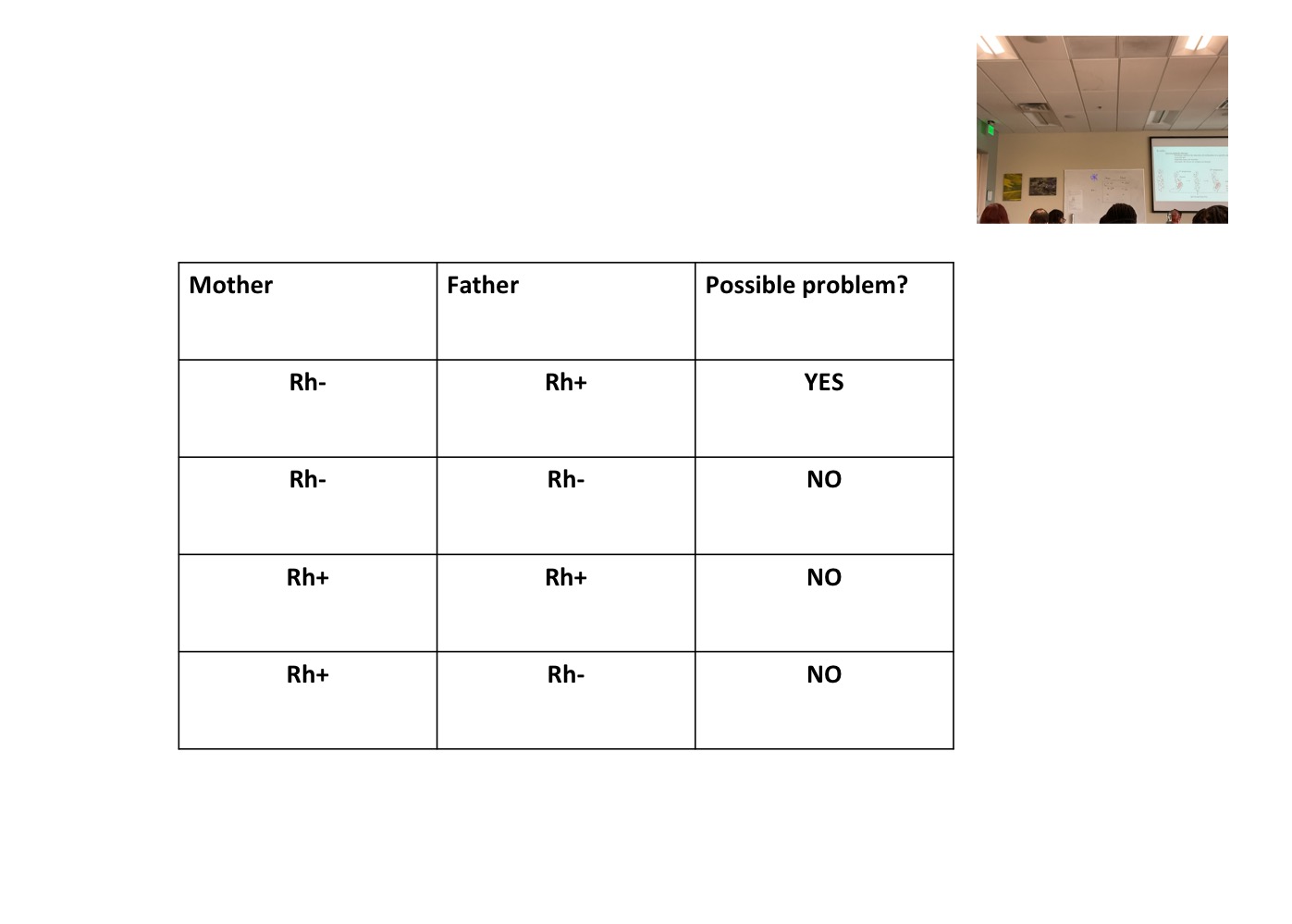
Possible problem of Rh- or Rh+ ?
Look @ chart
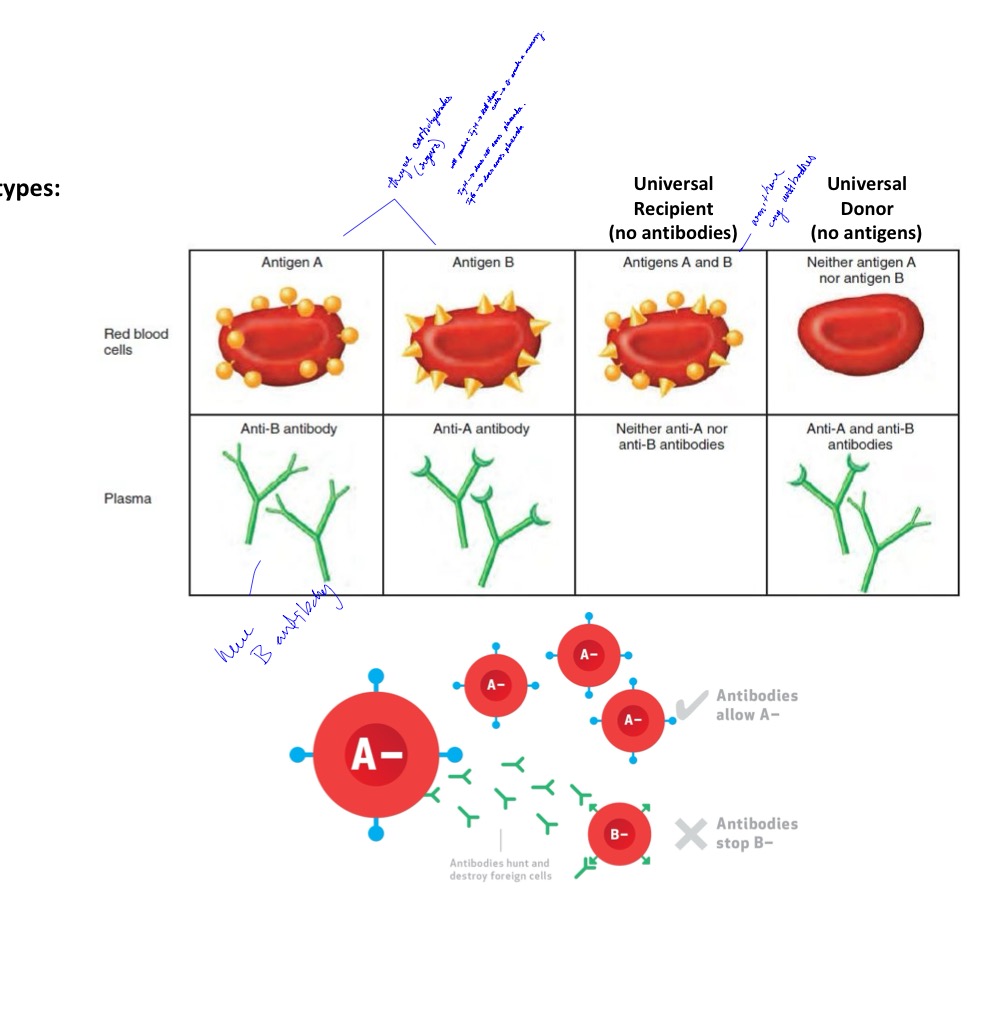
What are blood types?
Red Blood Cells:
Antigen A
Antigen B
Antigen A & B → (universal Recipient = NO antibodies
Neither Antigen A nor Antigen B → (Universal Donor = NO antigens)
Plasma:
Anti-B antibody
Anti-A antibody
Neither anti-A nor anti-B antibodies
Anti-A & anti-B antibodies
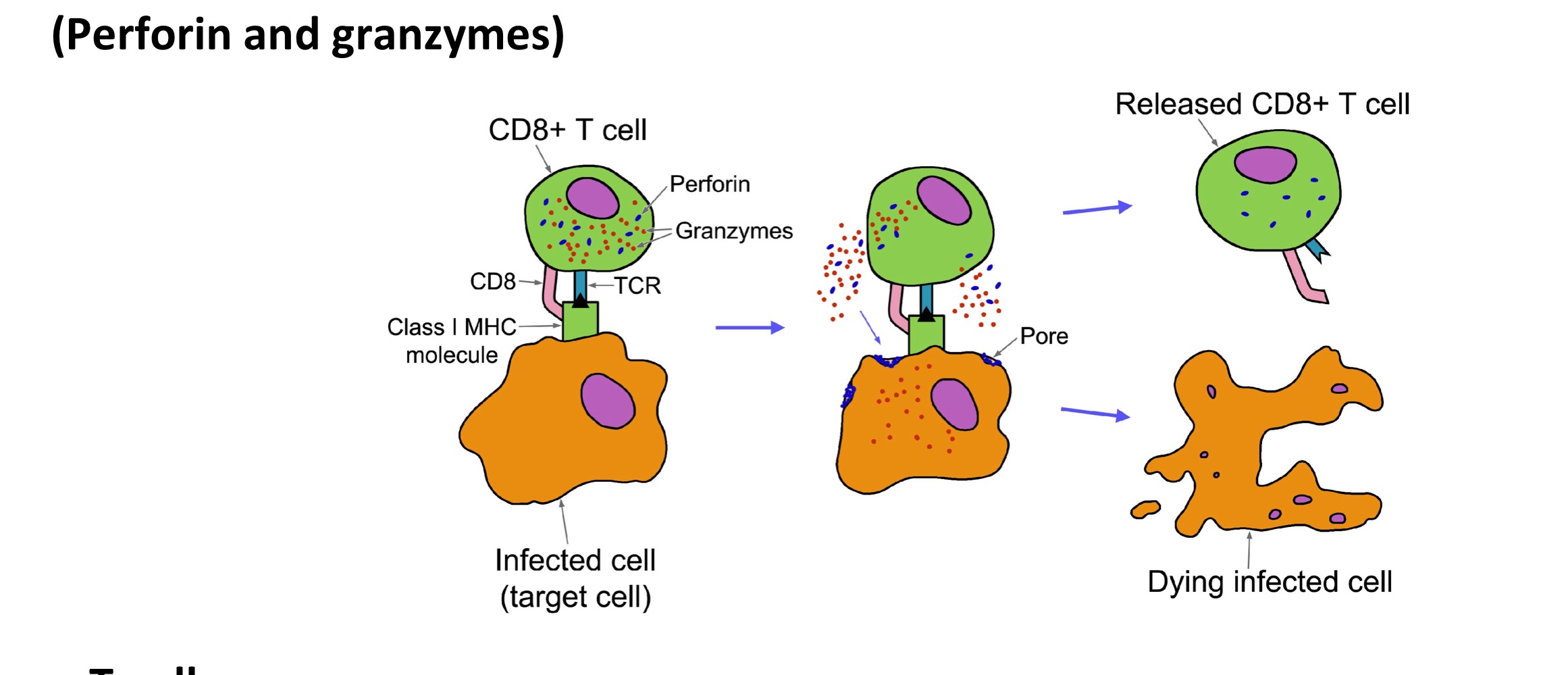
(Slide #25). What are T-cells → T-cytotoxic cells (CD3+, CD8+ cells) → EFFECTOR CELLS?
Effector Cells → (target + eliminate current infection/ infected cells)
Specific recognition of antigens on surface of infected cells (only recognize protein antigens)
(T-cell receptor)
Bind to antigen bound to MCH I molecule
Kills infected cell/foreign cell/cancerous cell
(Perforin + Granzymes)
Slide #25). What are T-cells → T-cytotoxic cells (CD3+, CD8+ cells) → MEMORY T-CELLS?
Memory T-cells
Require re-stimulation to differentiate + divide → into (Effector cells + more memory cells)
Half life of 5 years
(Slide #26). What are T-cells → T-cytotoxic cells (CD3+, CD8+ cells)
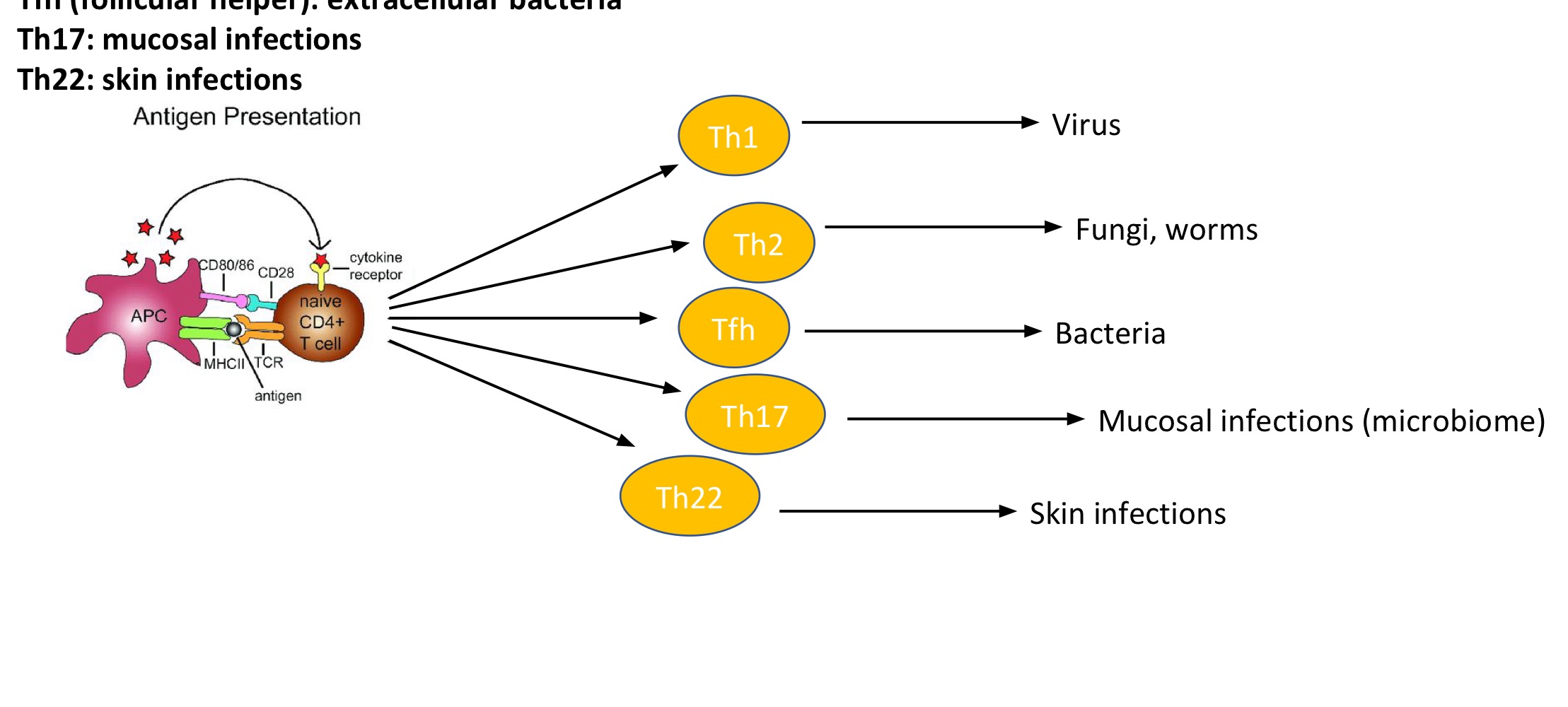
Regulate immune reactions → control/activate adaptive immune response
Get presented antigen by antigen presenting cells (conventional DENTRIC CELL, macrophage, B-cell, Basophil)
As a naïve Th0 (resting cell)
Once presented antigen + exposed to CTYOKINES → differentiate / mature into:
Th1: Intracellular infections
Th2: Extracellular parasites (fungi, Protozoa, worms)
Tfh: (Follicular helper): Extracellular bacteria
Th17: Mucosal infections
Th22: Skin infections
Slide #27). What are T-cells → T-cytotoxic cells (CD3+, CD8+ cells) → Involved in what of the immune response?
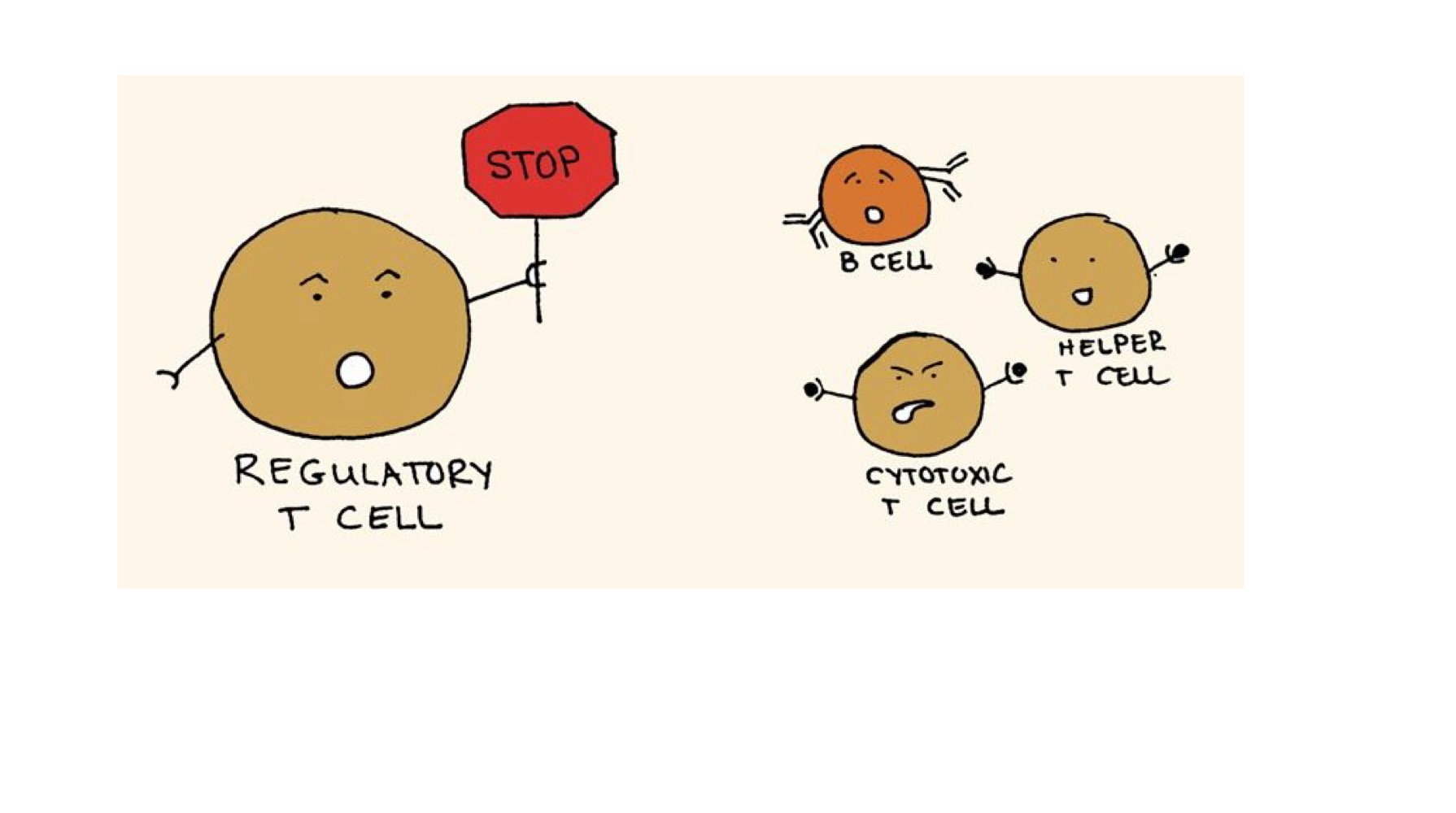
Involved in suppression of immune response (After infection cleared)
Dysfunction related to autoimmune responses
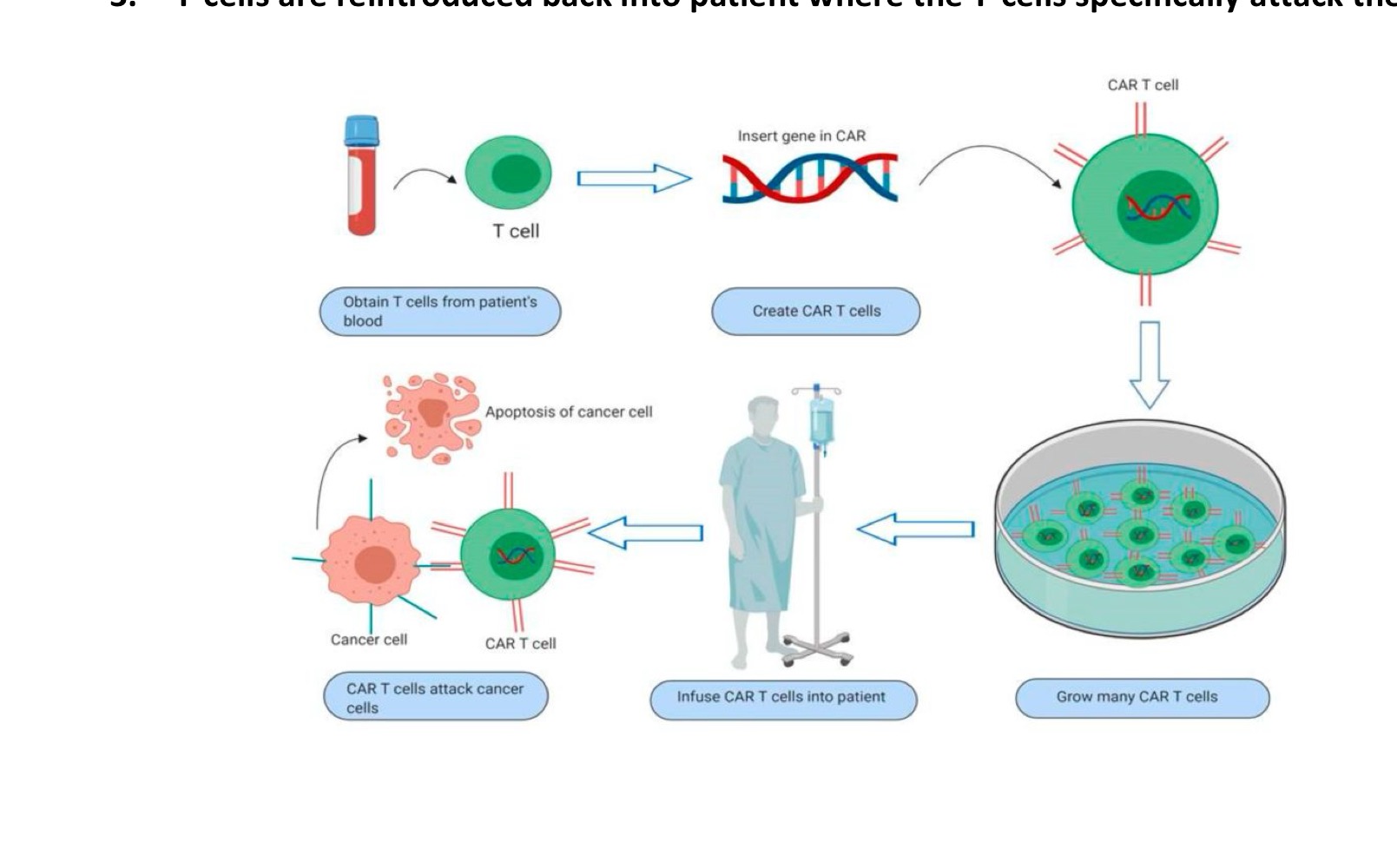
(Slide #28). What is T-cell Cancer Therapy (CAR-T-cell — Chimeric Anitgen Receptor)?
Blood obtained from a Ca patient + T-cytotoxic cells purified
T-cytotoxic cells are engineered to have T-cell receptor that will bind to Ca antigen
T-cells are reintroduced back into pt where the T-cells specifically attack the Cancer