Definitions, Heat, Ice
 Call Kai
 Learn
Learn Practice Test
 Spaced Repetition
 Match
Match Flashcards
 Knowt Play
1/14

There's no tags or description
Looks like no tags are added yet.
Name | Mastery | Learn | Test | Matching | Spaced | Call with Kai | Chat |
|---|
No analytics yet
Send a link to your students to track their progress
15 Terms
Receptors
Mechanoreceptors → detect mechanical stimuli such as touch, pressure, movement, and tension.
Baroreceptors → detect changes in blood pressure.
Chemoreceptors → detect chemicals or changes in chemical substances.
Thermoreceptors → detect changes in temperature.
Photoreceptors → detect light and are involved in vision.
Pain gate fibres
A-delta fibres → larger and faster-conducting due to their thin myelin covering.
Responsible for sharp, well-localised pain that occurs first.
Activated by mechanical and thermal stimuli.
Are free nerve endings that detect painful pressure and temperature stimuli.
A-alpha fibres → primary sensory receptors of the muscle spindle and Golgi tendon organ.
A-beta fibres → act as secondary receptors of the muscle spindle and contribute to cutaneous mechanoreception (sensation from the skin).
Cryotherapy
Cryotherapy → uses cold to lower local tissue temperature.
Common cold modalities include:
Cold packs
Ice massage
Cold baths
Vapocoolant sprays
Cold compression units
Physiological effects of cold:
↓ Pain
↓ Blood flow
↓ Edema (swelling)
↓ Inflammation
↓ Muscle spasm
↓ Metabolic demand
Effects of heat (10)
Physiological effects of heat
Core temp: 37°C
Hypothermia: <35°C
Hyperthermia: >39°C
Thermoregulation: controlled by CNS.
Surface temp: varies widely depending on multiple factors.
Localised effects of heat depend on:
Tissue volume + characteristics
Ability to dissipate heat (blood supply)
Rate of temp rise
Temperature tissue reaches
Cellular:
↑ temp → ↑ chemical reactions + metabolic activity (13% ↑ per 1°C)
↑ O₂/nutrient requirements + ↑ waste products
Activity ↑ to a peak, then declines.
>45°C → protein damage → cellular destruction/burns
Circulation:
Skin → vasodilation → ↑ blood flow/redness
Deep tissue → vasoconstriction from blood diversion to surface
BUT ↑ muscle metabolism → vasodilation
Depth of heating affects these processes.
Collagen:
Heat changes viscoelastic properties → may facilitate stretch (evidence conflicting).
Muscle tone:
Heat may ↓ increased muscle tone from peripheral mechanisms.
↑ Golgi tendon organ firing → ↑ inhibition.
Pain:
May ↓ pain from muscle spasm/ischaemia.
↑ nerve conduction velocity may affect pain mechanisms.
Performance:
Muscle strength ↓ immediately after heating
May ↑ above pre-treatment levels 2 hrs later.
Healing:
Heat ↑ bleeding, oedema, chemical activity + nociception.
At 38.6°C: ↑ O₂ uptake + blood flow → ↑ O₂, nutrients + white cells.
Early healing: potentially detrimental.
Later healing: potentially beneficial.
Systemic:
Generalised vasodilation + possible ↑ core temp
↓ splanchnic blood flow → heat transported to surface
Sweating → cooling
Humidity → sweating less effective
Risks: heat illness, swelling, rash, water/salt deficiency
Heat stroke: >41°C → CNS control systems fail.
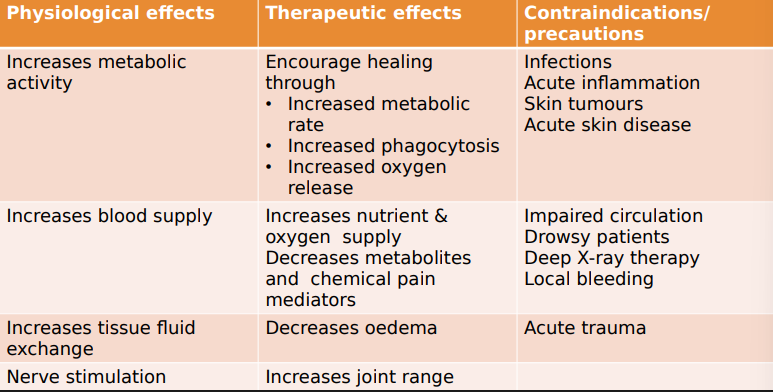
Effects of heat table
Modalities of heat therapy: WAX
Paraffin wax + mineral oil in a temperature-controlled bath: 42–50°C.
Wax is better tolerated than water at the same temp because it has a lower specific heat → releases less energy when cooling.
Limb is dipped + withdrawn repeatedly to let wax set: 6–12 times.
Then wrapped in an insulating layer.
Wax can be cleaned + reused.
Do NOT put used wax directly back into the bath.
Indications:
Softens adhesions + scars on skin
Proliferative & remodelling stages of healing
Contraindications / Precautions
Wounds
Wax contamination
Allergy
Acute dermatitis → may be worsened
Defective thermal sensation
Highly flammable → requires safety measures
Wax can make the floor very slippery.
Modalities of heat therapy: HOT PACKS
Dry packs/pads
E.g. heat-retentive gels, hot water bottles, wheat/microwave bags
Final temp: ~40–42°C
Moist packs/pads
Immersed/kept in hot water (hydrocollator)
Cool more quickly than dry packs → may need replacement during treatment.
Modalities of heat therapy: Radiant Heat (Infrared Lamp)
Superficial thermal agent
Uses electromagnetic radiation between microwaves + light → produces heating.
Limited evidence for efficacy in:
Pain → old studies; recent work suggests ↑ nerve conduction → may ↑ nociception.
Joint stiffness → evidence based on 1 study / 2 participants.
Skin lesions e.g. fungal infections.
NOT for open wounds → can cause further damage.
Modalities of heat therapy: HYDROTHERAPY
Whirlpool Baths
Use hot water to heat tissue.
Allow localised treatment.
Water temp: 36–41°C.
Water movement stimulates skin receptors → may activate the pain gate mechanism.
Hazards & Detrimental Effects
Impaired sensation → ↑ risk of burns.
Faulty equipment → ↑ risk of burns/injury.
Contact techniques + wounds → risk of infection + further tissue damage.
Open wounds → heat can cause further damage.
Fertility: heating may temporarily lower sperm count.
Infants: risk of apnoea.
Elderly: risk of dehydration, dizziness + headaches.
Contraindications & Precautions
Absolute contraindications:
Lack of thermal sensitivity
Recent bleeding/haemorrhage in area
Devitalised skin e.g. after deep X-ray treatment
Certain skin conditions e.g. skin carcinomas
Use caution with:
Impaired local circulation
Damaged/infected tissue → risk of breakdown
Before applying heat:
Perform a thermal skin test
Check equipment
Educate patient on expected sensations.
Cryotherapy
Cryotherapy
Cryotherapy = local/general cooling of the body for therapeutic purposes.
Involves transfer of energy away from the tissue.
Cooling depends on:
Temperature difference between surfaces
Thermal conductivity of tissue
Duration of application
Size of area being cooled
Physiological effects of cooling
Physiological Effects of Cold
↓ Majority of cellular processes (freezing causes damage).
Vasoconstriction of cutaneous vessels → CIVD (cold-induced vasodilation) may follow.
Peripheral nervous system: ↓ nociceptive effects via competing impulses.
At 4°C: nerves stop firing.
↓ Blood flow in muscle + deep tissue.
Muscle: ↓ time to contraction, same force.
↓ Muscle tone.
Tissue repair: cold has both positive + negative effects.
Cold — Inflammatory Phase
Very effective during the inflammation stage of healing in soft-tissue injuries.
Promotes vasoconstriction + more viscid blood.
Pressure over wound → haemostasis.
Prolonged/intense cooling → delays clotting.
Prompt cooling of skin burns → reduces tissue damage.
Cooling ↓:
Swelling
Production of irritants
Pain
Cell necrosis reactions
Nociceptor firing speed.
Efficacy of Cryotherapy
Evidence supports cryotherapy for:
Pain
Muscle spasm
Muscle spasticity
Chronic inflammation + joint effusion
Cryotherapy modalities
Commercial Cold Packs
Plastic bags containing water + anti-freezing solids.
Silica gel is most common.
Stored at −5 to −10°C.
Apply for ~20 min.
Cover with a towel → reduces risk of ice burn.
Towel should be wet, not frozen.
🧊 Cryo/Cuff
Provides compression + ice therapy.
↓ Swelling + pain and may ↓ need for analgesia.
Can provide cryotherapy for hours.
3 main parts:
Cuff: pouch filled with ice-cold water.
Tube: connects cuff → canister; allows water exchange.
Canister: holds ice + water.
Replace ice every 6–8 hours.
Ice Immersion
Cold tap water + flaked ice: 50:50
Temperature: 16–18°C
Duration: 15–20 min
Agitate water every 5 min
If water is 10°C: intermittent immersion → 1 min at a time
Mainly used for extremities.
Cold Packs
Flaked ice folded in damp terry-towelling.
Towel may be wrapped in a plastic sheet.
Duration: ~20 min.
Water/run-off water creates an insulating layer → keeps skin at 5–10°C.
Neater method: flaked ice in plastic → wrapped in towel.
Oil on skin ↓ risk of ice burn.
Ice Massage
Solid ice block on a wooden stick or in a polystyrene cup.
Muscle stimulus:
Stroke for 4 sec over the same dermatome as the muscle being activated.
Commonly used in Bell’s palsy → stroked over the cheek.
Can also be used over trigger points.
Pain management: slow circular movements over an area up to 15 cm².
Cold — Hazards & Detrimental Effects
Ice burns:
Mild → erythema + tenderness for a few hours; subsides after 1–2 days.
Severe → fatty necrosis + frostbite, lasting up to 3 weeks.
Neural damage to superficial nerves → axonotmesis.
↑ Collagen stiffness → consider this when planning mobilisation (MOB).
Cold — Precautions
Open wounds
Hypertension or hypotension
Poor thermal/heat sensation → perform thermal skin test
Avoid treating very large areas → risk of systemic effects
Monitor all treatments for signs of cold burns.
Cold — Contraindications
Acute febrile illness
Cardiac disease
Peripheral vascular disease
Vasospasm / Raynaud’s disease
Cryoglobinaemia → abnormal blood proteins react at low temperatures → may block vessels
Cold urticaria → hives/swollen skin triggered by cold
Patient dislikes cold
Axonotmesis → peripheral nerve injury
Sensory deficiency → cooling causes partial sensory loss → ↑ risk of tissue damage.